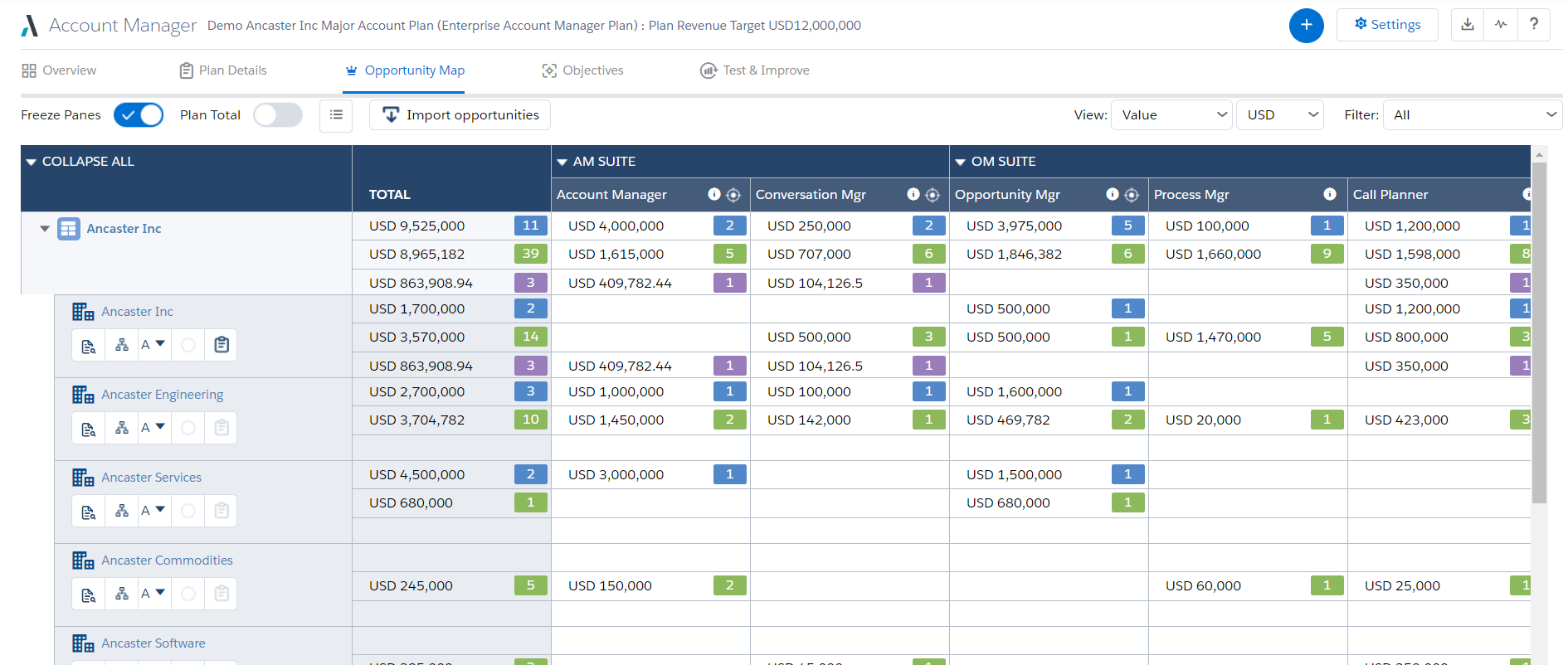
Altify’s suite of Salesforce native solutions guide and coach sellers to identify and map key relationships, uncover business insights, align sales processes to buying processes, qualify, manage and execute deals, and grow wallet share in accounts.
N/A
Terminus ABM Platform
Score 8.0 out of 10
Mid-Size Companies (51-1,000 employees)
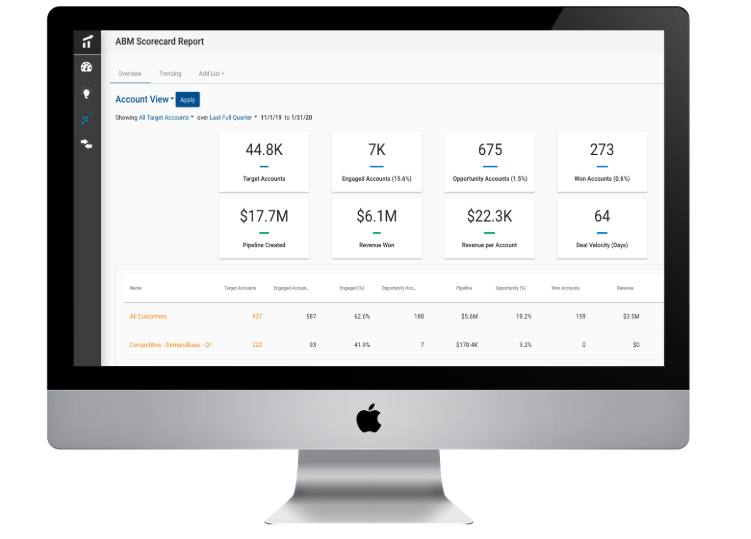
Supporting B2B strategies, the Terminus platform offers tactical playbooks that help teams meet accounts throughout their entire lifecycle. It is a platform rooted in first-party data that surrounds buyers with engaging digital experiences from account acquisition to expansion and renewal. The Terminus engine is built to drive ROI, minimize fraud, prioritize brand safety, and turn intent into relevant, actionable insight for GTM teams. Key benefits of Terminus: - Relevant…
While Skuid is not a match to what Altify does in terms of capabilities, Skuid did allow us to natively create the functions that we needed within the business in a way that was more useful than the Altify tools out of the box functionality. Altify does not offer anything for a …
I would say Terminus is easier to use and more cost effective. It is a better solution for beginners to get up and running with ABM marketing with enough runway to advance. Their customer service team is average, but there are learning tools to teach yourself. Lots of …
I was not involved in the evaluation process, however, I have heard that [the] Terminus ABM Platform is much more robust and the information [source] is much better.
It's a great all-around platform. With each of these ABM vendors, you have to pay for all the bells and whistles they offer. Terminus ABM Platform "base" packages include everything you need to get started and you can add on bits and pieces like chat, email or personalization …
Where Terminus ABM Platform was better than other options we evaluated: Much better quality and reach of [the] display network. More ability to tweak display network preferences and do things like contextual content targeting. Good control over ad budgets and pacing with …
Intent data & ad experiences were more robust & allowed for more customizations. Also - the interface was much more difficult to navigate to gain reporting insights that are valuable.
Terminus is competitive from not just a pricing perspective, but [its] ability to push more campaigns, through multiple channels, all through the Terminus platform.
I ran through a demo with the Triblio rep about a month ago. The platform seems to be very comparative to Terminus when it comes to the primary functionality. You can do display advertising to individuals based on company and other criteria. In talking with the Triblio rep, …
Sendoso and Terminus are alike in that they both work to add "personalization" into Marketing. However, they are not competitors per-say. Sendoso personalizes the physical interactions (direct mail) while Terminus works on the digital landscape. I would say Terminus more …
Terminus's professional services and support, along with its command-center approach, deliver a huge value to a ultra-lean fast moving business like Phononic. As a semiconductor startup that is rapidly growing, we need partners that can not only keep up with us, but also push …
Bizible is the only tool that I've done quite a bit of research on and it seems to be more advanced and further along than Terminus. They have an integration with SFDC as well as the ability to connect to a data warehouse.
We chose Terminus because of the campaign attribution models. Many companies do target account ad targeting, but none did that plus the revenue attribution from marketing.
Engagio: their analytics platform is slightly more refined, but Terminus is rapidly catching up. It is worth just using Terminus for the cost and would be another tool to complicate the Martech stack. Triblio: for a basic program, they have too many bells and whistles that are …
Sigstr is a solution for commercial teams. It allows the Customer Experience or Marketing team to manage the environment without getting IT involved. Other solutions we saw were basic IT managed solutions with no integrations or analytics.
Drift has banners available in their email tool, furthermore, we are able to mimic a Sigstr banner in Hubspot when we build emails by placing the banner image with a link in the bottom of an email, it's just a more manual process.
Terminus is a lot easier to use than other tools we have used or evaluated for our ABM campaigns. Updating what we want to see and working with their team has been a great experience. They listen and seem to understand our specific industry better. They aren't looking to …
Well suited for accounts in pipe. I'm not sure how well the entire team experience will play out in reality. Resources are primarily available when the opportunity is piped.
I really love working with the team. If you are looking to get more targeted in your advertising approach, leverage intent data & have your sales team utilize this data for a more personalized experience - that is the best-case scenario. You do need to invest quite a bit into your advertising to be able to gather data & see [the] influence, so if your AOV would be impacted drastically by this cost, I would not recommend using the advertising experiences and chat experiences until you can invest more.
Event Announcements. We use Sigstr to promote hosted and co-hosted events. Email recipients can click on the Sigstr to register for the event itself. By promoting events through Sigstr we have been able to increase event registration and attendance.
Content Sharing. New blog post, webinar, presentation, infographic... you name it, you can use Sigstr to promote it. Furthermore, you can personalize the content to target different audiences based of the sender group. Example: customer content Sigstr belongs to support, while marketing new business content belongs to sales.
Announcements. Product enhancements, Company news etc. You can use Sigstr to promote general announcements relevant to the audience.
Sales Process Manager: The Altify Sales Process manager's biggest drawback is the lack of usability for the end user. Altify has an out of the box sales process or a custom one can be created based on the company sales process. The drawback is that unless the sales process includes very few items, it can be more cumbersome than helpful. The Rep walks through the Sales Process by selection whether they have "Completed" are "In Progress" or have "Not Completed" the sales process activities at each stage of the opportunity. Altify saves after each selection so there is considerable downtime as the user waits for their selection to be recorded before they can answer the next question. Altify has an option to automatically advance the Salesforce opportunity Sales Stage once a certain % or mandatory steps in the sales process are completed, however this is not entirely useful as it does not advance until the set % or mandatory marked processes within a Sales Stage are completed AS WELL as at least one process from the next sales stage. This becomes very confusing and cumbersome for the users. In most cases, the sales process manager becomes more of a micromanagement tool with managers requiring all items to be marked completed and the Users merely marking items to satisfy that requirement without getting the intended benefit of the guided selling experience.
Account Plans: Account Plans can be grouped in both "does well" and "does poorly" for the Altify Suite. I will outline the bad in this portion of the review. Altify Account Plans do have some ability for customization, however the standard out of the box options are incredibly overbuilt. Filling out all of the information within the Account Plan can consume 40+ man hours for a single Account. While some of this information can be useful and important to note, other portions become more cumbersome than useful. The Completeness and Scorecard portions of the use a number of calculations. These calculations are explained at the bottom of the page but from a user perspective are very confusing and not straightforward. Most users that begin using account plans quickly abandon them because of the difficulty in setting them up correctly and the minimal insights that are gleaned out of the work put into them. One place for the greatest opportunity to improve account plans is in the objectives section, there the user can set objectives and activities (tasks) to meet them. The tasks must be manually selected to create an actual task in Salesforce and this cannot be assigned out to other SF Users. This portion of the Account plan would be improved if it could be used as a holistic account management platform to manage tasks across all the opportunities and potential opportunities, with an ability to assign them out to others in Salesforce within the account team.
Altify Max Insights: Altify max insights is intended to provide coaching advice at the opportunity level. This feature is tied into the opportunity manager. The drawback to this feature is that the insight mainly pertains to whether or not a user filled out all the steps in the opportunity manager: the sales process, the opportunity assessment, strategy, and the customer relationship map. The insights are far less action-oriented and more of a reminder to use the tool components. This tool just doesn't hold value, especially as it is an add on product.
Lack of Customization - While Altify does allow customization of some of their products and components, Altify has a ton of limitations. One of the most frustrating aspects is that all of the processes happen from their "black box" which is the dealmaker opportunity objects that Altify creates. This is essentially a shadow copy of the opportunities within Salesforce that then push changes to the actual opportunity. There is no way to tap into this shadow opportunity to either run custom processes or to even surface the Altify insights in a BI tool such as Einstein. This means that a lot of the use and functionality that Altify does do well cannot be leveraged for company insights or user end improvements.
They recently purchased some new solutions that are being integrated into the platform so once that is completed it will be a much more robust solution.
I think updating what is considered high value vs brand awareness on the spike report could be a little more seamless.
For Salesforce integration, Terminus information unfortunately doesn't pull in historically, it just shows what has happened since the integration started. I think it's unfortunate because that historical data tells us a lot.
Terminus is a turn-key partner in the B2B Account-Based Marketing space. Their model is flexible and efficient which in turn provides effective results. Their sales staff is great and never tries to up-sell, but rather coach and educate our teams to be better at our jobs. It has been great to collaborate
While Skuid is not a match to what Altify does in terms of capabilities, Skuid did allow us to natively create the functions that we needed within the business in a way that was more useful than the Altify tools out of the box functionality. Altify does not offer anything for a more "light touch" opportunity, which is its greatest drawback. With Skuid we were able to create our own solution for these lighter touch opportunities
It's a great all-around platform. With each of these ABM vendors, you have to pay for all the bells and whistles they offer. Terminus ABM Platform "base" packages include everything you need to get started and you can add on bits and pieces like chat, email or personalization as your organization continues to mature through their ABM journey.
Micromanagement (negative): By implementing Altify as the sales process management tool for our company during a change in sales methodology we created a micromanagement storm that left reps not truly gaining the benefit of the buyer-centric methodology. Rather than using the tool as a guide to the new process, it became a series of checkboxes that reps were mandated to fill out by management. This has left us unpicking the process to reengage the reps in a positive manner on how to work through opportunities in a customer-focused way. Sales process manager and opportunity assessment were disabled to try to fix this negative impact.
Account Plans (positive): While difficult for smaller accounts, the account plan feature did create a standard way for sales users to create account plans and manage their accounts better
It's EXTREMELY hard to assess total ROI with display advertising unless you're getting clicks on your ads. Even then you probably want additional tracking metrics such as Google Analytics, form fills, etc.
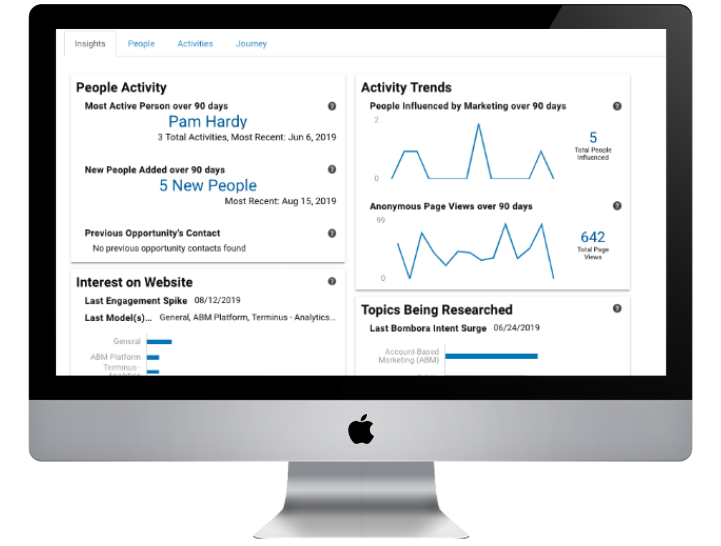
Our sales guys like the engagement spike reports, which can be useful for prompting them to reach out to their contacts.