AWS offers the Amazon API Gateway supports the creation and publication of an API for web applications, as well as its monitoring and maintenance. The Amazon API Gateway is able to support thousands of API calls concurrently and provides traffic management, as well as monitoring and access control.
$0.90
Per Million
SwaggerHub
Score 8.0 out of 10
N/A
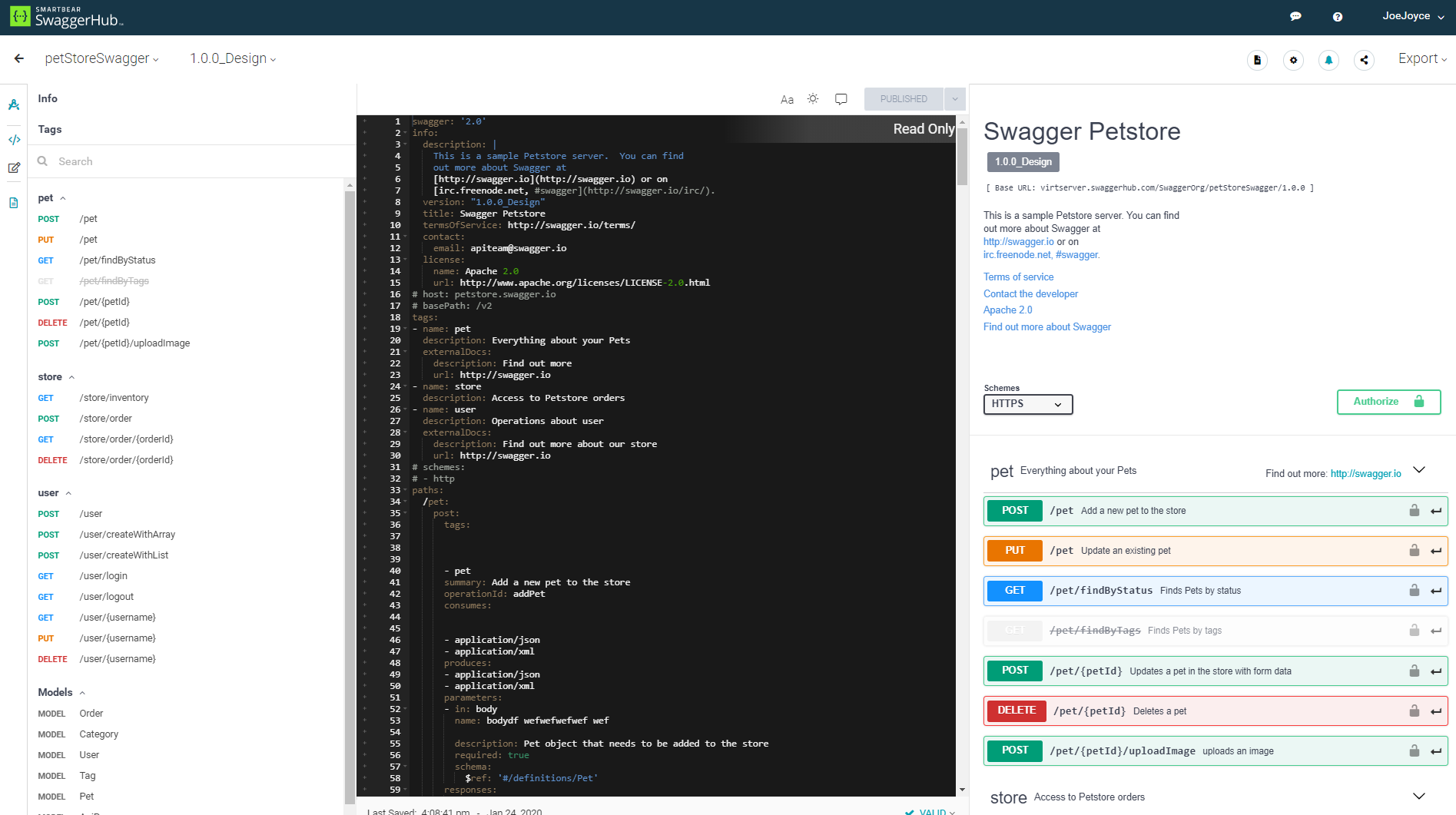
SwaggerHub is a platform for API design and documentation with OpenAPI. Whether it’s push generating an API’s design and code to source control hosts, deploying the API to API Management platforms, or triggering a Jenkins build, SwaggerHub boasts a host of integrations. Faster, Standardized API Design Design APIs in an editor that is built for efficiency without any loss in design…
Our primary architecture is AWS, so we selected [Amazon] API Gateway as our gateway solution. While Apigee and SwaggerHub provide great solutions for service orchestration, [Amazon] API Gateway provided the best integrations with our web services which were mostly running …
Our organization uses AWS infrastructure for many projects across different business units so we choose Amazon API Gateway for initial web services development. After exploring all features especially integration with other Amazon services like Lamda and Cloud watch we chose to …
The only other product we looked at was Postman. But we liked the SwaggerHub UI & the integrations it has with the AWS API gateway. Though Postman has some other great features like the ability to write test cases & execute them, SwaggerUI was more convenient to document & …
API GW is great for giving access to asynchronous operations that are fast and don't need to be online all the time. Lambda functions are the classic example. In the past, an operation that is called on via an HTTP endpoint would be implemented using a server-based solution. With high availability in place that would include a server or two and a load balancer. Over time this setup can be costly, especially if the service is not used at full capacity; cycles are wasted when the servers are sitting there waiting to respond. If the operation can be distilled down to a function, an API GW + Lambda solution could be put in place that performs the operation as needed only when requested. Comparing the low price point for API GW requests and Lambda CPU+Memory, the savings can be night and day over the server-based implementation.
We use SwaggerHub to design API endpoint and documentation for our microservices architecture system. It's working really great for us to be able to collaborate more easily on developing API in our team. It also can test our API endpoint which makes an integration test easier when we deploy changes to the API, especially for non-developers/QA.
API Gateway integrates well with AWS Lambda. This allows us to build a web server in the language and framework of our choice, deploy it as a Lambda function, and expose it through API Gateway.
API Gateway manages API keys. Building rate limiting and request quota features are not trivial (or interesting).
API Gateway's pricing can be very attractive for services that are accessed infrequently.
We always had a great experience with the AWS support team. They were always on time and very dependable. It was a good partnership while we worked to resolve our issues.
Pricing is better at Amazon API gateway. Amazon API gateway is more user-friendly than SAP HANA Cloud. But SAP HANA Cloud supports more programming languages. The centralized management and monitoring system of Amazon API Gateway is more user-friendly. The User-Interface of Amazon API gateway is also better. Overall we can conclude that Amazon API Gateway provides a better work experience than SAP HANA.