The Amazon Elastic File System (EFS) provides a simple, scalable, elastic file system for Linux-based workloads for use with AWS Cloud services and on-premises resources.
$0.04
per month per GB (One zone)
AWS CloudFormation
Score 8.8 out of 10
N/A
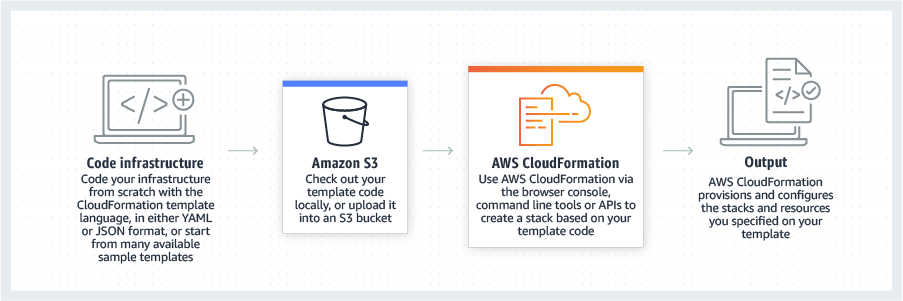
AWS CloudFormation gives developers and systems administrators a way to create and manage a collection of related AWS resources, provisioning and updating them in a predictable fashion. Use AWS CloudFormation’s sample templates or create templates to describe the AWS resources, and any associated dependencies or runtime parameters, required to run an application. Users don’t need to figure out the order for provisioning AWS services or the subtleties of making those dependencies work.…
$0
Pricing
Amazon Elastic File System (EFS)
AWS CloudFormation
Editions & Modules
US East & West Region
$0.043
per month per GB (One zone)
Europe (Ireland) Region
$0.046
per month per GB (One zone)
Asia Pacific & Canada Region
$0.047
per month per GB (One zone)
Africa (Cape Town) Region
$0.054
per month per GB (One zone)
AWS GovCloud (US-East)
$0.056
per month per GB (One zone)
US East & West Region
$0.08
per month per GB (Standard)
Asia Pacific & Canada Region
$0.09
per month per GB (Standard)
Europe (Ireland) Region
$0.09
per month per GB (Standard)
Africa (Cape Town) Region
$0.10
per month per GB (Standard)
AWS GovCloud (US-East)
$0.11
per month per GB (Standard)
Free Tier - 1,000 Handler Operations per Month per Account
$0.00
Handler Operation
$0.0009
per handler operation
Offerings
Pricing Offerings
Amazon Elastic File System (EFS)
AWS CloudFormation
Free Trial
Yes
Yes
Free/Freemium Version
No
Yes
Premium Consulting/Integration Services
No
No
Entry-level Setup Fee
No setup fee
No setup fee
Additional Details
There is no minimum fee or setup charge. You pay only for the storage you use, for read and write access to data stored in Infrequent Access storage classes, and for any provisioned throughput. Amazon EFS offers four storage classes: two standard storage classes, including Amazon EFS Standard and Amazon EFS Standard-Infrequent Access (EFS Standard-IA), and two One Zone storage classes, including Amazon EFS One Zone and Amazon EFS One Zone-Infrequent Access
There is no additional charge for using AWS CloudFormation with resource providers in the following namespaces: AWS::*, Alexa::*, and Custom::*. In this case you pay for AWS resources (such as Amazon EC2 instances, Elastic Load Balancing load balancers, etc.) created using AWS CloudFormation as if you created them manually. You only pay for what you use, as you use it; there are no minimum fees and no required upfront commitments.
When you use resource providers with AWS CloudFormation outside the namespaces mentioned above, you incur charges per handler operation. Handler operations are create, update, delete, read, or list actions on a resource.
More Pricing Information
Community Pulse
Amazon Elastic File System (EFS)
AWS CloudFormation
Considered Both Products
Amazon Elastic File System (EFS)
Verified User
Anonymous
Chose Amazon Elastic File System (EFS)
Both S3 and EBS have their place in implementations but it does matter in looking at technology solutions from a total viewpoint of marrying various projects and systems and then weighing the advantages (and disadvantages) of EFS against them.
If your Team/Company already using AWS and you are building a scalable solution which require API building which connect to a database consist numerous file, then Amazon EFS is definitely must go to tool. which enable the productivity with less maintenance highly compatibility …
EFS is essentially an NFS export offering, just simplified and accessible through all the automation and scalability that AWS offers. It provides high-available replicated data in multiple AZs with is akin to something like DRBD, but without having to manage the layer of …
Since the product I'm involved is primarily hosted on AWS we use CloudFormation but in some other products where we have hybrid cloud deployments we prefer terraform which is opensource.
Cloning a virtual machine creates a virtual machine that is cloning a virtual machine creates a virtual machine that is a copy of the original. The new virtual machine is configured with the same virtual hardware, installed software, and other properties that were configured …
As we have our whole infrastructure on AWS, that is why we selected AWS CloudFormation. AWS CloudFormation is better integrated with AWS services than other available products and also provides visibility and tracking on AWS. AWS CloudFormation is free while Terraform …
We didn't look into anything else as Cloudformation was "built-in" for AWS, it just kind of made sense to go with that. Terraform was something that we briefly looked into Terraform but decides to stick with Cloudformation because our task was relatively "simple". Apparently if …
AWS CloudFormation has more features and robustness. It is suited for professional projects since it provides stability and a wide variety of options for configurations. These include not only dividing stacks by specific code changes, but also in regions. This allows more …
The only real comparison would be to Terraform, which is another IaC technology at the infra level. Terraform is cloud-agnostic, which means most popular cloud providers are supported. While AWS CloudFormation is AWS-only. Although, if you consider CDK, CDK for Terraform …
This tool is very well suited if you want to work in the AWS ecosystem along with other AWS tools as it easily integrates with them. This works very fast for distributed systems. Sometimes, you can face compatibility issues with the operating system so my advice would be to check that before the implementation.
Cloning a virtual machine creates a virtual machine that is a copy of the original. The new virtual machine is configured with the Cloning Cloning a virtual machine creates a virtual machine that is a copy of the original. The new virtual machine is configured with the same virtual hardware, installed software, and other properties that were configured for the original virtual machine. For information about persistent memory and PMem storage, see the vSphere Resource Management Guide. For information virtual machine creates a virtual machine that is a copy of the original. The new virtual machine is configured with the same virtual hardware, installed software, and other properties that were configured for the original virtual machine. For information about persistent memory and PMem storage, see the vSphere Resource. Management guide. For information virtual hardware, installed software cloning a virtual machine creates a virtual machine that is a copy of the original. The new virtual machine is configured with the same virtual hardware, installed software, and other properties that were configured for the original virtual machine. For information about persistent memory and PMem storage, see the vSphere Resource Management Guide. For information and other properties that were configured for the original virtual machine. For information about persistent memory and PMem storage, see the vSphere Resource Management Guide. For information.
It's easy enough to get a shared template & apply it. You don't even have to download-then-upload or copy-and-paste, a publicly-accessible url works.
Diving deeper, it has enough powerful capabilities to make the life of a platform / DevOps engineer bearable.
However, you need equally deep knowledge to troubleshoot issues, when they inevitably pop up. This is the same for all IaC technologies, as they are additional abstraction layers on top of the native API provided by the cloud providers.
The documentation is sufficient for setting up and it is basic NFS for mounting so not much support is required. I have not had any issues to warrant a request with AWS support.
Both S3 and EBS have their place in implementations but it does matter in looking at technology solutions from a total viewpoint of marrying various projects and systems and then weighing the advantages (and disadvantages) of EFS against them.
Since the product I'm involved is primarily hosted on AWS we use CloudFormation but in some other products where we have hybrid cloud deployments we prefer Terraform which is opensource.