It was based on previous experience and a few things that are good about AWS, like S3 and Lambda, the ease of integrating AWS's in-house services, and, of course, support. So, our organization has decided to use AWS.
The AWS relational database service was selected because at the early stages of the implementation of the company product the team didn't have a lot of experience in creating and configuring database inside the company cluster, but there was a need to have a relation database, …
Amazon Relational Database Service (RDS) stands out among similar products due to its seamless integration with other AWS services, automated backups, and multi-AZ deployments for high availability. Its support for various database engines, such as MySQL, PostgreSQL, and …
In a few words, we are just to confortable working with oracle and sql server. Using RDS add another layer of distributed database in order to backup everything we have in case of a disaster and also complies with authorities locally and internacionally. All database we use, …
Deploying PostgreSQL by yourself may appear easy at first but running a production PostgreSQL cluster with millions of records is a hard task, especially for compliance, scalability, and security. RDS automates all complex tasks so you can focus on building your database schema …
With products like Google Cloud SQL, Azure SQL Database, AWS RDS stacks up quite well in all features. Features like licensing, performance, security comes to my mind the most. Another aspect is AWS's global reach.
There are a lot of factor we took into consideration the most important ones are: Ease of use and setup - Compared to other similar options Amazon RDS is very easy to setup just clicking few options and its ready for POC and for production very easy and flexible Terraform …
With the latest serverless technology Amazon Relational Database Service (RDS) has an edge over all its competitors, it works really fast with high log retention.
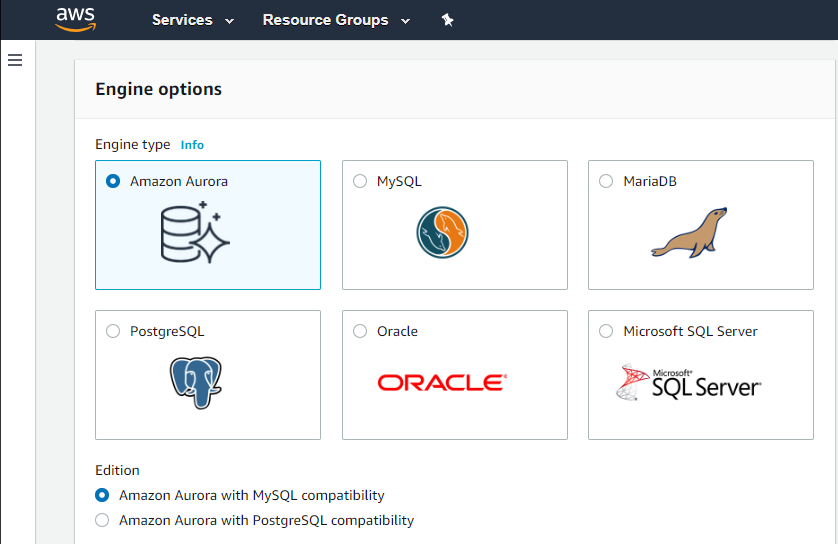
Amazon RDS supports a wider range of database engines, including MySQL,
PostgreSQL, Oracle, Microsoft SQL Server, and Amazon Aurora (MySQL and
PostgreSQL-compatible) than Google Cloud SQL. When compared to Google Cloud SQL, AWS provides a larger global footprint with …
Mongodb is nosql database and some clients prefer it. In our presentation we try to persuade them to use RDS with its pros and cons. The type of selection depends upon the actual need.
Although the Rackspace service is not comparable, even though it is very good, it requires a lot of administration on my part. Regarding Atlas, although it is not the same as RDS in terms of provisioning and administration panel, I mention it because I found it simpler and more …
Previously used Media Temple database hosting (now GoDaddy). While that endeavor was also successful, the AWS RDS is more secure, with higher availability and better documentation.
We have a strong preference for AWS managed services, and we find that RDS offers excellent integration with various AWS services, making it a seamless choice for our infrastructure. Furthermore, RDS supports integration with automation tools such as Terraform, enhancing our …
The main area that stuck out to me in looking at AWS RDS compared to Azure Data Lake Storage was still that RDS is simple to get up and running with over its competitors. The only negative and it holds true for both solutions is that can both be hard to estimate cost control …
During the migration from MySQL installed on Linux to AWS RDS, we were almost surprised as it was done by few clicks rather than too much configurations ans steps in case of traditional DB migrations. In no time our platform was up and running.
Installing, configuring, and managing Oracle Database can be challenging, especially for people who are new to Oracle products. Longer learning curves and higher operational overhead can be caused by this complexity. Amazon Relational Database Service is easy to understand and …
We consider initially only to have the back up product. After analysing different products, we realize that we needed a more complete and robust product such as Amazon Relational Database Service (RDS). Then, the option to hire Amazon Relational Database Service (RDS) was …
1: If your company is already deeply involved in the AWS ecosystem, such as AWS Lambda, Amazon S3, or Amazon Redshift, leveraging Amazon RDS might result in a more seamless integration of services. AWS offers a broad set of cloud services, which makes it easier to design and …
Amazon RDS excels with its widely adopted and mature ecosystem, supporting various database engines. While Azure SQL Database offers a tiered pricing structure and automatic patching, and Cloud SQL provides straightforward pricing and easy scaling, Amazon RDS's extensive …
is much better as it’s easily accessible provides velvet documentation and fulfils all our needs as well as easily integrated into clients, environment
Google BigQuery is simpler and I say it has simpler UI too. If you have a clear long term ask , mainly business intelligence needs then Google BigQuery offers you good. If you need too much of features under a single cloud and you are ok to be lil clumsy then you can check …
I have used most of the data analytics platforms. Based on my work, I have found that the user interface of Google BigQuery is simple to navigate. I like the front view - ease of joining tables, and integration with other platforms.
Compared to every other analytics DB solution I've used, Google BigQuery was by far the easiest to set up and maintain, and scale. The price was also much lower for our use case (internal data analysis).
For our usage, Google BigQuery is cheaper and more performant. The others have their place, but in certain scenarios, Google BigQuery is a better solution.
We actually use Snowflake and BigQuery in tandem because they both currently meet various needs. Redshift, however, has barely been used since our migration away from it. In the case of both Snowflake and BigQuery, they beat Redshift by a long shot. The main reasons are their …
I came to use BigQuery from a traditional system like MS SQL server, the features which are available in BigQuery as a cloud service far outweigh the features from SQL server. I have not used other similar tools like Amazon Redshift but Google BigQuery serves multiple use cases …
Google BigQuery is cheaper and much faster as compared to both. While as compared to Snowflake , we tested it was faster and cheaper by 30%, that is after Snowflake tweaked their environment, if not for that it would have been 90% cheaper than snowflake. Redshift is not easy …
In my opinion, Google BigQuery is custom made to be the best data lake system that is easy to use, scalas to fit any business size, has inbuilt security, as well as tools for data integrity. Although a few other tools have some of the same functionality, Google BigQuery is the …
It's easier to connect data between BigQuery and looker studio instead of connecting the data between BigQuery and tableau in terms of data explore or dashboard creating. Therefore we are considering migrating dashboards from tableau to looker studio for the whole company. On …
When comparing Google BigQuery and Databricks, both platforms are powerful tools for managing and analyzing large datasets. BQ is ideal for businesses requiring large-scale analytics, reporting, and dashboarding with minimal operational overhead. It’s also great for ad-hoc …
Google BigQuery's main advantage over its direct competitors (Amazon Redshift and Azure Synapse) is that it is widely supported by non-Google software, while the others rely heavily on their own cloud ecosystems.
I have used other data manipulation tools like SQL Server and Google BigQuery feels more intuitive, Google provides so much documentation and tutorials that getting to know the software is not only easy but even satisfactory, so I'd say Google BigQuery is very superior to that …
Amazon Redshift was a likely alternative we were considering , but it needs to be provisioned on cluster and nodes, which increases infrastructure management, whereas Google BigQuery is serverless, so no infra management :) Also, I remember when comparing them we did found out …
Google BigQuery as a platform allows for more integrations and customizability than many other offerings. Users mostly need to understand the basics of database and SQL programming in order to get the most from the product. However, other products like Hevo do have less of a …
There are some areas in which this product is better while there are some in which others do better. It's not like Google BigQuery surpasses them in every metric. For a holistic view, I will say we use this because of - scalability, performance, ease of use, and seamless …
The data performance of Google BigQuery is best as per other software. Limitations on Google BigQuery's data size are superior to those of Microsoft SQL. Obtaining real-time data from several IoT devices is another benefit.
I personally find it by far simpler than Amazon redshift due it's onboarding seamlessness. For a quick start and simplify tye access to read the data big query provide better user experience and a smoother user interface. More importantly, the fact that Big Query can be easily …
BigQuery can automatically scale to accommodate the data and query load, providing potentially unlimited scalability. At the same time, Redshift requires manual scaling efforts to increase or decrease capacity, which might affect performance during scaling operations.
We focused more on data volume and less on full application capabilities. All in all, we found that the two solutions complement each other. For integration, some sources were better handled in SAP HANA, particularly other SAP systems where Google Big Query was more suitable …
SingleStore has a much lower query latency compared to BigQuery. Thus, we segregate faster tasks to SingleStore, and use BigQuery has our main database to store all historical data.
Google BigQuery i would say is better to use than AWS Redshift but not SQL products but this could be due to being more experience in Microsoft and AWS products. It would be really nice if it could use standard SQL server coding rather than having to learn another dialect of …
First and foremost, Google BigQuery's pricing structure, based on data processing and storage, is more cost-effective for our needs. Secondly, since we already use other Google Cloud services, its tight integration with them especially, with Cloud Storage and Dataflow was a big …
If your application needs a relational data store and uses other AWS services, AWS RDS is a no-brainer. It offers all the traditional database features, makes it a snap to set up, creates cross-region replication, has advanced security, built-in monitoring, and much more at a very good price. You can also set up streaming to a data lake using various other AWS services on your RDS.
Google BigQuery is great for being the central datastore and entry point of data if you're on GCP. It seamlessly integrates with other Google products, meaning you can ingest data from other Google products with ease and little technical knowledge, and all of it is near real-time. Being serverless, BigQuery will scale with you, which means you don't have to worry about contention or spikes in demand/storage. This can, however, mean your costs can run away quickly or mount up at short notice.
Automated Database Management: We use it for streamlining routine tasks like software patching and database backups.
Scalability on Demand: we use it to handle traffic spikes, scaling both vertically and horizontally.
Database Engine Compatibility: It works amazingly with multiple database engines used by different departments within our organization including MySQL, PostgreSQL, SQL Server, and Oracle.
Monitoring: It covers our extensive monitoring and logging, and also has great compatibility with Amazon CloudWatch
Its serverless architecture and underlying Dremel technology are incredibly fast even on complex datasets. I can get answers to my questions almost instantly, without waiting hours for traditional data warehouses to churn through the data.
Previously, our data was scattered across various databases and spreadsheets and getting a holistic view was pretty difficult. Google BigQuery acts as a central repository and consolidates everything in one place to join data sets and find hidden patterns.
Running reports on our old systems used to take forever. Google BigQuery's crazy fast query speed lets us get insights from massive datasets in seconds.
It is a little difficult to configure and connect to an RDS instance. The integration with ECS can be made more seamless.
Exploring features within RDS is not very easy and intuitive. Either a human friendly documentation should be added or the User Interface be made intuitive so that people can explore and find features on their own.
There should be tools to analyze cost and minimize it according to the usage.
It is challenging to predict costs due to BigQuery's pay-per-query pricing model. User-friendly cost estimation tools, along with improved budget alerting features, could help users better manage and predict expenses.
The BigQuery interface is less intuitive. A more user-friendly interface, enhanced documentation, and built-in tutorial systems could make BigQuery more accessible to a broader audience.
We do renew our use of Amazon Relational Database Service. We don't have any problems faced with RDS in place. RDS has taken away lot of overhead of hosting database, managing the database and keeping a team just to manage database. Even the backup, security and recovery another overhead that has been taken away by RDS. So, we will keep on using RDS.
We have to use this product as its a 3rd party supplier choice to utilise this product for their data side backend so will not be likely we will move away from this product in the future unless the 3rd party supplier decides to change data vendors.
I've been using AWS Relational Database Services in several projects in different environments and from the AWS products, maybe this one together to EC2 are my favourite. They deliver what they promise. Reliable, fast, easy and with a fair price (in comparison to commercial products which have obscure license agreements).
web UI is easy and convenient. Many RDBMS clients such as aqua data studio, Dbeaver data grid, and others connect. Range of well-documented APIs available. The range of features keeps expanding, increasing similar features to traditional RDBMS such as Oracle and DB2
I have never had any significant issues with Google Big Query. It always seems to be up and running properly when I need it. I cannot recall any times where I received any kind of application errors or unplanned outages. If there were any they were resolved quickly by my IT team so I didn't notice them.
I think Google Big Query's performance is in the acceptable range. Sometimes larger datasets are somewhat sluggish to load but for most of our applications it performs at a reasonable speed. We do have some reports that include a lot of complex calculations and others that run on granular store level data that so sometimes take a bit longer to load which can be frustrating.
I have only had good experiences in working with AWS support. I will admit that my experience comes from the benefit of having a premium tier of support but even working with free-tier accounts I have not had problems getting help with AWS products when needed. And most often, the docs do a pretty good job of explaining how to operate a service so a quick spin through the docs has been useful in solving problems.
BigQuery can be difficult to support because it is so solid as a product. Many of the issues you will see are related to your own data sets, however you may see issues importing data and managing jobs. If this occurs, it can be a challenge to get to speak to the correct person who can help you.
Amazon Relational Database Service (RDS) stands out among similar products due to its seamless integration with other AWS services, automated backups, and multi-AZ deployments for high availability. Its support for various database engines, such as MySQL, PostgreSQL, and Oracle, provides flexibility. Additionally, RDS offers managed security features, including encryption and IAM integration, enhancing data protection. The pay-as-you-go pricing model makes it cost-effective. Overall, Amazon RDS excels in ease of use, scalability, and a comprehensive feature set, making it a top choice for organizations seeking a reliable and scalable managed relational database service in the cloud.
Google BigQuery of course collects a much much larger array of raw data and can handle (practically) an unlimited amount of data. For a large enterprise like ours that relies on large-scale analytics, this is absolutely imperative. Google BigQuery can also combine GA4 data with external sources (like CRM tools), so our analytics can be unified. Due to our heavy reliance on GA4, Google BigQuery is the natural choice since it is a Google product and has better integration.
We have continued to expand out use of Google Big Query over the years. I'd say its flexibility and scalability is actually quite good. It also integrates well with other tools like Tableau and Power BI. It has served the needs of multiple data sources across multiple departments within my company.
In some places, Google BigQuery has helped us save some money by avoiding the need for expensive infrastructure and reducing some of the operational costs.
Scalability is up-to-date and really helpful in multiple places.
Knowledge transfer is easy as it is very user-friendly, so the learning curve has been reduced.
Also, it gives us more insights from our data, helping us make smarter decisions for our business.