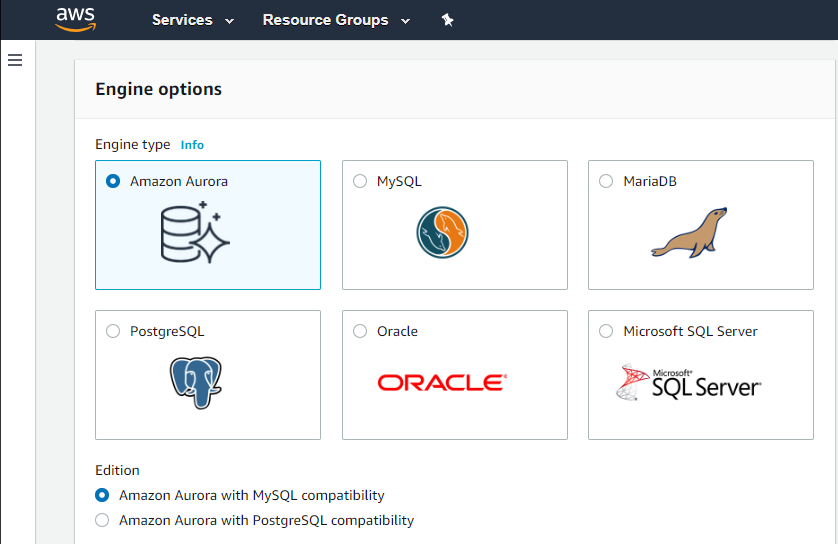
Amazon Relational Database Service (Amazon RDS) is a database-as-a-service (DBaaS) from Amazon Web Services.
N/A
IBM Cloud Databases
Score 8.6 out of 10
N/A
IBM Cloud Databases are open source data stores for enterprise application development. Built on a Kubernetes foundation, they offer a database platform for serverless applications. They are designed to scale storage and compute resources seamlessly without being constrained by the limits of a single server. Natively integrated and available in the IBM Cloud console, these databases are now available through a consistent consumption, pricing, and interaction model. They aim to provide a cohesive…
N/A
Pricing
Amazon Relational Database Service (RDS)
IBM Cloud Databases
Editions & Modules
Amazon RDS for PostgreSQL
$0.24 ($0.48)
per hour, R5 Large (R5 Extra Large)
Amazon RDS for MariaDB
$0.25 ($0.50)
per hour, R5 Large (R5 Extra Large)
Amazon RDS for MySQL
$0.29 ($0.58)
per hour, R5 Large (R5 Extra Large)
Amazon RDS for Oracle
$0.482 ($0.964)
per hour, R5 Large (R5 Extra Large)
Amazon RDS for SQL Server
$1.02 ($1.52)
per hour, R5 Large (R5 Extra Large)
No answers on this topic
Offerings
Pricing Offerings
Amazon RDS
IBM Cloud Databases
Free Trial
No
No
Free/Freemium Version
No
No
Premium Consulting/Integration Services
No
No
Entry-level Setup Fee
Optional
No setup fee
Additional Details
—
—
More Pricing Information
Community Pulse
Amazon Relational Database Service (RDS)
IBM Cloud Databases
Considered Both Products
Amazon RDS
Verified User
Anonymous
Chose Amazon RDS
AWS RDS supports many engines and is more efficient than just MySQL.

It was based on previous experience and a few things that are good about AWS, like S3 and Lambda, the ease of integrating AWS's in-house services, and, of course, support. So, our organization has decided to use AWS.
The AWS relational database service was selected because at the early stages of the implementation of the company product the team didn't have a lot of experience in creating and configuring database inside the company cluster, but there was a need to have a relation database, …
Amazon Relational Database Service (RDS) stands out among similar products due to its seamless integration with other AWS services, automated backups, and multi-AZ deployments for high availability. Its support for various database engines, such as MySQL, PostgreSQL, and …
In a few words, we are just to confortable working with oracle and sql server. Using RDS add another layer of distributed database in order to backup everything we have in case of a disaster and also complies with authorities locally and internacionally. All database we use, …
Deploying PostgreSQL by yourself may appear easy at first but running a production PostgreSQL cluster with millions of records is a hard task, especially for compliance, scalability, and security. RDS automates all complex tasks so you can focus on building your database schema …
With products like Google Cloud SQL, Azure SQL Database, AWS RDS stacks up quite well in all features. Features like licensing, performance, security comes to my mind the most. Another aspect is AWS's global reach.
There are a lot of factor we took into consideration the most important ones are: Ease of use and setup - Compared to other similar options Amazon RDS is very easy to setup just clicking few options and its ready for POC and for production very easy and flexible Terraform …
With the latest serverless technology Amazon Relational Database Service (RDS) has an edge over all its competitors, it works really fast with high log retention.
Amazon RDS supports a wider range of database engines, including MySQL,
PostgreSQL, Oracle, Microsoft SQL Server, and Amazon Aurora (MySQL and
PostgreSQL-compatible) than Google Cloud SQL. When compared to Google Cloud SQL, AWS provides a larger global footprint with …
Mongodb is nosql database and some clients prefer it. In our presentation we try to persuade them to use RDS with its pros and cons. The type of selection depends upon the actual need.
Although the Rackspace service is not comparable, even though it is very good, it requires a lot of administration on my part. Regarding Atlas, although it is not the same as RDS in terms of provisioning and administration panel, I mention it because I found it simpler and more …
Previously used Media Temple database hosting (now GoDaddy). While that endeavor was also successful, the AWS RDS is more secure, with higher availability and better documentation.
We have a strong preference for AWS managed services, and we find that RDS offers excellent integration with various AWS services, making it a seamless choice for our infrastructure. Furthermore, RDS supports integration with automation tools such as Terraform, enhancing our …
The main area that stuck out to me in looking at AWS RDS compared to Azure Data Lake Storage was still that RDS is simple to get up and running with over its competitors. The only negative and it holds true for both solutions is that can both be hard to estimate cost control …
During the migration from MySQL installed on Linux to AWS RDS, we were almost surprised as it was done by few clicks rather than too much configurations ans steps in case of traditional DB migrations. In no time our platform was up and running.
Installing, configuring, and managing Oracle Database can be challenging, especially for people who are new to Oracle products. Longer learning curves and higher operational overhead can be caused by this complexity. Amazon Relational Database Service is easy to understand and …
We consider initially only to have the back up product. After analysing different products, we realize that we needed a more complete and robust product such as Amazon Relational Database Service (RDS). Then, the option to hire Amazon Relational Database Service (RDS) was …
1: If your company is already deeply involved in the AWS ecosystem, such as AWS Lambda, Amazon S3, or Amazon Redshift, leveraging Amazon RDS might result in a more seamless integration of services. AWS offers a broad set of cloud services, which makes it easier to design and …
Amazon RDS excels with its widely adopted and mature ecosystem, supporting various database engines. While Azure SQL Database offers a tiered pricing structure and automatic patching, and Cloud SQL provides straightforward pricing and easy scaling, Amazon RDS's extensive …
a powerful storm disrupted power supplies and network connections to the data center hosting our critical databases. Despite the external factors causing widespread service disruptions, IBM Cloud Databases demonstrated its exceptional reliability. The auto-failover feature …
UI is easier to use and flexible. AWS EBS is very simple to use and do upgrades and monitor the upgrades easily. I also recommend IBM to implement these.
The reason why I choose IBM Cloud Databases is that the IBM cloud toolset is already being used in other functions of the company and by using IBM Cloud Databases, the other cloud tools are better embedded and integrated. If the company is set to use amazon tools, I would go …
IBM cloud database has a lot of features than amazon dynamodb. This is my personal opinion. But I can't say amazon dynamodb is a bad one. But IBM cloud database has a lot of securities and file storage and backup features than amazon dynamodb. But both are good in their own …
I have used Amazon DynamoDm and compared to IBM Compose, I would say IBM Compose is affordable, easy to use and very fast as well. I would opt IBM Cloud Databases given the two choices
they do a great job at handling our business needs. we like what they offer and how they respond to questions we provide. they do a lot of great things that help our business thrive and stay ahead. we are grateful for how this compnay has responded to our unique requests and …
We already had existing contracts with IBM and Microsoft, so those made the most sense to verify. Both are good options for data storage. Since much of our existing Dbs are IBM related, we stuck with IBM cloud dbs, just so that the SQL code would port well. Additionally, we …
The kubernete service is the front end for the transactions of our core systems and our cloud databases (Postgres and DB2) are the persistence storage.
It is very similar to the way on which we operated before except that we don't have to worry about high availability, backups …
AWS RDS & Oracle OCI. AWS RDS has a wider range of databases but at a higher cost. IBM Compose has fewer databases but is perfect for data related solutions like data warehousing (IBM Db2 AI enabled Warehouse is a GREAT product!)
Cloudant is HIPAA compliant and replicated out of the box. We recommend use of Cloudant vs Mongodb for that purpose. We use Redis only as a session cache.
We have Cassandra database that is currently not available as part of IBM Cloud Databases. We ended up using classic infrastructure IaaS to host our Cassandra server.
I did compare IBM Compose for PostgreSQL with PostgreSQL offerings available from Amazon and Google. IBM Compose was judged easier to provision and maintain.
I'm pleased with the additional more granular provisioning flexibility and more favorable cost structure that has come …
While at the time, Amazon RDS did/does not create Mongo databases, I was able to set up many with PostgreSQL databases with the same ease as IBM Compose. However, IBM compose does seem to offer a more intuitive application control panel. Amazon RDS costs run on a server …
We selected Compose because we initially thought that they would provide great support, and that they would bring encryption at rest within months. That has not materialized yet.
We also thought that the cost, while far from being the lowest, was reasonable.
Aiven backup options are very limited (you can't download backups and you don't have an API) and their dashboard is incomplete and without an optimal design; but they accept way more data centers, and they have more pricing options.
If your application needs a relational data store and uses other AWS services, AWS RDS is a no-brainer. It offers all the traditional database features, makes it a snap to set up, creates cross-region replication, has advanced security, built-in monitoring, and much more at a very good price. You can also set up streaming to a data lake using various other AWS services on your RDS.
Less Appropriate Scenario: 1) Small Scale or Low Budget Projects 2) Organizations with limited expertise in cloud technologies may find the learning curve steep, especially if they are not familiar with the IBM Cloud platform 3) If database requirements are highly dynamic and change frequently, the comprehensive features and management provided by IBM Cloud Databases might be overkill. A more flexible, self-managed solution could be preferable for adapting to rapid changes.
Automated Database Management: We use it for streamlining routine tasks like software patching and database backups.
Scalability on Demand: we use it to handle traffic spikes, scaling both vertically and horizontally.
Database Engine Compatibility: It works amazingly with multiple database engines used by different departments within our organization including MySQL, PostgreSQL, SQL Server, and Oracle.
Monitoring: It covers our extensive monitoring and logging, and also has great compatibility with Amazon CloudWatch
The ease of setup was effortless. For anyone with development experience, a few simple questions such as name and login data will get you set up.
The web application to manage cluster settings, billing settings and even introspect the data was simple and most importantly worked all the time. This can not always be said for web interfaces of other products.
It is a little difficult to configure and connect to an RDS instance. The integration with ECS can be made more seamless.
Exploring features within RDS is not very easy and intuitive. Either a human friendly documentation should be added or the User Interface be made intuitive so that people can explore and find features on their own.
There should be tools to analyze cost and minimize it according to the usage.
Better cost reports, before just increasing to another tier, thus increasing the price. This is critical for early stage startups, where budget is tight.
Add more data center options. As a comparison, a similar service, Aiven.io has dozen more options than Compose (basically all big cloud providers). We moved from AWS to Digital Ocean, which made us stop using Compose, since Compose forces us to be either on IBM or AWS.
We do renew our use of Amazon Relational Database Service. We don't have any problems faced with RDS in place. RDS has taken away lot of overhead of hosting database, managing the database and keeping a team just to manage database. Even the backup, security and recovery another overhead that has been taken away by RDS. So, we will keep on using RDS.
I've been using AWS Relational Database Services in several projects in different environments and from the AWS products, maybe this one together to EC2 are my favourite. They deliver what they promise. Reliable, fast, easy and with a fair price (in comparison to commercial products which have obscure license agreements).
IBM Cloud Databases' pricing structure is easy to understand, and if you choose the right product, you can operate your system at minimal cost. Although there is ample documentation available, there doesn't seem to be a user community running on it, so specific usage know-how and troubleshooting can sometimes take longer than expected.
I have only had good experiences in working with AWS support. I will admit that my experience comes from the benefit of having a premium tier of support but even working with free-tier accounts I have not had problems getting help with AWS products when needed. And most often, the docs do a pretty good job of explaining how to operate a service so a quick spin through the docs has been useful in solving problems.
Support is helpful enough, but we haven't always had questions answered in a satisfactory manner. At one time we realized that Compose had stopped taking database snapshots on its two-per-day schedule, and had in fact not taken one for many days. Support recognized the problem and it was fixed, but the lack of proactive checks and the inability to share exactly what happened has caused us to look elsewhere for production work loads
Amazon Relational Database Service (RDS) stands out among similar products due to its seamless integration with other AWS services, automated backups, and multi-AZ deployments for high availability. Its support for various database engines, such as MySQL, PostgreSQL, and Oracle, provides flexibility. Additionally, RDS offers managed security features, including encryption and IAM integration, enhancing data protection. The pay-as-you-go pricing model makes it cost-effective. Overall, Amazon RDS excels in ease of use, scalability, and a comprehensive feature set, making it a top choice for organizations seeking a reliable and scalable managed relational database service in the cloud.
The reason why I choose IBM Cloud Databases is that the IBM cloud toolset is already being used in other functions of the company and by using IBM Cloud Databases, the other cloud tools are better embedded and integrated. If the company is set to use amazon tools, I would go for rds.