Amazon Relational Database Service (RDS) vs. Microsoft Access

Overview
ProductRatingMost Used ByProduct SummaryStarting Price
Amazon RDS
Score 8.7 out of 10
N/A
Amazon Relational Database Service (Amazon RDS) is a database-as-a-service (DBaaS) from Amazon Web Services.N/A
Microsoft Access
Score 7.6 out of 10
N/A
Microsoft Access is a database management system from Microsoft that combines the relational Microsoft Jet Database Engine with a graphical user interface and software-development tools.
$139.99
per PC
Pricing
Amazon Relational Database Service (RDS)Microsoft Access
Editions & Modules
Amazon RDS for PostgreSQL
$0.24 ($0.48)
per hour, R5 Large (R5 Extra Large)
Amazon RDS for MariaDB
$0.25 ($0.50)
per hour, R5 Large (R5 Extra Large)
Amazon RDS for MySQL
$0.29 ($0.58)
per hour, R5 Large (R5 Extra Large)
Amazon RDS for Oracle
$0.482 ($0.964)
per hour, R5 Large (R5 Extra Large)
Amazon RDS for SQL Server
$1.02 ($1.52)
per hour, R5 Large (R5 Extra Large)
Microsoft Access
$139.99
per PC
Offerings
Pricing Offerings
Amazon RDSMicrosoft Access
Free Trial
NoNo
Free/Freemium Version
NoNo
Premium Consulting/Integration Services
NoNo
Entry-level Setup FeeOptionalNo setup fee
Additional Details
More Pricing Information
Community Pulse
Amazon Relational Database Service (RDS)Microsoft Access
Considered Both Products
Amazon RDS
Chose Amazon RDS
AWS RDS supports many engines and is more efficient than just MySQL.

Chose Amazon RDS
It was based on previous experience and a few things that are good about AWS, like S3 and Lambda, the ease of integrating AWS's in-house services, and, of course, support. So, our organization has decided to use AWS.
Chose Amazon RDS
The AWS relational database service was selected because at the early stages of the implementation of the company product the team didn't have a lot of experience in creating and configuring database inside the company cluster, but there was a need to have a relation database, …
Chose Amazon RDS
Amazon Relational Database Service (RDS) stands out among similar products due to its seamless integration with other AWS services, automated backups, and multi-AZ deployments for high availability. Its support for various database engines, such as MySQL, PostgreSQL, and …
Chose Amazon RDS
In a few words, we are just to confortable working with oracle and sql server. Using RDS add another layer of distributed database in order to backup everything we have in case of a disaster and also complies with authorities locally and internacionally. All database we use, …
Chose Amazon RDS
Deploying PostgreSQL by yourself may appear easy at first but running a production PostgreSQL cluster with millions of records is a hard task, especially for compliance, scalability, and security. RDS automates all complex tasks so you can focus on building your database schema …
Chose Amazon RDS
RDS Provides broader range of database engine. Well integration capabilities with third party makes it unique
Chose Amazon RDS
With products like Google Cloud SQL, Azure SQL Database, AWS RDS stacks up quite well in all features. Features like licensing, performance, security comes to my mind the most. Another aspect is AWS's global reach.
Chose Amazon RDS
There are a lot of factor we took into consideration the most important ones are: Ease of use and setup - Compared to other similar options Amazon RDS is very easy to setup just clicking few options and its ready for POC and for production very easy and flexible Terraform …
Chose Amazon RDS
With the latest serverless technology Amazon Relational Database Service (RDS) has an edge over all its competitors, it works really fast with high log retention.
Chose Amazon RDS
Amazon RDS supports a wider range of database engines, including MySQL, PostgreSQL, Oracle, Microsoft SQL Server, and Amazon Aurora (MySQL and PostgreSQL-compatible) than Google Cloud SQL. When compared to Google Cloud SQL, AWS provides a larger global footprint with …
Chose Amazon RDS
Mongodb is nosql database and some clients prefer it. In our presentation we try to persuade them to use RDS with its pros and cons. The type of selection depends upon the actual need.
Chose Amazon RDS
Although the Rackspace service is not comparable, even though it is very good, it requires a lot of administration on my part.
Regarding Atlas, although it is not the same as RDS in terms of provisioning and administration panel, I mention it because I found it simpler and more …
Chose Amazon RDS
Previously used Media Temple database hosting (now GoDaddy). While that endeavor was also successful, the AWS RDS is more secure, with higher availability and better documentation.
Chose Amazon RDS
We have a strong preference for AWS managed services, and we find that RDS offers excellent integration with various AWS services, making it a seamless choice for our infrastructure. Furthermore, RDS supports integration with automation tools such as Terraform, enhancing our …
Chose Amazon RDS
The main area that stuck out to me in looking at AWS RDS compared to Azure Data Lake Storage was still that RDS is simple to get up and running with over its competitors. The only negative and it holds true for both solutions is that can both be hard to estimate cost control …
Chose Amazon RDS
RDS seems to be the best cross-section between cost, availability, deployment and throughput.
Chose Amazon RDS
Also ElephantSQL. Not as cost effective, but more integrated into our cloud environment.
Chose Amazon RDS
During the migration from MySQL installed on Linux to AWS RDS, we were almost surprised as it was done by few clicks rather than too much configurations ans steps in case of traditional DB migrations. In no time our platform was up and running.
Chose Amazon RDS
Installing, configuring, and managing Oracle Database can be challenging, especially for people who are new to Oracle products. Longer learning curves and higher operational overhead can be caused by this complexity. Amazon Relational Database Service is easy to understand and …
Chose Amazon RDS
We consider initially only to have the back up product. After analysing different products, we realize that we needed a more complete and robust product such as Amazon Relational Database Service (RDS). Then, the option to hire Amazon Relational Database Service (RDS) was …
Chose Amazon RDS
1: If your company is already deeply involved in the AWS ecosystem, such as AWS Lambda, Amazon S3, or Amazon Redshift, leveraging Amazon RDS might result in a more seamless integration of services. AWS offers a broad set of cloud services, which makes it easier to design and …
Chose Amazon RDS
Amazon RDS excels with its widely adopted and mature ecosystem, supporting various database engines. While Azure SQL Database offers a tiered pricing structure and automatic patching, and Cloud SQL provides straightforward pricing and easy scaling, Amazon RDS's extensive …
Microsoft Access
Chose Microsoft Access
Microsoft Access is a superb software in database management system. I have been using it for many years without any hesitations. The software is making it different from other software with its awesome features. The software is cost effective for the organisation. It also …
Chose Microsoft Access
Excel is a fantastic - robust application that can do so much so easily. Its easy to train and understand. However - excel does not provide a reporting function and that is typically where we will suggest a move to [Microsoft] Access. [Microsoft] Access requires a little more …
Chose Microsoft Access

With [Microsoft] Access I am able to quickly create simple database driven solutions with built in UI and reporting in one tool. Advanced coding is not necessary and the tool guides you through building out. Opponents for a robust, end-to/end product.

Chose Microsoft Access
Having used Snowflake, I can definitely say that both of these tools are very easy to use and value for money. Although for me, the aspects where Microsoft Access stacks up are its low cost and usability. Snowflake is good with its cloud-based system but for startups where the …
Chose Microsoft Access
I haven't really used another database product other than Microsoft Access since the mid-90s. I don't even remember which program I did use, but needless to say, it did not have as much functionality nor was it as user friendly as databases today. So I really can't say how …
Chose Microsoft Access
Crystal is easier for report writing, but isn't a database solution. Salesforce is lovely, but much more expensive than an old copy of Microsoft Office. For a small budget, [Microsoft] Access was really the only viable option. I only wish it was easier to write complex reports.
Chose Microsoft Access
[Selected Microsoft Access for] employee learning simplicity, attractive graphical environment and features of Microsoft 365 with responsive Microsoft support.
Chose Microsoft Access
Visual FoxPro is a discontinued software, and no longer has support. Also, very few people still use it, or ever know how to use it. Excel is very popular, but [Microsoft] Access can do things like data joins much easier and faster
Chose Microsoft Access
Although SQL is a full-blown platform for heavy database management, Microsoft Access serves the purpose perfectly for small and mid-scale enterprises. It is also perfect for people just getting started with database management. The graphical user interface is a major plus …
Chose Microsoft Access
Microsoft Access is better for large files and backlogs than Excel because it can handle the workload. Excel is great as well, but filtering and searching is limited, and it can crash rather easily. You don't see those problems with Access.
Chose Microsoft Access
We've actually started to use both of these programs. There are pros and cons to both.
Microsoft Access is best for linking two sets of data that already have a common shared field (i.e. both sets of data include a student ID number, social security number, etc)
Airtable is best …
Chose Microsoft Access
  • Microsoft Access is great for local low code, relational database applications where users are creating, reading, updating, and deleting data (CRUD)..
  • Useful mostly for locally stored database and not network or cloud-based applications
  • Easy-to-user interface makes it hard to …
Chose Microsoft Access
SharePoint is good for simple data structures, use of workflow, integration with AD, etc. But SharePoint does not support fully relational data or complex reporting, whereas Access absolutely does.
Chose Microsoft Access
Being a similar "Windows application" it's easier to start to use as part of Office. Also, the GUI capabilities are much more advanced than other high-performance databases.
Chose Microsoft Access
Tableau is not even a 'switch-out' tool, it's for visualization so it's not a fair comparison. Against other databasing tools, MySQL is still my favorite may be simply due to being a creature of comfort because that's where I first learned to manage DB. However, Microsoft …
Chose Microsoft Access
MS SQL is a more powerful tool but I love the reporting feature in MS Access. MS Excel is useful for complex calculations but to me, MS Access helps me organize that data. InfoPath is similar to MS Access in that you can create forms for data entry, but it does not include …
Chose Microsoft Access
Microsoft Access is a bit dated compared to other database tools. It is slower, not able to handle quantities of data that are as large as the other tools, and a bit more finicky. However, it is sometimes the preferred tool for some clients. It also has a lower barrier to entry …
Chose Microsoft Access
Filemaker Pro focuses more on data collection in a single, flat file while Access allows for relationships to be drawn between data tables the reduces duplication. I have not worked with FileMaker Pro for several years but found it to be very unwieldy for my needs which were …
Chose Microsoft Access
We tried Salesforce, which was expensive and not as customizable as Access. QuickBase also was pricey compared to already having an MS license with the existing package, and QuickBase was not very intuitive. The other option was an open source version which was less intuitive …
Chose Microsoft Access
Microsoft Access is much easier to understand and use than SAP. There are a lot of menus in SAP which can be very difficult to navigate. If you are familiar with Microsoft Word/Excel it is very similar and should be easy to learn. Also maintaining databases in Access is much …
Chose Microsoft Access
Microsoft Access databases are more suitable for us because we are a smaller team. It's easy for us to export the reporting. It's also easy for people to create their own databases as well! Microsoft Access is honestly a one-stop-shop for us, and we figured we were not at a …
Best Alternatives
Amazon Relational Database Service (RDS)Microsoft Access
Small Businesses
InterSystems IRIS
InterSystems IRIS
Score 7.7 out of 10
InterSystems IRIS
InterSystems IRIS
Score 7.7 out of 10
Medium-sized Companies
InterSystems IRIS
InterSystems IRIS
Score 7.7 out of 10
InterSystems IRIS
InterSystems IRIS
Score 7.7 out of 10
Enterprises
SAP IQ
SAP IQ
Score 10.0 out of 10
SAP IQ
SAP IQ
Score 10.0 out of 10
All AlternativesView all alternativesView all alternatives
User Ratings
Amazon Relational Database Service (RDS)Microsoft Access
Likelihood to Recommend
8.8
(0 ratings)
5.0
(0 ratings)
Likelihood to Renew
8.4
(0 ratings)
10.0
(0 ratings)
Usability
8.0
(0 ratings)
7.0
(0 ratings)
Availability
9.0
(0 ratings)
8.0
(0 ratings)
Performance
7.0
(0 ratings)
-
(0 ratings)
Support Rating
9.6
(0 ratings)
6.4
(0 ratings)
Online Training
10.0
(0 ratings)
-
(0 ratings)
Implementation Rating
-
(0 ratings)
10.0
(0 ratings)
Ease of integration
-
(0 ratings)
8.0
(0 ratings)
Product Scalability
9.0
(0 ratings)
5.0
(0 ratings)
User Testimonials
Amazon Relational Database Service (RDS)Microsoft Access
Likelihood to Recommend
If your application needs a relational data store and uses other AWS services, AWS RDS is a no-brainer. It offers all the traditional database features, makes it a snap to set up, creates cross-region replication, has advanced security, built-in monitoring, and much more at a very good price. You can also set up streaming to a data lake using various other AWS services on your RDS.
Read full review
Having worked at startups, I can say Microsoft Access is most suited for their needs. Some of the reasons for that can be the ease and ability to create tables, design an entity-relationship diagram, define the relationship between different tables, feeding data into the tables, and retrieving data. All of this can be curated very easily into a process for small to medium-size enterprises. But a serious limitation can be observed where Access does not provide better features for large-scale companies. Another limitation is for companies where Mac is used as work computers.
Read full review
Pros
  • Automated Database Management: We use it for streamlining routine tasks like software patching and database backups.
  • Scalability on Demand: we use it to handle traffic spikes, scaling both vertically and horizontally.
  • Database Engine Compatibility: It works amazingly with multiple database engines used by different departments within our organization including MySQL, PostgreSQL, SQL Server, and Oracle.
  • Monitoring: It covers our extensive monitoring and logging, and also has great compatibility with Amazon CloudWatch
Read full review
  • One good aspect of Microsoft Access is how the software can be customized for different applications. This is very useful because we are able to use this software for multiple applications, which makes it cost-friendly.
  • Another strong point of Microsoft Access is the skill required to customize, the amount of programming required is less than most other database programs. This is good for a beginner looking to get into database management.
  • Microsoft Access is one of the more cost-friendly database applications, and most of the time it comes with Microsoft Office. Other database programs can be expensive and not as easy to use.
Read full review
Cons
  • It is a little difficult to configure and connect to an RDS instance. The integration with ECS can be made more seamless.
  • Exploring features within RDS is not very easy and intuitive. Either a human friendly documentation should be added or the User Interface be made intuitive so that people can explore and find features on their own.
  • There should be tools to analyze cost and minimize it according to the usage.
Read full review
  • Generally high learning curve for new users. Especially if they are not comfortable with technology.
  • Desktop only program; not available in web-format like other O365 products
  • Fewer experienced users, means it's a lot of self-teaching and troubleshooting when you run into an issue
Read full review
Likelihood to Renew
We do renew our use of Amazon Relational Database Service. We don't have any problems faced with RDS in place. RDS has taken away lot of overhead of hosting database, managing the database and keeping a team just to manage database. Even the backup, security and recovery another overhead that has been taken away by RDS. So, we will keep on using RDS.
Read full review
I and the rest of my team will renew our Microsoft Access in the future because we use and maintain many different applications and databases created using Microsoft Access so we will need to maintain them in the future. Additionally, it is a standard at our place of work so it is at $0 cost to us to use. Another reason for renewing Microsoft Access is that we just don' t have the resources needed to extend into a network of users so we need to remain a single-desktop application at this time.
Read full review
Usability
I've been using AWS Relational Database Services in several projects in different environments and from the AWS products, maybe this one together to EC2 are my favourite. They deliver what they promise. Reliable, fast, easy and with a fair price (in comparison to commercial products which have obscure license agreements).
Read full review
Microsoft Access is easy to use. It is compatible with spreadsheets. It is a very good data management tool. There is scope to save a large amount of data in one place. For using this database, one does not need much training, can be shared among multiple users. This database has to sort and filtering features which seem to be very useful.
Read full review
Reliability and Availability
No answers on this topic
I don't think the program has ever failed me. It is one of those programs where there is always a solution if you know where to look.
Read full review
Support Rating
I have only had good experiences in working with AWS support. I will admit that my experience comes from the benefit of having a premium tier of support but even working with free-tier accounts I have not had problems getting help with AWS products when needed. And most often, the docs do a pretty good job of explaining how to operate a service so a quick spin through the docs has been useful in solving problems.
Read full review
While I have never contacted Microsoft directly for product support, for some reason there's a real prejudice against MS Access among most IT support professionals. They are usually discouraging when it comes to using MS Access. Most of this is due to their lack of understanding of MS Access and how it can improve one's productivity. If Microsoft invested more resources towards enhancing and promoting the use of MS Access then maybe things would be different.
Read full review
Online Training
the online training & digital content available on the web from AWS was having sufficient information to deploy and run the service
Read full review
No answers on this topic
Implementation Rating
No answers on this topic
there is no key idea, since it is easy to implement Microsoft Access
Read full review
Alternatives Considered
Amazon Relational Database Service (RDS) stands out among similar products due to its seamless integration with other AWS services, automated backups, and multi-AZ deployments for high availability. Its support for various database engines, such as MySQL, PostgreSQL, and Oracle, provides flexibility. Additionally, RDS offers managed security features, including encryption and IAM integration, enhancing data protection. The pay-as-you-go pricing model makes it cost-effective. Overall, Amazon RDS excels in ease of use, scalability, and a comprehensive feature set, making it a top choice for organizations seeking a reliable and scalable managed relational database service in the cloud.
Read full review
Excel is a fantastic - robust application that can do so much so easily. Its easy to train and understand. However - excel does not provide a reporting function and that is typically where we will suggest a move to [Microsoft] Access. [Microsoft] Access requires a little more knowledge of data manipulation.
Read full review
Return on Investment
  • The overall cost increases, but we spect this and we can mitigate other risks.
  • Is easy to work from the cloud. Is reliable, but we keep our local solution as well where RDS works quite good.
  • RDS allow us to focurs on owr objetives instead of the other matters regarding databases.
Read full review
  • Microsoft Access has had a mostly positive impact on our business objectives in that most of our work is funded by grants and those grants need reports with data about our projects. Microsoft Access makes getting and organizing that data very easy.
  • Another positive is that since it is built on an Excel backbone, Excel files can be easily imported into Microsoft Access and also it is easy to export Microsoft Access reports, data sheets, etc. into Excel and some other programs as well. That might help more people who already use Excel learn how to work in a database.
  • I can't really think of a negative impact other than not many people at my workplace have ever used or understand how to use a database. Most people tend to use Excel rather than a database, like Microsoft Access.
Read full review
ScreenShots

Amazon RDS Screenshots

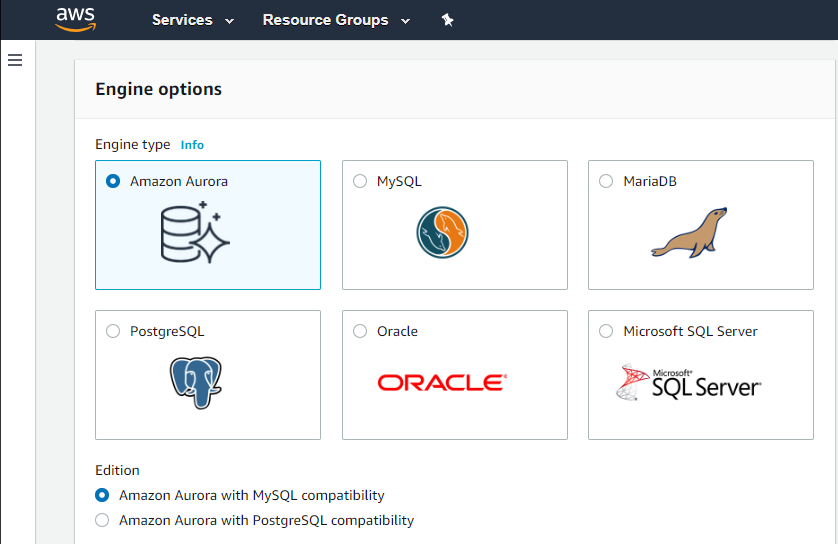
Screenshot of A look inside the RDS console.