Amazon Relational Database Service (RDS) vs. SAP HANA Cloud

Overview
ProductRatingMost Used ByProduct SummaryStarting Price
Amazon RDS
Score 8.7 out of 10
N/A
Amazon Relational Database Service (Amazon RDS) is a database-as-a-service (DBaaS) from Amazon Web Services.N/A
SAP HANA Cloud
Score 8.9 out of 10
N/A
SAP HANA is an application that uses in-memory database technology to process very large amounts of real-time data from relational databases, both SAP and non-SAP, in a very short time. The in-memory computing engine allows HANA to process data stored in RAM as opposed to reading it from a disk which means that the data can be accessed in real time by the applications using HANA. The product is sold both as an appliance and as a cloud-based software solution.N/A
Pricing
Amazon Relational Database Service (RDS)SAP HANA Cloud
Editions & Modules
Amazon RDS for PostgreSQL
$0.24 ($0.48)
per hour, R5 Large (R5 Extra Large)
Amazon RDS for MariaDB
$0.25 ($0.50)
per hour, R5 Large (R5 Extra Large)
Amazon RDS for MySQL
$0.29 ($0.58)
per hour, R5 Large (R5 Extra Large)
Amazon RDS for Oracle
$0.482 ($0.964)
per hour, R5 Large (R5 Extra Large)
Amazon RDS for SQL Server
$1.02 ($1.52)
per hour, R5 Large (R5 Extra Large)
No answers on this topic
Offerings
Pricing Offerings
Amazon RDSSAP HANA Cloud
Free Trial
NoYes
Free/Freemium Version
NoNo
Premium Consulting/Integration Services
NoNo
Entry-level Setup FeeOptionalOptional
Additional DetailsIncludes a one year free trial.
More Pricing Information
Community Pulse
Amazon Relational Database Service (RDS)SAP HANA Cloud
Considered Both Products
Amazon RDS
Chose Amazon RDS
AWS RDS supports many engines and is more efficient than just MySQL.

Chose Amazon RDS
It was based on previous experience and a few things that are good about AWS, like S3 and Lambda, the ease of integrating AWS's in-house services, and, of course, support. So, our organization has decided to use AWS.
Chose Amazon RDS
The AWS relational database service was selected because at the early stages of the implementation of the company product the team didn't have a lot of experience in creating and configuring database inside the company cluster, but there was a need to have a relation database, …
Chose Amazon RDS
Amazon Relational Database Service (RDS) stands out among similar products due to its seamless integration with other AWS services, automated backups, and multi-AZ deployments for high availability. Its support for various database engines, such as MySQL, PostgreSQL, and …
Chose Amazon RDS
In a few words, we are just to confortable working with oracle and sql server. Using RDS add another layer of distributed database in order to backup everything we have in case of a disaster and also complies with authorities locally and internacionally. All database we use, …
Chose Amazon RDS
Deploying PostgreSQL by yourself may appear easy at first but running a production PostgreSQL cluster with millions of records is a hard task, especially for compliance, scalability, and security. RDS automates all complex tasks so you can focus on building your database schema …
Chose Amazon RDS
RDS Provides broader range of database engine. Well integration capabilities with third party makes it unique
Chose Amazon RDS
With products like Google Cloud SQL, Azure SQL Database, AWS RDS stacks up quite well in all features. Features like licensing, performance, security comes to my mind the most. Another aspect is AWS's global reach.
Chose Amazon RDS
There are a lot of factor we took into consideration the most important ones are: Ease of use and setup - Compared to other similar options Amazon RDS is very easy to setup just clicking few options and its ready for POC and for production very easy and flexible Terraform …
Chose Amazon RDS
With the latest serverless technology Amazon Relational Database Service (RDS) has an edge over all its competitors, it works really fast with high log retention.
Chose Amazon RDS
Amazon RDS supports a wider range of database engines, including MySQL, PostgreSQL, Oracle, Microsoft SQL Server, and Amazon Aurora (MySQL and PostgreSQL-compatible) than Google Cloud SQL. When compared to Google Cloud SQL, AWS provides a larger global footprint with …
Chose Amazon RDS
Mongodb is nosql database and some clients prefer it. In our presentation we try to persuade them to use RDS with its pros and cons. The type of selection depends upon the actual need.
Chose Amazon RDS
Although the Rackspace service is not comparable, even though it is very good, it requires a lot of administration on my part.
Regarding Atlas, although it is not the same as RDS in terms of provisioning and administration panel, I mention it because I found it simpler and more …
Chose Amazon RDS
Previously used Media Temple database hosting (now GoDaddy). While that endeavor was also successful, the AWS RDS is more secure, with higher availability and better documentation.
Chose Amazon RDS
We have a strong preference for AWS managed services, and we find that RDS offers excellent integration with various AWS services, making it a seamless choice for our infrastructure. Furthermore, RDS supports integration with automation tools such as Terraform, enhancing our …
Chose Amazon RDS
The main area that stuck out to me in looking at AWS RDS compared to Azure Data Lake Storage was still that RDS is simple to get up and running with over its competitors. The only negative and it holds true for both solutions is that can both be hard to estimate cost control …
Chose Amazon RDS
RDS seems to be the best cross-section between cost, availability, deployment and throughput.
Chose Amazon RDS
Also ElephantSQL. Not as cost effective, but more integrated into our cloud environment.
Chose Amazon RDS
During the migration from MySQL installed on Linux to AWS RDS, we were almost surprised as it was done by few clicks rather than too much configurations ans steps in case of traditional DB migrations. In no time our platform was up and running.
Chose Amazon RDS
Installing, configuring, and managing Oracle Database can be challenging, especially for people who are new to Oracle products. Longer learning curves and higher operational overhead can be caused by this complexity. Amazon Relational Database Service is easy to understand and …
Chose Amazon RDS
We consider initially only to have the back up product. After analysing different products, we realize that we needed a more complete and robust product such as Amazon Relational Database Service (RDS). Then, the option to hire Amazon Relational Database Service (RDS) was …
Chose Amazon RDS
1: If your company is already deeply involved in the AWS ecosystem, such as AWS Lambda, Amazon S3, or Amazon Redshift, leveraging Amazon RDS might result in a more seamless integration of services. AWS offers a broad set of cloud services, which makes it easier to design and …
Chose Amazon RDS
Amazon RDS excels with its widely adopted and mature ecosystem, supporting various database engines. While Azure SQL Database offers a tiered pricing structure and automatic patching, and Cloud SQL provides straightforward pricing and easy scaling, Amazon RDS's extensive …
SAP HANA Cloud
Chose SAP HANA Cloud
It enables preview and better cloud service than other cloud platforms. Easy document transfer and faster document transfer are the key points for the selection of the HANA cloud server. The preview of data before its execution is also one of the factors in the selection of the …
Chose SAP HANA Cloud
Multiple things as SAP HANA Cloud is used to handle large volumes of data with smooth use of different data types, including great real-time data storage.
Chose SAP HANA Cloud
Ease of use, real time storage and update.
Chose SAP HANA Cloud
Better tools and more integrated to BTP solutions.
Chose SAP HANA Cloud
This is our main erp, very stable and intergrated
Chose SAP HANA Cloud
The main reason is purely HANA database performance, and it supports both row and column store data. And the way optimization is running behind the schedule is another added benefit.
Chose SAP HANA Cloud
It's better with regards to real time or live data analytics in comparison to SAP BW
Chose SAP HANA Cloud
We use them in integration as it makes us provide best solutions and products for our clients as we are using the available software in the market.
Chose SAP HANA Cloud
Value is the reason we choose SAP
Chose SAP HANA Cloud
I have deep knowledge of other disk based DBMSs. They are venerable technology, but the attempts to extend them to current architectures belie the fact they are built on 40 year old technology. There are some good columnar in-memory databases but they lack the completeness of …
Chose SAP HANA Cloud
HANA Cloud would be same as on premise, only hosted
Would save the hassles of maintaining a data center but still allow full HANA functionality.
Chose SAP HANA Cloud
One area where SAP HANA Cloud stood out for us is in its support for real-time analytics on live transactional data. As a business that relies on up-to-date information to make critical decisions, this capability was essential for us. We found that SAP Analytics Cloud was more …
Chose SAP HANA Cloud
Both SAP Cloud Platform and Oracle Cloud Platform provide the API management, data and application integration, using real-time insights to develop and deploy integrate applications, but SAP proved more beneficial for our firm and was mostly a decision taken by management.
Chose SAP HANA Cloud
Earlier, the cloud-based database of azure was being used, and since it is also a cloud-based database solving all the analytical problems but once using Sap Hana, it seems to be more modern type problem solving and highly secure and highly user-friendly, solving a lot of …
Chose SAP HANA Cloud
The reason remains the same , The dataflow between SAP application works seamlessly with SAP HANA cloud . The in memory capability really helps here a lot to make the reports run faster . Where as the other database engines that doesn't have the in-memory capability.
Chose SAP HANA Cloud
In any software selection process, considering all options is critical to ensuring the best system is selected.It's even true for top-tier products like S/4HANA, SAP's newest ERP platform. For larger, more complex global organizations, an enterprise-class option from SAP may …
Chose SAP HANA Cloud
On the BTP stack, SAP HANA Cloud has no alternative which can compete in terms of performance and integration to the overall platform
Chose SAP HANA Cloud
SAP HANA Cloud allows for more advanced custom developments compared to comparable solutions build in the Business Warehouse. SAP BW, on the other hand, still has far more build in tools, like system monitoring, delta loading, advanced scheduling, and other data loading …
Best Alternatives
Amazon Relational Database Service (RDS)SAP HANA Cloud
Small Businesses
InterSystems IRIS
InterSystems IRIS
Score 7.7 out of 10
InterSystems IRIS
InterSystems IRIS
Score 7.7 out of 10
Medium-sized Companies
InterSystems IRIS
InterSystems IRIS
Score 7.7 out of 10
InterSystems IRIS
InterSystems IRIS
Score 7.7 out of 10
Enterprises
SAP IQ
SAP IQ
Score 10.0 out of 10
SAP IQ
SAP IQ
Score 10.0 out of 10
All AlternativesView all alternativesView all alternatives
User Ratings
Amazon Relational Database Service (RDS)SAP HANA Cloud
Likelihood to Recommend
8.8
(0 ratings)
9.3
(0 ratings)
Likelihood to Renew
8.4
(0 ratings)
9.1
(0 ratings)
Usability
8.0
(0 ratings)
9.1
(0 ratings)
Availability
9.0
(0 ratings)
3.6
(0 ratings)
Performance
7.0
(0 ratings)
3.6
(0 ratings)
Support Rating
9.6
(0 ratings)
9.1
(0 ratings)
Online Training
10.0
(0 ratings)
-
(0 ratings)
Implementation Rating
-
(0 ratings)
9.1
(0 ratings)
Configurability
-
(0 ratings)
3.6
(0 ratings)
Ease of integration
-
(0 ratings)
4.5
(0 ratings)
Product Scalability
9.0
(0 ratings)
4.5
(0 ratings)
Vendor post-sale
-
(0 ratings)
4.5
(0 ratings)
Vendor pre-sale
-
(0 ratings)
3.6
(0 ratings)
User Testimonials
Amazon Relational Database Service (RDS)SAP HANA Cloud
Likelihood to Recommend
If your application needs a relational data store and uses other AWS services, AWS RDS is a no-brainer. It offers all the traditional database features, makes it a snap to set up, creates cross-region replication, has advanced security, built-in monitoring, and much more at a very good price. You can also set up streaming to a data lake using various other AWS services on your RDS.
Read full review
SAP HANA Cloud works effectively with SMBs or small to medium-sized enterprises and requires an affordable, scalable ERP system. Companies that must implement SAP S/4 HANA as soon as possible. Companies looking to take advantage of the newest innovation from SAP are looking to cut expenses on their IT infrastructure. SAP HANA CLOUD is not suitable for 1. Large companies with intricate operational procedures. 2. Companies with stringent policies regarding data residency. 3. Businesses with a sizable SAP landscape on premises 4. Companies must closely integrate SAP HANA CLOUD with non-SAP systems.
Read full review
Pros
  • Automated Database Management: We use it for streamlining routine tasks like software patching and database backups.
  • Scalability on Demand: we use it to handle traffic spikes, scaling both vertically and horizontally.
  • Database Engine Compatibility: It works amazingly with multiple database engines used by different departments within our organization including MySQL, PostgreSQL, SQL Server, and Oracle.
  • Monitoring: It covers our extensive monitoring and logging, and also has great compatibility with Amazon CloudWatch
Read full review
  • SAP HANA Cloud can help drive data analytics, data migration, and data management exceptionally well.
  • It offers an integration service that lets you integrate data and processes with 3rd party app or any other cloud app.
  • In-memory capability helps in faster data processing.
Read full review
Cons
  • It is a little difficult to configure and connect to an RDS instance. The integration with ECS can be made more seamless.
  • Exploring features within RDS is not very easy and intuitive. Either a human friendly documentation should be added or the User Interface be made intuitive so that people can explore and find features on their own.
  • There should be tools to analyze cost and minimize it according to the usage.
Read full review
  • Requires higher processing power, otherwise it won't fly. How ever computing costs are lower. Incase you are migrating to cloud please do not select the highest config available in that series . Upgrading it later against a reserved instance can cost you dearly with a series change
  • Lack of clarity on licensing is one major challenge
  • Unless S/4 with additional features are enabled mere migration HANA DB is not a rewarding journey. Power is in S/4
Read full review
Likelihood to Renew
We do renew our use of Amazon Relational Database Service. We don't have any problems faced with RDS in place. RDS has taken away lot of overhead of hosting database, managing the database and keeping a team just to manage database. Even the backup, security and recovery another overhead that has been taken away by RDS. So, we will keep on using RDS.
Read full review
At this moment we are not focusing on SAP, however would love to in the future. This is primarily because of our limited ability to generate more revenue to fund for SAP partnerships and products. Our initial tryst with SAP Partneredge open ecosystem didn't go as planned and we have shelved that for now. Hope we can revive in the future
Read full review
Usability
I've been using AWS Relational Database Services in several projects in different environments and from the AWS products, maybe this one together to EC2 are my favourite. They deliver what they promise. Reliable, fast, easy and with a fair price (in comparison to commercial products which have obscure license agreements).
Read full review
SAP HANA Cloud requires significant expertise on technical side to admin and manage it.It surely is lot of improvement over previous versions of SAPThe modern, role-based SAP Fiori interface has enhanced the user experience for applications like S/4HANA, though the complexity of the underlying database remains. For the average business user, the usability of SAP solutions running on the HANA database has seen a major transformation, largely thanks to the Fiori user interface.
Read full review
Support Rating
I have only had good experiences in working with AWS support. I will admit that my experience comes from the benefit of having a premium tier of support but even working with free-tier accounts I have not had problems getting help with AWS products when needed. And most often, the docs do a pretty good job of explaining how to operate a service so a quick spin through the docs has been useful in solving problems.
Read full review
One specific example of how the support for SAP HANA Cloud impacted us is in our efforts to troubleshoot and resolve technical issues. Whenever we encountered an issue or had a question, the support team was quick to respond and provided us with clear and actionable guidance. This helped us avoid downtime and keep our analytics operations running smoothly.
Read full review
Online Training
the online training & digital content available on the web from AWS was having sufficient information to deploy and run the service
Read full review
No answers on this topic
Implementation Rating
No answers on this topic
Professional GIS people are some of the most risk-averse there are, and it's difficult to get them to move to HANA in one step. Start with small projects building to 80% use of HANA spatial over time.
Read full review
Alternatives Considered
Amazon Relational Database Service (RDS) stands out among similar products due to its seamless integration with other AWS services, automated backups, and multi-AZ deployments for high availability. Its support for various database engines, such as MySQL, PostgreSQL, and Oracle, provides flexibility. Additionally, RDS offers managed security features, including encryption and IAM integration, enhancing data protection. The pay-as-you-go pricing model makes it cost-effective. Overall, Amazon RDS excels in ease of use, scalability, and a comprehensive feature set, making it a top choice for organizations seeking a reliable and scalable managed relational database service in the cloud.
Read full review
It enables preview and better cloud service than other cloud platforms. Easy document transfer and faster document transfer are the key points for the selection of the HANA cloud server. The preview of data before its execution is also one of the factors in the selection of the HANA server.
Read full review
Scalability
No answers on this topic
Limitation of training deliverable by organization
Read full review
Return on Investment
  • The overall cost increases, but we spect this and we can mitigate other risks.
  • Is easy to work from the cloud. Is reliable, but we keep our local solution as well where RDS works quite good.
  • RDS allow us to focurs on owr objetives instead of the other matters regarding databases.
Read full review
  • perception that it is "expensive" - this is a messaging issue, not a real issue
  • perception that it only runs ERP - SAP is a victim of it's own success in this regard
  • perception that it isn't an industrial strength DBMS when, in fact, it is
Read full review
ScreenShots

Amazon RDS Screenshots

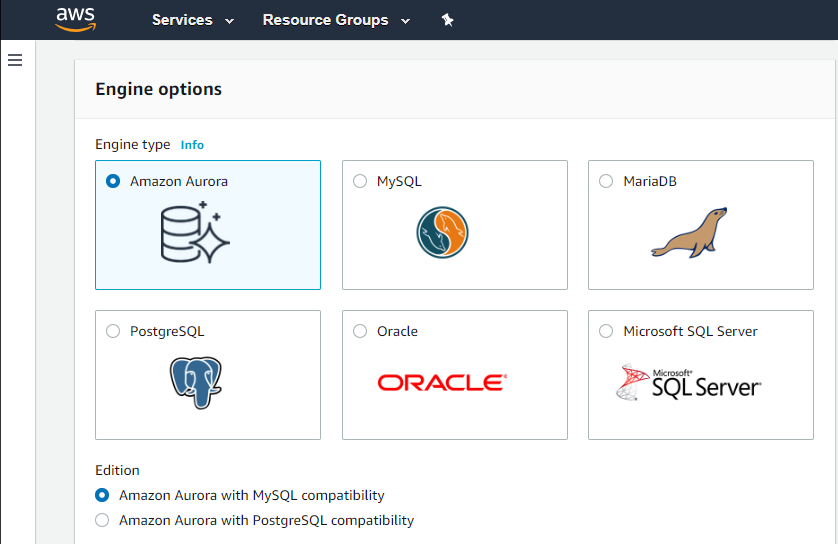
Screenshot of A look inside the RDS console.