Amazon Web Services (AWS) Provides the Amazon Simple Queue Service (SQS), a managed message queue service which supports the safe decoupling and distribution of different components in a cloud infrastructure and cloud applications.
$0
per GB
Anypoint Platform
Score 7.8 out of 10
N/A
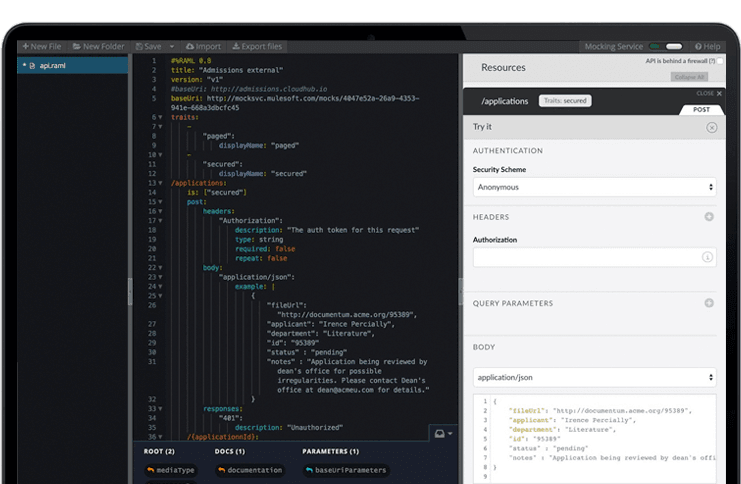
The Anypoint Platform developed by MuleSoft and acquired by Salesforce in early 2018 is designed to
connect apps, data, and devices anywhere, on-premises or in the cloud. This platform was built to
offer out-of-the-box connectors as well as tools that architects and developers can adopt quickly to
design, build and manage the entire lifecycle of their APIs, applications, and products.
N/A
Pricing
Amazon Simple Queue Service (SQS)
MuleSoft Anypoint Platform
Editions & Modules
All Data Transfer In
$0.00
per GB
Standard Queue
$0.00000004
per request
FIFO Queue
$0.00000005
per request
No answers on this topic
Offerings
Pricing Offerings
Amazon SQS
Anypoint Platform
Free Trial
No
Yes
Free/Freemium Version
Yes
Yes
Premium Consulting/Integration Services
No
No
Entry-level Setup Fee
No setup fee
No setup fee
Additional Details
—
—
More Pricing Information
Community Pulse
Amazon Simple Queue Service (SQS)
MuleSoft Anypoint Platform
Considered Both Products
Amazon SQS
Verified User
Anonymous
Chose Amazon SQS
Simple and quick implementation makes it a first go to service when not familiar with queue management. Handling of Dead messages in queue is helpful, as over time these messages stack up causing lots of unnecessary processing at listener end. Retry mechanism for failed …
I wanted to select "RabbitMQ" instead of IBM Cloud Messages for RabbitMQ.... At first, we have some instances running RabbitMQ but SQS is a fully managed queuing service it was way more convenient to use it and get rid of RabbitMQ !
To be blunt: Amazon SQS was the simplest to implement given our requirements. Other services in this space work just as well, and SQS does not have any benefits outside of being the easiest to implement when using an otherwise fully AWS stack. AWS itself even has other …
The reason for the choice is due to maintenance needs and HIPPA compliance, as well as the great options under the AWS ecosystem, with very useful configurable parameters.
The most comparable products are RabbitMQ, and perhaps ActiveMQ. Until recently, AWS did not offer a managed ActiveMQ product. Running RabbitMQ will never be to my team's competitive advantage; we wanted a managed service.
Amazon SQS stacks up with the best of them as most of their products do. The only issue comparatively that I’ve had with this service, in particular, is the silently failing messages and then allocation of time to dedicate to debugging when the issue of why a message got stuck …
AWS is a very good tool but still evolving and offers a small set of API management features. The main reason why we chose MuleSoft Anypoint Platform API Manager is because it is well suited with the APIs developed in Mule ESB.
Once we have moved all of our system integration APIs to the MuleSoft Anypoint Platform, we will need to communicate with a wide variety of external systems. All of our business and service logic is stored in the aforementioned core systems. Anypoint Platform (and all of our …
Overall a better experience in pricing negotiation with the Sales team. The breadth of services offered by Mulesoft was really important and the expertise offered by our consulting partner influenced the decision. The overall deployment was completed well within the timelines. …
Once we use [MuleSoft] Anypoint Platform to host all our system integration APIS, we need to exchange data with a lot of different resources. Those listed systems are our main systems that hold all business and logic behind our service. The integration from Anypoint Platform …
We selected Mulesoft for speed of implementation. We did not have the luxury of time and needed a solution that can be learned and implemented within weeks so we can take advantage of newly formed partnerships. The training that was provided to use during our pre-sales and …
We believe Anypoint Platform is best in breed and has features that match nearly any other iPaaS offering. It also allows for accomplishing much more challenging and complex integrations due to the ability to connect to nearly any system, use custom connectors, and embed …
The main problem with this software is the different connector type that is used for different protocols except for a different SAP connector. There is only one connector called SAP. It will be great if there will have a different connectors like idoc, RFC, proxy, etc.
Anypoint has tons of capabilities baked in one platform, and other competitors like Built.io or Workato may not have all those like Anypoint Exchange. However where these products shine are in usability, as it's ridiculously easy to build integrations using Built.io. I was …
Anypoint Platform is really very easy to adopt for application integration. Simple UI and easy data weave language allows user to focus on business portion only. The API management and deployment of application are hassle free. We have selected Anypoint platform because it is …
Dell Boomi is kind of similar in drag and drop implementation. However, it doesn't have as many connectors (shapes in Dell Boomi). Moreover, it also doesn't have deployment stuff on its own.
Informatica is way behind Dell Boomi and Anypoint Platform, but users are still using it …
Compared to Dell Boomi the API management suite of Mulesoft is much mature, however if its only about the integration , then i would always go for Dell Boomi, as there is no infrastructure setup that needs to be done from the developer's end.
The main reason why we chose Anypoint API Manager is because it is well suited with the APIs developed in Mule ESB. AWS, on the other hand, is a very good tool but still evolving and offers a small set of API management features.
API led architecture focus with a decent API ecosystem for developer collaboration, policy management and declarative implementation. Batch processing, visualization, Anypoint MQ and ObjectStore leave a lot to be explored. Multiple deployment models make it worth considering.
It enables customers to expose their APIs in a very simple and fast way. It can be used by non-expert developers. It is compliant with all major connection and data representation world standard.
We provide options to customers to choose from the best tools. Customers are the decision makers. Personally, because of open-source and large community base, MuleSoft is the repo in the market.
It is a powerful tool with smart intelligence. The drag and drop feature makes my work easy. The tool has great connecting support which is the best reason to use the tool on a daily basis. Powerful functionality with designing and implementing APIs. Hosted on public IP.
While we use AmazonSimple Queue Service (SQS) in our serverless applications, it would be a great option to handle queue management for any internet-connect application. It provides the most benefit in situations where your application or service must maintain mission-critical queue of messages or jobs. If you're already using other AWS services you will find the greatest benefit.
MuleSoft Anypoint Platform is best tool in the market for developing APIs with complex structures communicating with various different types of applications including web applications as well as legacy applications. Also applications including database connectivity for fetching and updating data in the DB tables. I cant think of any scenario which MuleSoft Anypoint Platform could not be used for developing the integrations.
Provides wide range of popular connectors like salesforce, netsuite, sftp and many more. A user can easily integrate with those services using specific connector.
Support API development using RAML and desing tool. The platform is very good in data type classification.
Cloud deployment and post deployment monitoring is easy. A user can configure application worker as per need. Alert and notifications are real time.
Has more features than what we really need so we're paying for more than we use. Sort of like paying for an Abrams tank when all we really need is a Toyota Corolla.
Not a value product, tends to be expensive.
Takes a while for developers to learn to use Mulesoft Anypoint.
MuleSoft Anypoint Platform is really very easy to adopt for application integration. Simple UI and easy data weave language allows user to focus on business portion only. The API management and deployment of application are hassle free.
Online blogging and documentation for SQS is great. There are many examples of implementing it and if you look hard enough, more than likely there are examples that meet the exact case with which you are working
Anypoint Platform support is very responsive. There is also a huge knowledge base and an active online forum where answers to most questions can be found. When needed support engages the engineering group so adequate solutions or workarounds are always provided.
To be blunt: Amazon SQS was the simplest to implement given our requirements. Other services in this space work just as well, and SQS does not have any benefits outside of being the easiest to implement when using an otherwise fully AWS stack. AWS itself even has other solutions that would work just as well, however, SQS had the most reasonable pricing model for our given situation. That will certainly not always be the case, but in several of the instances where we are using it, it just made the most sense.
Once we have moved all of our system integration APIs to the MuleSoft Anypoint Platform, we will need to communicate with a wide variety of external systems. All of our business and service logic is stored in the aforementioned core systems. Anypoint Platform (and all of our APIs) makes it easy to connect to various other platforms. In order to link to these many other systems, connectors and/or components are utilized, and they are simple to configure and integrate.