Amplitude Analytics is an analytics platform for mobile and web. It is designed to help organizations segment users and analyze funnels, retention and revenue. Amplitude Analytics helps product marketers to achieve actionable insights from customer digital journeys and uses behavioral graphs to build customer-focused products. Amplitude also optimizes digital products for increased quality engagements, increased conversion rates, and long-term customer loyalty.
$49
per month (paid annually)
Coveo Qubit
Score 7.4 out of 10
Enterprise companies (1,001+ employees)
Qubit, now from Coveo (acquired October 2021) uses visitor history data to understand different user segments and serve personalized messages to segments using JavaScript. It is available as either a managed or self-service model. Data is collected using Qubit's own Universal Variable data model, or by integrating the user's existing model via our API. It combines quantitative data with qualitative visitor feedback to give Qubit users the ability to detect areas for optimization.
Using…
N/A
Pricing
Amplitude Analytics
Coveo Qubit
Editions & Modules
Plus
$49
per month (paid annually)
Growth
Contact Sales
Enterprise
Contact Sales
Starter
Free
No answers on this topic
Offerings
Pricing Offerings
Amplitude Analytics
Coveo Qubit
Free Trial
No
No
Free/Freemium Version
Yes
No
Premium Consulting/Integration Services
No
No
Entry-level Setup Fee
No setup fee
No setup fee
Additional Details
—
—
More Pricing Information
Community Pulse
Amplitude Analytics
Coveo Qubit
Best Alternatives
Amplitude Analytics
Coveo Qubit
Small Businesses
StatCounter
Score 9.0 out of 10
Bloomreach - The Agentic Platform for Personalization
I would highly recommend Amplitude to people in the product and business analytics domains who have a need for deep, data-driven insights into customer behavior, accessible in a self-service platform. Amplitude stands out in its comprehensiveness and flexibility; once events are implemented, there are a multitude of options to combine, track, form journeys, and dive deeper into user behavior. Though the barrier for entry is a little bit steep, Amplitude is more friendly to non-technical users than other business insight platforms, without compromising the effectiveness of the analysis tools. Amplitude may not be best suited for web marketing analytics - traffic, page views, etc - since it is more focused on full-platform product analytics.
Coveo Qubit is a very helpful platform mainly for organizations that need to provide a solid business model before carrying out any implementation or new functionality. In addition, it is a very good tool to generate changes and show different content to different types of clients, with their personalization and segmentation criteria.It is ideal for simultaneous testing and customization, only one of these activities individually is not recommended.
It provides me great answers about my critical questionnaire, by which I can easily explore behavioral data across any chart, persona, and cohort that are simple and intuitive to understand as they have made easy segmentation.
It offers its services for SQL queries due to which I have reduced the workload and save the time that was spent in finding out the technical aspects.
The testing platform itself is continually evolving. This means that we are always able to try new ideas as well as quickly and efficiently put others into practice.
The beta programme and the additional functionality products are both exciting to see as well as ensuring we can cherry pick the functionality we need. This means that we don't end up paying for functionality we don't need
Some of the reporting within Qubit has been overly simplified in the past, a point they are continually addressing.
At times the syntax of experience (test) creation can be specific to Qubit and so there is a slight learning curve for developers.
Unless developers have much time to allocate to creating tests in Qubit, marketers may potentially find simple tests limited. I would recommend having someone in-house as we do.
Great product Good value for the cost/initiate Support docs and FAQs are great - they limit the necessity of reaching out to in-person support. So when you do call them ... it is for a legit question/issue, no just a "where is it" or a "how to I do xyz123?"
Qubit helps out immensely and lays out in plain English the profitability of each of our A-B tests. Say Qubit has provided us overall with a 5% profit increase this year (that is a completely arbitrary figure for illustration only), then if we didn't renew it could be seen as us taking a 5% loss as Qubit wouldn't be there. The results of our tests are showing no slowing down and as Qubit and Toast grow to understand each other better we can only see our performance getting better as the years go on.
It's a fairly straightforward platform that's beginner friendly. The biggest usability hurdle is most often created by your own team, as it's imperative to know what event sources are being sent to Amplitude and what those event names are. Within being properly onboarded by a team member it can be hard to get started using Amplitude. It takes time to understand what data your company may be sending to the product, the naming conventions of events (especially if there are old or deprecated events names
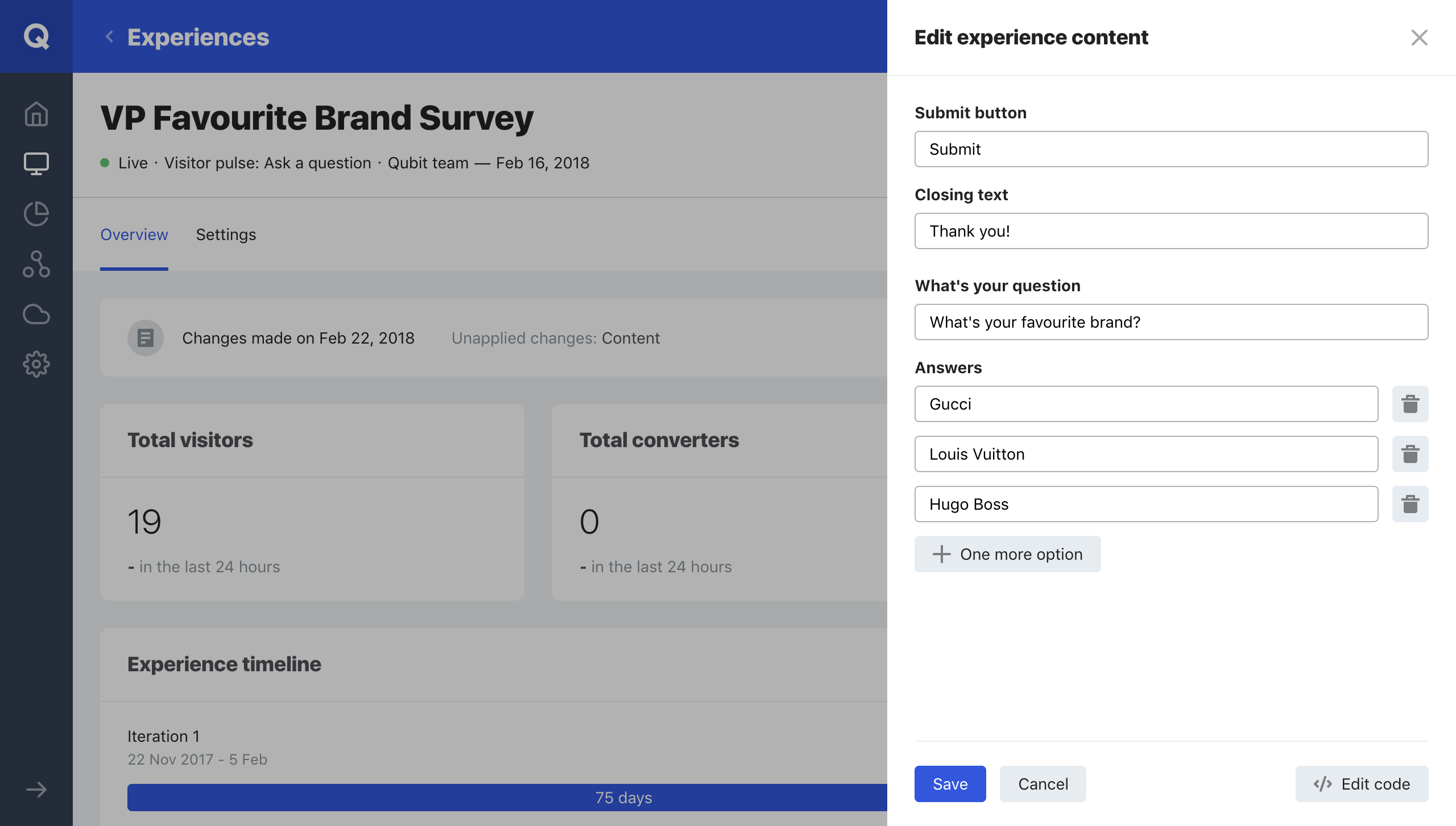
Overall navigation on Qubit is very user friendly and requires a minimal training to be up and running. Be it reviewing existing experiences or setting up new experiences, the process is pretty simple for business user. Add some basic development skills to your kitty, you can do magic with Qubit and make your website do wonders!
Alway up and running, or if there is a problem we can get back in the game right away. The reliability was a big selling point for me, and it was true when this company got it. Rollouts can be tough, but this was pretty seamless. Good support throughout the process, good documentation to handle questions/tips
I would say that the Qubit account managers are always available for any request. We have a lot of different promotions that could always do with last minute optimizing or changes and Qubit can be relied on to get this changes up and running in an impressive amount of time, so that we don't need to patch live or wait for the next IT sprint. Invaluable to our business.
No issues, problems, or negative remarks from us!! We had a plan, vendor support was rock solid, our data folks have experience, OCM supported as needed, and we got the rollout done on time, on budget, and with only minor hiccups. SInce the rollout, most of us have already forgotten the hiccups and generally speak highly of the product
Technology is good for A/B testing and personalisation - allowing any team with a dedicated developer to create test relatively easily and to report/analyse them in a fair amount of details. Some advanced features, especially on the set up of test cells, are dearly missing. Unfortunately, new features are often not free of bugs... Also, support is sub-par, which means new features are realised without proper documentation, example or training (but of our Qubit counterparts and internally).
I haven't used the Amplitude support other than their training docs so I can't speak too much to the in-person support but the docs are serviceable. Nothing too crazy but between the user tips, email notifications, and the decent number of docs I was able to get the support I needed to ramp up on the tool.
Qubit are supportive and flexible in providing support. They are happy working out of usual hours, even on weekends and if I have any doubts about the set up of an experience they’re quick to respond and willing to check my work. On particularly big revenue days they monitor our account and they’re quick to identify and problem solve any issues.
Virtual Not bad considering the timeframe and turnaround. The biggest benefit was for my end-users to hear a voice (other than mine/ours! LOL) telling them about the new features and capabilities. The in-person training was really good for having an expert that knows the answers and could refer to past experiences, problems, solutions. THey were a great resource to ease the transition ... basically a "you are gonna be okay with this change ... you got this etc.!" kinda vibe
The training was great, but would be great to have a script or PDF with some explanations of the qubit JS layer. Without the script you can just try to learn on your own, so the training is not as powerfull as it could be. On the other hand - would be great to have training related to reading statistics or personalisation.
Good enough to get strong baseline. I always make sure our our users go to and/or focus on the vebndor-provided support docs rather than any formal training. Our instructors come and go, but written policy and how-to docs live much longer in a corporate setting. That said, the online training is sufficient. I like that the training curric is stacked and progressive.
My team members all have background as data analysts, so Amp was pretty easy to for them. There was sufficient online training available. We also used the available support documents. The actual rollout went well. We did significant testing beforehand. We did a phased rollout, with partial silent rollout (part of OCM's plan) for the smallest line of business. THe silent one was "silent" b/c it was done without fanfare or public notices ... it was just a "we're doing some things, it wont impact your work or workday
Implementation couldn't be easier. All we needed to do was insert the tag. (easy) and set up the data layer. (dev required) This was pretty smooth in comparison to some of the other tools we use on our site, and was done in less than a day. Note : Data needs to be collected for a set period of time before you can accurately rely on the data that you are receiving. This is normal though with everyone else that we have used
Amplitude Analytics is a robust platform that can take your data reporting beyond what's currently capable in GA. Heap is a great intermediate tool, that takes data analysis a step further and is an excellent product in it's own right. Mixpanel is the most comparable both have very similar reporting/dashboarding functionality. Amplitude can often be preferred by product and data engineering teams for it's ease of setup and impressive analytics displays.
We're using Qubit as a fully managed testing platform, and their account management and level of service we've received from any other contact (technical, support, sales etc) was above any of their competitors. Integration and on-boarding was well done and we feel confident that the campaigns are developed and tested thoroughly.
Like all the other grades, it was mostly an easy implementation ... we have experience people, the rollout in general is well planned, and the vendor was very supportive
Our requirements change throughout the year like most E Commerce retailers. At Christmas and Peak we're dealing with around ten times the usual traffic on the site. Qubit had no problems with this at all, tests continued to fire, and stats were still reported accurately. I don't think that it is the most server intensive .js anyway, but we have seen no issues at all.