Anaconda vs. OpenText Magellan

Overview
ProductRatingMost Used ByProduct SummaryStarting Price
Anaconda
Score 8.1 out of 10
N/A
Anaconda provides access to the foundational open-source Python and R packages used in modern AI, data science, and machine learning. These enterprise-grade solutions enable corporate, research, and academic institutions around the world to harness open-source for competitive advantage and research. Anaconda also provides enterprise-grade security to open-source software through the Premium Repository.
$0
per month
OpenText Magellan
Score 9.0 out of 10
N/A
OpenText Magellan Analytics Suite leverages a comprehensive set of data analytics software to identify patterns, relationships and trends through data visualizations and interactive dashboards.N/A
Pricing
AnacondaOpenText Magellan
Editions & Modules
Free Tier
$0
per month
Starter Tier
$9
per month
Business Tier
$50
per month per user
Enterprise Tier
60.00+
per month per user
No answers on this topic
Offerings
Pricing Offerings
AnacondaOpenText Magellan
Free Trial
NoNo
Free/Freemium Version
YesNo
Premium Consulting/Integration Services
NoNo
Entry-level Setup FeeNo setup feeNo setup fee
Additional Details
More Pricing Information
Community Pulse
AnacondaOpenText Magellan
Considered Both Products
Anaconda
Chose Anaconda
I am using both; when it comes to application deployment on the server, I use Docker, and sometimes, I use Docker with conda image for deployment when it comes to ML/DL apps.

Chose Anaconda
There are several reasons why Anaconda is better to use for me including that it is much easier to use than Baycharm. Also, the user interface is not as complicated as that of Baycharm. Even Anaconda does not slow down my device, using PaySharm slowed down my device in an …
Chose Anaconda
It provides several IDEs like Spyder and Jupiter that would be enough for me to write my Python script. You can easily install it on a Windows or Linux computer and supports many libraries.
Chose Anaconda
In Anaconda, [it is easy] to find and install the required libraries. Here, we can work on multiple projects with different sets of the environment. [It is] easy to create the notebook for developing the ML model and deployment. Right now, it is the best data science version …
Chose Anaconda
I have used many other tools for coding purposes.
But for python programming, the best fit tool is Anaconda.
Memory management is best in Anaconda.
Chose Anaconda
One of the main competitors to Anaconda can be Google products such as Colab. Colab gives you the flexibility to handle large datasets gives it an edge over Anaconda. But again, the ease of access and usability of Anaconda stacks up against Colab. Besides, Anaconda relies more …
Chose Anaconda
It is almost dishonest to compare Anaconda with PyCharm as they do different things in their basic forms unless you spend a lot of time configuring plugins on your PyCharm environment. Anaconda has a lot of things ready and you just need to install your libs and dependencies.
Chose Anaconda
This is an open source tool and used very easily. All the notebooks are under one navigator solved the whole problem.
Chose Anaconda
Anaconda has features which overpowers it over the other analytical tools I have used. Also it provides multiple ways to reach to the solution, depending on the developers expertise. When I was a beginner at using Anaconda, since it is open source and the community using …
Chose Anaconda
Free ware, better design ease of use
Chose Anaconda
On top of all the software that I have used, Anaconda is the best because in Anaconda we have built-in packages that provide no headache to install packages and we can design a separate environment for different projects. Anaconda has versions made for special use cases. …
Chose Anaconda
Some analyzed tools, such as Pycharm and Spyder, are simpler to use but still do not have all the libraries needed for those starting out in data science--or in institutions that need to grow in that direction. Anaconda is more robust but stable, more complete, and the …
Chose Anaconda
If the project is not large scale then Jupiter notebooks or Visual Studio Code serve well. If you don't have any dependency on Python versions, these IDEs can be well suited for fast development and deployment.
Chose Anaconda
Anaconda includes many standard data science packages where as the regular python installation does not.
Depending on use case, some may feel Anaconda may be "bloated"
For ease Anaconda is better, for minimizing extraneous package installation, the regular python installer is …
Chose Anaconda
I know that Pycharm is a IDE and Anaconda is a distribution. However I use Anaconda largely due to Jupyter Notebook, which more or less does the same job as Pycharm. 1 year ago I decided to use Anaconda (Jupiyer Notebook) as it is easier to use it as a beginner(at least my …
Chose Anaconda
Anaconda has 64-bit support in the community edition, and package management is more in line with the way we think.
Chose Anaconda
I have not used another program like Anaconda before.
Chose Anaconda
MATLAB is more of a pay-as-you-go alternative, which not only does not use Python but is also more bloated and costly. MATLAB takes longer to install, setup, and configure for new users who may require specific packages - such as the Classification Learner (machine learning), …
Chose Anaconda
Compare Anaconda to Unix coding system. You can use PIP to install and create requirement.txt to replace environment.yml to avoid using Anaconda. However, Anaconda is such an excellent tool to maintain your environment and check the version of your package and update the …
Chose Anaconda
Anaconda is very strong in the environment and version control that make data science work much easier. The only thing that might be comparable to Anaconda would be using Kubernetes to control Docker. Another potential improvement would be replacing spyder with PyCharm and Atom …
Chose Anaconda
I like SpyDER, which comes with Anaconda better for its intuitive layout and variable explorer options.
Chose Anaconda
Anaconda gives freedom to do anything with its packages, compared to other non-programming language-based softwares. It is almost possible to do anything with Anaconda. Anaconda brings ease of integrity because it is possible to integrate anything with a Python Py script, …
Chose Anaconda
Suitable for Python development where there’s internal supporting for Python; otherwise, other platform offers similar capabilities with lower cost.
Chose Anaconda
I prefer Anaconda due to the control I have at every level over the data and the visualizations. Power BI does a better job at guessing what graphics to use, but these usually aren't the most helpful. Anaconda and the slew of Python extensions that add incredible functionality, …
Chose Anaconda
Other systems might be easier to set-up but Anaconda is a fairly flexible analytics toolkit. It can be configured in a way that truly matches the way in which your business or analytics department works. Built on top of lots of open source projects so things aren't siloed and …
OpenText Magellan
Chose OpenText Magellan
There is multiple software available in the market to do the reporting and text analytics. Generally, analysts prefer using Python or R. Or we try to use any API available. This software can fulfill almost 80% of those needs without writing the codes. It has the integration …
Chose OpenText Magellan
OpenText Magellan can produce reports that are much more elaborate than PowerBI, which is ideal for users that just need to see a report. On the other hand, PowerBI seems to be better at allowing users to interact with data.
Chose OpenText Magellan
It is vastly superior to these in many ways, for complex reporting it is a much more sophisticated solution. Visualizations are very good. Javascript extensibility is very powerful, others don't support this or as well. Pentaho and MS are both OLAP oriented. Pentaho is moving …
Chose OpenText Magellan
Actuate has been in the industry a while and the open source community make going with Actuate's BIRT a stable decision. Changing report engines can be expensive, so going with a company with a good reputation helps long-term.
Chose OpenText Magellan
I've used JReports and Actuate is very similar but seems to have a lot more customization features for the end user of BIRT reports.
Chose OpenText Magellan
Actuate has a HUGE number of features that can tie nicely into almost any ERP but it takes some time to learn and the development community was relatively small compared to the Crystal Reports alternative. Crystal was far easier to learn and had a massive support base. Probably …
Chose OpenText Magellan
We looked at a few other competitor's products but based on value for features chose Actuate for its total cost of ownership.
Features
AnacondaOpenText Magellan
Platform Connectivity
Comparison of Platform Connectivity features of Product A and Product B
Anaconda
9.3
Ratings
11% above category average
OpenText Magellan
-
Ratings
Connect to Multiple Data Sources9.80 Ratings00 Ratings
Extend Existing Data Sources8.00 Ratings00 Ratings
Automatic Data Format Detection9.70 Ratings00 Ratings
MDM Integration9.60 Ratings00 Ratings
Data Exploration
Comparison of Data Exploration features of Product A and Product B
Anaconda
8.5
Ratings
2% above category average
OpenText Magellan
-
Ratings
Visualization9.00 Ratings00 Ratings
Interactive Data Analysis8.00 Ratings00 Ratings
Data Preparation
Comparison of Data Preparation features of Product A and Product B
Anaconda
9.0
Ratings
10% above category average
OpenText Magellan
-
Ratings
Interactive Data Cleaning and Enrichment8.80 Ratings00 Ratings
Data Transformations8.00 Ratings00 Ratings
Data Encryption9.70 Ratings00 Ratings
Built-in Processors9.60 Ratings00 Ratings
Platform Data Modeling
Comparison of Platform Data Modeling features of Product A and Product B
Anaconda
9.2
Ratings
9% above category average
OpenText Magellan
-
Ratings
Multiple Model Development Languages and Tools9.00 Ratings00 Ratings
Automated Machine Learning8.90 Ratings00 Ratings
Single platform for multiple model development10.00 Ratings00 Ratings
Self-Service Model Delivery9.00 Ratings00 Ratings
Model Deployment
Comparison of Model Deployment features of Product A and Product B
Anaconda
9.5
Ratings
11% above category average
OpenText Magellan
-
Ratings
Flexible Model Publishing Options10.00 Ratings00 Ratings
Security, Governance, and Cost Controls9.00 Ratings00 Ratings
BI Standard Reporting
Comparison of BI Standard Reporting features of Product A and Product B
Anaconda
-
Ratings
OpenText Magellan
7.0
Ratings
15% below category average
Customizable dashboards00 Ratings7.00 Ratings
Report Formatting Templates00 Ratings7.00 Ratings
Ad-hoc Reporting
Comparison of Ad-hoc Reporting features of Product A and Product B
Anaconda
-
Ratings
OpenText Magellan
8.3
Ratings
3% above category average
Drill-down analysis00 Ratings8.00 Ratings
Formatting capabilities00 Ratings8.00 Ratings
Integration with R or other statistical packages00 Ratings9.00 Ratings
Report sharing and collaboration00 Ratings8.00 Ratings
Report Output and Scheduling
Comparison of Report Output and Scheduling features of Product A and Product B
Anaconda
-
Ratings
OpenText Magellan
8.3
Ratings
0% below category average
Publish to Web00 Ratings8.00 Ratings
Publish to PDF00 Ratings8.00 Ratings
Report Versioning00 Ratings9.00 Ratings
Report Delivery Scheduling00 Ratings8.00 Ratings
Data Discovery and Visualization
Comparison of Data Discovery and Visualization features of Product A and Product B
Anaconda
-
Ratings
OpenText Magellan
8.0
Ratings
0% above category average
Pre-built visualization formats (heatmaps, scatter plots etc.)00 Ratings9.00 Ratings
Predictive Analytics00 Ratings7.00 Ratings
Access Control and Security
Comparison of Access Control and Security features of Product A and Product B
Anaconda
-
Ratings
OpenText Magellan
9.0
Ratings
6% above category average
Role-Based Security Model00 Ratings9.00 Ratings
Multiple Access Permission Levels (Create, Read, Delete)00 Ratings9.00 Ratings
Single Sign-On (SSO)00 Ratings9.00 Ratings
Mobile Capabilities
Comparison of Mobile Capabilities features of Product A and Product B
Anaconda
-
Ratings
OpenText Magellan
7.0
Ratings
11% below category average
Responsive Design for Web Access00 Ratings7.00 Ratings
Dashboard / Report / Visualization Interactivity on Mobile00 Ratings7.00 Ratings
Application Program Interfaces (APIs) / Embedding
Comparison of Application Program Interfaces (APIs) / Embedding features of Product A and Product B
Anaconda
-
Ratings
OpenText Magellan
6.2
Ratings
23% below category average
REST API00 Ratings5.00 Ratings
Javascript API00 Ratings9.00 Ratings
Java API00 Ratings5.00 Ratings
Themeable User Interface (UI)00 Ratings7.00 Ratings
Customizable Platform (Open Source)00 Ratings5.00 Ratings
Best Alternatives
AnacondaOpenText Magellan
Small Businesses
Jupyter Notebook
Jupyter Notebook
Score 9.4 out of 10
BrightGauge
BrightGauge
Score 9.1 out of 10
Medium-sized Companies
Posit
Posit
Score 10.0 out of 10
Reveal
Reveal
Score 10.0 out of 10
Enterprises
Posit
Posit
Score 10.0 out of 10
Kyvos Semantic Intelligence Layer
Score 9.9 out of 10
All AlternativesView all alternativesView all alternatives
User Ratings
AnacondaOpenText Magellan
Likelihood to Recommend
10.0
(0 ratings)
9.0
(0 ratings)
Likelihood to Renew
7.0
(0 ratings)
3.9
(0 ratings)
Usability
9.0
(0 ratings)
9.0
(0 ratings)
Support Rating
8.9
(0 ratings)
9.0
(0 ratings)
User Testimonials
AnacondaOpenText Magellan
Likelihood to Recommend
I have asked all my juniors to work with Anaconda and Pycharm only, as this is the best combination for now. Coming to use cases: 1. When you have multiple applications using multiple Python variants, it is a really good tool instead of Venv (I never like it). 2. If you have to work on multiple tools and you are someone who needs to work on data analytics, development, and machine learning, this is good. 3. If you have to work with both R and Python, then also this is a good tool, and it provides support for both.
Read full review
It depends on extensibility, set-up, access & style. Actuate performs fairly well, but has performance issues because it sits on top of eclipse, which sits on top of Java. Extensibility usually comes at that price. Set-up is fairly straightforward and it can be secured.
Read full review
Pros
  • Installing packages is very easy with Anaconda. Anaconda comes with 'anaconda navigator', a terminal-like utility from which you can easily install R packages and python libraries.
  • Launching R and python IDEs as well as Jupyter notebooks from anaconda navigator is simple, and Anaconda makes it very easy to keep these packages up-to-date.
  • I really like the fact that if you don't want to install the full version of Anaconda, you can opt to install a lightweight version (called Miniconda) that includes less python libraries and only core conda. I've installed it when I didn't want to take up as much disk space as Anaconda requires, but it works just the same.
Read full review
  • Ability to connect to different kinds of sources, including web services, and customize those queries to the extend needed
  • Provide tools to customize the look & feel of the reports as much as needed, even being able to choose different appearances for different outputs
  • Allowing scripting in the reports extends the functionality available
  • Allowing to embed reports without further licensing and maintaining all the functionality
Read full review
Cons
  • More graphics need in Spyder book. If you work for couple of years then you will be bored with the graphics.
  • Extra tools are required for making it secure. We uses extra tools for adding Username /Password to Jupyter.
  • R Studio Hangs a lot when open from Anaconda Navigator.
Read full review
  • Report rendering can take a long time for large reports (250,000+ pages) - we run these in batch over night
  • The deployment of production code from development to test to production enviroments can be complex due to the number of components that must compile
Read full review
Likelihood to Renew
It's really good at data processing, but needs to grow more in publishing in a way that a non-programmer can interact with. It also introduces confusion for programmers that are familiar with normal Python processes which are slightly different in Anaconda such as virtualenvs.
Read full review
I am no longer working for the company that was using Actuate but I believe they would continue to use it because the stitching costs would be to high. It would require a complete rewrite of the reports and the never version of Actuate (BIRT) even required an almost complete report rewrite
Read full review
Usability
I am giving this rating because I have been using this tool since 2017, and I was in college at that time. Initially, I hesitated to use it as I was not very aware of the workings of Python and how difficult it is to manage its dependency from project to project. Anaconda really helped me with that. The first machine-learning model that I deployed on the Live server was with Anaconda only. It was so managed that I only installed libraries from the requirement.txt file, and it started working. There was no need to manually install cuda or tensor flow as it was a very difficult job at that time. Graphical data modeling also provides tools for it, and they can be easily saved to the system and used anywhere.
Read full review
It is quite intuitive to use. It is fit specifically for doing sentiment, emotion, and intention analysis as well as text classification and text summarization. I would have given 10 if it is fit for the purpose of doing image processing and analysis as well. There is a huge market to analyze video and image data.
Read full review
Support Rating
Anaconda provides fast support, and a large number of users moderate its online community. This enables any questions you may have to be answered in a timely fashion, regardless of the topic. The fact that it is based in a Python environment only adds to the size of the online community.
Read full review
Always there on the front and backend for us and the client.
Read full review
Alternatives Considered
One of the main competitors to Anaconda can be Google products such as Colab. Colab gives you the flexibility to handle large datasets gives it an edge over Anaconda. But again, the ease of access and usability of Anaconda stacks up against Colab. Besides, Anaconda relies more on your machine which makes it safe to use.
Read full review
It is vastly superior to these in many ways, for complex reporting it is a much more sophisticated solution. Visualizations are very good. Javascript extensibility is very powerful, others don't support this or as well. Pentaho and MS are both OLAP oriented. Pentaho is moving more toward big data, which was not our primary focus. Others are stuck in the Crystal Reports Band metaphor.
Read full review
Return on Investment
  • Positive impact - Multiple options for data presenting , visualizing and sharing. (Eg: R-Markdown).
  • Positive impact - Ease of access to build complex machine learning models. (I work in NLP, it has multiple built in models to analyze the various contexts).
  • Positive impact - Conda package let's to deal with external packages which can be used in Jupyter.
Read full review
  • Actuate can handle 50 to 60 sub reports inside a report very well.
  • Dynamically creating the datasource, chart, graph, reports are the main advantages. We can do any level of drilling, and can create a performance matrix dashboard efficiently.
Read full review
ScreenShots

OpenText Magellan Screenshots

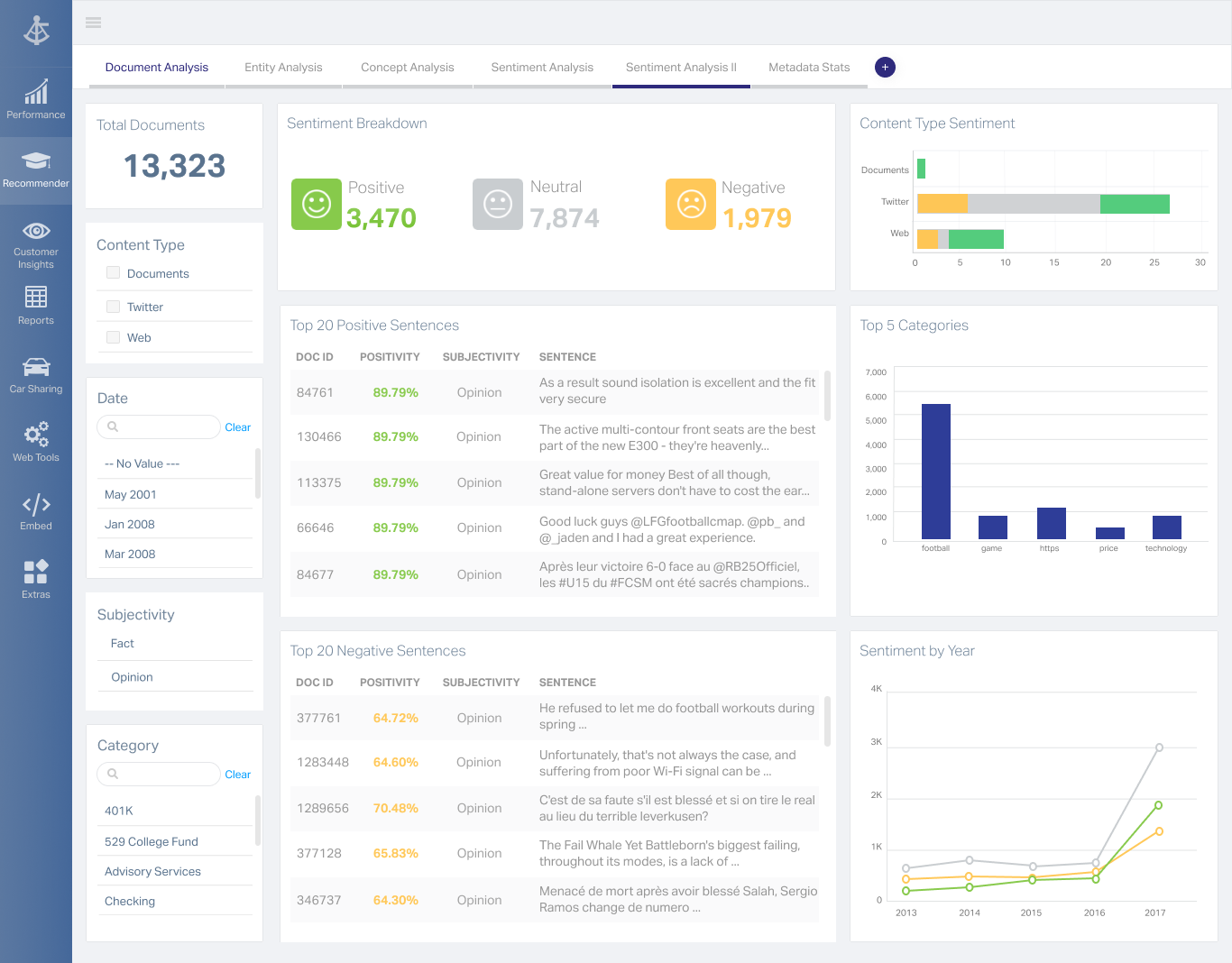
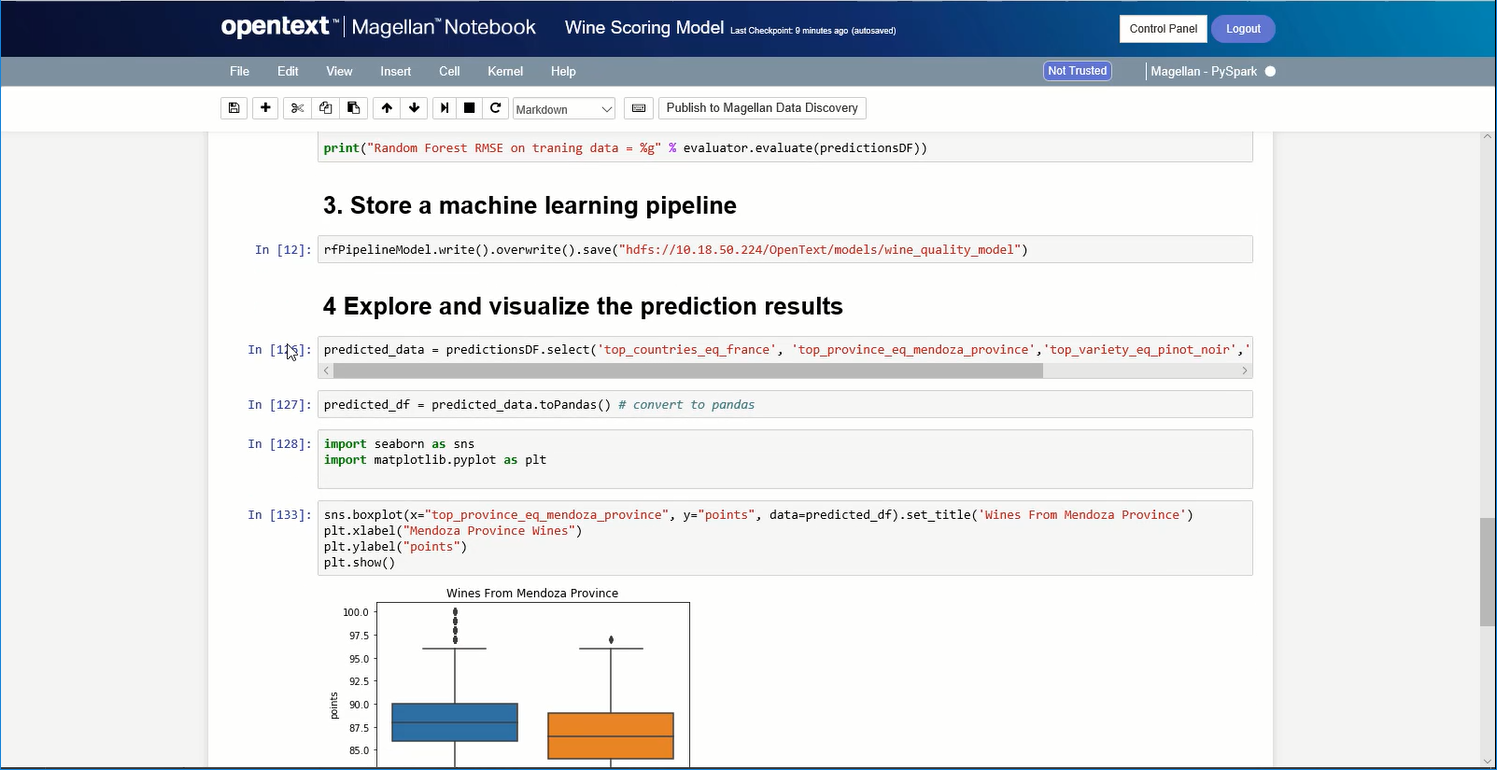
Screenshot of A Magellan BI & Reporting dashboard that an individual can interact with and personalize to their needs, such as changing chart types or computations.Screenshot of Magellan Data Discovery provides a Smart User Interface, designed to equip new users and users seeking a more streamlined set of features for insightsScreenshot of Magellan Data Discovery provides an Advanced User Interface that allows data analytics pros to leverage its breadth of sophisticated capabilities for insightsScreenshot of Magellan Text Mining insights can be displayed within easy-to-use dashboards.Screenshot of Data scientists can create visualizations within the Magellan Notebook and see it dynamically update as they write changes to it.