Anaconda vs. Spotfire

Overview
ProductRatingMost Used ByProduct SummaryStarting Price
Anaconda
Score 8.1 out of 10
N/A
Anaconda provides access to the foundational open-source Python and R packages used in modern AI, data science, and machine learning. These enterprise-grade solutions enable corporate, research, and academic institutions around the world to harness open-source for competitive advantage and research. Anaconda also provides enterprise-grade security to open-source software through the Premium Repository.
$0
per month
Spotfire
Score 8.1 out of 10
N/A
Spotfire, formerly known as TIBCO Spotfire, is a visual data science platform that combines visual analytics, data science, and data wrangling, so users can analyze data at-rest and at-scale to solve complex industry-specific problems.N/A
Pricing
AnacondaSpotfire
Editions & Modules
Free Tier
$0
per month
Starter Tier
$9
per month
Business Tier
$50
per month per user
Enterprise Tier
60.00+
per month per user
No answers on this topic
Offerings
Pricing Offerings
AnacondaSpotfire
Free Trial
NoYes
Free/Freemium Version
YesNo
Premium Consulting/Integration Services
NoNo
Entry-level Setup FeeNo setup feeNo setup fee
Additional DetailsFor Enterprise engagements, contact Spotfire directly for a custom price quote.
More Pricing Information
Community Pulse
AnacondaSpotfire
Considered Both Products
Anaconda
Chose Anaconda
I am using both; when it comes to application deployment on the server, I use Docker, and sometimes, I use Docker with conda image for deployment when it comes to ML/DL apps.

Chose Anaconda
There are several reasons why Anaconda is better to use for me including that it is much easier to use than Baycharm. Also, the user interface is not as complicated as that of Baycharm. Even Anaconda does not slow down my device, using PaySharm slowed down my device in an …
Chose Anaconda
It provides several IDEs like Spyder and Jupiter that would be enough for me to write my Python script. You can easily install it on a Windows or Linux computer and supports many libraries.
Chose Anaconda
In Anaconda, [it is easy] to find and install the required libraries. Here, we can work on multiple projects with different sets of the environment. [It is] easy to create the notebook for developing the ML model and deployment. Right now, it is the best data science version …
Chose Anaconda
I have used many other tools for coding purposes.
But for python programming, the best fit tool is Anaconda.
Memory management is best in Anaconda.
Chose Anaconda
One of the main competitors to Anaconda can be Google products such as Colab. Colab gives you the flexibility to handle large datasets gives it an edge over Anaconda. But again, the ease of access and usability of Anaconda stacks up against Colab. Besides, Anaconda relies more …
Chose Anaconda
It is almost dishonest to compare Anaconda with PyCharm as they do different things in their basic forms unless you spend a lot of time configuring plugins on your PyCharm environment. Anaconda has a lot of things ready and you just need to install your libs and dependencies.
Chose Anaconda
This is an open source tool and used very easily. All the notebooks are under one navigator solved the whole problem.
Chose Anaconda
Anaconda has features which overpowers it over the other analytical tools I have used. Also it provides multiple ways to reach to the solution, depending on the developers expertise. When I was a beginner at using Anaconda, since it is open source and the community using …
Chose Anaconda
Free ware, better design ease of use
Chose Anaconda
On top of all the software that I have used, Anaconda is the best because in Anaconda we have built-in packages that provide no headache to install packages and we can design a separate environment for different projects. Anaconda has versions made for special use cases. …
Chose Anaconda
Some analyzed tools, such as Pycharm and Spyder, are simpler to use but still do not have all the libraries needed for those starting out in data science--or in institutions that need to grow in that direction. Anaconda is more robust but stable, more complete, and the …
Chose Anaconda
If the project is not large scale then Jupiter notebooks or Visual Studio Code serve well. If you don't have any dependency on Python versions, these IDEs can be well suited for fast development and deployment.
Chose Anaconda
Anaconda includes many standard data science packages where as the regular python installation does not.
Depending on use case, some may feel Anaconda may be "bloated"
For ease Anaconda is better, for minimizing extraneous package installation, the regular python installer is …
Chose Anaconda
I know that Pycharm is a IDE and Anaconda is a distribution. However I use Anaconda largely due to Jupyter Notebook, which more or less does the same job as Pycharm. 1 year ago I decided to use Anaconda (Jupiyer Notebook) as it is easier to use it as a beginner(at least my …
Chose Anaconda
Anaconda has 64-bit support in the community edition, and package management is more in line with the way we think.
Chose Anaconda
I have not used another program like Anaconda before.
Chose Anaconda
MATLAB is more of a pay-as-you-go alternative, which not only does not use Python but is also more bloated and costly. MATLAB takes longer to install, setup, and configure for new users who may require specific packages - such as the Classification Learner (machine learning), …
Chose Anaconda
Compare Anaconda to Unix coding system. You can use PIP to install and create requirement.txt to replace environment.yml to avoid using Anaconda. However, Anaconda is such an excellent tool to maintain your environment and check the version of your package and update the …
Chose Anaconda
Anaconda is very strong in the environment and version control that make data science work much easier. The only thing that might be comparable to Anaconda would be using Kubernetes to control Docker. Another potential improvement would be replacing spyder with PyCharm and Atom …
Chose Anaconda
I like SpyDER, which comes with Anaconda better for its intuitive layout and variable explorer options.
Chose Anaconda
Anaconda gives freedom to do anything with its packages, compared to other non-programming language-based softwares. It is almost possible to do anything with Anaconda. Anaconda brings ease of integrity because it is possible to integrate anything with a Python Py script, …
Chose Anaconda
Suitable for Python development where there’s internal supporting for Python; otherwise, other platform offers similar capabilities with lower cost.
Chose Anaconda
I prefer Anaconda due to the control I have at every level over the data and the visualizations. Power BI does a better job at guessing what graphics to use, but these usually aren't the most helpful. Anaconda and the slew of Python extensions that add incredible functionality, …
Chose Anaconda
Other systems might be easier to set-up but Anaconda is a fairly flexible analytics toolkit. It can be configured in a way that truly matches the way in which your business or analytics department works. Built on top of lots of open source projects so things aren't siloed and …
Spotfire
Chose Spotfire
No experience with the tools in the list above other than Spotfire.
Chose Spotfire
Spotfire has an extremely large and dynamic range of visual analysis tools that can be catered for most issues or projects to create a custom analytics dashboard when compared to other tools I've used. It's multitude of available database connections allow for most …
Chose Spotfire
No, the spotfire is being selected by dev team and architecture team.
Chose Spotfire
Spotfire is stronger than other tools to built complex metrics within the tool, without needs of etl updates and query changing. It has lots of useful visualizations to deep dive data and give interesting analysis to business users. Moreover, with some studies and tests, you …
Chose Spotfire
Although Spotfire has a longer learning curve, it has proven to be more practical and impactful than Tableau. We had only evaluated other tools at a high level initially, and were surprised to hear the success stories of companies moving from Tableau to Spotfire. We have found …
Chose Spotfire
Because of Spotfire's robust features and capabilities, I chose it as my preferred software. Spotfire's greater overall performance and scalability set it apart from other software solutions. It can handle
Chose Spotfire
Spotfire is appropriate for every organization of any size because it can be a recipient of data for better decision-making. Being a robust development platform for creating reports and dashboards, creating a new Spotfire dashboard is relatively simple. Developers can create …
Chose Spotfire
Spotfire is more suited for manufacturing industries with regards the huge data to process to make relevant decision that use big data for making decisions, besides this Spotfire supports more and excels at Availability & Scalability, Data Sources Connectivity and Deployment …
Chose Spotfire
Spotfire is better for geo mapping and easier to maniuplate the data. i am not very good at Tableau anyways but that is what i have used in the past
Chose Spotfire
I prefer Spotfire greatly. While is may seem like a "one trick pony", it does that one trick really well.
Chose Spotfire
We select Spotfire because of its connectors, Big data capabilities, Drill down and inmersive analytics and capacita to manage miliseconds information
Chose Spotfire
Quick analysis and create reports
Chose Spotfire
I choose Spotfire because of the following - custom visual using JavaScript - on the fly chart property update using iron python - easy report Deployment and update -easy to manage user access via so or ldap - best report data Extraction -mix data sources -custom data load …
Chose Spotfire
Spotfire is significantly ahead of both products from an ETL and data ingestion capability. Spotfire also has substantially better visualizations than Power BI, and although the native visualizations aren't as flexible in Tableau, Spotfire enables users to create completely …
Chose Spotfire
Spotfire's key strength les in extent of customization possible and it's inherent Data Analytics capabilities. With in-memory and in-database analysis capabilities, it comes out as a high performance and high efficiency BI solution.
Adding to it, Spotfire integrates the …
Chose Spotfire
Easy to use and is a very flexible tool. Great to have multiple services. Find it to be a trusted platform. The ability to add Iron Python scripts and include code snippets is very useful. Like the style of the created views.
Chose Spotfire
I find both Microsoft Power BI and Spotfire very easy to use. I would rate them on par with each other. There isn’t much to differentiate them. Maybe the learning curve on Spotfire is a bit steeper than Microsoft Power BI.
Chose Spotfire
Augmented AI with Spotfire is very useful for data virtualization. Since data visualization is a quick and very easy way to convey our information. This software makes it easier with its interactive way of presenting data in charts, graphs, and 3D forms.
Chose Spotfire
It provides all tools along with in-built apps for analysis and generating reports, metrics, charts, and graphs. Comes with appropriate costing model at least for an average size organization
Chose Spotfire
We ultimately switched to Tableau desktop as we realized it was able to do all of the things we required of Spotfire.
Chose Spotfire
I haven’t tried any other tools by TIBCO. The only tool we use in our company is Spotfire, so my analysis is limited to Spotfire.
Chose Spotfire
Spotfire stacks well in comparison to other BI products and provides a simplified way to manage reporting and visualization requirements.
Chose Spotfire
Spotfire is the best application for power users by virtue of its wide variety of visualizations, incorporated analytics, superior data canvas, and ability to integrate code such as R or Python. The learning curve is steeper and the menus are Windows 7 once you are past some …
Chose Spotfire
The only other tool we use in my course is Tableau. Tableau is very popular regionally (Omaha, NE), runs locally on Mac and PC, is free for students and faculty, and has a web outlet for sharing. It also plays well with AWS. For these reasons, we use it as the primary …
Features
AnacondaSpotfire
Platform Connectivity
Comparison of Platform Connectivity features of Product A and Product B
Anaconda
9.3
Ratings
11% above category average
Spotfire
7.2
Ratings
15% below category average
Connect to Multiple Data Sources9.80 Ratings7.80 Ratings
Extend Existing Data Sources8.00 Ratings7.40 Ratings
Automatic Data Format Detection9.70 Ratings7.80 Ratings
MDM Integration9.60 Ratings6.00 Ratings
Data Exploration
Comparison of Data Exploration features of Product A and Product B
Anaconda
8.5
Ratings
2% above category average
Spotfire
9.1
Ratings
8% above category average
Visualization9.00 Ratings9.00 Ratings
Interactive Data Analysis8.00 Ratings9.20 Ratings
Data Preparation
Comparison of Data Preparation features of Product A and Product B
Anaconda
9.0
Ratings
10% above category average
Spotfire
7.4
Ratings
10% below category average
Interactive Data Cleaning and Enrichment8.80 Ratings7.20 Ratings
Data Transformations8.00 Ratings8.00 Ratings
Data Encryption9.70 Ratings7.00 Ratings
Built-in Processors9.60 Ratings7.50 Ratings
Platform Data Modeling
Comparison of Platform Data Modeling features of Product A and Product B
Anaconda
9.2
Ratings
9% above category average
Spotfire
7.6
Ratings
10% below category average
Multiple Model Development Languages and Tools9.00 Ratings7.50 Ratings
Automated Machine Learning8.90 Ratings8.50 Ratings
Single platform for multiple model development10.00 Ratings7.60 Ratings
Self-Service Model Delivery9.00 Ratings6.70 Ratings
Model Deployment
Comparison of Model Deployment features of Product A and Product B
Anaconda
9.5
Ratings
11% above category average
Spotfire
7.4
Ratings
14% below category average
Flexible Model Publishing Options10.00 Ratings7.80 Ratings
Security, Governance, and Cost Controls9.00 Ratings7.00 Ratings
Best Alternatives
AnacondaSpotfire
Small Businesses
Jupyter Notebook
Jupyter Notebook
Score 9.4 out of 10
Jupyter Notebook
Jupyter Notebook
Score 9.4 out of 10
Medium-sized Companies
Posit
Posit
Score 10.0 out of 10
Posit
Posit
Score 10.0 out of 10
Enterprises
Posit
Posit
Score 10.0 out of 10
Posit
Posit
Score 10.0 out of 10
All AlternativesView all alternativesView all alternatives
User Ratings
AnacondaSpotfire
Likelihood to Recommend
10.0
(0 ratings)
8.4
(0 ratings)
Likelihood to Renew
7.0
(0 ratings)
9.6
(0 ratings)
Usability
9.0
(0 ratings)
8.0
(0 ratings)
Availability
-
(0 ratings)
9.0
(0 ratings)
Performance
-
(0 ratings)
7.1
(0 ratings)
Support Rating
8.9
(0 ratings)
8.7
(0 ratings)
In-Person Training
-
(0 ratings)
8.3
(0 ratings)
Online Training
-
(0 ratings)
9.0
(0 ratings)
Implementation Rating
-
(0 ratings)
8.4
(0 ratings)
Configurability
-
(0 ratings)
7.1
(0 ratings)
Ease of integration
-
(0 ratings)
7.0
(0 ratings)
Product Scalability
-
(0 ratings)
7.0
(0 ratings)
Vendor post-sale
-
(0 ratings)
5.0
(0 ratings)
Vendor pre-sale
-
(0 ratings)
5.0
(0 ratings)
User Testimonials
AnacondaSpotfire
Likelihood to Recommend
I have asked all my juniors to work with Anaconda and Pycharm only, as this is the best combination for now. Coming to use cases: 1. When you have multiple applications using multiple Python variants, it is a really good tool instead of Venv (I never like it). 2. If you have to work on multiple tools and you are someone who needs to work on data analytics, development, and machine learning, this is good. 3. If you have to work with both R and Python, then also this is a good tool, and it provides support for both.
Read full review
Spotfire was used to look at a large data set of an in process manufacturing step. The data visualization was set up to look at yield as a function of several inputs (chemical / equipment / operator). After only a short analysis it was immediately obvious that there was a 5% yield discrepancy based on the operator using the equipment. The operators were retrained and the yield gap was eliminated.
Read full review
Pros
  • Installing packages is very easy with Anaconda. Anaconda comes with 'anaconda navigator', a terminal-like utility from which you can easily install R packages and python libraries.
  • Launching R and python IDEs as well as Jupyter notebooks from anaconda navigator is simple, and Anaconda makes it very easy to keep these packages up-to-date.
  • I really like the fact that if you don't want to install the full version of Anaconda, you can opt to install a lightweight version (called Miniconda) that includes less python libraries and only core conda. I've installed it when I didn't want to take up as much disk space as Anaconda requires, but it works just the same.
Read full review
  • It has the best coding integration (python, R) of any BI product
  • The ability to work with very large datasets (10 mil+) is better than competitors
  • Export options are more complete and have better functionality
  • The data canvas is the best tool to join and transform data vs. competitors
Read full review
Cons
  • More graphics need in Spyder book. If you work for couple of years then you will be bored with the graphics.
  • Extra tools are required for making it secure. We uses extra tools for adding Username /Password to Jupyter.
  • R Studio Hangs a lot when open from Anaconda Navigator.
Read full review
  • They should have a lower price point for users to access the analyst version who don't require advanced capabilities. For example, a lower price if users just need to do some basic slicing and dicing with their data and not have to the data science functionality (ie. K-means clustering, regression modeling, classification modeling, etc.).
  • Currently, you can't change the font type/color on the axis, which I'm sure will eventually be available in the future as they have a Spotfire Ideas portal that they're fairly responsive to and act on. I guess at the end of the day, it's about the data and what insights you get from it.
Read full review
Likelihood to Renew
It's really good at data processing, but needs to grow more in publishing in a way that a non-programmer can interact with. It also introduces confusion for programmers that are familiar with normal Python processes which are slightly different in Anaconda such as virtualenvs.
Read full review
It's a very powerful tool that allows for a myriad of customizations within the analysis files themselves, particularly with the custom expression functionality. There have been some great strides with the quality of the visualization options (which were not great to begin with) and I hope to see more improvements made as the product gets updated.
Read full review
Usability
I am giving this rating because I have been using this tool since 2017, and I was in college at that time. Initially, I hesitated to use it as I was not very aware of the workings of Python and how difficult it is to manage its dependency from project to project. Anaconda really helped me with that. The first machine-learning model that I deployed on the Live server was with Anaconda only. It was so managed that I only installed libraries from the requirement.txt file, and it started working. There was no need to manually install cuda or tensor flow as it was a very difficult job at that time. Graphical data modeling also provides tools for it, and they can be easily saved to the system and used anywhere.
Read full review
Basic tasks like generating meaningful information from large sets of raw data are very easy. The next step of linking to multiple live data sources and linking those tables and performing on the fly analysis of the imported data is understandably more difficult.
Read full review
Reliability and Availability
No answers on this topic
Even though, it's a rather stable and predictable tool that's also fast, it does have some bugs and inconsistencies that shut down the system. Depending on the details, it could happen as often as 2-3 times a week, especially during the development period.
Read full review
Performance
No answers on this topic
Generally, the Spotfire client runs with very good performance. There are factors that could affect performance, but normally has to do with loading large analysis files from the library if the database is located some distance away and your global network is not optimal. Once you have your data table(s) loaded in the client application, usually the application is quite good performance-wise.
Read full review
Support Rating
Anaconda provides fast support, and a large number of users moderate its online community. This enables any questions you may have to be answered in a timely fashion, regardless of the topic. The fact that it is based in a Python environment only adds to the size of the online community.
Read full review
Support has been helpful with issues. Support seems to know their product and its capabilities. It would also seem that they have a good sense of the context of the problem; where we are going with this issue and what we want the end outcome to be.
Read full review
In-Person Training
No answers on this topic
The instructor was very in depth and provided relevant training to business users on how to create visualizations. They showed us how to alter settings and filter views, and provided resources for future questions. However, the instructor failed to cover data sources, connecting to data, etc. While it was helpful to see how users can use the data to create reports, they failed to properly instruct us on how to get the dataset in to begin with. We are still trying to figure out connections to certain databases (we have multiple different types).
Read full review
Online Training
No answers on this topic
The online training is good, provides a good base of knowledge. The video demonstrations were well-done and easy to follow along. Provided exercises are good as well, but I think there could be more challenging exercises. The training has also gone up in price significantly in the last 3 years (in USD, which hurts us even more in Canada), and I'm not sure it is worth the money it now costs (it is worth how much it cost 3 years ago, but not double that.)
Read full review
Implementation Rating
No answers on this topic
The original architecture I created for our implementation had only a particular set of internal business units in mind. Over the years, Spotfire gained in popularity in our company and was being utilized across many more business units. Soon, its usage went beyond what the original architectural implementation could provide. We've since learned about how the product is used by the different teams and are currently in the middle of rolling out a new architecture. I suggest:
  • Have clearly defined service level agreements with all the teams that will use Spotfire. Your business intelligence group might only need availability during normal working hours, but your production support group might need 24/7 availability. If these groups share one Spotfire server, maintenance of that server might be a problem.
  • Know the different types of data you will be working with. One group might be working with "public" data while another group might work with sensitive data. Design your Library accordingly and with the proper permissions.
  • Know the roles of the users of Spotfire. Will there only be a small set of report writers or does everyone have write access to the Library?
  • ALWAYS add a timestamp prompt to your reports. You don't want multiple users opening a report that will try and pull down millions of rows of data to their local workstations. Another option, of course, is to just hard code a time range in the backing database view (i.e. where activity_date >= sysdate - 90, etc.), but I'd rather educate/train the user base if possible.
  • This probably goes without saying, but if possible, point to a separate reporting database or a logical standby database. You don't want the company pounding on your primaries and take down your order system.
Read full review
Alternatives Considered
One of the main competitors to Anaconda can be Google products such as Colab. Colab gives you the flexibility to handle large datasets gives it an edge over Anaconda. But again, the ease of access and usability of Anaconda stacks up against Colab. Besides, Anaconda relies more on your machine which makes it safe to use.
Read full review
Spotfire is appropriate for every organization of any size because it can be a recipient of data for better decision-making. Being a robust development platform for creating reports and dashboards, creating a new Spotfire dashboard is relatively simple. Developers can create highly customized dashboards using the tools it provides. I will recommend this software to others
Read full review
Scalability
No answers on this topic
In an enterprise architecture, if Spotfire Advanced Data services(Composite Studio),data marts can be managed optimally and scalability in a data perspective is great. As the web player/consumer is directly proportional to RAM, if the enterprise can handle RAM requirement accomodating fail over mechanisms appropraitely, it is definitely scalable,
Read full review
Return on Investment
  • Positive impact - Multiple options for data presenting , visualizing and sharing. (Eg: R-Markdown).
  • Positive impact - Ease of access to build complex machine learning models. (I work in NLP, it has multiple built in models to analyze the various contexts).
  • Positive impact - Conda package let's to deal with external packages which can be used in Jupyter.
Read full review
  • Spotfire really helped a lot of people in terms of analysis. It eliminates data analysis in excel. Because even underlying data you can explore it in Spotfire.
  • Spotfire helps data analysts to investigate data and also help analysts solve inconsistency of data.
  • Spotfire helps data analysts in building great dashboard that provide insights to users to make decisions to drive revenue and manage the churn.
Read full review
ScreenShots

Spotfire Screenshots

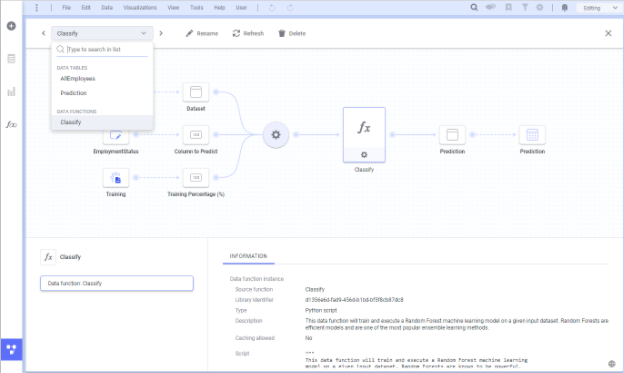
Screenshot of Smart Visual AnalyticsScreenshot of Geospatial AnalyticsScreenshot of Intelligent Data WranglingScreenshot of Point-and-click Data ScienceScreenshot of Real-time Streaming Analytics