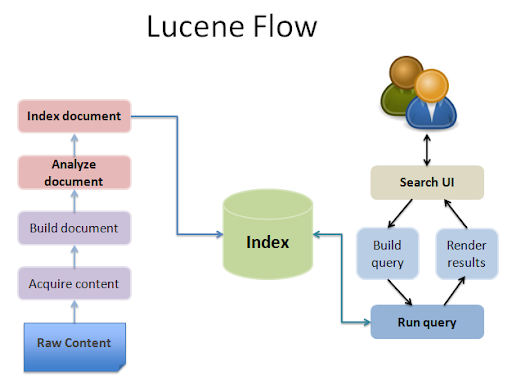
Apache Lucene is an open source and free text search engine library written in Java. It is a technology suitable for applications that requires full-text search, and is available cross-platform.
N/A
Apache Solr
Score 8.9 out of 10
N/A
Apache Solr is an open-source enterprise search server.
Applications Developer Information Technology Specialist
Chose Apache Lucene
The search and index performance of [Apache] Lucene is excellent and the quality of results is good, if not better. For implementing it with small scale applications it is a no brainer, Lucene is the best and most cost effective solution. Learning curve is not too steep either.
I have tried Elastic and Sphinx, each has their benefits but I feel like Apache Lucene overall is the best performing and easiest to setup and maintain.
We have considering AWS search and Elastic search but decide to go with Solr as we need high speed and flexible query, and so far it meets all our requirement so we still continue with Solr.
We tried to use both Elasticsearch and Swiftype with Drupal 8 but there are currently no good modules that integrate Drupal with those solutions. So Solr was really the only option for a Drupal 8 web site. It's not as easy to learn or use as Swiftype, but in the end I think it …
Before using Solr, we used a self-made search engine. Solr has helped us increase our capacity to serve our customers the results they are looking for easily without breaking down. Our previous platform was not dynamic enough to accommodate our growing traffic or smart enough …
Azure Search is not as mature as Apache Solr at this point. So the range of query flexibility is less than Solr. Also, when indexing content goes beyond 1 TB, it might become costly for Azure Search.
Between Solr and ElasticSearch, there is a constant struggle to pick the best one. ElasticSearch is part of ELK and ties in well with LogStash and Kibana which makes it great for logs and big data stuff. Add some logs and see which works best for your particular access methods …
We switched from search indexes stored in mysql to soar and it's made a world of difference for our growing businesses. The relational databases are very poor for handling the complex data searches require and Solr delivered all the tools we need to get the performance our end …
Apache Solr in general stacks up very well to its competitors, it provides much of the same features and performance and has the benefits of being an open-source project with an active contributor base that works consistently and improves the platform. Depending on your setup …
We tryed to promote Redis as cache solution for application, in order to replace Apache Solr, but it won't go well. Redis best pratices requires some more computer resources. With Elastic Search, the use case was another, and don't compete with Apache Solr.
Apache Lucene offers great full-text search library that makes it easy to add search functionality to a website or other applications. Lucene is ideal if you want low-level access to the indexes and its APIs. For general purposes, Apache Solr, the web application built atop of Lucene can be used instead. Apache Solr comes with caching, HTTP/ JSON APIs and a simple web administration console.
Very effective for end-user searching applications and for generating search results. Also very well suited to those looking for high reliability and performance. If [you're doing] fuzzy searching or if you are working on a smaller end-user application or an internal application that does not require high performance and flexible/adapting searching then it may not be necessary to use Solr.
Faceted navigation and field collapsing/grouping : filtering and quick results were what we needed for our websites. Our customers needed to have this functionalities for good and efficient results.
We tested them with our customers' registered searches (they received all new goods matching with their registered searches by emails and/or mobile push). Results were incredible by comparison with our old system (old MySQL requests).
Note : we didn't put all our data in Solr. Just what we need for searching uses. Other data stayed in our MySQL database.
Auto-suggest : our old auto-suggest wasn't performing well. With Apache Solr, our new one was worked really well ! The suggestions came quickly and suggestions were good.
We also extended auto-suggestion with geo-spatial data and it worked well.
Hit highlighting : we used this functionality and we didn't have problem and nasty surprise.
Keep all data status during data upgrading (see next details for improvements)
We had difficulty porting the project to a cluster based environment on the cloud.
For our particular use case of retrieving documents based on text pattern matching, the program worked efficiently however, we did not find many resources for image pattern recognition based on their metadata.
It takes some time to deploy and currectly maintein it. And also, to learn how to use and integrate in the enviroment as well. Once you get theses steps done, it usability is very simple, and almost of the time it don't require no further attention on it. Even for maintence, if you deploy it on a cluster mode, it is very reliable and easy to take one host down.
The search and index performance of [Apache] Lucene is excellent and the quality of results is good, if not better. For implementing it with small scale applications it is a no brainer, Lucene is the best and most cost effective solution. Learning curve is not too steep either.
We switched from search indexes stored in MySQL to soar and it's made a world of difference for our growing businesses. The relational databases are very poor for handling the complex data searches require and Solr delivered all the tools we need to get the performance our end users are demanding.
It's enabled us to deliver fast, relevant search results on our new website. The site is still in beta and being actively developed so our complete ROI is still unknown.
It integrates very well with Drupal so it has saved us from having to develop a custom solution.