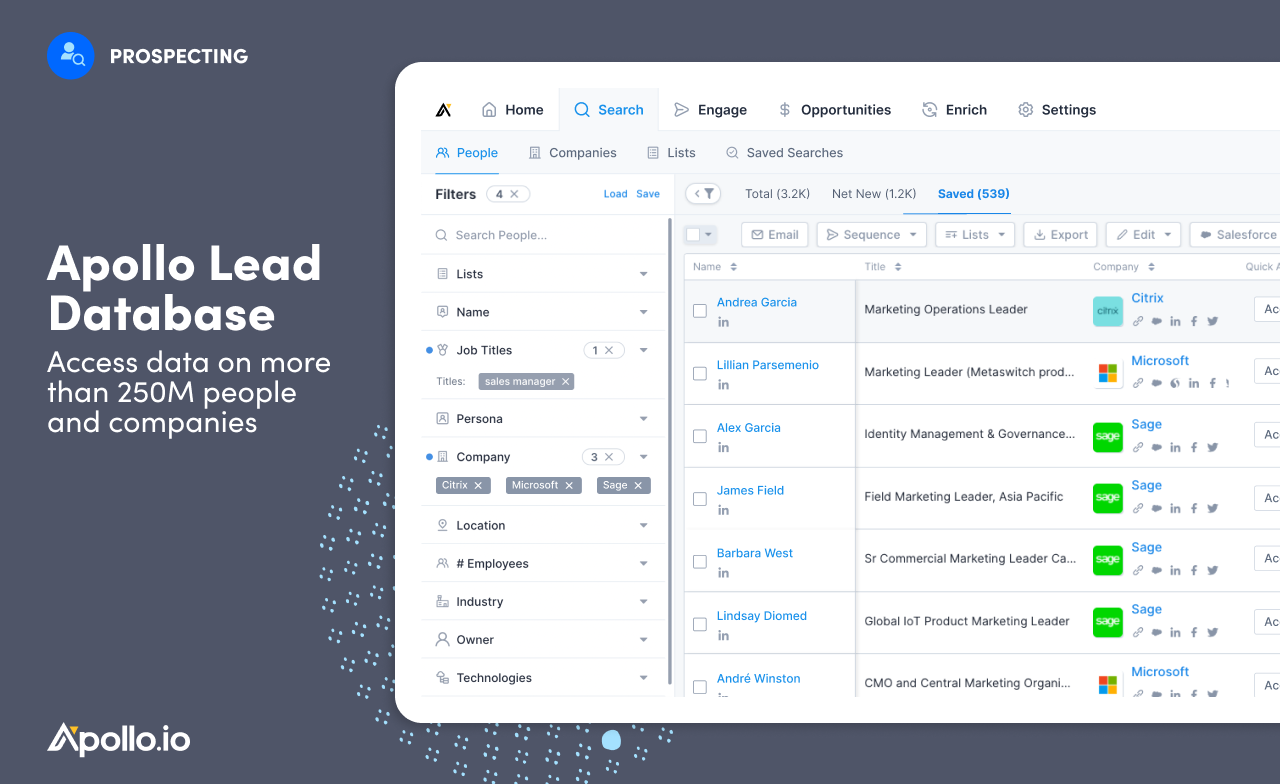
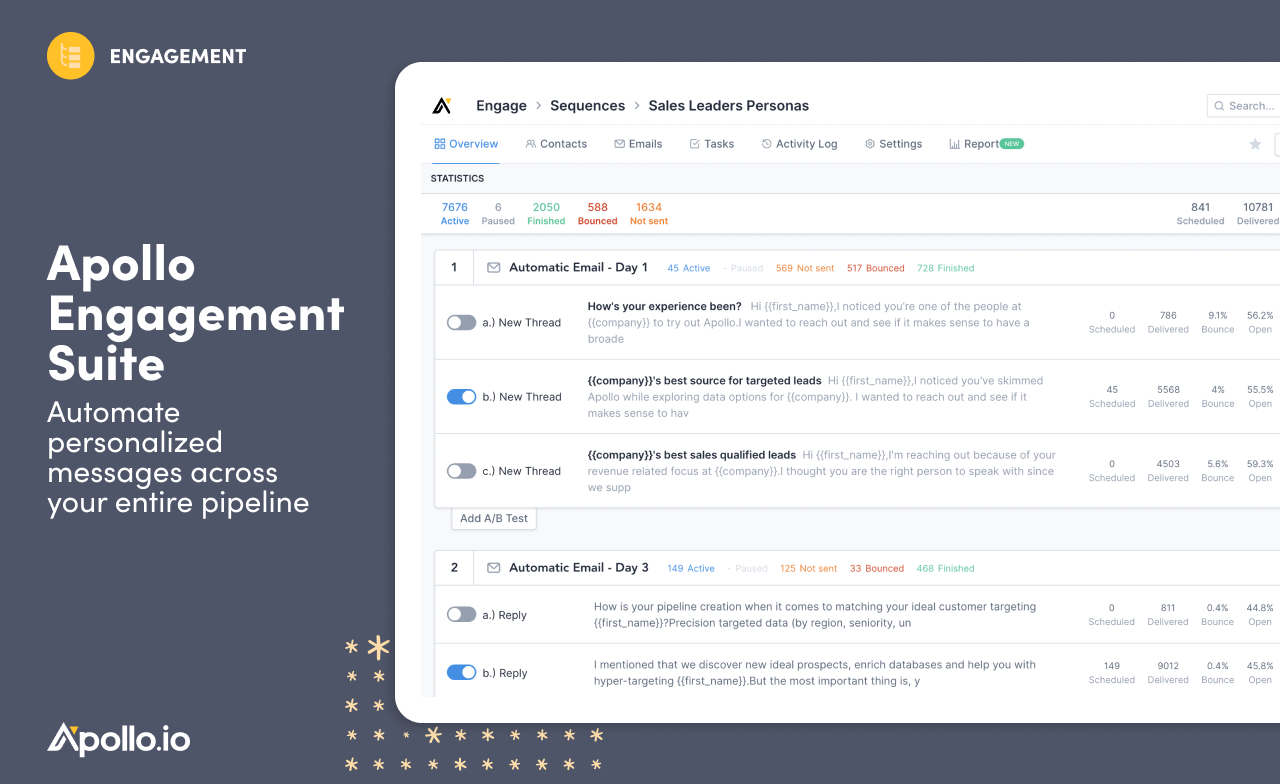
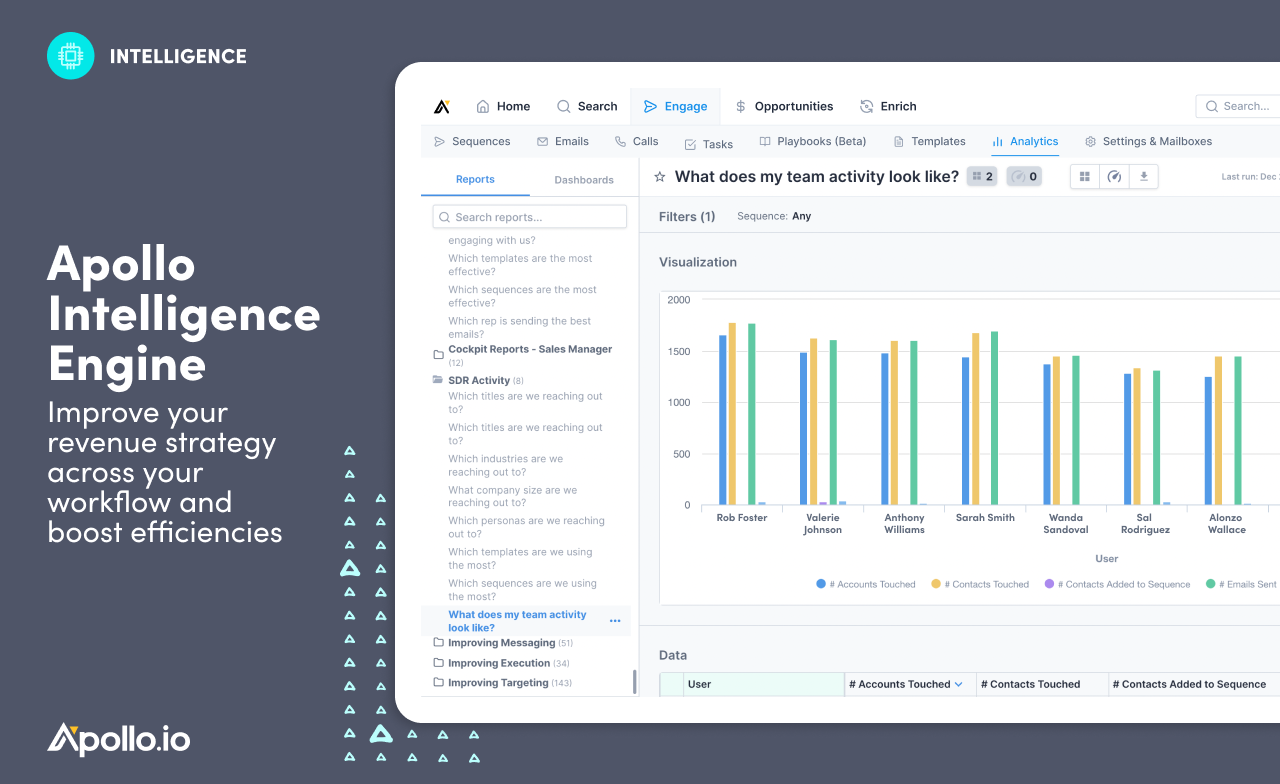
Apollo is a $1.6B AI-powered sales platform that helps revenue teams find and engage leads, automate outreach, manage deals, and enrich data. Boasting B2B database of more than 210 million contacts and 35 million companies, Apollo’s end-to-end platform helps businesses of all sizes unlock their full market potential with precision and ease.
With users among 500,000+ companies, including Autodesk, Cyera, and DocuSign, Apollo offers a go-to-market platform to…
$59
per month per user
CleverMaps
Score 8.0 out of 10
N/A
Czeck company CleverMaps (formerly CleverAnalytics) offers their eponymous location intelligence platform for market research, competitor analysis, and locating business potential.
N/A
Pricing
Apollo.io
CleverMaps
Editions & Modules
Basic
$59
per month per user
Professional
$99
per month per user
Organization
$1,188
per year per user
No answers on this topic
Offerings
Pricing Offerings
Apollo.io
CleverMaps
Free Trial
Yes
No
Free/Freemium Version
Yes
No
Premium Consulting/Integration Services
No
No
Entry-level Setup Fee
Optional
No setup fee
Additional Details
20% discount for annual billing on the Basic and Professional plans.
—
More Pricing Information
Community Pulse
Apollo.io
CleverMaps
Features
Apollo.io
CleverMaps
Prospecting
Comparison of Prospecting features of Product A and Product B
Apollo.io
7.9
Ratings
2% above category average
CleverMaps
-
Ratings
Advanced search
7.50 Ratings
00 Ratings
Identification of new leads
7.80 Ratings
00 Ratings
List quality
7.70 Ratings
00 Ratings
List upload/download
8.30 Ratings
00 Ratings
Ideal customer targeting
7.80 Ratings
00 Ratings
Load time/data access
8.30 Ratings
00 Ratings
Sales Intelligence Data Standards
Comparison of Sales Intelligence Data Standards features of Product A and Product B
Apollo.io
7.8
Ratings
0% above category average
CleverMaps
-
Ratings
Contact information
7.80 Ratings
00 Ratings
Company information
8.20 Ratings
00 Ratings
Industry information
7.50 Ratings
00 Ratings
Data Augmentation & Lead Qualification
Comparison of Data Augmentation & Lead Qualification features of Product A and Product B
Apollo.io
7.7
Ratings
4% above category average
CleverMaps
-
Ratings
Lead qualification process
7.80 Ratings
00 Ratings
Smart lists and recommendations
7.60 Ratings
00 Ratings
Salesforce integration
8.30 Ratings
00 Ratings
Company/business profiles
7.70 Ratings
00 Ratings
Alerts and reminders
7.00 Ratings
00 Ratings
Data hygiene
7.20 Ratings
00 Ratings
Automatic data refresh
7.30 Ratings
00 Ratings
Tags
7.70 Ratings
00 Ratings
Filters and segmentation
8.50 Ratings
00 Ratings
Sales Intelligence Email Features
Comparison of Sales Intelligence Email Features features of Product A and Product B
The automatic email feature is extremely helpful for quickly contacting more potential clients. It is user-friendly and easy to access all buttons, which helps you navigate the task efficiently. It could greatly help to acquire more clients for a project to be successful. I cannot see anything less appropriate for me to achieve the goal I am aiming for.
If you need to characterize the loaded data with statistical parameters, it is preferable to do the analysis previously and only load the results for the software to show them. This does not detract from the software, it is simply impossible to "have the best of everything" in a single application.
The response of the software to the requirements has been consistently fast. Only in extreme cases where the speed of the internet system present in the site where the tool is being used is extremely slow, we have recorded delays in accessing information.
The software allows the possibility of several people located in different geographic locations, simultaneously accessing the same information, without interfering with each other.
It has made it possible to detect "information gaps" that were thought to be non-existent, and that resulted in expedited decision-making, to try to fill the gap or to find alternative solutions, not initially contemplated.
It is not functional if it is intended to be used in small mobile screens, since to achieve an adequate visualization of the maps and the side panel, at least one screen the size of a tablet is needed.
There are times when you do not want to show (for reasons of confidentiality or for commercial reasons, for example) all the data that is associated and loaded in the database. So far we have not found a way to load the data in a way that ensures that "sensitive data" is displayed only when desired, and not automatically with the data set in general. The option is possible. Research is continuing on this.
Apollo.io has an amazing amount of features. It's great being able to complete so many tasks in one space but it's also overwhelming. It took me a few days to work through all of the options when searching for a company or person. After a few days it started to provide companies for me which was confusing before I understood what was happening. At first, I was also confused about what a "sequence" was so maybe some of the jargon can be confusing. I think with time I will become more comfortable once I understand all of the options offered.
The team wants to solve probelms, but we are finding that they don't know how to solve the more technical issues quickly. I suspect that they don't have a mature process for escalations, and they don't have a usable knowledge base article repository. They seems to push emails around to let us know that people are working on the issues to find solutions, but this takes weeks and oftentimes still leaves us without a resolution.
Apollo.io has all features of prospecting, outreach automation including email sequences, campaign tracking, lead scoring, and analytics in one interface which enables sales persons to manage their entire sales funnel without having any other extra tool. Another benefit is for pricing related which has been understand from our management team.
With sincerity, the company has not opted in particular for any of these applications. It has evaluated the benefits and weaknesses of the named applications and other additional ones that are not included in the previous list. As it happens with almost everything in life: there are skills and potentialities of a software that are more applicable in certain fields of work, and for certain characteristics inherent to the data that it handles. Within this same company, there are applications that are more useful for a certain type of data and information and less versatile for others.
More important is the knowledge that must have, about the data and processes involved, the person who has the responsibility of selecting a certain software.
Increased # of booked meetings from outbound email outreach.
Our sales team's productivity has improved when prospecting/doing outreach (which has a monetary value, given our salaried status). This makes us more productive, enabling us to accomplish more and reach a greater number of people in a day.
We've only recently implemented this, so we're still waiting to close, but leads are on their way to doing so.
It allowed detecting "information gaps" in places where it was not expected that this scenario could occur.
It has made it possible to quickly visualize, locations where, although information existed, this information was relatively old, or of low quality compared to that which can be obtained with the most recent technologies.
The detection of these scenarios improved the level of satisfaction that the company routinely asks of its clients, who stated that they are highly satisfied with the level of knowledge that the company has in relation to information, especially the historical records, that in our field of action is of high importance.