Appium vs. Opkey (now with pCloudy)

Overview
ProductRatingMost Used ByProduct SummaryStarting Price
Appium
Score 7.0 out of 10
N/A
N/AN/A
Opkey
Score 9.0 out of 10
N/A
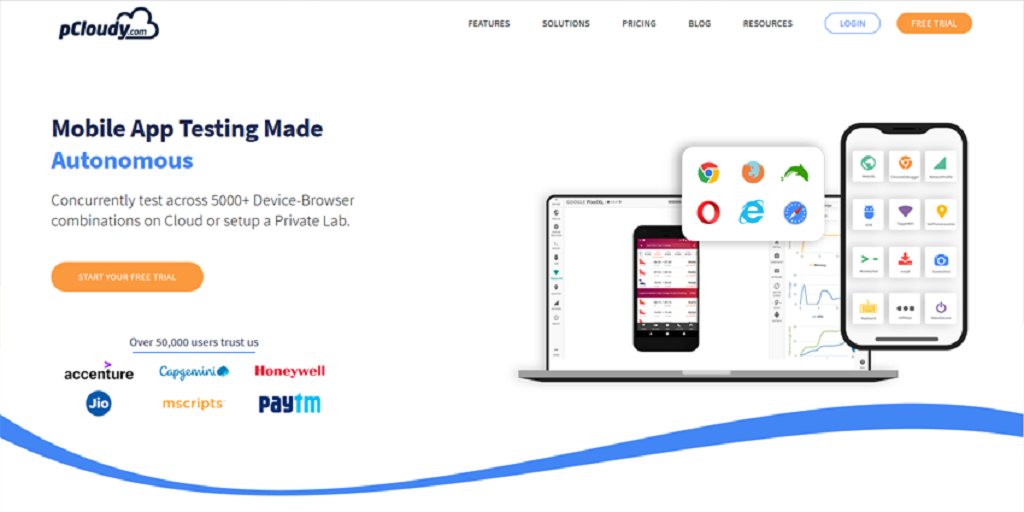
Opkey (now with pCloudy) is a mobile app testing platform for performing manual as well as automated testing on more than 5,000 device-browser combinations hosted on the cloud. It provides hosts of other services like bot testing and in-field user experience testing. Opkey provides On-Premise, Private and Public device cloud solutions, which enterprises can choose from based on their needs. With rising digital spectrum, it now offers a complete digital assurance platform where testing…N/A
Pricing
AppiumOpkey (now with pCloudy)
Editions & Modules
No answers on this topic
Offerings
Pricing Offerings
AppiumOpkey
Free Trial
NoYes
Free/Freemium Version
NoNo
Premium Consulting/Integration Services
NoNo
Entry-level Setup FeeNo setup feeOptional
Additional Details
More Pricing Information
Community Pulse
AppiumOpkey (now with pCloudy)
Considered Both Products
Appium
Chose Appium
Most of mobile testing tools which are available in the market are paid license tools. But Appium is Open source mobile testing tool. We can create customised automation framework using Appium. It also supports various languages such as Java, Javascript etc. And also supports …
Chose Appium
The main reason we selected Appium is that we had people experienced in WebDriver API and some framework solutions in place, so given our setup, it provided a faster and cheaper kick-off. Another reason we selected Appium was that SauceLabs had pretty good support for Appium …
Chose Appium
Appium is a wrapper of selenium and is available for mobile based applications. It has also the similar features as selenium has for website automation. Together both provide a combined solution for automating web and mobile apps. Can provide end to end automation with a …
Chose Appium
Appium is comparable with Calabash because it's the only cross-platform tool like appium. Espresso is only to automate Android tests and XCTest is only for iOS. We selected Appium because it solves a lot of automation situations and gestures of the mobile apps. We've used …
Chose Appium
If you're an Apple developer, you use Xcode. It's practically a forced necessity. For system testing though, it doesn't have to be. You can have your development team focus on unit and integration tests in their platform and another team automate acceptance tests with a …
Chose Appium
Hard to compare Appium to Xcode and Android sdk because Appium uses them, but those are the only comparisons I could come up with to compare Appium with another product. I'm sure there may be other mobile automation tools, but none are as mainstream as Appium or with the …
Chose Appium
I have not used any other product that compares to Appium in the realm of mobile automated testing.
Chose Appium
Appium is one of the most valuable fully featured open-source tools with good support for iOS and Android mobile automation which cannot be matched even by enterprise tools.
Opkey
Chose Opkey
pCloudy is a niche player in mobile test automation area and provides a wide variety of devices over cloud. They have a pretty good support system which compliments the platform even better.

Best Alternatives
AppiumOpkey (now with pCloudy)
Small Businesses
Swiftify
Swiftify
Score 9.0 out of 10
BrowserStack
BrowserStack
Score 8.6 out of 10
Medium-sized Companies
Swiftify
Swiftify
Score 9.0 out of 10
ReadyAPI
ReadyAPI
Score 7.0 out of 10
Enterprises
Swiftify
Swiftify
Score 9.0 out of 10
ignio AIOps
ignio AIOps
Score 8.1 out of 10
All AlternativesView all alternativesView all alternatives
User Ratings
AppiumOpkey (now with pCloudy)
Likelihood to Recommend
9.0
(0 ratings)
9.0
(0 ratings)
Usability
-
(0 ratings)
9.0
(0 ratings)
Support Rating
-
(0 ratings)
9.0
(0 ratings)
User Testimonials
AppiumOpkey (now with pCloudy)
Likelihood to Recommend
Appium works well for well-structured mobile applications test automation that is particularly easy to leverage when different pages of the app use similar building blocks. If it takes time for some content in the app to be rendered, ask your dev team to add progress indicators and ensure they are accessible. That might be more complicated to do with Appium, though, if there's no good contact with Dev team established so you can request accessibility IDs added quickly enough when needed. Appium supports another locator strategies as well though (such as xPath or iOS class chain on iOS) but they wouldn't work as fast so you may get really slow tests.
Read full review
pCloudy is a niche player in mobile qa automation space with extremely good support system.
Read full review
Pros
  • Crossdevice: With Appium you can automate tests for Android and iOS both. There is no need to learn more than 1 language.
  • Easy: It's really easy to configure and use appium; it's very useful when you're testing strategy is based on "developers write tests".
  • Open Source: It's such a nice strength of appium, because you don't need to pay to use a good tool like Appium is.
Read full review
  • Physical devices over cloud.
  • Very good support system.
  • Good integration with open source tool set.
Read full review
Cons
  • There are a number of expected methods that are not implemented, yet. With a similar sounding name as Selenium with similar functions, people who are familiar with Selenium try to use methods that appear to be available, but give a "not yet implemented" exception when run.
  • Documentation can be confusing.
  • Setup was a difficult process. This may not necessarily be the case once you figure everything out, but the whole figuring it out process was difficult and I ran into many, many problems when I first started.
Read full review
  • Platform slowness
  • Additional capabilities wrt automation
Read full review
Likelihood to Renew
I am rating 10/10 because Appium can use with multiple programming languages with multiple Test engines. Also, it works for both Android and iOS.
Read full review
No answers on this topic
Usability
I would like to give 9/10 rating to Appium because of it can easily integrate with popular frameworks and CI/CD tools, as well as it is reliable, flexible and easy to use. The setup can bit complex in initial step, but once on configured it's very easy to use and enables stable and scalable mobile automation for real and cloud devices.
Read full review
Extremely good UI and the learning curve is very [small].
Read full review
Support Rating
No answers on this topic
Extremely good support system and I have a personal experience wherein we needed support and they provided a dedicated person to resolve the issues.
Read full review
Alternatives Considered
Most of mobile testing tools which are available in the market are paid license tools. But Appium is Open source mobile testing tool. We can create customised automation framework using Appium. It also supports various languages such as Java, Javascript etc. And also supports various operating systems such as Android, IOS etc. We can easily integrate Appium frameworks with CI/CD [Jenkins, Git etc].
Read full review
pCloudy is a niche player in mobile test automation area and provides a wide variety of devices over cloud. They have a pretty good support system which compliments the platform even better.
Read full review
Return on Investment
  • For cost of ownership, the increase is positive times infinity, as it's free to install and use
  • Lead time for suite development can be a negative, if not planned for during sprint planning
  • Using Appium to execute tests in parallel across a cloud solution can improve CI/CD cycles by 100's of a percent
Read full review
  • Saved a lot of investment in procuring physical devices.
  • Since the setup is over cloud, we did not procure devices in multiple locations.
Read full review
ScreenShots

Opkey Screenshots

Screenshot of pCloudy