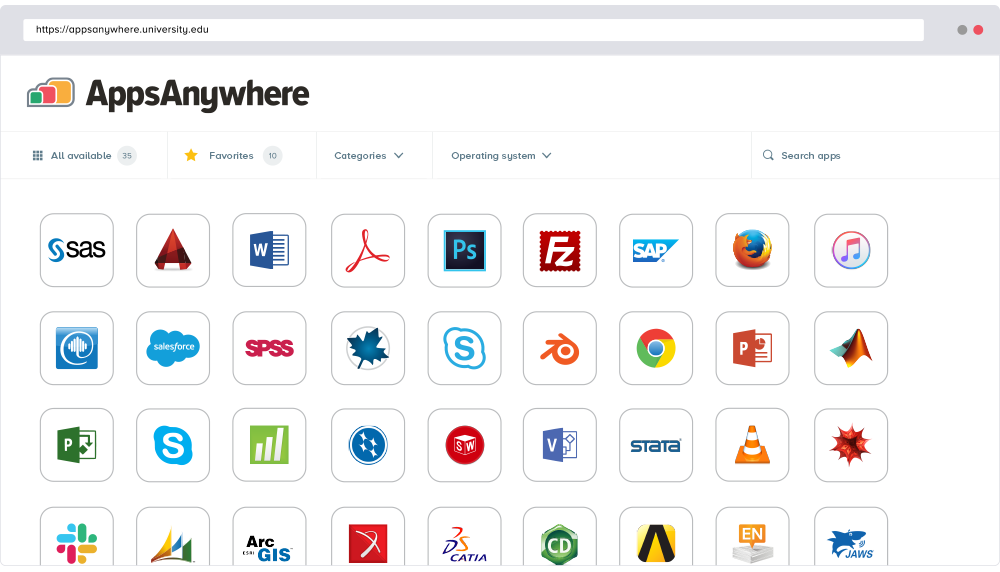
AppsAnywhere
is a software delivery platform that gives students and staff access to
the software they need to get their work done wherever they are, both on and
off campus.
Boasting more than 2 million students at over 200 universities
and colleges worldwide, the vendor states AppsAnywhere improves student outcomes by making
software available on any device, including BYOD, thanks to their unique approach
to virtualization. Used by higher ed
institutions, including University…
N/A
Azure Virtual Desktop
Score 7.9 out of 10
N/A
Azure Virtual Desktops are a comprehensive desktop and app virtualization service running in the cloud.
N/A
Pricing
AppsAnywhere
Azure Virtual Desktop
Editions & Modules
No answers on this topic
No answers on this topic
Offerings
Pricing Offerings
AppsAnywhere
Azure Virtual Desktop
Free Trial
Yes
Yes
Free/Freemium Version
No
No
Premium Consulting/Integration Services
No
No
Entry-level Setup Fee
Required
No setup fee
Additional Details
—
—
More Pricing Information
Community Pulse
AppsAnywhere
Azure Virtual Desktop
Features
AppsAnywhere
Azure Virtual Desktop
Application Virtualization
Comparison of Application Virtualization features of Product A and Product B
AppsAnywhere is basically suitable for its purpose, despite some usability problems. In our place, applications can in principle be delivered to other machines (not owned by us but by the end-user), who are not even on-site - provided the user can connect to our domain, almost any kind of device is ok. However, I have not tried that myself. The UI could let people work faster, but only by a little, and most people get there in the end. It is basically quite simple to use and appealing to look at
You can publish as many host pools as you need to accommodate your diverse workloads
Brings your own image for production workloads or test from the Azure Gallery
Reduces costs with pooled, multi-session resources.
With the new Windows 10 Enterprise multi-session capability exclusive to Windows Virtual Desktop and Remote Desktop Session Host (RDSH) role on Windows Server, you can greatly reduce the number of virtual machines and operating system (OS) overhead while still providing the same resources to your users.
Almost everyone you tell to use it to access a specialist application can find the software they need and install it. However, surprisingly many have difficulties finding AppsAnywhere under the start menu or on the task bar - it is not a icon or name they recognise, and they really want to lunch the target specialist software (Zbrush or whatever). Once you find it, many people ignore the search function which is probably the fastest method, and browse the long list alphabetically, because the standard filters do not help much. Favouriting is rarely used as it is too burdensome and not an issue for users when they are looking for the applicationt hey need.
I recently had the opportunity to compare AppsAnywhere with Oracle VM, Amazon Workspaces, and Kasm Workspaces. I found that AppsAnywhere was the most intuitive and easiest to use out of the four, and it also had the best customer support. Its powerful cloud-based technology made it easy to access applications from any device without having to worry about compatibility issues. The user experience was also great and I found that I could easily customize my workspace according to my needs.
For us Parallels RAS is still more a "onpremise" solution, with Azure Virtual Desktop we can really leverage the power of the cloud. We can spin up additional hosts if the load is too high and spin down hosts in the night to cut costs. Not being bound to onpremise hardware makes this extremely flexible. Seeing as most of our customers already have a M365 license that includes Azure Virtual Desktop licensing it doesn't cost us additional CAL's for Parallels RAS