AppsAnywhere
is a software delivery platform that gives students and staff access to
the software they need to get their work done wherever they are, both on and
off campus.
Boasting more than 2 million students at over 200 universities
and colleges worldwide, the vendor states AppsAnywhere improves student outcomes by making
software available on any device, including BYOD, thanks to their unique approach
to virtualization. Used by higher ed
institutions, including University…
N/A
Microsoft System Center
Score 9.0 out of 10
N/A
Microsoft System Center Suite is a family of IT management software for network monitoring, updating and patching, endpoint protection with anti-malware, data protection and backup, ITIL- structured IT service management, remote administration and more.
It is available in two editions: standard and datacenter. Datacenter provides unlimited virtualization for high density private clouds, while standard is for lightly or non-virtualized private cloud workloads.
I recently had the opportunity to compare AppsAnywhere with Oracle VM, Amazon Workspaces, and Kasm Workspaces. I found that AppsAnywhere was the most intuitive and easiest to use out of the four, and it also had the best customer support. Its powerful cloud-based technology …
The AppsAnywhere team is very quick in setting up things and also having everything in a single place. The bundle of the apps can be easily configured as the documentation is also very straightforward while setting up things and also having the team to work accordingly …
the only other way of providing students access to specialised software wherever they are that I've used myself is probably VMware Horizon, where students log in to a machine in the cloud that is pre-configured to run the software they need, and they run it there. This is much …
Both AppsAnywhere and Amazon WorkSpaces are software that allows users to have access to their files and applications from basically and device, such as Mac and Windows, tablets, etc. Both AppsAnywhere and Amazon WorkSpaces make remote work accessible for users in easy to …
AppsAnywhere is more reliable and easy to used, it's value for money. I find a good review about this software online, good match for my organization and businesses. AppsAnywhere is the first choice for my organization and we are happy with the AppsAnywhere support team and …
None. We are a Microsoft business, and this is THE tool for imaging, packaging, remote support, and antivirus management. Microsoft's tool is the best for managing its software, systems, and antivirus clients. I will say that Microsoft Intune, the cloud platform, can be used …
The versatility of the suite of application provided by the Microsoft experience center was way above the other competitors , it helped gained leverage over the other products in the market . That why we made the decision of choosing Microsoft system center as a infrastructure …
We use Azure, we have lisences, so we have no needs any other cost. And also, we want to save backup data in Azure. Veritas ask additional cost reagurally and have to rebuild bakcup environment.
Because Datadog was too small, we decided quickly to use Microsoft System Center. We use a lot of other Microsoft products so that discussion was quickly set internally.
We have used Ghost from Symantec (licensed), FOG and Clonezilla which are freeware products. All three products had their pros and cons. The two freeware products were functional but did lack some polish, and Ghost was a good product for imaging of desktop computers. All did …
We previously used a mix of FOG and Clonezilla to image machines. The biggest issues with these products is that changing one piece of the image required you to rebuild the entire image itself. These pieces of software also did not allow you to manage applications and Windows …
We are using Microsoft products for a long time, so the overall confidence played a part in the decision, the feature set and licensing cost was also very high when compared with above products, so we decided to use System Center for our environment, so far it has solved many …
Microsoft System Center has more options. Microsoft System Center has the ability to image PCs as well as remotely connect to PCs, and software installation and patching where Symantec Ghost Solution Suite didn't handle all of these options as well. We haven't looked at many …
Much better UI for system center. Also, Tivoli was discontinued, so it was an easy decision. Altiris was acquired by Symantec but was unreliable and painful. It's UI was unresponsive and generally outdated. It wouldn't clean up old packages and would hog GB of disk space, …
I would say Microsoft System Center and Oracle were about the same. Oracle seemed to be a little more user-friendly, but for the most part, they are both comparable.
I have used ZENworks, Altiris, and Landesk. They are all good products in their own right and have many strengths. The pricing, bundling SCCM with our Microsoft site license, really helps create an ROI that puts SCCM over the top. Pricing aside it is a tool designed by …
I have not chosen this software directly because I found myself in an environment that already used this product, a purely Microsoft environment. Therefore the choice that has been made has proved very effective and above all suited to our needs, and for this reason, no …
It's better than others because Microsoft knows its own OS better than anyone. It has a very rich feature set and allows companies to hit many areas of need with one tool. You can have IT staff get multiple tasks done just by logging in and they don't even have to leave their …
We built our POC of the private cloud with vRealize Suite and Microsoft System Center. We are VMware shop so we thought the vrealize will be solution for us but we found pretty fast the vrealize suite is very limited and very expensive compare to Microsoft. With System Center …
AppsAnywhere is basically suitable for its purpose, despite some usability problems. In our place, applications can in principle be delivered to other machines (not owned by us but by the end-user), who are not even on-site - provided the user can connect to our domain, almost any kind of device is ok. However, I have not tried that myself. The UI could let people work faster, but only by a little, and most people get there in the end. It is basically quite simple to use and appealing to look at
We used a product before that was designed to prevent users making changes and saving files to the desktop computer. This required a renewal of the license. By using SCCM in our environment we were able to discontinue using that product because SCCM allows us to completely restore a machine back to the original configuration. We have taught our users to save their individual work on either a network drive or a cloud drive. By doing this, if we do a re-image of their machine they have lost no data, and it makes for a faster resolution. In some instances having a computer in our SCCM environment it can become cumbersome when creating new users for very specific purposes. It can be done by creating new organizational units and applying new policies but when in a pinch it can be frustrating. For the most part we have tried to make "new" purpose images and groups to at least accommodate a quick install.
Provides our users the ability to deploy and manage our own datacenter based on defined software with understandable solutions for storage, compute, networking and security.
We are able to update at once all the computers from all departments without having to install the OS on every computer.
It allows us to have everything in one place for database management and datacenter inspection as well.
Needs web based storefront for requesting new software
Needs ability to manage the packaging work flow better
Sometimes is slow to download and there is no indication the entire catalog is being loaded, resulting in confused users not being able to find common software in the available list.
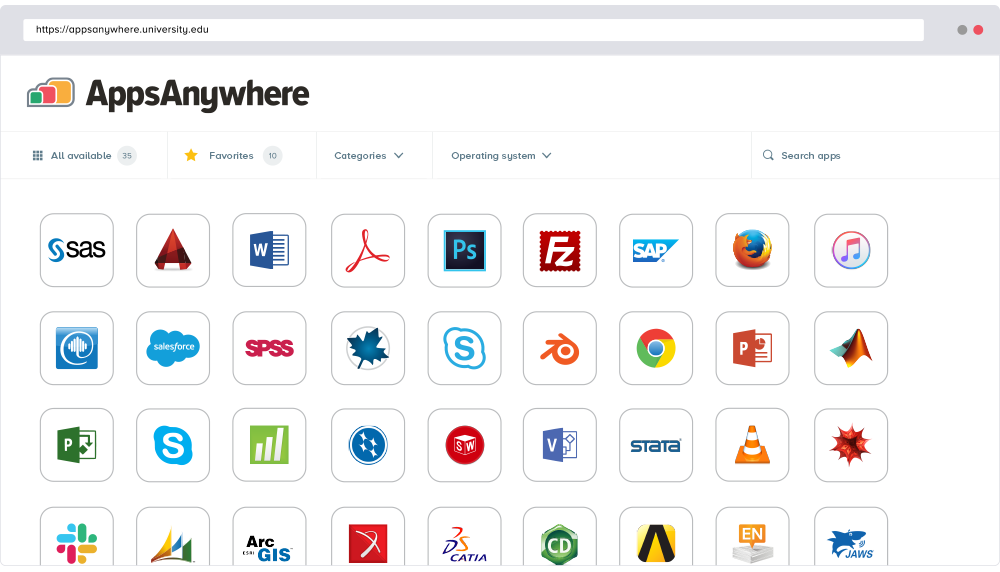
Almost everyone you tell to use it to access a specialist application can find the software they need and install it. However, surprisingly many have difficulties finding AppsAnywhere under the start menu or on the task bar - it is not a icon or name they recognise, and they really want to lunch the target specialist software (Zbrush or whatever). Once you find it, many people ignore the search function which is probably the fastest method, and browse the long list alphabetically, because the standard filters do not help much. Favouriting is rarely used as it is too burdensome and not an issue for users when they are looking for the applicationt hey need.
No matter our issues with the software, its ability to centrally manage systems, patch, image, and remote help users has far exceeded our timeliness to help staff. Its ability to keep current, enable us to keep the network secure, and standardize our end-user experience has saved us many hours, dollars, and time every day.
If I had to dislike something about the system it would be how much it changes once you upgrade. This could be more of a problem of mine since I get used to one way and don't like it when it changes so much. I am enjoying the newest update, but it is a mess when you are actually going through the upgrades.
I recently had the opportunity to compare AppsAnywhere with Oracle VM, Amazon Workspaces, and Kasm Workspaces. I found that AppsAnywhere was the most intuitive and easiest to use out of the four, and it also had the best customer support. Its powerful cloud-based technology made it easy to access applications from any device without having to worry about compatibility issues. The user experience was also great and I found that I could easily customize my workspace according to my needs.
None. We are a Microsoft business, and this is THE tool for imaging, packaging, remote support, and antivirus management. Microsoft's tool is the best for managing its software, systems, and antivirus clients. I will say that Microsoft Intune, the cloud platform, can be used for those with heavy 365 usage, but for us, that does not meet our current company needs.
We have been able to automate our patch management, firmware and other security concerns.
We have a standardized "image" ensuring our setup is consistent across the enterprise. This alone has saved us in time to support and time to understand how to use our desktops.