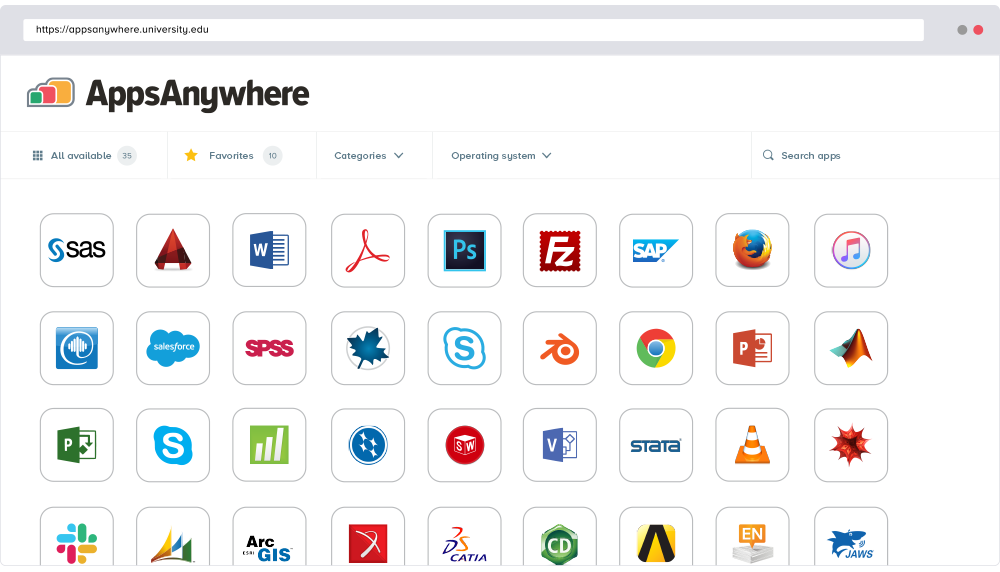
AppsAnywhere
is a software delivery platform that gives students and staff access to
the software they need to get their work done wherever they are, both on and
off campus.
Boasting more than 2 million students at over 200 universities
and colleges worldwide, the vendor states AppsAnywhere improves student outcomes by making
software available on any device, including BYOD, thanks to their unique approach
to virtualization. Used by higher ed
institutions, including University…
N/A
Nutanix AHV
Score 9.0 out of 10
N/A
Nutanix AHV is presented as a modern and secure virtualization platform that powers VMs and containers for applications and cloud-native workloads on-premises and in public clouds. Its tools and automated workflows simplify the day-to-day administration of VMs and containers.
I recently had the opportunity to compare AppsAnywhere with Oracle VM, Amazon Workspaces, and Kasm Workspaces. I found that AppsAnywhere was the most intuitive and easiest to use out of the four, and it also had the best customer support. Its powerful cloud-based technology …
The AppsAnywhere team is very quick in setting up things and also having everything in a single place. The bundle of the apps can be easily configured as the documentation is also very straightforward while setting up things and also having the team to work accordingly …
the only other way of providing students access to specialised software wherever they are that I've used myself is probably VMware Horizon, where students log in to a machine in the cloud that is pre-configured to run the software they need, and they run it there. This is much …
Both AppsAnywhere and Amazon WorkSpaces are software that allows users to have access to their files and applications from basically and device, such as Mac and Windows, tablets, etc. Both AppsAnywhere and Amazon WorkSpaces make remote work accessible for users in easy to …
AppsAnywhere is more reliable and easy to used, it's value for money. I find a good review about this software online, good match for my organization and businesses. AppsAnywhere is the first choice for my organization and we are happy with the AppsAnywhere support team and …
50/50, not much in it, to be honest. Nutanix AOS wins on the support, training, and certification ease but Dell / EMC has the name and integration support with its other products (e.g., Nutanix not supporting Networkers hot add mode).
By far, in my opinion, Nutanix AOS is heads above VMware. From the creation of a VM to updating the nodes themselves, Nutanix AOS is so much easier, faster, and just an overall better product. I would choose Nutanix AOS over VMware any day.
VMware ESXi has been around much longer and because of this is much more fully featured. However, on the flip side, it then makes Nutanix AOS much less complicated to operate. Nutanix AOS online support (and knowledge base articles) are very well written and comprehensive. …
Nutanix [AOS] is a hyper-converged solution, and in the vSphere it was originally designed for the use of SAN, although they also have a hyper-converged solution. But the architecture and load testing showed the inconsistency of the hyper-converged solution from VMware.
As mentioned before I feel that Nutanix meets or exceeds the capabilities of the competition, where that is in ease of use, how well they support their platform, upgrading software, migrating VM's from another hypervisor to Nutanix or simply moving VM's between one Nutanix …
There are other clustering solutions, to be sure. And there are significantly less expensive solutions for preventing downtime, such as Hyper-V replication, which is what I was using before Nutanix. But Nutanix is in the upper-right of the Gartner magic quadrant for …
We looked at both Simplivity and Cisco Hyperflex. Both are pretty good in their own right. Simplivity was very 'efficient' in the way they handled data, but we didn't like the idea of a propitiatory hardware card. Cisco's Hyperflex was our second choice, but we were so …
AppsAnywhere is basically suitable for its purpose, despite some usability problems. In our place, applications can in principle be delivered to other machines (not owned by us but by the end-user), who are not even on-site - provided the user can connect to our domain, almost any kind of device is ok. However, I have not tried that myself. The UI could let people work faster, but only by a little, and most people get there in the end. It is basically quite simple to use and appealing to look at
[Nutanix AOS] is good when you need easy scaling and high reliability. The good architecture of the solution allows to solve the tasks set for the platform. This solution allows to reduce the number of personnel serving the infrastructure due to the ease of management and a good knowledge base. As a disadvantage, I would attribute the complexity of customizing some types of loads to optimal work on DFS, for example, high-load databases.
Management of VMs on AHV take some getting used to. It's just a list of VMs that are displayed, and you search through it. Not the normal folder structure that I'm used to in VMware.
Also can't disable a NIC card in a VM in AHV. Very handy feature present in VMware.
Larger workloads may have to be tweaked to get the performance you need/want.
We made a huge financial investment with this platform (four clusters, all-flash storage array), so we're in it for the long haul. Luckily it's a beast. I've had to use support more than any other platform I've administered, but the help has been very good. Nutanix continues to add features and innovations which increase the ROI
Almost everyone you tell to use it to access a specialist application can find the software they need and install it. However, surprisingly many have difficulties finding AppsAnywhere under the start menu or on the task bar - it is not a icon or name they recognise, and they really want to lunch the target specialist software (Zbrush or whatever). Once you find it, many people ignore the search function which is probably the fastest method, and browse the long list alphabetically, because the standard filters do not help much. Favouriting is rarely used as it is too burdensome and not an issue for users when they are looking for the applicationt hey need.
Nutanix Prism Element and Prism Central are easy-to-use HTML5-based web consoles. The layout makes sense; you're only a few clicks away from getting to where you need to be. The AHV hypervisor is integrated into the platform for a fast and seamless experience. Rich data on VM metrics is also available.
The performance is very impressive. I am used to VMware and the snapshots were taking 10 minutes. The first time I had to restore from a snapshot on Nutanix it took 5 seconds and I couldn't believe it. Everything done on the server is fast. Powering on VM is done in seconds compared.to what we were using before.
Our first support ticket to Nutanix was responded to within 10 minutes of submission. That was kind of impressive. They have worldwide support so that when a support request is created, support is acknowledged in a relative short amount of time.
I recently had the opportunity to compare AppsAnywhere with Oracle VM, Amazon Workspaces, and Kasm Workspaces. I found that AppsAnywhere was the most intuitive and easiest to use out of the four, and it also had the best customer support. Its powerful cloud-based technology made it easy to access applications from any device without having to worry about compatibility issues. The user experience was also great and I found that I could easily customize my workspace according to my needs.
By far, in my opinion, Nutanix AOS is heads above VMware. From the creation of a VM to updating the nodes themselves, Nutanix AOS is so much easier, faster, and just an overall better product. I would choose Nutanix AOS over VMware any day.