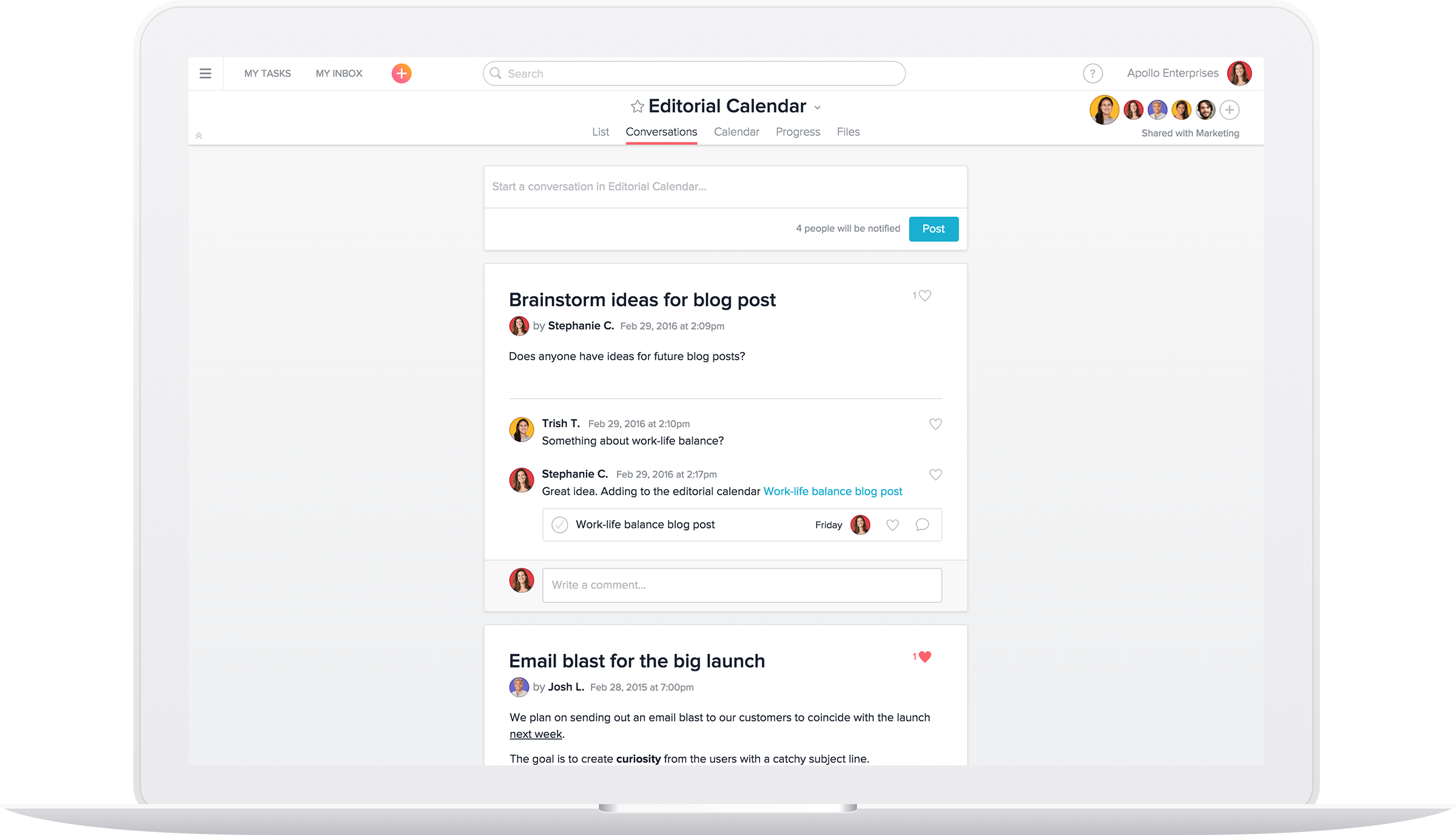
Asana is a web and mobile project management app. With tasks, projects, conversations, and dashboards, Asana lets an entire team know who's doing what by when, enabling workload balancing. Users can also add integrations for GANTT charts, time tracking and more.
$13.49
per month per user
Contractor Foreman
Score 6.9 out of 10
N/A
Contractor Foreman is an online construction management software for contractors and boasts users among contractors in more than 75 countries.
$588
per year
Pricing
Asana
Contractor Foreman
Editions & Modules
Starter
$13.49
per month per user
Advanced
$30.49
per month per user
Enterprise
Contact Sales
Personal
Free
Basic
$588
per year
Standard
$948
per year
Plus
$1,497
per year
Pro
$1,990
per year
Unlimited
$2,988
per year
Offerings
Pricing Offerings
Asana
Contractor Foreman
Free Trial
Yes
Yes
Free/Freemium Version
Yes
No
Premium Consulting/Integration Services
No
No
Entry-level Setup Fee
Optional
No setup fee
Additional Details
A discount is offered for annual billing.
Plans are based on features and licenses needed. Plus, Pro, and Unlimited plans include a 100-day money back guarantee.
Contractor Foreman’s pricing is much more cost-effective for small to mid-sized construction businesses, making it a better fit for my company’s budget. It offers an intuitive interface with pre-built construction templates, minimizing setup time and making it easier at least …
The usability of Asana is broad since it's available in a variety of platforms that are widely used nowadays. I think that it would be great for people who are constantly on the move and switching devices, since it has allowed me to work from my phone, too. I also think that Asana has proven itself to handle a large quantity of work
Contractor Foreman has been a great tool for managing a variety of projects, from home remodels to large-scale builds. It works especially well for keeping everything organized in one place, whether it’s estimates, schedules, or job costs. One scenario where it’s been really useful is in managing multiple jobs at once. With several remodels and new construction projects happening at the same time, having a centralized system to track progress, store documents, and communicate with subcontractors has helped keep everything on schedule. It’s also great for estimating—being able to quickly generate and send professional proposals has made bidding much more efficient. It’s especially well-suited for projects that require a lot of moving parts, like tracking permits and compliance documents. For larger jobs, like school construction, it helps ensure that all approvals, budgets, and schedules stay on track without getting lost in a mess of paperwork. Where it’s less ideal is for smaller, one-off jobs where a full project management system might be overkill. If it’s just a quick repair or a simple remodel, sometimes it’s easier to just handle things manually. The mobile app could also be a bit more intuitive for on-site use, especially for field updates and quick changes. Overall, it’s a strong tool for contractors managing multiple projects, budgets, and teams. It keeps things organized and saves time, especially on jobs that require detailed tracking and coordination.
I just can't see us getting it off of Asana any time soon, despite the many headaches it has caused us. We have too much data in there, too much time & training invested into it, too much at stake to move. If we were just starting out today, fresh, I don't know for certain that I would absolutely go the same direction, but I *think* I still would. I just haven't seen anything better yet. Maybe if Podio's support staff hadn't treated me like a worthless nuisance to them, I might feel differently, but the fact is that their task management is simply inferior to Asana's. That can't be denied, and in fact Podio said it themselves: "Tasks are a simple function. They cannot be customized. Tasks in Podio can be used for quick to-do's for you and your team members." In our operation, however, prompt task completion is a big deal; one task can't be completed until another one is done first, and closing the gaps between those tasks is critical in meeting deadlines and servicing our customers. Asana gets us there, the others don't.
It is very user-friendly. Takes a new employee an hour to start figuring out how the system works. That's an important factor. You don't want to encounter the issue where employees need a week to understand how the system works. For example, JIRA, I tried using it for a week and I still don't understand the complicated layout. Asana has a simple interface. Once you see it, you get it type of program.
Mostly great, especially for the price. The features appear to have definitely been designed by a team with a depth of construction specific experience. I also highly rate the usability because of the vast vast amount of customizability inherent in the system. It appears that almost all forms and features are customabizable on the company level and even specific to different individual users.
Many times we had issues that turned out to be errors and bugs. At first, we would be told forcefully that there were no bugs, then we would document them, and we would get an acknowledgement but no apology for essentially either gaslighting us or being ignorant of their system
I haven't had to use their support so I can't rate it. The fact that I haven't needed them reflects the ease of use of the product. I would recommend that any new users schedule a complete demo of the product to ensure that they are using it to it's fullest (there's a lot of useful features).
Absolutely top notch! They were always there to help and immediately. Very happy with the communication they provided and the knowledge they had of their product. I would venture to say that they are one of the best in terms of support in their space.
Asana is a top-tier project management software that helps us organize and track projects from start to finish. It allows us to apply tasks/to-dos to multiple projects without duplication, divide complex projects into smaller tasks, and track project progress. It also helps us organize work on Kanban boards or linear lists. It stands out from the crowd in a big way compared to the competition.
I used Projul and Buildium when I was primarily managing rental properties rather than full home builds. Projul was great for estimating and invoicing, while Buildium served its purpose well at the time. Now, as a small construction company, Contractor Foreman provides everything we need in one platform, making project management much more efficient.
Cost Savings. Integration with QuickBooks and Bills improved financial control. 0-15% cost savings per project.
Time Savings: Streamlined project management led to a 20-30% reduction in administrative time, boosting on-site productivity, and with project tracking a 15-20% reduction in project delays.
Enhanced Collaboration: Centralized documentation and real-time updates improved team communication, increasing collaboration by 5-10%.
Overall, CF has provided a 10-15% return on investment annually through increased efficiency and cost control.