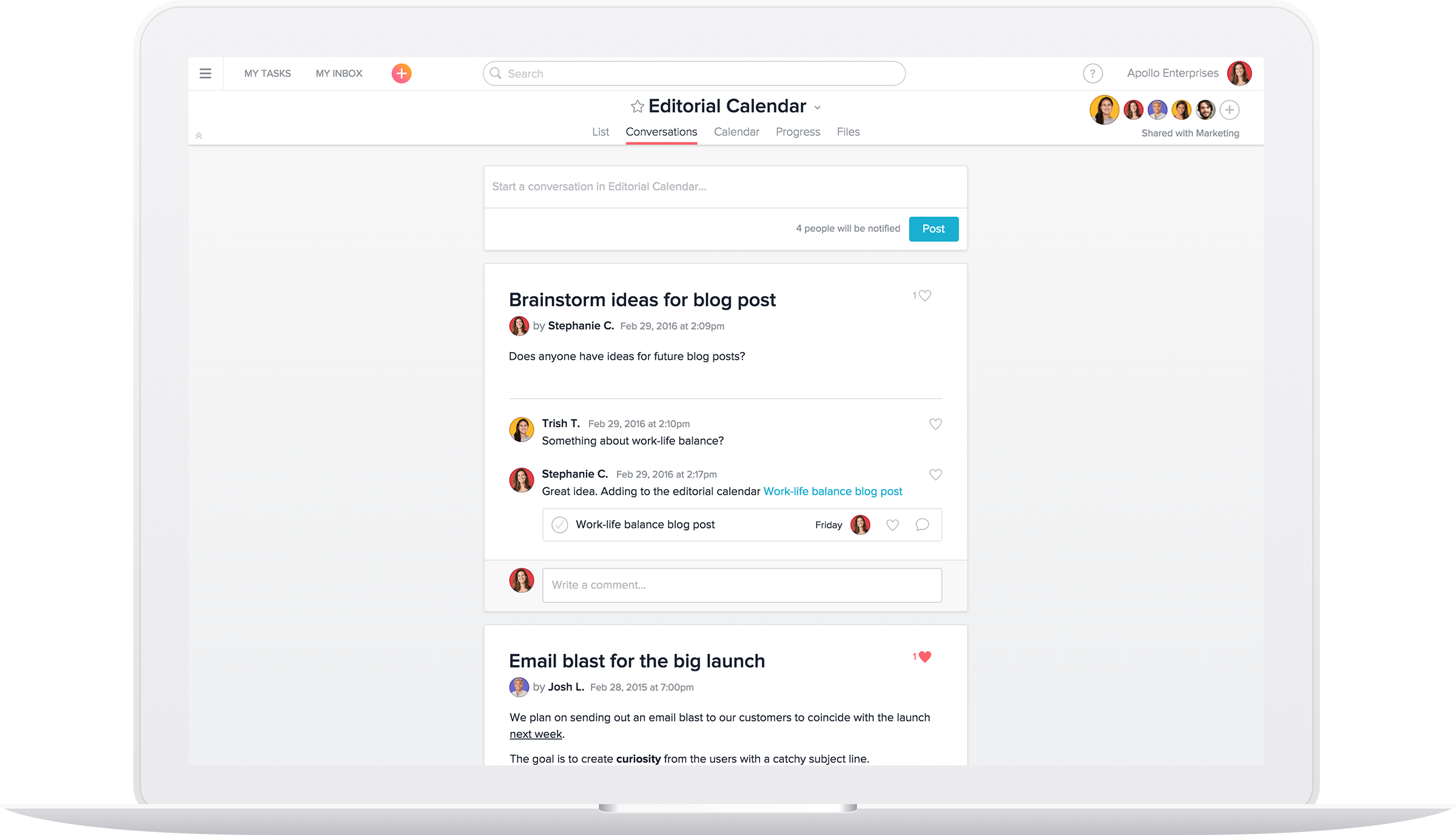
Asana is a web and mobile project management app. With tasks, projects, conversations, and dashboards, Asana lets an entire team know who's doing what by when, enabling workload balancing. Users can also add integrations for GANTT charts, time tracking and more.
$13.49
per month per user
Quip
Score 9.5 out of 10
N/A
Quip is a collaboration tool, from Salesforce, that helps sales teams accelerate business in real-time with embedded documents, live Salesforce data, and other built-in collaboration features.
$25
per user per month
Pricing
Asana
Quip
Editions & Modules
Starter
$13.49
per month per user
Advanced
$30.49
per month per user
Enterprise
Contact Sales
Personal
Free
Enterprise
$25
per user per month
Starter
$120
per year per user
Plus
$300
per year per user
Advanced
$1,200
per year per user
Offerings
Pricing Offerings
Asana
Quip
Free Trial
Yes
No
Free/Freemium Version
Yes
No
Premium Consulting/Integration Services
No
No
Entry-level Setup Fee
Optional
No setup fee
Additional Details
A discount is offered for annual billing.
All editions include unlimited personal documents and folders and a custom subdomain. Paid versions include unlimited document revision history, message archive and group sharing.
More Pricing Information
Community Pulse
Asana
Quip
Considered Both Products
Asana
Verified User
Anonymous
Chose Asana
Asana is much better than both of these other options. Timelines and status updates are very integrated into the software and are easy to use.
Overall for the money Asana brings a lot of value for organizations who want to do more with less and need a task and project management solution as a small company is growing and scaling to get to the next level. In the space when we evaluated didn't find a lot of other …
Against Jira it offers a more modern experience with less complex user interfaces. The admin and setup experience is also way faster with less (or no) legacy complexity.
Against other modern players like Linear and Basecamp it offers way more integrations so we can pull in data …
Asana is a top-tier project management software that helps us organize and track projects from start to finish. It allows us to apply tasks/to-dos to multiple projects without duplication, divide complex projects into smaller tasks, and track project progress. It also helps us …
Asana provides a mix of features between notion and Jira. Unlike Notion, it helps ease up the collaboration on vast projects and between multiple teams. Jira proved to be a little expensive with similar set of features if not more and which is why we thought of going with Asana.
I believe that Asana is more professional than Trello. I used Trello a long time ago, but it looked more suitable for a student project rather than for a professional team or business environment. I believe it has great features to help companies in different stages and of …
Since I have tried the two applications and saw their advantages and disadvantages, I see that Asana is much better in terms of dealing with files, ease of use, and the many features and characteristics that it has. Also, I noticed that it does not consume much space on my …
Side by side with the other two Asana by far beats Monday.com and is comparable and slightly better than ClickUp. Monday is completely browser-based and is hard to navigate and figure out how to set up. Asana and ClickUp are the exact opposite. Both are easy to set up and …
I like how extensive the capabilities are for Asana. With other softwares it seems there are many things lacking. I feel like Asana is also a very user friendly platform and aesthetically pleasing which is important in a modern office. We have many young people entering our …
Asana compared to Jira is certainly better in terms of user experience, since most of the people can start using it basically without having any kind of training or previous explanation, which makes it really useful not only for people already used to project management but …
Asana is amazing for a remote team, that we are currently as its accessible seamlessly to all our team member no matter where they are in the world. Its very easy to onboard new members to this platform as its very intuitive and easy for new people to get a hang of it. It has …
Basecamp was a great tool, but it was paid and things like recurring tasks and opening new projects was a pain. Asana, as a free tool, has been better for our organization as it serves the basic functions very well and is not complicated otherwise. I really like the …
Asana is one of the good going project management tools in the market. It has a great user interface with high performance. Its project dashboard management is handy when compared to other products.
Asana does well at the assignment of tasks and task management, but it is not a resource planning tool. Other tools do better at resource planning and some principles of agile/scrum. It is simple and easy to use within the mobile application and on desktop, but it doesn't have …
Quip is simpler lighter and easier to use than the Atlassian products. Atlassian products could be more complete and have more functionalities, but it is hard to master all the functionalities.
1. We use it as an effective way of collaboration between teams. 2. Can be used as an online spreadsheet. 3. It helps in accessing the data by multiple teams hassle-free. 4. Can customize the action, like editing or locking the spreadsheet to the other users based on the …
Quip was easier to use than any options when we were looking (5 years ago now). Google didn't really offer offline options. OneDrive was (and still is) not great. ShareFile was only considered because we already were using it for file transfer. Quip didn't have any real …
It's easy to use and can be integrated with more 3rd-party software and documents--multiple formats are supported. And the unique feature of chatting makes it very useful, as you not need to switch to any other app for having a discussion with your team. Also data can be synced …
Quip is more robust because it pulls data in from Salesforce to allow you to collaborate with real information. You don't have to live in two systems, which is great. It also gives you access to share with external users, like these other solutions. However, it is not a 1-1 …
Notion was very good in my personal use of it; however, I have used Quip in a professional environment, and the integration of security control was superb. I think that Quip's version of tables and spreadsheets is better than Notion, but they are very similar in many aspects.
monday.com is a good product but lacks overall capabilities compared with Quip. Quip doesn't look visually appealing like monday.com but is more functional when it's broken down into real-time management categories and embedded files. You can easily assign files and tasks to …
Quip was much better. I often have difficulty formatting Google Docs the way I'd like and especially searching for what I need. Sometimes in Google Docs I'll search the exact title of something I'm searching for and it will not appear. That's not an issue with Quip.
We needed to find a way to work together on documents and, to get out of emailing and converge on a single solution. We tried to use our intranet tool, Jive, but that was too cumbersome and hard. Others used Google Docs, but that was not very secure. We looked within Salesforce …
Quip is the best in terms of collaborative features its robustness features are worse compared to the two software. I consider Quip as the big company to watch which will compete with big companies over time.
Main competitors for Quip are the Microsoft and Google product suites respectively. Quip wins in terms of collaborative features, but lags in robustness in comparison to the much large incumbents. Though I do see Quip as a company to watch, who will be capable of competing …
While Quip is a fine tool, I personally would recommend an organization leverage Google Work Suite for Docs, Slides, and Sheets over Quip. I found Quip's feature set to be limited in relation to Google, all things considered. However, Quip can be valuable if your company has …
It's like Google Docs or Microsoft Word, but more team-focused than either. It also reminds me of Slack a little bit in how you can add comments and everyone can view documents right in one place. There's also a side bar where chats can occur. I also really like that you can …
Google Drive is an obvious choice for a collaboration suite, but it still has this old-fashioned Windows 95 feel to it, with the standard file system hierarchy and spread-sheet like lists of files. Quip has a fresh take on the user interface, and the comments and discussion on …
We no longer use Teamwork but when we did, we tried to house documents but we'd always forget where they were. They weren't easy to access. Dropbox we still use sometimes, but if all our clients used quip, we would no longer need to use dropbox except for audio and video files …
slack is visually pleasant, has nice features. Its learning curve, the templates and documents management, and the team communication are also very good, and another point that stands out is the template feature (and I'm sure they will add more in future updates.) It helps gain …
Quip integrates the best with Salesforce. It is not as speedy or as full-featured as these applications. In some cases like Slack, it offers document capabilities that are not possible. Sharepoint has little collaboration other than everyone going to the same location. Quip …
Quip is primarily for document creation and organization -- in this capacity it far outperforms Google Drive with it's user-friendly interface and rich built-in features like Kanban boards, tables, and checklists. However, it is not designed to be a fully customizable database …
The usability of Asana is broad since it's available in a variety of platforms that are widely used nowadays. I think that it would be great for people who are constantly on the move and switching devices, since it has allowed me to work from my phone, too. I also think that Asana has proven itself to handle a large quantity of work
Quip is an excellent program for pulling all writing together under one roof. Some may argue that you could just use the Google suite of products (which is technically true), however, I think Quip is easier to use and bring all document types together with better organization. The searchability is top-notch (I solely use ctrl+j and the search pane to move through Quip). For any company that does a lot of writing for multiple clients, or has a lot of projects going, it provides solid organization. It also is great for allowing visibility into project status without someone potentially causing a conflict (corrupting a document). If you are looking for a full-scale project management software - Quip could probably do it, but it would likely take a bit more internal work to get your system setup.
Lists - Quip makes it easy to log your thoughts or tasks into bulleted, numbered or check-boxed lists. You can click checkboxes to mark things off the list, and you can drag and drop single line items to reorder your list very easily. This is especially helpful in prioritizing tasks on the fly.
Organization - you can group your documents into various folders, favorite the ones you use most, and track changes and updates to each file. It has a very Slack-y feel to the way things are organized, which I find useful.
Sharing - Quip is a very collaborative tool, allowing you to share and edit documents with co-workers, and get notifications when they update or respond on a particular file.
The search feature is powerful but it could definitely be finetuned. Sometimes it shows results that make me wonder why those particular ones showed up.
The update to the dashboard (recent update) happened without us being aware and we had to relearn how to work around the platform.
I just can't see us getting it off of Asana any time soon, despite the many headaches it has caused us. We have too much data in there, too much time & training invested into it, too much at stake to move. If we were just starting out today, fresh, I don't know for certain that I would absolutely go the same direction, but I *think* I still would. I just haven't seen anything better yet. Maybe if Podio's support staff hadn't treated me like a worthless nuisance to them, I might feel differently, but the fact is that their task management is simply inferior to Asana's. That can't be denied, and in fact Podio said it themselves: "Tasks are a simple function. They cannot be customized. Tasks in Podio can be used for quick to-do's for you and your team members." In our operation, however, prompt task completion is a big deal; one task can't be completed until another one is done first, and closing the gaps between those tasks is critical in meeting deadlines and servicing our customers. Asana gets us there, the others don't.
It is very user-friendly. Takes a new employee an hour to start figuring out how the system works. That's an important factor. You don't want to encounter the issue where employees need a week to understand how the system works. For example, JIRA, I tried using it for a week and I still don't understand the complicated layout. Asana has a simple interface. Once you see it, you get it type of program.
It is the best collaboration tool in my company. Through it, the organization has achieved better connectivity and efficiency in its communication. Primarily, the docs feature of this software is the most utilized in the company. Slowly, dash-boarding and project management features have also been utilized. Generally, it is the best tool, very easy and fairly streamlined
I haven't had to use their support so I can't rate it. The fact that I haven't needed them reflects the ease of use of the product. I would recommend that any new users schedule a complete demo of the product to ensure that they are using it to it's fullest (there's a lot of useful features).
I have never used Quip's support. To be fair, we hired someone who used to work for Quip before working at our company, and he implemented it and pushed it with the team. He was very biased toward the product, and yes it was better than Google Drive, but by how much?
Asana is a top-tier project management software that helps us organize and track projects from start to finish. It allows us to apply tasks/to-dos to multiple projects without duplication, divide complex projects into smaller tasks, and track project progress. It also helps us organize work on Kanban boards or linear lists. It stands out from the crowd in a big way compared to the competition.
1. We use it as an effective way of collaboration between teams. 2. Can be used as an online spreadsheet. 3. It helps in accessing the data by multiple teams hassle-free. 4. Can customize the action, like editing or locking the spreadsheet to the other users based on the business need.
It is a tool that allows work teams to move forward in a centralized way and meet their objectives as efficiently as possible; this has allowed us to meet our customers and brought more work to the organization, therefore more revenue; I would say that the ROI was fast enough, as expected.