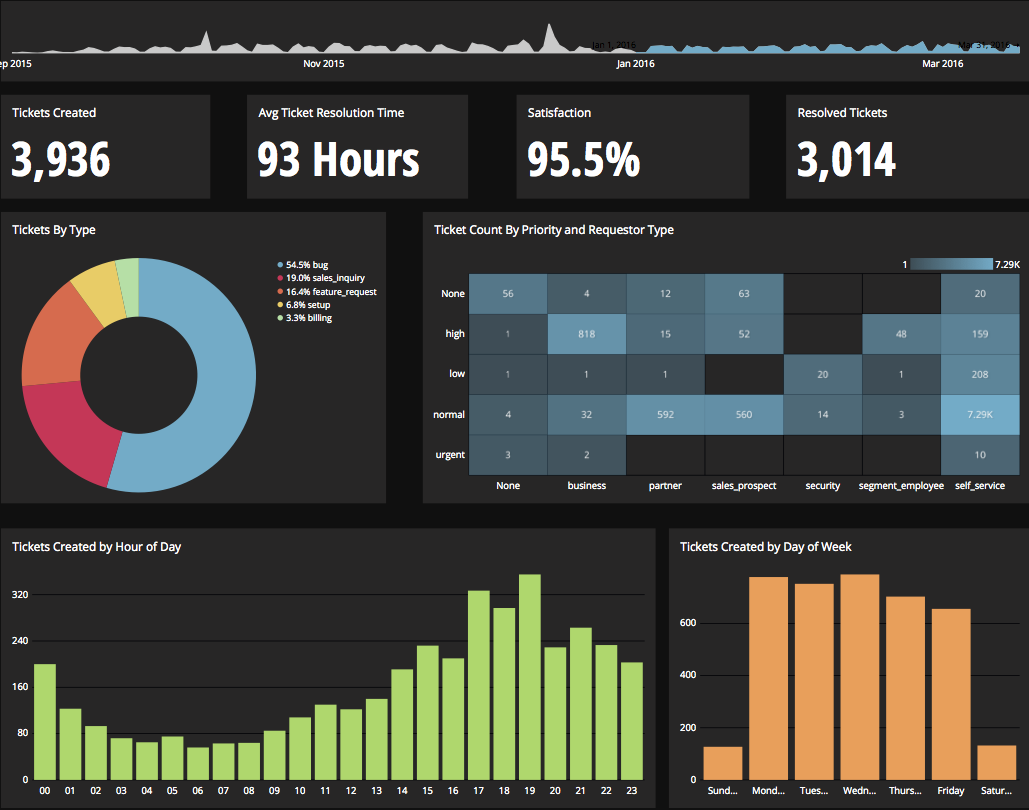
Chartio is a visualization tool designed to enable anyone to explore, transform and visualize data on the fly through a drag-and-drop interface. Chartio was acquired by Atlassian in February 2021 so that it's capabilities could be integrated into the Atlassian product portfolio's capabilities. Chartio is no longer available to new customers, standalone. Existing customers must migrate to alternatives by March 2022, when the service will be retired.
$40
per user/per month
Tableau Public
Score 9.6 out of 10
N/A
Tableau Public is a free edition of the Desktop product. With this edition, data can only be published to the Tableau public website and does not allow work to be saved or exported locally.
I've honestly never really seen another product like Chartio. The closest I can compare is 6sense, but it's fairly different. I think 6sense and Chartio work well together.
Chartio so far has been the easiest BI tool to setup and has also been the most affordable. There are some other, great, BI tools out there but they were a bit to heavy handed for what we needed. Also - despite the high cost per user in Chartio, the other tools were still more …
We used GoodData before Chartio. Our main reason for the change was that GoodData also stored our data and we could not query our own databases. We had to load the data first before creating a new dashboard which made the whole process (and also the maintenance) more difficult. …
Initially, we selected chartio because it was the easiest to connect to data and get going making visualizations. Ultimately, we moved away from Chartio because we needed a tool that would work as a buffer between our data structure and the visualizations. But majority of BI …
Again, Chartio provides the best multi-user presentation ability for us. Other tools are great for slicing and dicing the data, but at the end, you still have to spend time trying to find a way to present it. Chartio has that built in.
Simple interface, simple dashboarding (very little ETL or Analysis requirement for our purposes) and ease of self-service and quick support response. The price was right for all of these things.
It's so much more customizable and allows you to use any data you could possibly want. The interface is also so much more sensible and allows you to decide how to look at things.
We have an older version of Crystal Reports that just hung around as the company grew. Now that we have more users, it's not feasible to continue with the limited Crystal experts that we have in order to get reporting out across the entire company. What we were aiming for was a …
I tried a number of competitors before selecting Chartio. Duckboard is a mess. Looker is an exciting product but requires a huge amount of configuration. Most enterprise solutions have been featurecreeped to death and all look like Excel circa 1998. We selected Chartio because …
I kind of hit on this earlier, but simply put: Usability. We were given tutorials by our Data Science team using Birst, and even they encountered a few hiccups explaining things: they use this everyday! We trialed Chartio with people having zero BI software experience and they …
The determining factor in us deciding to go with Tableau Public over Power BI Free was the ease of Tablueau's ability to easily process larger datasets in comparison to Power BI Free's limitations.
Tableau public is Free and no subscription is required whereas Tableau Desktop is a paid subscription. if there is no private or confidential data it's easy to tableau public and share reports with people. Tableau public has same features and options same as desktop. its easy …
Tableau Public provides a variety of visualization and point-and-click functionality, with little or no scripting, gives Tableau the advantage. Also, being lightweight, Tableau Public finds the ease of use from our PSU bank-clients that use low-end hardware and devices. Tableau …
Tableau Public allows users to upload their work to a designated place online, where others can view and download it. This feature does not available in OriginLab, which is also a useful and popular program to do data analysis.
Tableau Public is most similar to Google Data Studio in terms of being freely available for public use. However, its capabilities and sophisticated visualizations are far and beyond anything offered by Data Studio: Tableau is ideal for creating professional caliber workbooks …
Google charts/Drive is sufficient for simpler data sets, but it does not integrate with other web platforms and the visualization does not look as professional. I'm not aware of any other competitors that offer the same package as Microsoft.
Tableau's core competency is to create a singular analytics platform and while Google and Microsoft provide viable alternatives, they don't quite match up. Tableau delves deeper into categories than Google and thus doesn't supply deep enough information. Microsoft on the other …
Salesforce can be a black box when it comes to CRM and even though Tableau isnt a CRM program our organization started using it for customer relations.
Tableau Public lacks data connectors to Oracle/SQL Server or just about any. No ability to share non-public data nor to package into Tableau Reader. No ability to connect to Tableau Server or Tableau Online to secure your information. However, if you want basic visualization …
We evaluated about 15 products when we selected Tableau 7 years ago, and periodically review products from other vendors (e.g. Microsoft, QlikView, Tibco Spotfire, Birst, Pentaho, etc.). To date, Tableau offers the widest variety of options and functionality at a reasonable …
This product is well suited for end users that don't want to get too in depth with reporting. The interface is simple and the default filter options are sufficient for a general report. Example: Total Sum of Net Sales for all products sold in X State between dates X and X. If the need is for a more complex query, then there is the Custom Query option. This would be something that an administrator would have to police as having users writing their own queries could get really messy really fast. I suppose the key questions to ask would be: Do you need a product that will... display all relevant charts/reports in one consistent place? ... be simple for an end user to navigate? ...be web-based and remotely accessed?
Tableau Public is great, especially if you're new to the platform or considering implementing it within an organization. The Public version has most of the capabilities of the full version, with extensive community documentation to troubleshoot issues you may run into. Additionally, there are many resources to check out Public workbooks from other users and communities: a GREAT learning resource to figure out new, innovative ways to visualize and present data. It is perfect for evaluating public datasets, for doing exploratory data analysis, or contributing to cross-organizational or extracurricular projects that may benefit from more sophisticated data analysis and exploration. Tableau Public, because it stores to the cloud and has limitations on connectivity (ie, cannot connect to SQL servers) is not suited for confidential, financial, PII, etc., data, and care should be taken to avoid including sensitive data in any of the Tableau Public workbooks used by an individual or organization.
Constantly updating: many of the BI tools we looked at were slow to iterate on their product. This was a main selling point for us.
Ease of Use: We have many users that are new to BIs tools and database management in general. BI software as a whole has a pretty steep learning curve for most people, but Chartio does a good job of making things easier all around.
Database Support: It seems as though every department insists on storing their information using different databases. Chartio had support for everyone one we needed which was very helpful.
Tableau Public can work with data that are differently formatted, such as MS Excel, .txt file, Google Sheets, not sure about MS Access.
GUI interface of Tableau Public is not that hard to start working on; Also, it can generate codes for the operations and so it is relatively easy to visualize and correct mistakes.
Lots of Tableau Public users upload their work to the online community, users can easily find very good figures/graphs that are similar to their problems and so they can use these figures/graphs as templates to modify and make their own ones.
The biggest drawback to the Public version of Tableau is that any data used in the program is 'public' and therefore not secure: workbooks are saved to the cloud, rather than locally
Tableau Public limits data ingestion to 10 million rows per source
Limited connections - can't connect to SQL databases to ingest data (must be through CSV, Access, TDE, or text files)
It has become a core part of the business in terms of identifying the health of our network. If we grow and there are certain things that might not fit well with Chartio (e.g. we'd want to store snapshots of every single day's dash instead of seeing realtime data), it might make sense to move some of the data analysis tool in-house if resources are available.
It's free, right? I'll keep using the free version. So the real question to ask is this? Will I pay $999 for the Personal version or $1,999 for the Professional? Yikes! That is a big stretch. I'm not sure about that. The product comparison chart is at: http://www.tableausoftware.com/public/comparison
I really like using Chartio. I use it on a daily basis for pulling data from different sources and combining data (the explore tab was a great idea for this use). I think I would give it 8/10 because there needs to be more documentation or maybe blog posts about things people are doing with it. I only have my own ideas about what to do /how to graph things. I know there are some articles, but it would be awesome to have a section on the neat dashboards people are building or how they show data in different ways. Another complaint is how much time it takes to load. I know our databases aren't set up precisely for Chartio and I have been creating data stores. But the data stores have so many more limitations that adds a whole new layer of frustration. Love the product, keep up the good work and the fast fixes.
Tableau public is a great training tool to understand the basics of Tableau before buying it. A great tool to extend Excel's visualization and to publish data for others. Not useful for anything you need secure. No ability to access databases. Static information only.
I use self learning materials. Pretty helpful. I find myself having to go back to the "drilldown" instructions though, and have a hard time finding hidden variables on a dashboard, so perhaps there is room for intuitive improvements (or maybe I'm just being lazy)
Start at the end and work backward. Identify the business case / issue and questions the end users have, then identify the data needed, and where to get it.
Again, Chartio provides the best multi-user presentation ability for us. Other tools are great for slicing and dicing the data, but at the end, you still have to spend time trying to find a way to present it. Chartio has that built in.
Tableau public is Free and no subscription is required whereas Tableau Desktop is a paid subscription. if there is no private or confidential data it's easy to Tableau public and share reports with people. Tableau public has same features and options same as desktop. its easy for students or beginners to signup and start learning/build reports.
Chartio has worked well as our datawarehouse has rapidly expanded, and the usability/performance hasn't seemed to have suffered. What we haven't yet realized is additional savings from additional users. We have some dashboard needs for users who truly just view of a few charts, and the licensing structure hasn't yet been structured in a way that would support that type of approach...having 50 "core" licenses, and then potentially several hundred view only licenses for partners that would use the application infrequently.