Automox is an endpoint management solution used to keep desktops, laptops, and servers updated and ready for users anywhere in the world. Using automation, IT can fix critical vulnerabilities and boost user productivity.
N/A
ConnectWise Automate
Score 8.3 out of 10
N/A
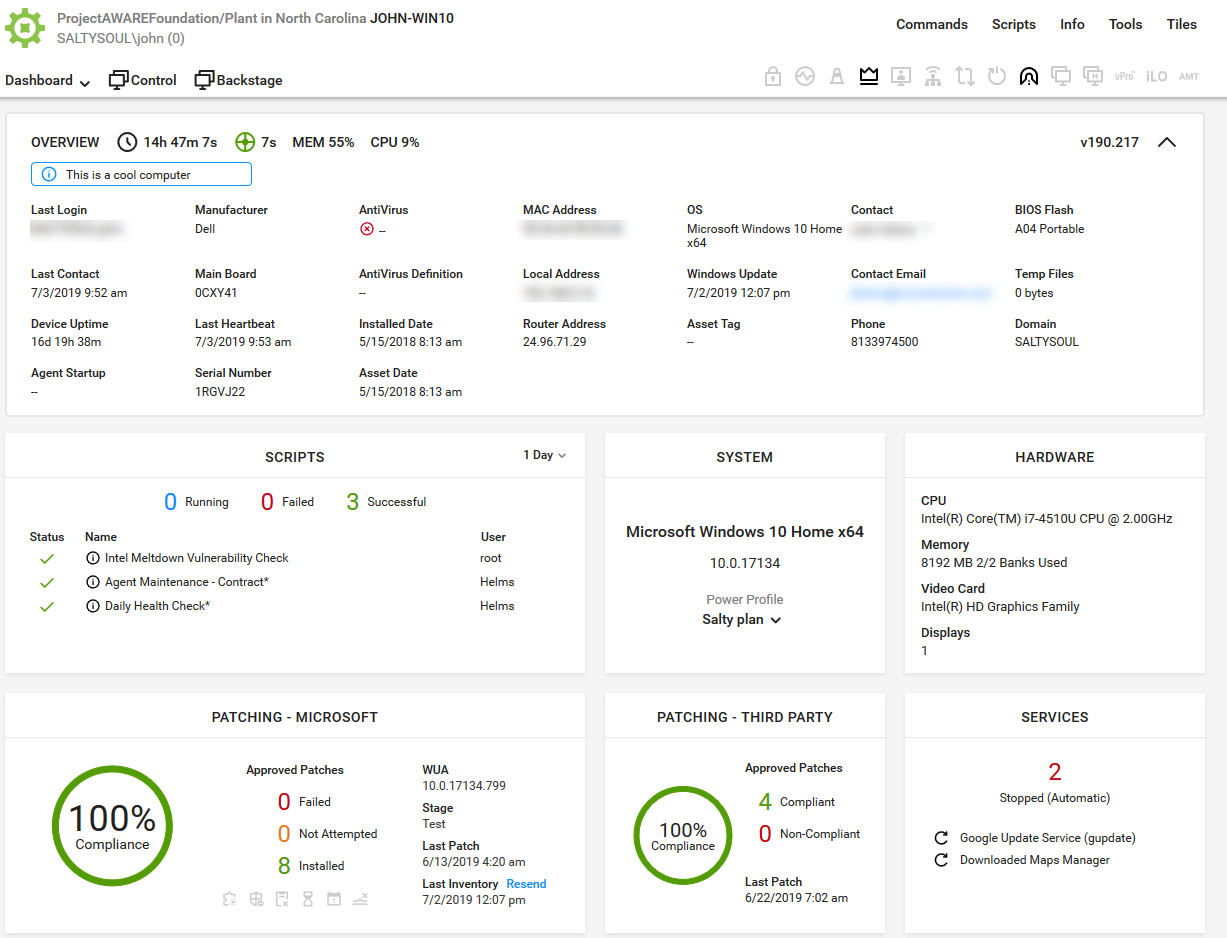
ConnectWise Automate, formerly LabTech, is a remote monitoring and management (RMM) platform. It provides powerful automation to discover and manage devices, monitor for problems, and scripts repetitive action.
$700
Pricing
Automox
ConnectWise Automate
Editions & Modules
No answers on this topic
Agents
$1.00-$6.00
per month/per agent
Implementation Fee
$700
Offerings
Pricing Offerings
Automox
ConnectWise Automate
Free Trial
Yes
Yes
Free/Freemium Version
No
No
Premium Consulting/Integration Services
No
No
Entry-level Setup Fee
No setup fee
No setup fee
Additional Details
Automox can patch macOS, Windows, and Linux endpoints with PatchOS, an offering at $1 per endpoint/ month with an annual commitment.
The Automate Essentials or Automate Enterprise packages are for scaling IT automation, endpoint configuration, and software updates.
Modules are available with Automox Assist, a one-on-one remote endpoint control and assistance for helpdesk technicians.
—
More Pricing Information
Community Pulse
Automox
ConnectWise Automate
Considered Both Products
Automox
Verified User
Anonymous
Chose Automox
worklegs are more advance on Automox, and the reports on Automox give you more detail information, the patching support is better on Automox, Atera can be simple but effective. However, Automox is a more efficient tool and like said before, better for large counts of devices. …
We felt that Automox provided us with the functionality our MSP offered, including OS and device patching, as well as remote control capabilities, but in a better and more manageable way. We also felt the usability of the tool gave us the ability to be effective in our way of …
Automox has a much better user interface. Much simpler to use and share tasks with other team members. They offer great additional training and certifications to help you become an expert.
We chose Automox for it's clean/easy to use UI, remote control capabilities, and automation/patching. The balance of effectiveness and cost made it the best choice for our org
While not a direct analog, we have noted that our A/V provider also handles patching. That being said, the solution is not as al la carte as Automox, and requires much more thought to implement. Automox is a favorite for its lightweight nature and it's time to implementation …
All of these other products are overly complicated with user interfaces that are not very friendly.. too technical, even for IT pros. They are also expensive for smaller companies or those with limited IT budgets. I've found that these other solutions are really geared for …
Automox has a could based console and platform which can cater the computers outside the network. It's not possible in Lan Guard. Also Automox support cross platform and have a very big 3rd party application support than intune. So better to go with Automox
Cloud-based solution with no need for on-prem infrastructure. Support Windows, macOS, Linux, and third-party applications. Cost-effective solution compared with other vendors.
Compared to these solutions, Automox outranks them as the Automox is highly personalized for different types of device types. It supports Windows, Linux, and macOS devices very effectively. Other products are also support other types of devices, but not this much of control can …
Automox is by far the easiest to use and does a better job patching. The built in AI tool is a real time saver making writing Powershell scripts quick and easy.
NinjaONE does really well as an RMM. They are still a baby in patching, but they are growing rapidly. Qualys for patching is a little complicated to use. You actually need to be certified with them to comfortably use it. Their support is a little bit hard to work with.
Enable has a clunky interface more suited for management reporting versus technician toolbox and Ninja is very basic and lacks any significant bells and whistles behind basic remote command interface. Very poor in features to the point if being quite disappointing during a …
If we have to do it again, we would not choose to Automate due to the number of efforts and monetary investment (3rd party consultants) to implement it as well on going managing it. But, in comparison to the other RMM products we used in the past, Automate offers more …
I regret using ConnectWise Automate since we can't effectively add and remove clients and I feel like we're locked into a multi-year contract where only ConnectWise seems to be happy.
I have evaluated NinjaRMM, but it was after I was already familiar with ConnectWise Automate. While it seems like a good product, I found that ConnectWise Automate was more flexible in allowing me to make custom configurations to meet various business needs across different …
I believe the monitoring and alerts in Continuum command is better, but [ConnectWise Automate (formerly LabTech)] does have stronger scripting, and perhaps a better interface. N-Central is inferior on all fronts to both. I did not make the purchasing decision. I would myself …
It just seems like Automate is a tool for professionals who want to be the best proactive solution for their customers. There are so many different things built into Connectwise Automate which makes it a superior tool compared to anything else on the market currently. Once …
So as you can see from this review my experience is mostly with its desktop sharing aspect; however the IT support team use this more comprehensively as a monitoring, inventory, reporting, even application deployment tool that the above-mentioned apps don't have.
Automate is by far the best of all RMM solutions we have tried. The overall ease of use and support is much better than we have experienced with other RMM vendors.
I touched on this in the previous section some. Kaseya's choice of managed antivirus was very poor (KAV, a tweaked version of Kaspersky) when it first started. It took them a long time to fix anything, and the fixes usually produced new and different issues. Kaseya kept …
We ended up choosing ConnectWise because LogMeIn which is part of Continuum is slow and requires a lot of system resources and the patching is all that great within Continuum.
Automate is one of the best when it comes to RMM-applications in terms of features and ability to execute, however, where it is weak is in the necessity for an SME to run and maintain it and while it is quick and gets the job done, it is difficult to stack it up to a full …
Automate is the most well-established platform among its peers. Because it is part of a native ecosystem, you know that everything from remote management to ticketing to quoting an invoicing will work together. I have used other platforms, and many of them share core …
We switched from Kaseya to Automate 7-8 years ago - it was no contest at the time and Kaseya wasn't cutting it in a number of areas at that time that was really hurting us. I'm sure it's improved since then.
We have only previously deployed HoundDog/GFI and Autotask but evaluated all that we found. In the long run, none of the others compare with the features of ConnectWise Automate. Many others are less expensive but simply do not do all that ConnectWise Automate can do. We …
The Continuum RMM is very simplistic in comparison to Automate. The scripting engine in Continuum doesn't compare at all with the scripting in Automate. Continuum has a single level of agent grouping (all agents for a client are in a single group). For clients that have …
Automate is the most flexible and customizable tool on the market - but it's also the most complex and requires the most care and feeding to run smoothly...
We selected ConnectWise Automate over Kaseya as it provided many of the same features but less of the headache. Often times, scripts would not work in Kaseya or updates would not push. We have not had this experience with Automate, scripts and such just run when scheduled. …
ConnectWise has a wider scale and more functionality than LogMeIn. ConnectWise is better suited to large organizations. Training using the software is fairly simple getting techs off the ground.
Automox is well-suited for managing workstations but lacks flexibility for server environments. It excels in scenarios where systems may not regularly connect to the corporate network but have internet access, ensuring devices can still check in and receive timely patches. This provides organizations with confidence in maintaining patch compliance across remote endpoints. However, effective use of Automox requires staff who are proficient in PowerShell scripting. The platform has limited native support for third-party applications, often requiring custom worklets to manage software updates. It performs best in environments that primarily rely on widely used, off-the-shelf software.
I recommend it to all IT colleagues; regardless of the size of the PCs with which you work most of the time, the application allows connection stability between computers that make it possible to continue working or taking care of the infrastructure from afar.
Automated patching. The patch management is very robust and doesn't let us down. We can rely on it to do its job.
Scripting. The scripting engine and layout is excellent. It's very easy to work with and adapt Powershell scripts and other script to the native format with its functions. It also gives detailed logs to help determine why something went wrong if there's issues.
You can track all your clients information and every single job you do for them. You can do quotes, send them, add providers to compare prices, manage the calendar of the employees, assign tickets to the correct person, there is nothing you can't do with this tool.
Inside all the greatness, there are some works around that you have to do for specific duties that could be automated.
Make sure you keep notes on each client profile, you can use the private note section, it is secure and it works as a reminder of everything you need to do about that specific client, only you and your employees will see those.
This is a software that just works. Once configured its a set and forget kind of tool that keeps things up to date and alerts me if something is wrong. I was able to work through an expansion project to deploy an additional 500 devices in almost no time and create a robust self-patching environment.
Support and the Speed of supporting the latest technology is the main reason for not giving this a 10. But the product is powerful and flexible. The best way that I can sum it up is "You can get out of it what you put in to it"
It is super simple to set up and deploy, Maintaining it also easy as pie. It gives great detailed information daily on patches that succeed and ones that fail as well. with remote, patching, scanning, and monitoring all in one pane it has saved us money hand over fist with the tools we no longer need to have for our organization.
Basic use of the product is fairly easy. Information about the machines you manage can be found in customizable dashboards, which can be unique for each user, and, therefore, properly suited to the users' needs/job function. This is not a 10 because some of the interfaces are very clunky (Patch Management), and some features are not intuitive and not well documented (reporting). Scripting and Patch Management have a fairly steep learning curve (For structure in patch management and syntax in scripting), but once learned, they work well.
It used to be great, but then they broke reporting, speed and responsiveness with version 11 and the new Patch Manager. It's really bad and their support people are way behind on fixing so many bugs. They have really gone downhill. If they don't get it together soon, we'll start looking around.
1. Simplicity and Ease of Use 2. Cross-Platform Support 3. Powerful Automation with Worklets 4. Real-Time Visibility and Control 5. Fast and Reliable Cloud-Based Updates 6. Strong Security Focus
Far too many issues that take ages to get resolved. Even their chat support takes a long time to get in contact with someone. When you do chat with a support rep they generally can't help you and just escalate the ticket. At least everything you've chatted about is now in the ticket.
LabTech online training is very very thorough in training and helping individuals understand the theory and practical side of using a Remote Monitoring & Management. The training has multiple methods of explaining each section which helps to re-enforce everything about the Training Modules. I have had some Engineers lose their interest after a number of modules because they said that it was too much, that was too similar. I've found that the training is tailored towards a technical background but the Sales training does help NON technical individuals familiarize themselves with the Remote Monitoring and Management components and how it relates to Managed Services.
Implementing Automox successfully starts with a clear strategy for organizing and grouping devices based on operating systems, environments, or business criticality. This ensures that patching and configuration policies can be applied with precision. A phased rollout approach is essential—beginning with a pilot group allows teams to test patching schedules, reboot behaviors, and custom Worklets before scaling across the organization. Leveraging Worklets from the start can significantly boost automation by enforcing security baselines and performing routine system tasks. Integration with existing SOC tools, such as SIEMs, enhances visibility and response time by correlating patch compliance with threat intelligence. Additionally, aligning patching schedules with operational downtimes minimizes disruptions, and consistent monitoring and reporting helps maintain compliance and prepare for audits. Overall, Automox offers a streamlined and effective solution, but its true value is unlocked through thoughtful planning, testing, and integration with existing IT and security workflows.
ConnectWise Automate was already implemented at all organizations I have used it at when I started at those MSPs. At my current MSP, we used professional services for a period after I took over management of it, and they assisted with changes that I saw needed to be made. While not specifically implemented, those services were well organized and well scheduled, and all things we discussed were tracked and recorded, allowing for good change management/tracking.
We felt that Automox provided us with the functionality our MSP offered, including OS and device patching, as well as remote control capabilities, but in a better and more manageable way. We also felt the usability of the tool gave us the ability to be effective in our way of working, as well as integrating with Rapid7 was a massive benefit for us.
I have evaluated NinjaRMM, but it was after I was already familiar with ConnectWise Automate. While it seems like a good product, I found that ConnectWise Automate was more flexible in allowing me to make custom configurations to meet various business needs across different clients. I have also evaluated Addigy. While I think Addigy does a better job of managing apple devices, it is clunkier, and customization is harder in Addigy than in ConnectWise Automate.
Being a start up, we have pivoted our strategies a number of times. The pay as you go model has worked very well for us, and has prevented us from overprovisioning
The time saved pulling reports to provide to auditors has been well worth our small spend on the solution
We have no need to maintain a scanning tool or invest in hardware thanks to the SaaS nature of Automox
As mentioned briefly previous there have been a couple of times where accessing servers at different sites due to point to point connectivity going down where this has been a big life saver