AWS CloudFormation vs. AWS Fargate

Overview
ProductRatingMost Used ByProduct SummaryStarting Price
AWS CloudFormation
Score 8.8 out of 10
N/A
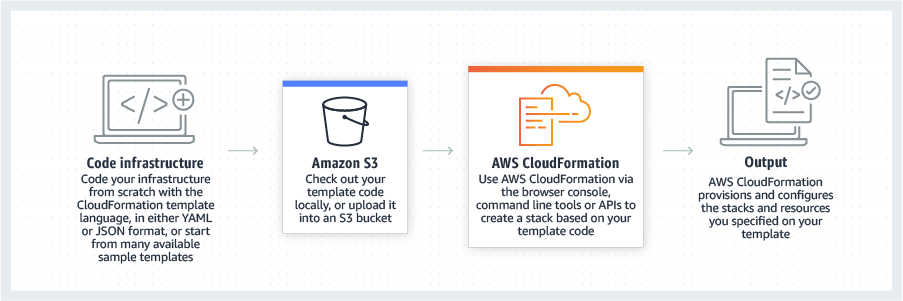
AWS CloudFormation gives developers and systems administrators a way to create and manage a collection of related AWS resources, provisioning and updating them in a predictable fashion. Use AWS CloudFormation’s sample templates or create templates to describe the AWS resources, and any associated dependencies or runtime parameters, required to run an application. Users don’t need to figure out the order for provisioning AWS services or the subtleties of making those dependencies work.…
$0
AWS Fargate
Score 9.3 out of 10
N/A
AWS Fargate is a compute engine for Amazon ECS that allows the user to run containers without having to manage servers or clusters. With AWS Fargate there is no need to provision, configure, and scale clusters of virtual machines to run containers.
$0
*per hour
Pricing
AWS CloudFormationAWS Fargate
Editions & Modules
Free Tier - 1,000 Handler Operations per Month per Account
$0.00
Handler Operation
$0.0009
per handler operation
Fargate Spot per GB
$0.00138679
*per hour
per GB
$0.004445
*per hour
Fargate Spot per vCPU
$0.01262932
*per hour
per vCPU
$0.04048
*per hour
Offerings
Pricing Offerings
AWS CloudFormationAWS Fargate
Free Trial
YesNo
Free/Freemium Version
YesNo
Premium Consulting/Integration Services
NoNo
Entry-level Setup FeeNo setup feeNo setup fee
Additional DetailsThere is no additional charge for using AWS CloudFormation with resource providers in the following namespaces: AWS::*, Alexa::*, and Custom::*. In this case you pay for AWS resources (such as Amazon EC2 instances, Elastic Load Balancing load balancers, etc.) created using AWS CloudFormation as if you created them manually. You only pay for what you use, as you use it; there are no minimum fees and no required upfront commitments. When you use resource providers with AWS CloudFormation outside the namespaces mentioned above, you incur charges per handler operation. Handler operations are create, update, delete, read, or list actions on a resource.*based on US East rates. Price varies region to region.
More Pricing Information
Community Pulse
AWS CloudFormationAWS Fargate
Considered Both Products
AWS CloudFormation
Chose AWS CloudFormation
Since the product I'm involved is primarily hosted on AWS we use CloudFormation but in some other products where we have hybrid cloud deployments we prefer terraform which is opensource.

Chose AWS CloudFormation
Cloning a virtual machine creates a virtual machine that is cloning a virtual machine creates a virtual machine that is a copy of the original. The new virtual machine is configured with the same virtual hardware, installed software, and other properties that were configured …
Chose AWS CloudFormation
As we have our whole infrastructure on AWS, that is why we selected AWS CloudFormation. AWS CloudFormation is better integrated with AWS services than other available products and also provides visibility and tracking on AWS. AWS CloudFormation is free while Terraform …
Chose AWS CloudFormation
We didn't look into anything else as Cloudformation was "built-in" for AWS, it just kind of made sense to go with that. Terraform was something that we briefly looked into Terraform but decides to stick with Cloudformation because our task was relatively "simple". Apparently if …
Chose AWS CloudFormation
AWS CloudFormation has more features and robustness. It is suited for professional projects since it provides stability and a wide variety of options for configurations. These include not only dividing stacks by specific code changes, but also in regions. This allows more …
Chose AWS CloudFormation
The only real comparison would be to Terraform, which is another IaC technology at the infra level. Terraform is cloud-agnostic, which means most popular cloud providers are supported. While AWS CloudFormation is AWS-only. Although, if you consider CDK, CDK for Terraform …
AWS Fargate
Chose AWS Fargate
We found the extra cost saved us frustration and time and ultimately money in the long run
Features
AWS CloudFormationAWS Fargate
Infrastructure-as-a-Service (IaaS)
Comparison of Infrastructure-as-a-Service (IaaS) features of Product A and Product B
AWS CloudFormation
-
Ratings
AWS Fargate
8.9
Ratings
10% above category average
Service-level Agreement (SLA) uptime00 Ratings10.00 Ratings
Dynamic scaling00 Ratings10.00 Ratings
Elastic load balancing00 Ratings10.00 Ratings
Pre-configured templates00 Ratings7.00 Ratings
Monitoring tools00 Ratings10.00 Ratings
Pre-defined machine images00 Ratings8.00 Ratings
Operating system support00 Ratings8.00 Ratings
Security controls00 Ratings8.00 Ratings
Automation00 Ratings9.00 Ratings
Best Alternatives
AWS CloudFormationAWS Fargate
Small Businesses
HashiCorp Terraform
HashiCorp Terraform
Score 8.5 out of 10
DigitalOcean Droplets
Score 8.7 out of 10
Medium-sized Companies
Ansible
Ansible
Score 9.2 out of 10
SAP on IBM Cloud
SAP on IBM Cloud
Score 9.5 out of 10
Enterprises
Ansible
Ansible
Score 9.2 out of 10
SAP on IBM Cloud
SAP on IBM Cloud
Score 9.5 out of 10
All AlternativesView all alternativesView all alternatives
User Ratings
AWS CloudFormationAWS Fargate
Likelihood to Recommend
7.6
(0 ratings)
10.0
(0 ratings)
Usability
-
(0 ratings)
10.0
(0 ratings)
Support Rating
-
(0 ratings)
8.0
(0 ratings)
User Testimonials
AWS CloudFormationAWS Fargate
Likelihood to Recommend
Cloning a virtual machine creates a virtual machine that is a copy of the original. The new virtual machine is configured with the Cloning Cloning a virtual machine creates a virtual machine that is a copy of the original. The new virtual machine is configured with the same virtual hardware, installed software, and other properties that were configured for the original virtual machine. For information about persistent memory and PMem storage, see the vSphere Resource Management Guide. For information virtual machine creates a virtual machine that is a copy of the original. The new virtual machine is configured with the same virtual hardware, installed software, and other properties that were configured for the original virtual machine. For information about persistent memory and PMem storage, see the vSphere Resource. Management guide. For information virtual hardware, installed software cloning a virtual machine creates a virtual machine that is a copy of the original. The new virtual machine is configured with the same virtual hardware, installed software, and other properties that were configured for the original virtual machine. For information about persistent memory and PMem storage, see the vSphere Resource Management Guide. For information and other properties that were configured for the original virtual machine. For information about persistent memory and PMem storage, see the vSphere Resource Management Guide. For information.
Read full review
If you need to deploy Docker containers, Amazon Fargate is a very good fit. It integrates very well with other AWS services like RDS, EFS, and Secrets manager. You can have a very robust application using those services. In case you have many containers to deploy, it is however more expensive
that if you use other services like ECS or EKS, since they allow you to
share the same infrastructure to deploy multiple containers.
Read full review
Pros
  • IaC, transactional on top of that
  • Support for "mainstream" general programming languages
  • Sharable IaC "snippets" that can setup standardized environments for individuals quickly
  • OOP techniques are available thanks to OOP languages
Read full review
  • scalability
  • ease of use
  • agility to up or downsize
Read full review
Cons
  • Error Description upon Failure Needs to be Improved.
  • Slow to create, delete or update.
  • Need to delete resources manually. It can ask before starting deletion whether to skip those resources or delete them.
Read full review
  • can't think of any
Read full review
Usability
It's easy enough to get a shared template & apply it. You don't even have to download-then-upload or copy-and-paste, a publicly-accessible url works.
Diving deeper, it has enough powerful capabilities to make the life of a platform / DevOps engineer bearable.
However, you need equally deep knowledge to troubleshoot issues, when they inevitably pop up. This is the same for all IaC technologies, as they are additional abstraction layers on top of the native API provided by the cloud providers.
Read full review
It's a very practical service to use. If you need to deploy any application with a Database, disk storage, you're pretty much set.
Everything around that can be taken care of using other AWS services. Like secrets manager, certificate manager, RDS ...
And the CI/CD part is also very easy to setup, you only need on AWS CLI command to trigger a deployment, and done !
Read full review
Support Rating
No answers on this topic
AWS provides different support tiers. They are usually very reactive and are able to help solve the issues very quickly.
As for everything, the higher the support tier you get, the better and faster support you get.
If you're also a part of big company, you probably have solution architects at your disposal to help you with any inqueries.
Read full review
Alternatives Considered
Since the product I'm involved is primarily hosted on AWS we use CloudFormation but in some other products where we have hybrid cloud deployments we prefer Terraform which is opensource.
Read full review
We found the extra cost saved us frustration and time and ultimately money in the long run
Read full review
Return on Investment
  • + We can standup a VPC in minutes
  • - It took a lot of inital time to set up
  • + With logging/rollback, made testing much easier.
Read full review
  • easier to optimize our computer costs
  • transition from server to serverless was easier once we decided to adopt Fargate
Read full review
ScreenShots

AWS CloudFormation Screenshots

Screenshot of CloudFormation - How it works overviewScreenshot of CloudFormation - High level how it worksScreenshot of CloudFormation - Template exampleScreenshot of CloudFormation - Template inputs overview