AWS CloudFormation vs. HashiCorp Terraform

Overview
ProductRatingMost Used ByProduct SummaryStarting Price
AWS CloudFormation
Score 8.8 out of 10
N/A
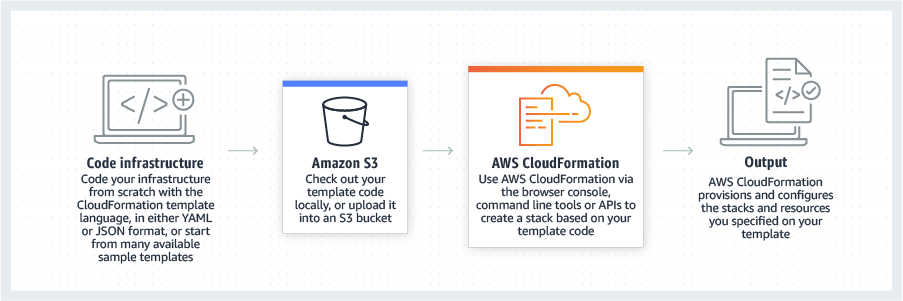
AWS CloudFormation gives developers and systems administrators a way to create and manage a collection of related AWS resources, provisioning and updating them in a predictable fashion. Use AWS CloudFormation’s sample templates or create templates to describe the AWS resources, and any associated dependencies or runtime parameters, required to run an application. Users don’t need to figure out the order for provisioning AWS services or the subtleties of making those dependencies work.…
$0
HashiCorp Terraform
Score 8.5 out of 10
N/A
Terraform from HashiCorp is a cloud infrastructure automation tool that enables users to create, change, and improve production infrastructure, and it allows infrastructure to be expressed as code. It codifies APIs into declarative configuration files that can be shared amongst team members, treated as code, edited, reviewed, and versioned. It is available Open Source, and via Cloud and Self-Hosted editions.
$0
Pricing
AWS CloudFormationHashiCorp Terraform
Editions & Modules
Free Tier - 1,000 Handler Operations per Month per Account
$0.00
Handler Operation
$0.0009
per handler operation
Open Source
$0
Team & Governance
$20/user
per user/per month
Enterprise
Contact sales team
Offerings
Pricing Offerings
AWS CloudFormationHashiCorp Terraform
Free Trial
YesNo
Free/Freemium Version
YesYes
Premium Consulting/Integration Services
NoNo
Entry-level Setup FeeNo setup feeNo setup fee
Additional DetailsThere is no additional charge for using AWS CloudFormation with resource providers in the following namespaces: AWS::*, Alexa::*, and Custom::*. In this case you pay for AWS resources (such as Amazon EC2 instances, Elastic Load Balancing load balancers, etc.) created using AWS CloudFormation as if you created them manually. You only pay for what you use, as you use it; there are no minimum fees and no required upfront commitments. When you use resource providers with AWS CloudFormation outside the namespaces mentioned above, you incur charges per handler operation. Handler operations are create, update, delete, read, or list actions on a resource.
More Pricing Information
Community Pulse
AWS CloudFormationHashiCorp Terraform
Considered Both Products
AWS CloudFormation
Chose AWS CloudFormation
Since the product I'm involved is primarily hosted on AWS we use CloudFormation but in some other products where we have hybrid cloud deployments we prefer terraform which is opensource.

Chose AWS CloudFormation
Cloning a virtual machine creates a virtual machine that is cloning a virtual machine creates a virtual machine that is a copy of the original. The new virtual machine is configured with the same virtual hardware, installed software, and other properties that were configured …
Chose AWS CloudFormation
As we have our whole infrastructure on AWS, that is why we selected AWS CloudFormation. AWS CloudFormation is better integrated with AWS services than other available products and also provides visibility and tracking on AWS. AWS CloudFormation is free while Terraform …
Chose AWS CloudFormation
We didn't look into anything else as Cloudformation was "built-in" for AWS, it just kind of made sense to go with that. Terraform was something that we briefly looked into Terraform but decides to stick with Cloudformation because our task was relatively "simple". Apparently if …
Chose AWS CloudFormation
AWS CloudFormation has more features and robustness. It is suited for professional projects since it provides stability and a wide variety of options for configurations. These include not only dividing stacks by specific code changes, but also in regions. This allows more …
Chose AWS CloudFormation
The only real comparison would be to Terraform, which is another IaC technology at the infra level. Terraform is cloud-agnostic, which means most popular cloud providers are supported. While AWS CloudFormation is AWS-only. Although, if you consider CDK, CDK for Terraform …
HashiCorp Terraform
Chose HashiCorp Terraform
Dbt was fine, but you end up with an extremely bloated repo/project. Often where all of the models are the same, named similarly, and generally just doesn't adhere to the concept of DRY coding.
In Terraform we're able to template a lot of this work and dynamically generate …
Chose HashiCorp Terraform
HashiCorp Terraform is much better than Cloud Formation. For one, the language is just easier to use, but more importantly, the provider ecosystem is much better in HashiCorp Terraform than in Cloud Formation.
Chose HashiCorp Terraform
HashiCorp Terraform has Cloud agnostic capability to use with different cloud vendors and the ease of creating the code with minimal effort.
Chose HashiCorp Terraform
I'm beginning to look at Pulumi. In my opinion, it looks like it would be a good replacement for HashiCorp Terraform, and it has the advantage of configuration via scripting, rather than via HCL, which is HashiCorp Terraform configuration markup language. In my opinion, the …
Chose HashiCorp Terraform
We have used Vagrant to develop our application in a virtual box environment and prepare it to be packed with Packer. The image created from these two tools will be deployed by Terraform.

We are using Consul for service discovery and as a job locking so we don't have two jobs or …
Chose HashiCorp Terraform
CloudFormation is only for AWS so if you're trying to deploy to another cloud provider then Terraform is your product. Terraform has lots of public support so you can find answers to questions by Googling. CloudFormation is easy to view the resources/services that are …
Chose HashiCorp Terraform
Terraform was more preferred over ansible as it is considerably more intutive.
Chose HashiCorp Terraform
Actually both products work very well. We use Terraform for speed and Ansible for configuration management both products work really well together
Chose HashiCorp Terraform
Terraform is a large step ahead of the previous generation of infrastructure-as-code providers. I'd never go back to, e.g. Puppet or Chef, Ansible, etc. That said I think that Pulumi has a good chance of displaying it, in no small part because the Terraform language itself …
Chose HashiCorp Terraform
AWS CloudFormation is better if you just want to stick with AWS because it's integration with AWS is better, provides auto-rollback in case of failures, and has GUI to manage and view the stacks built. Terraform is better when we want to stay cloud-agnostic. Terraform is better …
Chose HashiCorp Terraform
I can't find these applications listed, but other IaC tools I have used include: AWS CloudFormation, Azure Resource Manager Templates, and GCP Cloud Deployment Templates. For a comparable tool, I have the most experience with CloudFormation.

Compared to CloudFormation, the first …
Chose HashiCorp Terraform
Chef and Terraform are not apples to apples because Chef is more focused on config management, whereas Terraform is more focused on provisioning. However, I can say that where they do overlap in configuration management is that Terraform is the preferred tool because it has an …
Chose HashiCorp Terraform
Terraform is the solid leader in the space. It allows you to do more then just provisioning within a pre-existing servers. It is more extensible and has more providers available than it competitors. It is also open source and more adopted by the community then some of the other …
Chose HashiCorp Terraform
Terraform is open source and has strong community support. It is cloud-agnostic versus competing products like AWS cloud formation, hence has a distinct advantage. The scripts once set up are easy for developers to administer during development, hence during production …
Chose HashiCorp Terraform
  • UI design and development always sticks when it comes to multiple or say 'n' number of same configurations.
  • It's very easy to download and execute
  • Provides cross platform support and it's reliable.
Chose HashiCorp Terraform
Terraform has made better choices in how their product works, is used over time, and can be integrated with.
Chose HashiCorp Terraform
Centralized and standard configuration. Ease of VM provisioning.
Chose HashiCorp Terraform
- Terraform syntax is much easier to read and learn than Cloud Formation. - Terraform already supports AWS as well as several other cloud providers. - Terraform is backed by a great and supportive open-source community.
Chose HashiCorp Terraform
Terraform shares the methodology of creating configuration files for your infrastructure with tools like CloudFormation. However, Terraform is cloud-agnostic unlike CloudFormation which is AWS specific.
Terraform can be used to maintain AWS and OpenStack clusters …
Chose HashiCorp Terraform
CloudFormation is the lingua franca of AWS. You certainly can't go wrong using it, but I like the syntax and open-source nature of Terraform. That's mostly a personal preference. I have not tried any other non-Amazon tools for provisioning AWS. And, of course, the AWS tools …
Chose HashiCorp Terraform
HashiCorp Terraform has more possibilities
Features
AWS CloudFormationHashiCorp Terraform
Configuration Management
Comparison of Configuration Management features of Product A and Product B
AWS CloudFormation
-
Ratings
HashiCorp Terraform
7.9
Ratings
2% below category average
Infrastructure Automation00 Ratings9.00 Ratings
Automated Provisioning00 Ratings8.70 Ratings
Parallel Execution00 Ratings6.30 Ratings
Node Management00 Ratings7.70 Ratings
Reporting & Logging00 Ratings7.80 Ratings
Version Control00 Ratings8.10 Ratings
Best Alternatives
AWS CloudFormationHashiCorp Terraform
Small Businesses
HashiCorp Terraform
HashiCorp Terraform
Score 8.5 out of 10
HashiCorp Vagrant
HashiCorp Vagrant
Score 10.0 out of 10
Medium-sized Companies
Ansible
Ansible
Score 9.2 out of 10
Ansible
Ansible
Score 9.2 out of 10
Enterprises
Ansible
Ansible
Score 9.2 out of 10
Ansible
Ansible
Score 9.2 out of 10
All AlternativesView all alternativesView all alternatives
User Ratings
AWS CloudFormationHashiCorp Terraform
Likelihood to Recommend
7.6
(0 ratings)
8.4
(0 ratings)
Usability
-
(0 ratings)
8.1
(0 ratings)
Performance
-
(0 ratings)
9.4
(0 ratings)
Support Rating
-
(0 ratings)
7.4
(0 ratings)
Ease of integration
-
(0 ratings)
9.2
(0 ratings)
User Testimonials
AWS CloudFormationHashiCorp Terraform
Likelihood to Recommend
Cloning a virtual machine creates a virtual machine that is a copy of the original. The new virtual machine is configured with the Cloning Cloning a virtual machine creates a virtual machine that is a copy of the original. The new virtual machine is configured with the same virtual hardware, installed software, and other properties that were configured for the original virtual machine. For information about persistent memory and PMem storage, see the vSphere Resource Management Guide. For information virtual machine creates a virtual machine that is a copy of the original. The new virtual machine is configured with the same virtual hardware, installed software, and other properties that were configured for the original virtual machine. For information about persistent memory and PMem storage, see the vSphere Resource. Management guide. For information virtual hardware, installed software cloning a virtual machine creates a virtual machine that is a copy of the original. The new virtual machine is configured with the same virtual hardware, installed software, and other properties that were configured for the original virtual machine. For information about persistent memory and PMem storage, see the vSphere Resource Management Guide. For information and other properties that were configured for the original virtual machine. For information about persistent memory and PMem storage, see the vSphere Resource Management Guide. For information.
Read full review
8 because it's currently best-in-class and is completely essential to use in contrast to not expressing your infrastructure as code. That said, new contenders are nipping at its heels, and I expect stronger tools to emerge in the coming years. Hopefully the Terraform team is able to keep pace.
Read full review
Pros
  • IaC, transactional on top of that
  • Support for "mainstream" general programming languages
  • Sharable IaC "snippets" that can setup standardized environments for individuals quickly
  • OOP techniques are available thanks to OOP languages
Read full review
  • Terraform is cloud agnostic. Just select the suitable provider for the cloud and it will do the job.
  • Templating is possible to make the Terraform templates reusable.
  • Variables can be created to make the templates generic so that it can be reused for different environments or resources.
Read full review
Cons
  • Error Description upon Failure Needs to be Improved.
  • Slow to create, delete or update.
  • Need to delete resources manually. It can ask before starting deletion whether to skip those resources or delete them.
Read full review
  • The errors generated by the plan and preview commands are pretty cryptic, it can be hard for newcomers to the scripting language to understand how to address problems.
  • Access controls around workspaces is limited which makes it harder to secure reduce the scope of teams ability.
  • Analytics around user usage, applies and plans would be helpful for managemenet.
Read full review
Usability
It's easy enough to get a shared template & apply it. You don't even have to download-then-upload or copy-and-paste, a publicly-accessible url works.
Diving deeper, it has enough powerful capabilities to make the life of a platform / DevOps engineer bearable.
However, you need equally deep knowledge to troubleshoot issues, when they inevitably pop up. This is the same for all IaC technologies, as they are additional abstraction layers on top of the native API provided by the cloud providers.
Read full review
I love Terraform and I think it has done some great things for people that are working to automate their provisioning processes and also for those that are in the process of moving to the cloud or managing cloud resources. There are some quirks to HCL that take a little bit of getting used to and give picking up Terraform a little bit of a learning curve, thus the rating
Read full review
Performance
No answers on this topic
Terraform's performance is quite amazing when it comes to deployment of resources in AWS. Of course, the deployment times depend on various parameters like the number of resources to deploy and different regions to deploy. Terraform cannot control that. The only minor drawback probably shows up when a terraform job is terminated mid way. Then in many cases, time-consuming manual cleanup is required.
Read full review
Support Rating
No answers on this topic
Terraform is community driven but does offer support for it's Enterprise product. When contacting the team at HashiCorp we have always gotten resolution to our issues. They have been very responsive in returning our calls and answering our questions as they come up. We are currently using the open source model.
Read full review
Alternatives Considered
Since the product I'm involved is primarily hosted on AWS we use CloudFormation but in some other products where we have hybrid cloud deployments we prefer Terraform which is opensource.
Read full review
dbt was fine, but you end up with an extremely bloated repo/project. Often where all of the models are the same, named similarly, and generally just doesn't adhere to the concept of DRY coding. In Terraform we're able to template a lot of this work and dynamically generate assets based on variables instead.
Read full review
Return on Investment
  • + We can standup a VPC in minutes
  • - It took a lot of inital time to set up
  • + With logging/rollback, made testing much easier.
Read full review
  • Using code, we are able to build and deploy cloud resources faster and more consistently than producing the same resources in the console manually.
  • For applications that share architectures, we can reuse code to expedite development. We can also do the same with modules that are shared across the organization.
  • By defining all of our resources as code, we can deploy complete environments with "batteries included." For example, we can use code that spins up servers in a cloud provider and at the same time, creates monitors with in our monitoring provider. Likewise, when the servers are decommissioned, the monitors are decommed along with them. In the past, the creation and decom of the monitors would have been a disjointed, manual step. With Terraform we get it all with one "terraform apply."
Read full review
ScreenShots

AWS CloudFormation Screenshots

Screenshot of CloudFormation - How it works overviewScreenshot of CloudFormation - High level how it worksScreenshot of CloudFormation - Template exampleScreenshot of CloudFormation - Template inputs overview

HashiCorp Terraform Screenshots

Screenshot of Terraform StateScreenshot of Terraform RunsScreenshot of Terraform VariablesScreenshot of Terraform WorkspacesScreenshot of Terraform Cost Estimation