AWS IoT Core is a managed cloud service that lets connected devices interact with cloud applications and other devices. It includes the Device Gateway and the Message Broker, which connect and process messages between IoT devices and the cloud. AWS IoT Core connects AWS and Amazon services like AWS Lambda, Amazon Kinesis, Amazon S3, Amazon SageMaker, Amazon DynamoDB, Amazon CloudWatch, AWS CloudTrail, Amazon QuickSight, and Alexa Voice Service to build IoT applications that gather, process,…
$0.08
Per Million Minutes
FlexiHub
Score 10.0 out of 10
N/A
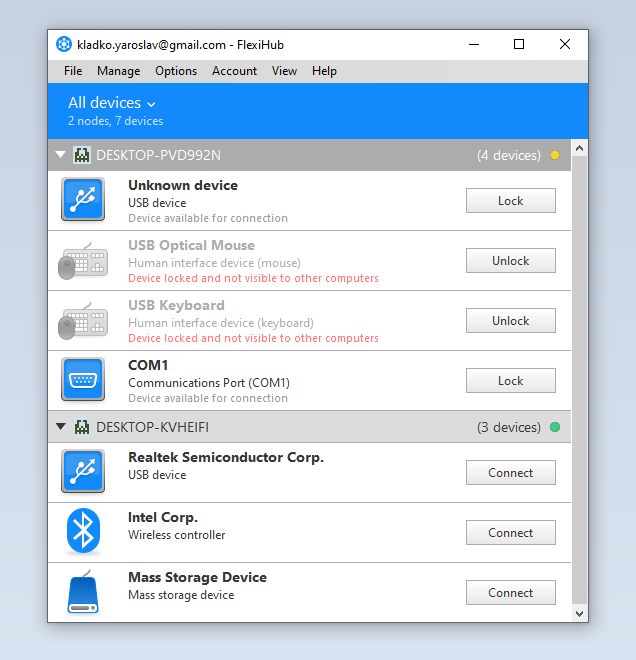
Software as a service for accessing USB devices connected to remote computers over the Internet FlexiHub enables users to set up a USB over network connection so they can link remotely-located computers with USB peripherals attached to a local machine. Users can share USB devices over Ethernet and connect them in real-time no matter if they are down the hall, across the city, or on the other side of the world. FlexiHub is a software as a service for redirecting all types of…
N/A
Pricing
AWS IoT Core
FlexiHub
Editions & Modules
Connectivity
$0.08
Per Million Minutes
Rules Engine
$0.15
Per Million Actions
Messaging
$1.00
Per Million Messages
No answers on this topic
Offerings
Pricing Offerings
AWS IoT Core
FlexiHub
Free Trial
No
Yes
Free/Freemium Version
No
No
Premium Consulting/Integration Services
No
No
Entry-level Setup Fee
No setup fee
Optional
Additional Details
—
—
More Pricing Information
Community Pulse
AWS IoT Core
FlexiHub
Considered Both Products
AWS IoT Core
Verified User
Anonymous
Chose AWS IoT Core
Azure IoT is a good product but since our whole suite of tech is now set up in AWS (ec2, s3, sagemaker, cloud formation, etc.), we wanted something that could quickly adapt to our environments. Learning a new tech for IoT was simply a bottleneck that we wanted to avoid at this …
AWS iot core is a good starting point which can be utilized for a variety of enterprise solutions. Barrier to entry to experiment and try AWS iot core is less and AWS eco-system providers ensure that even startups can try a variety of solutions and build key skills and …
Azure IoT service provides more or less the same services as compared to AWS IoT core, however the costing of AWS lead us to continued usage of IoT core over Azure IoT services. Also, considering our existing technology stack is on AWS, it was a natural selection for better …
It turns out that AWS IoT Core is the most mature solution on the market with the best variety of integration tools available. On the downside, it is not the cheapest platform existing out there. Amazon IoT Core is easy to start and set up, and our prior engagement with Amazon …
For our use case, we ended up with AWS because the human resources that were planning to be resourced on this particular project happened to have prior familiarity with the AWS ecosystem. The conversation became can we justify continuing with this ecosystem rather than pivoting …
We have checked other IoT platforms such as IBM Watson IoT and Microsoft Azure IoT, but Amazon IoT Core seems reasonable in terms of pricing and overall functionalities. Amazon IoT Core is easy to start and set up and our prior engagement with Amazon for AWS was a factor to go …
AWS IoT Core is faster, easier, cheaper, and enjoyed by our employees more than Microsoft Azure. We selected AWS IoT because we saw an advertisement for it and have used it ever since. We will continue to use it as long as it is around or until we find one that is better.
We prefer Amazon storage and content delivery S3 services rather than Microsoft Blob Storage. Also, AWS IoT Core seems to be the cheaper alternative compared to Azure IoT.
I made the switch to FlexiHub because I found it to be more reliable and user-friendly for my specific needs. FlexiHub offers a more seamless experience when it comes to remotely accessing and managing USB devices, with fewer connectivity issues compared to the other products I …
AWS iot core is very useful if you need to scale very quickly for managing lots of devices without handling the underlying infrastructure cost. It can enable real time publishing and subscription of devices, monitoring and early stage intervention in case of unexpected issues while developing a full stack solution. However, healthcare scenarios where government intervention is needed should be developed and scaled by following the set of compliance policies of the government and the SLA requirements of the customer. Finally, it is great where you need to do data science research after anonymizing data
We’ve put FlexiHub through its paces to see if it’s any good for remote vehicle health checks. We tried the app out with a handful of USB devices for car diagnostics and so far, everything is going smoothly. We also worked to develop an iOS app for remote diagnostics. Our testers from another office easily connected over the Internet thanks to FlexiHub. FlexiHub works perfectly in UDP connections, and needs an Internet connection. But there is no opportunity to work over LAN. This can be an issue.
I give AWS IoT Core's overall usability this rating because it is very easy to use and is enjoyed by all of our staff. The only problem is that it sometimes glitches and it freezes a lot. So overall, the usability of AWS IoT Core is very good, and we will continue to use it.
It covers all the aspects of IoT services required for an IoT company. It supports all the industry-wide protocols for secure data transmission and integrates powerful AL and ML technology for data analytics. For data storage, Amazon S3 is a great solution. Strong tech support and user community. Since it is widely used as compared to other products, there is an abundance of training and learning material on the web.
Azure IoT is a good product but since our whole suite of tech is now set up in AWS (ec2, s3, sagemaker, cloud formation, etc.), we wanted something that could quickly adapt to our environments. Learning a new tech for IoT was simply a bottleneck that we wanted to avoid at this point.
I made the switch to FlexiHub because I found it to be more reliable and user-friendly for my specific needs. FlexiHub offers a more seamless experience when it comes to remotely accessing and managing USB devices, with fewer connectivity issues compared to the other products I was using. also TeamViewer's pricing structure didn't align well with my needs. FlexiHub's subscription plans offered a better fit for my usage.