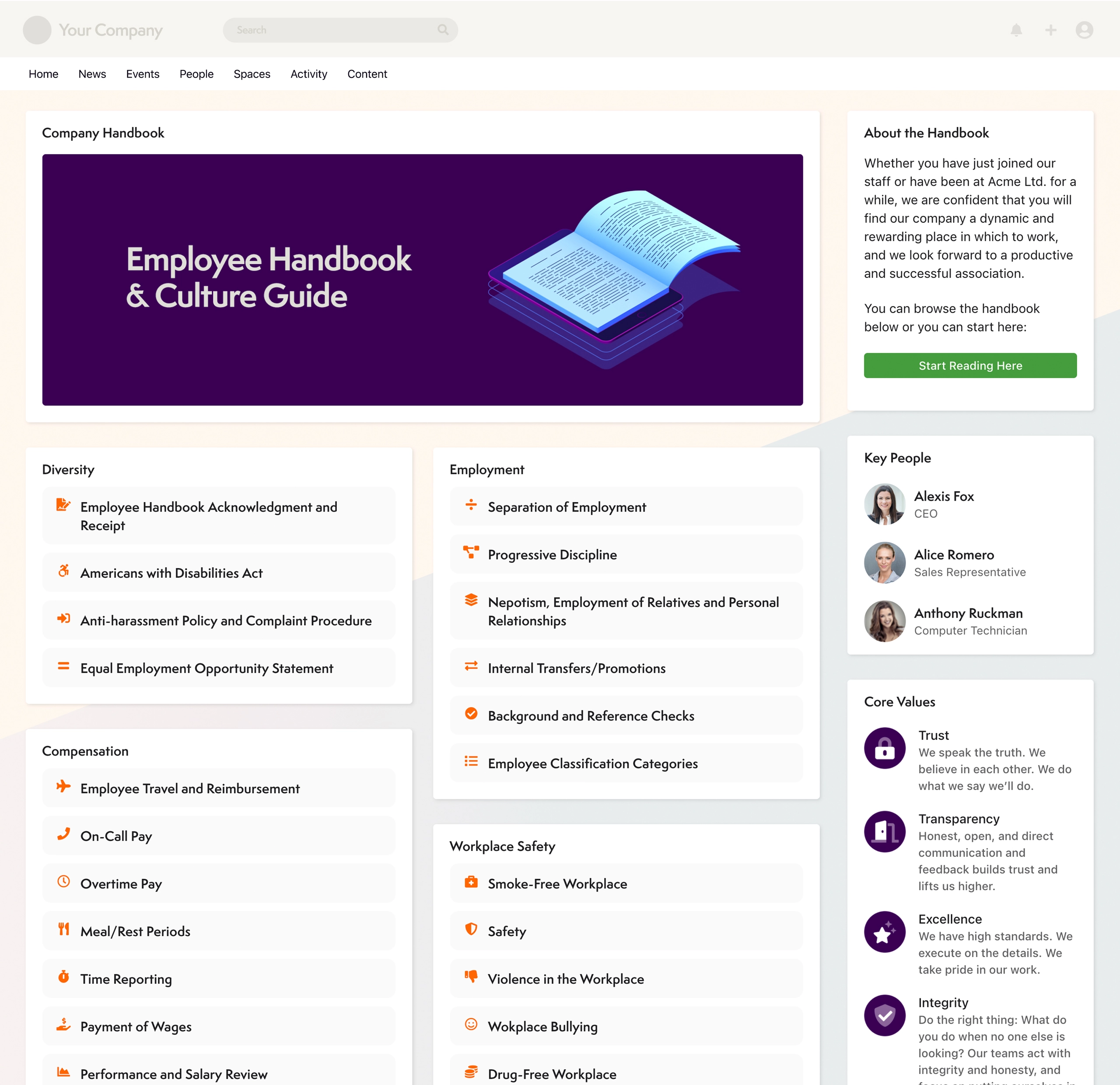
Axero's Communifire is an Enterprise Social and Collaboration platform. Used internally, it connects employees, key customers and partners to pursue shared goals. Used to build an online community, it puts the emphasis on working together, not just meeting socially. The platform, designed to encourage the spread and expansion of ideas is suited for organizations that want their community to not only get connected but also feel they are getting things done.
N/A
Concrete CMS
Score 9.2 out of 10
N/A
Concrete CMS (formerly Concrete5) is a free and open source, PHP built content management system for content on the web and also for intranets. It is optimized to support the creation of online magazines and newspapers.
N/A
Pricing
Axero
Concrete CMS
Editions & Modules
No answers on this topic
No answers on this topic
Offerings
Pricing Offerings
Axero
Concrete CMS
Free Trial
Yes
No
Free/Freemium Version
No
Yes
Premium Consulting/Integration Services
No
No
Entry-level Setup Fee
No setup fee
No setup fee
Additional Details
Axero tailors your investment to meet your unique needs. Custom pricing and volume discounting available. Contact Axero for details.
—
More Pricing Information
Community Pulse
Axero
Concrete CMS
Features
Axero
Concrete CMS
Security
Comparison of Security features of Product A and Product B
Axero
-
Ratings
Concrete CMS
9.5
Ratings
16% above category average
Role-based user permissions
00 Ratings
9.50 Ratings
Platform & Infrastructure
Comparison of Platform & Infrastructure features of Product A and Product B
Axero
-
Ratings
Concrete CMS
9.7
Ratings
24% above category average
API
00 Ratings
9.70 Ratings
Internationalization / multi-language
00 Ratings
9.70 Ratings
Web Content Creation
Comparison of Web Content Creation features of Product A and Product B
Axero
-
Ratings
Concrete CMS
8.4
Ratings
8% above category average
WYSIWYG editor
00 Ratings
9.30 Ratings
Code quality / cleanliness
00 Ratings
10.00 Ratings
Admin section
00 Ratings
10.00 Ratings
Page templates
00 Ratings
10.00 Ratings
Library of website themes
00 Ratings
4.20 Ratings
Mobile optimization / responsive design
00 Ratings
9.70 Ratings
Publishing workflow
00 Ratings
7.70 Ratings
Form generator
00 Ratings
6.60 Ratings
Web Content Management
Comparison of Web Content Management features of Product A and Product B
Specific scenarios where Communifire would be well suited to an organisation, would be companies that are people focused and committed to frequent and open communication channels from both the top-down and bottom-up. It also would suit organizations that are committed to providing the staff opportunities to collaborate, share and actively contribute to company initiatives and planning. If these aren't elements of your organization's culture, the system would still work for you or those companies who just want to push information out and have an effective intranet. Communifire would cater to these scenarios just as well and is more than capable of providing that type of simple solution.
Concrete5 is perfect for a website that needs to be regularly updated without accessing the code, whether that be because a developer created your site for you, or because you yourself are a developer who wants to keep the time spent on updates down.
In my experience, it's less useful for modern web apps such as PWAs that would benefit more from technologies such as React and Vue.
Concrete5 has a modular editing system, so you can edit the pages without having knowledge of coding. You just pick the module you want to insert or edit and click where you want it to go.
You are able to edit modules in an HTML format if you would like to, so if you have the knowledge you can have even more control over your modules.
You can also edit entire page themes by selecting them from the page layout menu. This allows you a greater versatility of the pages on your site.
Concrete5.6 websites have no good path to migrate to 5.7, short of manual content migration. This is a big problem and affected the user community negatively.
Some features that were available as paid add-ons in 5.6, such as discussion forums and e-commerce shopping cart, are missing from newer versions 5.7/5.8.
Starting to develop add-ons and customizations for Concrete5 can be challenging as 5.7/5.8 documentation is not yet complete.
Our business depends upon this software to provide information on all aspects of our business. The future of business is a marriage between web site and customer interaction. This software will allow us to move in that direction.
I have had nothing but good experiences with Concrete5. I have used it on several client websites and even several of my own sites. It is the leading CMS I will go to if I have a need to dynamically update content on a website by people who are typically untrained. They have solved every angst I had with the other solutions I have evaluated in the past and continue to be the simplest to implement and customize.
This rating has a caveat - there is always room for improvement, and this team gets it. You always learn from customers how to do things better and easier, so it is a constant learning of how people use the site. Although the search engine is exceptional, most people do not use it as their first line of research. Much of the usability has to do with layout - and is not just a software usability item, so the rating is severely dependent up on the layout/options you choose for your usage. And their team will do anything in their power to get the results and layout you want. The areas that need improvement - and acknowledged by the team - are the administrative tools. There are a ton of options, and it takes a little to learn some of those. For most people, however, this won't be an issue, because the support team will always help you. This is always the case with more power. If there were fewer options it would no doubt be easier, but they give you the keys to all of the cars in the lot; so a little more to learn.
Although there is a slight learning curve (as with any software), it is very easy to use once you get a hold of it. It is easy to upload and manage files (and other digital assets), and the drag-n-drop interface on the front-end is easy for end-users to understand
Since it's not tied to a central server (other than for authorizing updates and assigning licenses to specific sites), it's available pretty much 100% of the time.
The site works extremely well, the front end flies, searches and form submissions are very fast indeed. The reason its a 9 not a ten? the back end can be a little slow at times, and this is unfair, because for the backend to be so amazing, it has to do a huge amount of work!
Concrete5 is open-source and has an incredibly strong, polite, and supportive community. You can get an answer to nearly anything you want to do with Concrete5 by googling for it, searching the Concrete5 discussion forums or stack overflow, or posting your question to the forum. Members are very courteous and do not look down on those with less knowledge. And answers are always quick, informative, and supportive.
It's important that any CMS is implemented by a skilled developer. Content management is not a commodity. One of the keys I've found with Concrete5 is to create a homogenous content-entry method (e.g. focus on in-context editing OR focus on using the Composer feature). This seems to make it more likely that site editors will be able to easily come back to editing after a layoff without having to "remember" too much.
I evaluated a number of platforms. Here's the list: Mango Apps, Jive, Jostle, Zyncro, Bitrix 24, Exo platform, Huddle, Confluence, Hip Chat, Wrike, Hive. Some of the other platforms were really nice but Communifire was the platform that best meet our needs.
I didn't have to spend too much time learning Concrete CMS, whereas I had to spend a long time learning other CMSs. After struggling to develop a plugin for WordPress, developing an add-on for Concrete CMS was piece of cake thanks to many available APIs. Making custom themes and blocks was much easier than WordPress.
Faster, more consistent onboarding. We host all training materials in an easy-to-access and easy-to-update space.
Better product knowledge = greater sales. We post training information about new products for immediate use by all team members.
Better communication within the store team translates to better customer service. Keeping part time team members up-to-date has always been a challenge. Now they are able to catch up quickly when they get to the store.