Azure Analysis Services delivers enterprise-grade BI semantic modeling capabilities with the scale, flexibility, and management benefits of the cloud. Azure Analysis Services helps transform complex data into actionable insights. Azure Analysis Services is built on the analytics engine in Microsoft SQL Server Analysis Services.
N/A
Looker
Score 8.7 out of 10
N/A
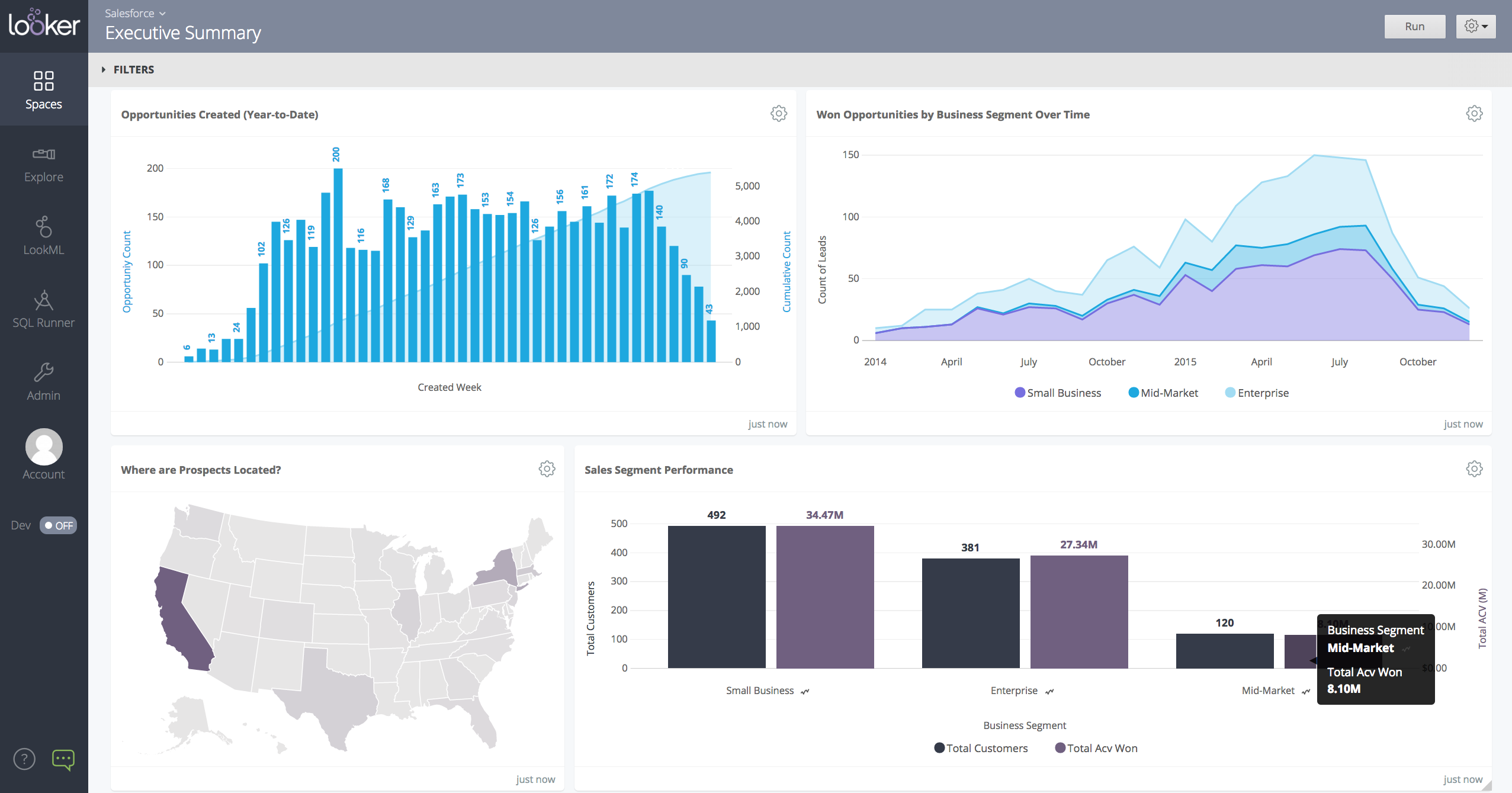
Looker is a BI application with an analytics-oriented application server that sits on top of relational data stores. It includes an end-user interface for exploring data, a reusable development paradigm for data discovery, and an API for supporting data in other systems.
N/A
Pricing
Azure Analysis Services
Looker
Editions & Modules
No answers on this topic
No answers on this topic
Offerings
Pricing Offerings
Azure Analysis Services
Looker
Free Trial
No
Yes
Free/Freemium Version
No
No
Premium Consulting/Integration Services
No
No
Entry-level Setup Fee
No setup fee
Required
Additional Details
—
Must contact sales team for pricing.
More Pricing Information
Community Pulse
Azure Analysis Services
Looker
Features
Azure Analysis Services
Looker
BI Standard Reporting
Comparison of BI Standard Reporting features of Product A and Product B
Azure Analysis Services
8.7
Ratings
6% above category average
Looker
8.7
Ratings
6% above category average
Pixel Perfect reports
8.90 Ratings
8.80 Ratings
Customizable dashboards
8.70 Ratings
9.00 Ratings
Report Formatting Templates
8.50 Ratings
8.40 Ratings
Ad-hoc Reporting
Comparison of Ad-hoc Reporting features of Product A and Product B
Azure Analysis Services
9.0
Ratings
11% above category average
Looker
8.5
Ratings
5% above category average
Drill-down analysis
9.00 Ratings
8.20 Ratings
Formatting capabilities
8.90 Ratings
7.80 Ratings
Integration with R or other statistical packages
8.90 Ratings
8.80 Ratings
Report sharing and collaboration
9.00 Ratings
9.20 Ratings
Report Output and Scheduling
Comparison of Report Output and Scheduling features of Product A and Product B
Azure Analysis Services
9.0
Ratings
8% above category average
Looker
8.8
Ratings
6% above category average
Publish to Web
9.10 Ratings
8.40 Ratings
Publish to PDF
8.90 Ratings
9.10 Ratings
Report Versioning
9.40 Ratings
8.60 Ratings
Report Delivery Scheduling
9.00 Ratings
9.20 Ratings
Delivery to Remote Servers
8.70 Ratings
00 Ratings
Data Discovery and Visualization
Comparison of Data Discovery and Visualization features of Product A and Product B
Microsoft Azure Analysis Services is best tool which is well suited for many type of scenarios. Like if the organization is dealing with a lot of critical data and need some better analysis and insights for that data then tool serves the best. It helps in depth analysis and getting the desired result which helps in making big decision for any organization. We can create role based access for sensitive data hence it is very helpful for security point of view. Helps in making the business more productive and taking decision based on facts. It is less appropriate for scenarios like where data amount is less and the solution is very costly and someone can get a cheaper solution. Also not suited for environment where user directory do not exist because without the help of user directory role could not be created hence proper utilization of this tool will not be possible.
When you need to create a centralised dashboard for multiple stakeholders that blends cross-channel reporting. As an SEO agency reporting for clients - Looker is a great solution. It's less appropriate depending on the intended users. For instance, in my experience Looker reports have been under-utilised because they're not accessed regularly, provide too much noise or often simple PDF reports are preferred
Microsoft Azure Analysis Services is very costly solution and in that price we can get some better business intelligence tool with lot more of capabilities
The dashboard or we can say user interface is complex and need time to understand and gain expertise in order for proper working.
It needs continuation monitoring which is sometime a big task.
Sometime, the tool shows unusual behavior and become unstable, so we need to clear temp files for proper functioning.
We are very haooy with Looker, it provides us with all the funciomalities we need for both the day to day oerformance tracking and longer periods reporting. It is easy to use for account managers, configurable and customizable for soecialists and what is most imoortant, our clinets generally really love it
Looker is relatively easy to use, even as it is set up. The customers for the front-end only have issues with the initial setup for looker ml creations. Other "looks" are relatively easy to set up, depending on the ETL and the data which is coming into Looker on a regular basis.
Somehow resources heavy, both on server and client. I recommned at least 50Mbs data rate and high performance desktop comouter to be abke to run comolex tasks and configure larger amount of data. On the other hand, the client does not need to worry when viewing, the performance is usually ok
Never had to work with support for issues. Any questions we had, they would respond promptly and clearly. The one-time setup was easy, by reading documentation. If the feature is not supported, they will add a feature request. In this case, LDAP support was requested over OKTA. They are looking into it.
We have used the IBM cloud which was truly a specific nightmare for our team. User experience, layout, and design is big for us as it understandably is with many people. Even if any type of program can technically do all that we need it to, we still found our team will not be as motivated or satisfied using it compared to something more visually appealing and smooth.
In my opinion, Looker is no Power BI. It is good, but I think Power BI is amazing. That said, in my experience, Power BI is nowhere near as easy to setup and report on Google services as Looker is. We plan to continue using Power BI for c-suite and corporate reporting, especially for internal databases, but will gladly use Looker for our marketing information for AdWords, Analytics, Search Console, and YouTube.
Other than some people not liking the numbers, I don't see any negative impacts; we haven't experienced that.
The reports help us unravel the story of our users and how they are sifting through our pages.
Our clients enjoy seeing the numbers to understand better what stands out on their sites.
The reports have helped us see what campaigns are working and where we need to tweak things.
The reports have enabled us to have better conversations with stakeholders about how their web pages should be modified, edited, etc., to reflect the data.