Azure API Management vs. MuleSoft Anypoint Platform

Overview
ProductRatingMost Used ByProduct SummaryStarting Price
Azure API Management
Score 7.9 out of 10
N/A
Microsoft's Azure API Management supports creation of API.
$0.04
Lightweight and serverless version of API Management service, billed per execution
Anypoint Platform
Score 7.8 out of 10
N/A
The Anypoint Platform developed by MuleSoft and acquired by Salesforce in early 2018 is designed to connect apps, data, and devices anywhere, on-premises or in the cloud. This platform was built to offer out-of-the-box connectors as well as tools that architects and developers can adopt quickly to design, build and manage the entire lifecycle of their APIs, applications, and products.N/A
Pricing
Azure API ManagementMuleSoft Anypoint Platform
Editions & Modules
Consumption
0.042 per 10,000 calls
Lightweight and serverless version of API Management service, billed per execution
Developer
$48.04
per month Non-production use cases and evaluations
Basic
$147.17
per month Entry-level production use cases
Standard
$686.72
per month Medium-volume production use cases
Premium
$2,795.17
per month High-volume or enterprise production use cases
Isolated
TBA
per month Enterprise production use cases requiring high degree of isolation
No answers on this topic
Offerings
Pricing Offerings
Azure API ManagementAnypoint Platform
Free Trial
NoYes
Free/Freemium Version
NoYes
Premium Consulting/Integration Services
NoNo
Entry-level Setup FeeNo setup feeNo setup fee
Additional Details
More Pricing Information
Community Pulse
Azure API ManagementMuleSoft Anypoint Platform
Considered Both Products
Azure API Management
Chose Azure API Management
Apigee is by Google and seems to be promising. The cost seems high though. With Azure, we do not have to make any special purchases. CapEx vs OpEx! But, Apigee could be more environment independent compared to Azure APIM. The promise of speed by Apigee is also better compared …
Chose Azure API Management
It’s a great tool, and so easy to seamlessly connect into your current Azure world that it’s hard not to look at it or even test the waters with it. It’s priced well, and is feature-rich enough to accomplish most tasks. I think the ease of having everything together and the …
Chose Azure API Management
Azure APIM vs Amazon API Gateway:
1) Azure APIM was a complete package that included a developer portal.
2) We are very Microsoft centric - so the Microsoft product suite aligned very well with our business needs.
Anypoint Platform
Chose Anypoint Platform
AWS is a very good tool but still evolving and offers a small set of API management features. The main reason why we chose MuleSoft Anypoint Platform API Manager is because it is well suited with the APIs developed in Mule ESB.
Chose Anypoint Platform
Mulesoft is a more modern, flexible, and faster-performing integration suite than traditional providers.
Chose Anypoint Platform
Once we have moved all of our system integration APIs to the MuleSoft Anypoint Platform, we will need to communicate with a wide variety of external systems. All of our business and service logic is stored in the aforementioned core systems. Anypoint Platform (and all of our …
Chose Anypoint Platform
Overall a better experience in pricing negotiation with the Sales team. The breadth of services offered by Mulesoft was really important and the expertise offered by our consulting partner influenced the decision. The overall deployment was completed well within the timelines. …
Chose Anypoint Platform
Once we use [MuleSoft] Anypoint Platform to host all our system integration APIS, we need to exchange data with a lot of different resources. Those listed systems are our main systems that hold all business and logic behind our service. The integration from Anypoint Platform …
Chose Anypoint Platform
We selected Mulesoft for speed of implementation. We did not have the luxury of time and needed a solution that can be learned and implemented within weeks so we can take advantage of newly formed partnerships. The training that was provided to use during our pre-sales and …
Chose Anypoint Platform
We believe Anypoint Platform is best in breed and has features that match nearly any other iPaaS offering. It also allows for accomplishing much more challenging and complex integrations due to the ability to connect to nearly any system, use custom connectors, and embed …
Chose Anypoint Platform
The main problem with this software is the different connector type that is used for different protocols except for a different SAP connector. There is only one connector called SAP. It will be great if there will have a different connectors like idoc, RFC, proxy, etc.
Chose Anypoint Platform
Anypoint has tons of capabilities baked in one platform, and other competitors like Built.io or Workato may not have all those like Anypoint Exchange. However where these products shine are in usability, as it's ridiculously easy to build integrations using Built.io. I was …
Chose Anypoint Platform
Anypoint Platform is really very easy to adopt for application integration. Simple UI and easy data weave language allows user to focus on business portion only. The API management and deployment of application are hassle free. We have selected Anypoint platform because it is …
Chose Anypoint Platform
Dell Boomi is kind of similar in drag and drop implementation. However, it doesn't have as many connectors (shapes in Dell Boomi). Moreover, it also doesn't have deployment stuff on its own.

Informatica is way behind Dell Boomi and Anypoint Platform, but users are still using it …
Chose Anypoint Platform
Compared to Dell Boomi the API management suite of Mulesoft is much mature, however if its only about the integration , then i would always go for Dell Boomi, as there is no infrastructure setup that needs to be done from the developer's end.

APIGEE api management is as good as …
Chose Anypoint Platform
The main reason why we chose Anypoint API Manager is because it is well suited with the APIs developed in Mule ESB. AWS, on the other hand, is a very good tool but still evolving and offers a small set of API management features.
Chose Anypoint Platform
API led architecture focus with a decent API ecosystem for developer collaboration, policy management and declarative implementation. Batch processing, visualization, Anypoint MQ and ObjectStore leave a lot to be explored. Multiple deployment models make it worth considering.
Chose Anypoint Platform
It enables customers to expose their APIs in a very simple and fast way. It can be used by non-expert developers. It is compliant with all major connection and data representation world standard.
Chose Anypoint Platform
TIBCO BusinessWorks and WSO2 Enterprise Service Bus
Chose Anypoint Platform
We provide options to customers to choose from the best tools. Customers are the decision makers. Personally, because of open-source and large community base, MuleSoft is the repo in the market.
Chose Anypoint Platform
It is a powerful tool with smart intelligence. The drag and drop feature makes my work easy. The tool has great connecting support which is the best reason to use the tool on a daily basis. Powerful functionality with designing and implementing APIs. Hosted on public IP.
Features
Azure API ManagementMuleSoft Anypoint Platform
API Management
Comparison of API Management features of Product A and Product B
Azure API Management
8.0
Ratings
4% below category average
MuleSoft Anypoint Platform
-
Ratings
API access control8.90 Ratings00 Ratings
Rate limits and usage policies5.40 Ratings00 Ratings
API usage data8.90 Ratings00 Ratings
API user onboarding9.00 Ratings00 Ratings
API versioning8.90 Ratings00 Ratings
Usage billing and payments5.20 Ratings00 Ratings
API monitoring and logging9.80 Ratings00 Ratings
Cloud Data Integration
Comparison of Cloud Data Integration features of Product A and Product B
Azure API Management
-
Ratings
MuleSoft Anypoint Platform
6.9
Ratings
15% below category average
Pre-built connectors00 Ratings7.50 Ratings
Connector modification00 Ratings7.20 Ratings
Support for real-time and batch integration00 Ratings6.70 Ratings
Data quality services00 Ratings6.00 Ratings
Data security features00 Ratings6.50 Ratings
Monitoring console00 Ratings7.20 Ratings
Best Alternatives
Azure API ManagementMuleSoft Anypoint Platform
Small Businesses
NGINX
NGINX
Score 9.2 out of 10
Make
Make
Score 8.9 out of 10
Medium-sized Companies
NGINX
NGINX
Score 9.2 out of 10
IBM App Connect
IBM App Connect
Score 9.5 out of 10
Enterprises
NGINX
NGINX
Score 9.2 out of 10
IBM App Connect
IBM App Connect
Score 9.5 out of 10
All AlternativesView all alternativesView all alternatives
User Ratings
Azure API ManagementMuleSoft Anypoint Platform
Likelihood to Recommend
8.0
(0 ratings)
7.6
(0 ratings)
Likelihood to Renew
-
(0 ratings)
9.0
(0 ratings)
Usability
-
(0 ratings)
7.0
(0 ratings)
Support Rating
-
(0 ratings)
6.8
(0 ratings)
User Testimonials
Azure API ManagementMuleSoft Anypoint Platform
Likelihood to Recommend
The range of policies that enable the APIs to loosely couple it with security, rate limit, retry, etc. are good. We can easily tie authentication mechanisms to external and other internal services without having to modify the backend.
Read full review
MuleSoft Anypoint Platform is best tool in the market for developing APIs with complex structures communicating with various different types of applications including web applications as well as legacy applications. Also applications including database connectivity for fetching and updating data in the DB tables. I cant think of any scenario which MuleSoft Anypoint Platform could not be used for developing the integrations.
Read full review
Pros
  • Management of APIs
  • Security of the API through Azure AD, AD B2C etc.
  • Providing an outer layer through APIs
Read full review
  • Provides wide range of popular connectors like salesforce, netsuite, sftp and many more. A user can easily integrate with those services using specific connector.
  • Support API development using RAML and desing tool. The platform is very good in data type classification.
  • Cloud deployment and post deployment monitoring is easy. A user can configure application worker as per need. Alert and notifications are real time.
Read full review
Cons
  • Cost - the upfront cost is a bit restrictive. I've been told it is because there are a few underlying VMs that are running this service. So if you're just starting out with API management, it can be an expensive proposition. Value increases as you add additional APIs. If you're using Azure B2C for the developer portal, you'll require Standard or Premium since they support AAD integration.
  • Security granularity - at time of writing, APIM doesn't support breaking out operations to products. For example, if you have an API that has a GET and a POST operation, and you want the POST operation to require a different subscription. There is a work around, but it makes management a bit messy.
  • Developer and Publisher portal - it's a little weird. Microsoft hasn't migrated all the publisher portal functionality into the "native" Azure portal. So some of it feels a little weird - especially when working with the content management side of things for the developer portal.
  • Scaling - while it's easy to scale up, the cost of APIM ramps up very quickly. Standard -> Premium is a 4x jump.
Read full review
  • Has more features than what we really need so we're paying for more than we use. Sort of like paying for an Abrams tank when all we really need is a Toyota Corolla.
  • Not a value product, tends to be expensive.
  • Takes a while for developers to learn to use Mulesoft Anypoint.
Read full review
Usability
No answers on this topic
MuleSoft Anypoint Platform is really very easy to adopt for application integration. Simple UI and easy data weave language allows user to focus on business portion only. The API management and deployment of application are hassle free.
Read full review
Support Rating
No answers on this topic
Anypoint Platform support is very responsive. There is also a huge knowledge base and an active online forum where answers to most questions can be found. When needed support engages the engineering group so adequate solutions or workarounds are always provided.
Read full review
Alternatives Considered
Azure APIM vs Amazon API Gateway:
1) Azure APIM was a complete package that included a developer portal.
2) We are very Microsoft centric - so the Microsoft product suite aligned very well with our business needs.
3) It was faster and easier to stand up Azure APIM for testing than it was for the Amazon API Gateway.
Read full review
Once we have moved all of our system integration APIs to the MuleSoft Anypoint Platform, we will need to communicate with a wide variety of external systems. All of our business and service logic is stored in the aforementioned core systems. Anypoint Platform (and all of our APIs) makes it easy to connect to various other platforms. In order to link to these many other systems, connectors and/or components are utilized, and they are simple to configure and integrate.
Read full review
Return on Investment
  • It’s really pay as you go, so it's not that costly to get in and try it out. There’s no expensive client to buy and manage, but you do need to stay on top of the rapidly changing Azure environment to be sure you upgrade or adjust when needed.
  • It’s not great having more than one API tool, but it’s ok to spread out your work, as you always want the right tool for the right job. For example, if you are a Salesforce-heavy organization, I’d go with Mule over Azure.
  • It was easy getting an external consultant access to the tool to build their own API for a project they were working on for us.

Read full review
  • Mulesoft can be used to provide an integration platform to a large number of systems like Salesforce, ODBC, JDBC, SAP, Mongo DB, etc.
  • An excellent option to develop microservices and real-time integrations.
  • Not as robust in handling large data volumes, Informatica is better in that respect.
Read full review
ScreenShots

Anypoint Platform Screenshots

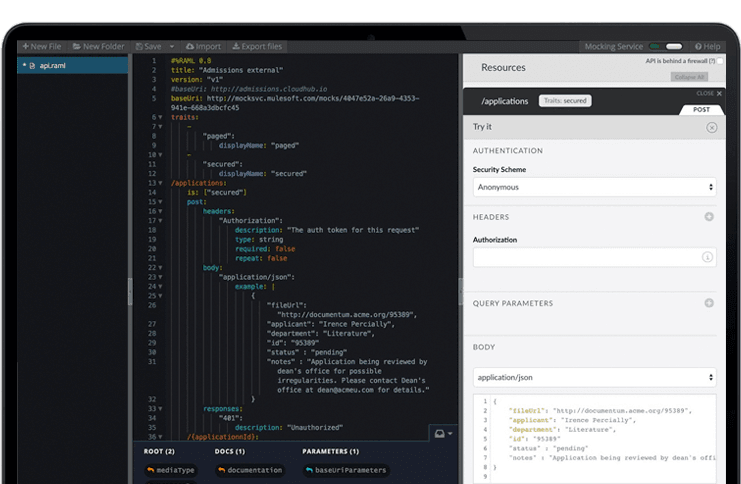
Screenshot of Connect any endpoints using out-of-the-box connectors, dynamic connectivity to API specifications, or by building reusable connectors with Anypoint DevKit™.Screenshot of A reporting suite that provides a real-time view of API consumption trends and operational performance. Analytics provides insight into how your API is being used and informs forward-looking design decisions.Screenshot of A platform to engage with API developers and drive adoption. Share documentation, examples and manage developer access from a single platform.