Azure DevOps (formerly VSTS, Microsoft Visual Studio Team System) is an agile development product that is an extension of the Microsoft Visual Studio architecture. Azure DevOps includes software development, collaboration, and reporting capabilities.
$2
per GB (first 2GB free)
Pantheon
Score 8.6 out of 10
N/A
Pantheon is a WebOps platform where marketers and developers collaborate to drive results. The vendor states that with Pantheon, site owners maximize their capacity to update website design and functionality, responding to market trends, catering to consumer behavior, and adding real value to the business's bottom line. Today, companies compete on the basis of digital experiences, and the best results emerge from an agile build-test-learn process. Whether it's publishing content,…
$29
per month
Pricing
Azure DevOps Services
Pantheon
Editions & Modules
Azure Artifacts
$2
per GB (first 2GB free)
Basic Plan
$6
per user per month (first 5 users free)
Azure Pipelines - Self-Hosted
$15
per extra parallel job (1 free parallel job with unlimited minutes)
Azure Pipelines - Microsoft Hosted
$40
per parallel job (1,800 minutes free with 1 free parallel job)
Jira is fantastic for project management and customer facing portal. It is not good for pure development (no integration with Git, pipeline management, automated testing features). If DevOps were to integrate and adopt the project features of Jira as well as the customer facing …
The moment I have been working with this tool everything has benn operating efficiently. The software development process has borne positive results under scalable environment. The cost of running Azure DevOps Services us much lower as compared to other tools in the market. It …
ADO has better linking than Confluence and is adaptable for a specific need, whereas Confluence might be a bit more rigid, but it's also sort of along the same lines as to what can be done with both tools. ADO also had an ease of use to it and can do a bunch of stuff with it, …
Jira is super clunky and doesn't behave in a modern fashion. monday.com is too flexible and doesn't provide enough feature set. AWS is the most competitive, but it's hard to wrap your brain around all of the features and offerings provided by amazon. ADO does a better job of …
Azure DevOps has a drag and drop editor so that you can quickly drag build steps into a build or release pipeline. This is much faster than looking up the correct yaml syntax. Additionally, its support for Microsoft and Azure is great. If you're on the .net stack or you use …
Microsoft Planner is used by project managers and IT service managers across our organization for task tracking and running their team meetings. Azure DevOps works better than Planner for software development teams but might possibly be too complex for non-software teams or …
Trello is simple to use, but it's only for a Kanban board. Jira might be the same, but I don't really have enough experience with Jira to fully compare them. When I used it, it missed certain functionalities that I was used to in Azure DevOps. Visually it's a lot different too.
Azure DevOps Services have huge functionality and are well supported by Microsoft as well. You will get plenty of features in the marketplace and learning documentation.
Writing the Docker Images, Storing them in Azure Container Registry and then Deploying onto Azure Kubernetes Services is an Easier process which no other software/product is currently providing in the market. Best till date in terms of End to End deployment and maintaining …
Azure DevOps is widely used because of its collaboration and integration with various other tools. Here the assign of the sub task is quite easy compare to Jira. Also Azure Devops can we integrate easily with Git for better code representation and versioning. It reporting is …
Azure DevOps is a completed product and ecosystem. It offers a robust ecosystem that does everything that is needed. The above products do lack features like pipelines tasks, third-party integrations. Besides all cloud benefits, the main advantage of Azure DevOps Services …
Currently, we use both products, however, we use more the Atlassian suite. We have started recently using Azure DevOps for specific implementations and projects. We don't have any plan yet to migrate all our projects to Azure DevOps, we may in the next couple of years. …
We tested alternatives for Azure DevOps over time. We tested GitHub a while ago and back then lack of some features that now hast, like the project boards and private repositories. We will check GitHub next year.
We also tested AWS CodeCommit and found it very cryptic, …
Beside all cloud benefits, the main advantage Azure DevOps Services compared to Azure DevOps Server is the easier remote access for third party team members, and always up to date software. On the other hand, on prem deployment (Azure DevOps Server) makes complex access or …
The greatest strength of Azure DevOps Services (formerly VSTS) is that it's a one-stop solution for all agile project management instead of setting up bits of different software put together for each and every need. Azure DevOps Services (formerly VSTS) has a great ecosystem …
I prefer Azure Devops over all other code repository / ci/cd systems that I've used in the past. All features are integrated into a single service (back log, repo mgmt, deployment pipelines, artifacts, etc.). The tools are easy to use and super powerful.
Our company is already using a lot of Azure services and it makes more sense to start using Azure DevOps Services (formerly VSTS) when we needed a CI/CD tool. We tested different features of Azure DevOps Services (formerly VSTS) and found out that the build and release …
One of the foremost reasons that acted in favor of Azure DevOps was its all-in-one packed web portal which enabled easy access to all the CI/CD tools and kits. Customizable screens, notifications via Teams/mails, project views, etc. Most other tools/products offer only part of …
While GitLab has the same features as Azure DevOps, and a potentially more competitive price, its project management features are a bit more primitive. It could be helpful for small projects, but ultimately for our larger projects we went with Azure DevOps. Bitbucket has good …
Azure DevOps provides a full workflow from planning through to development through to production. After the acquisition of GitHub by Microsoft, GitHub is becoming more fully-featured with the features being ported becoming more polished in the transition. Both are great …
DevOps is more full-featured than its on-prem predecessor or any of the above with the possible exception of the Atlassian suite. I would say those two are roughly comparable. However, the ease of integration is much better with DevOps and other Microsoft products (although …
They are really close. Azure DevOps is better because of the deep integration with Microsoft technologies. Jira is better on the customization side. However, Azure DevOps is really improving on that front. They are releasing new features every other week now. Azure DevOps also …
Acquia was terrible. We use DigitalOcean for some all-purpose computing needs and Platform.sh for an application that does more computing and high-throughput processing where we do not want page views (API calls) to count against our usage.
Although it may seem a good fit for a company that needs extra control over the deployment process and development process, for a firm that is mainly concentrating on SEO, it would be an overkill. Pantheon provides that sweet automation that allows us to shed some weight on …
We use several hosting solutions depending on the client needs or what they were already setup on. Pantheon is very similar to them and offers similar services however one of the main features we use is the Multidev service which allows us to test pieces of work separately and …
I found Cloudways to be a better solution for our needs in comparison to Pantheon. With their integration of multiple hosting providers we had a wider selection of locations to choose from and finally a server nearer to our core audience.
Linode is good if you want to keep control of the infrastructure, webservers, etc. However, if you want to forget about it and focus in your website content; Pantheon will make your life much easier. acquia support system is terrible, it is slow and they send outdated …
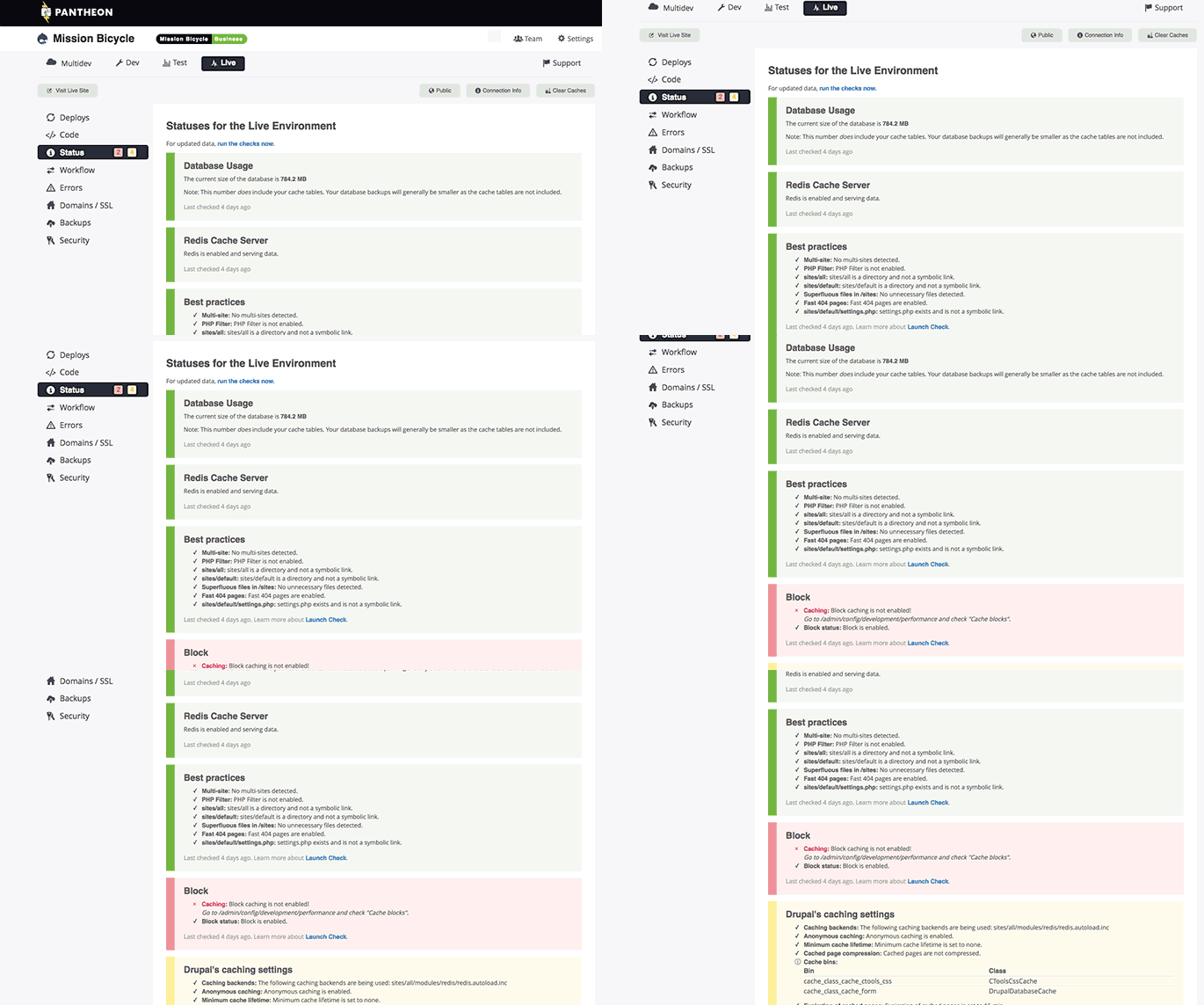
The differentiating advantage that Pantheon has is the incredibly intuitive workflow UI, with seamless GIT integrations between each environment: Dev, Test, and Live.
Pantheon stacks up fairly equally, and we chose Pantheon originally because, at the time of making our decision, they were the best partner for our business size, and who could help us through challenges that VIP could not. Today, we are with VIP as that was a faster and more …
Pantheon unlike the above platforms is very easy to use the features and even on initial features configuration and also the deployment on Cloud is excellent. Pantheon has great data and other marketing content management capabilities through Cloud services and the …
A lot of the other providers on this list are different from each other with very different target audiences. The only thing Pantheon can compare with is managed WordPress hosting, WordPress-related support, and hosting on Google Compute Engine. Pantheon wins hands down in …
GoDaddy can't compete with Pantheon's speed, support, and backed tools. We built a WordPress site for a client in Pantheon, they insisted on us moving it to their existing GoDaddy account, and within three months, they paid us to move it back to Pantheon because of the site's …
Pantheon is great because I can do everything and anything needed as a developer to get my clients satisfied. Drupal is the main CMS we use on Pantheon, and my experience has been pretty positive so far. I manage WordPress sites on my own, and that's easier to maintain for most …
Pantheon is leaps and bounds ahead of its competition in platform reliability, support, and platform features. The most important factor for us is uptime and support response times.
Pantheon provides stellar premium hosting for Drupal and WordPress. The platform is highly performant. Support is responsive and knowledgeable. System-enforced best practices improve site stability alongside rock-solid platform reliability. However, Pantheon absolutely charges …
Pantheon offers an advantage over WP Engine and Flywheel by offering hosting support for both Drupal and WordPress websites. Pantheon's pricing model could be much more competitive, however. Pantheon ended up winning out over Media Temple in World Literature Today's hosting …
Our former hosting company was Dreamhost. While we loved Dreamhost, especially since it was free for nonprofits, we were always flying by the seat of our pants developing and updating plugins on the live website. Pantheon's multi-dev platform allows us to work on several …
Pantheon's use of Git is much better than WP Engine, and Pantheon's interface is better. However, Pantheon costs more and would likely suit medium to larger organizations. GoDaddy's dedicated WordPress offering is much more restrictive compared with Pantheons and suits …
Pantheon has been only the product I have had experience within my entire working career. It performs effectively with great ROI on the overall production of our company. The deployment process was easy, and all our team members had less time learning how it operates. I have …
I have no experience with similar products though Pantheon has proven to be the best WebOps. It has all tools that we require in website infrastructure from development to launching. Our teamwork has enabled us to create websites that have boosted the growth of our organization …
ADO is well suited for the visibility of day-to-day tasks and responsibilities as well as things such as Features, user stories, etc. Off the top of my head, I can't think of any scenario where it might not be well suited, as you can customize ADO to your liking to a degree.
Great Cloud-based coordination platform which offers the team excellent capabilities on easy workflow management, multiple project activity tracking and easy to monitor all the project assets from one desk. Pantheon offers the best content management tools, strategic on development project life cycle management is excellent and the reporting features with Pantheon are effective and useful real-time data analytical capability.
Flexible Requirements Hierarchy Management: AZDO makes it easy to track items such as features or epics as a flat list, or as a hierarchy in which you can track the parent-child relationship.
Fast Data Entry: AZDO was designed to facilitate quick data entry to capture work items quickly, while still enabling detailed capture of acceptance criteria and item properties.
Excel Integration: AZDO stands out for its integration with MS Excel, which enables quick updates for bulk items.
Need to make the changes so that it doesn't occupy most of the CPU utilization and memory
Execution of Bulky SQl Queries leads to either the SQl being out of exception or the VS being unresponsive
Integration with Microsoft products is easy, but with non-Microsoft products it is more difficult, and you have to make a lot of configuration changes to integrate
With every upgrade of the Visual Studio, like from VS 2010 to VS 2013 , we need to upgrade our hardware/machine, as the VS hardware requirement also increases
If code is getting compiled in one visual studio, like in VS 2010, that the same code could possibly give an error when compiled in VS 2013, due to certain changes in keyword, data format, etc., with the VS upgrade
I don't think our organization will stray from using VSTS/TFS as we are now looking to upgrade to the 2012 version. Since our business is software development and we want to meet the requirements of CMMI to deliver consistent and high quality software, this SDLC management tool is here to stay. In addition, our company uses a lot of Microsoft products, such as Office 365, Asp.net, etc, and since VSTS/TFS has proved itself invaluable to our own processes and is within the Microsoft family of products, we will continue to use VSTS/TFS for a long, long time.
Azure DevOps is a powerful, complex cloud application. As such there are a number of things it does great and something where there is room for improvement. One of those areas would be in usability. In my opinion it relies too much on search. There is no easy way to view all projects or to group them in a logical way. You need to search for everything.
Monitoring of project development is very easy using a dashboard with its integration capability, showing all processes in a single screen which is easy to use and also easy to navigate through. A powerful tool that allows testing to be carried on without the user noticing any changes to the system and a highly interactive tool for groups and project members.
When we've had issues, both Microsoft support and the user community have been very responsive. DevOps has an active developer community and frankly, you can find most of your questions already asked and answered there. Microsoft also does a better job than most software vendors I've worked with creating detailed and frequently updated documentation.
Even tier 1 Pantheon chat and ticket support are knowledgeable, competent, and useful. They routinely understand and promptly resolve urgent, complex, and/or unusual issues that other hosts need to escalate to tier 2 or tier 3 support personnel. I honestly can't think of a truly negative or disappointing support experience in the years I've used Pantheon hosting for client websites.
Jira is fantastic for project management and customer facing portal. It is not good for pure development (no integration with Git, pipeline management, automated testing features). If DevOps were to integrate and adopt the project features of Jira as well as the customer facing interfaces, I feel it would be a complete project management system.
Acquia was terrible. We use DigitalOcean for some all-purpose computing needs and Platform.sh for an application that does more computing and high-throughput processing where we do not want page views (API calls) to count against our usage.