Boomi is a cloud-based, on-premise, or hybrid integration platform. It offers a low-code/no-code
interface with the capacity for API and EDI connections for integrating with external organizations and
systems, as well as compliance with data protection regulations.
$550
per month
Anypoint Platform
Score 7.8 out of 10
N/A
The Anypoint Platform developed by MuleSoft and acquired by Salesforce in early 2018 is designed to
connect apps, data, and devices anywhere, on-premises or in the cloud. This platform was built to
offer out-of-the-box connectors as well as tools that architects and developers can adopt quickly to
design, build and manage the entire lifecycle of their APIs, applications, and products.
Boomi is one of the best integration platforms out there, but it still has its niche. It is suitable for most integration scenarios especially those that doesn't require very high throughput. The runtime could be hosted on-prem and in the cloud or even in a hybrid mode, which …
MuleSoft and Boomi are built on totally different frameworks. Mulesoft is an API-led network whereas Boomi is an ETL middleware approach. In easy words, Mulesoft can connect to several apps and business units, can create and reuse multiple components. Boomi offers only …
Mulesoft was evaluated by [and] definitely was not the right fit for the organization considering the type of integrations which were built in the enterprise historically. Dell Boomi on the other hand was more graphical and was more easy to use and is the best ipaas at the …
We have evaluated Mulesoft as well before going with Dell Boomi. The only difference is the Complete Cloud architecture provided by Boomi and also the ease of using the software, where you don't need to install anything on a developer machine or testing machine or any quality …
Dell Boomi - no installation. Start immediate coding - it's the best thing which I like. Now all PaaS providers are doing same. Dell Boomi entered the game first.
Even though Azuqua may be a bit more user friendly, Boomi can handle many more situations. Azuqua couldn't handle the majority of the processes we wanted to perform.
Dell Boomi is kind of similar in drag and drop implementation. However, it doesn't have as many connectors (shapes in Dell Boomi). Moreover, it also doesn't have deployment stuff on its own.
Informatica is way behind Dell Boomi and Anypoint Platform, but users are still using it …
Compared to Dell Boomi the API management suite of Mulesoft is much mature, however if its only about the integration , then i would always go for Dell Boomi, as there is no infrastructure setup that needs to be done from the developer's end.
Overall a better experience in pricing negotiation with the Sales team. The breadth of services offered by Mulesoft was really important and the expertise offered by our consulting partner influenced the decision. The overall deployment was completed well within the timelines. …
We selected Mulesoft for speed of implementation. We did not have the luxury of time and needed a solution that can be learned and implemented within weeks so we can take advantage of newly formed partnerships. The training that was provided to use during our pre-sales and …
We believe Anypoint Platform is best in breed and has features that match nearly any other iPaaS offering. It also allows for accomplishing much more challenging and complex integrations due to the ability to connect to nearly any system, use custom connectors, and embed …
Anypoint Platform is really very easy to adopt for application integration. Simple UI and easy data weave language allows user to focus on business portion only. The API management and deployment of application are hassle free. We have selected Anypoint platform because it is …
API led architecture focus with a decent API ecosystem for developer collaboration, policy management and declarative implementation. Batch processing, visualization, Anypoint MQ and ObjectStore leave a lot to be explored. Multiple deployment models make it worth considering.
We provide options to customers to choose from the best tools. Customers are the decision makers. Personally, because of open-source and large community base, MuleSoft is the repo in the market.
Dell Boomi is well-suited as a middleware to talk between systems. I am a personal fan of Dell's products and I enjoy this service. Dell Boomi is very easy to use, even to the less technically-inclined user. It is less appropriate to use in one system alone, but users would still find it functional in one system alone because it helps manage the system's metadata and allows that system to be integrated with other systems in the future.
MuleSoft Anypoint Platform is best tool in the market for developing APIs with complex structures communicating with various different types of applications including web applications as well as legacy applications. Also applications including database connectivity for fetching and updating data in the DB tables. I cant think of any scenario which MuleSoft Anypoint Platform could not be used for developing the integrations.
Provides wide range of popular connectors like salesforce, netsuite, sftp and many more. A user can easily integrate with those services using specific connector.
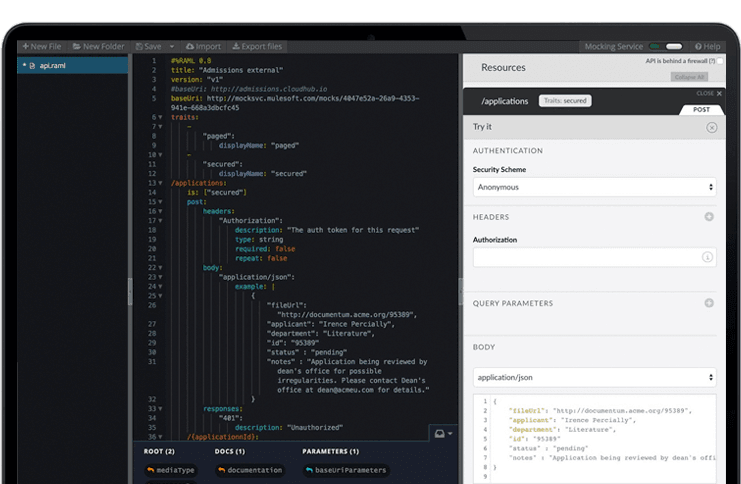
Support API development using RAML and desing tool. The platform is very good in data type classification.
Cloud deployment and post deployment monitoring is easy. A user can configure application worker as per need. Alert and notifications are real time.
More from a development perspective. It is always difficult to use the properties features. It takes a while to understand how the data/variables can be used across an integration.
Dell Boomi should also invest more on API Management and not just seen as a ETL,ESB tool.
Should roll out features more often based on users reviews.
Has more features than what we really need so we're paying for more than we use. Sort of like paying for an Abrams tank when all we really need is a Toyota Corolla.
Not a value product, tends to be expensive.
Takes a while for developers to learn to use Mulesoft Anypoint.
Dell Boomi has provided us with the ability to connect our campus together using our various existing platforms. There are many supported features and have yet to run into something that we cannot do. Its user interface is very intuitive which would allow users to begin developing fairly easily. There is a myriad of resources available
First of all, as a service (cloud service), we don't need to care about server maintenance any more, no worries about incorrect configurations, about down time. Second, for maintaining, we don't need a large team to do it. And of course, using Dell Boomi instead of manual transaction could help us to avoid people mistake while inputting data or doing transactions.
MuleSoft Anypoint Platform is really very easy to adopt for application integration. Simple UI and easy data weave language allows user to focus on business portion only. The API management and deployment of application are hassle free.
I would rate Dell Boomi as highly performant. We have used it for 4+ years and have not had any major issues with availability or speed. We also have not observed performance degradation when connecting it with other software solutions.
Boomi support was responsive and knowledgable, however being a closed cloud service, it doesn't have good community support. We found the learning curve to be steep and there aren't avenues like google, forums, or blogs that provide community driven insight into the product or how to go about designing solutions using the tool
Anypoint Platform support is very responsive. There is also a huge knowledge base and an active online forum where answers to most questions can be found. When needed support engages the engineering group so adequate solutions or workarounds are always provided.
MuleSoft and Boomi are built on totally different frameworks. Mulesoft is an API-led network whereas Boomi is an ETL middleware approach. In easy words, Mulesoft can connect to several apps and business units, can create and reuse multiple components. Boomi offers only on-premise and on-cloud integration solutions whereas MuleSoft is capable of providing on-premise, on-cloud as well as hybrid solutions. We can say that MuleSoft is much more flexible and offers multiple integration solutions.
Once we have moved all of our system integration APIs to the MuleSoft Anypoint Platform, we will need to communicate with a wide variety of external systems. All of our business and service logic is stored in the aforementioned core systems. Anypoint Platform (and all of our APIs) makes it easy to connect to various other platforms. In order to link to these many other systems, connectors and/or components are utilized, and they are simple to configure and integrate.
ROI was flat. Coding directly in apps we were knowledgable in would have been faster, but maintenance higher.
It brought good process to the integration team that was new, however I wouldn't say it was a huge gain monetarily. It is a valid path out of many paths for integration, but doesn't rule them all.