Catalytic headquartered in Chicago offers their Catalytic Automation Cloud, which they state is used by operations, finance, procurement, HR, and legal organizations to automate and orchestrate complex and variable processes.
N/A
Stackby
Score 9.0 out of 10
N/A
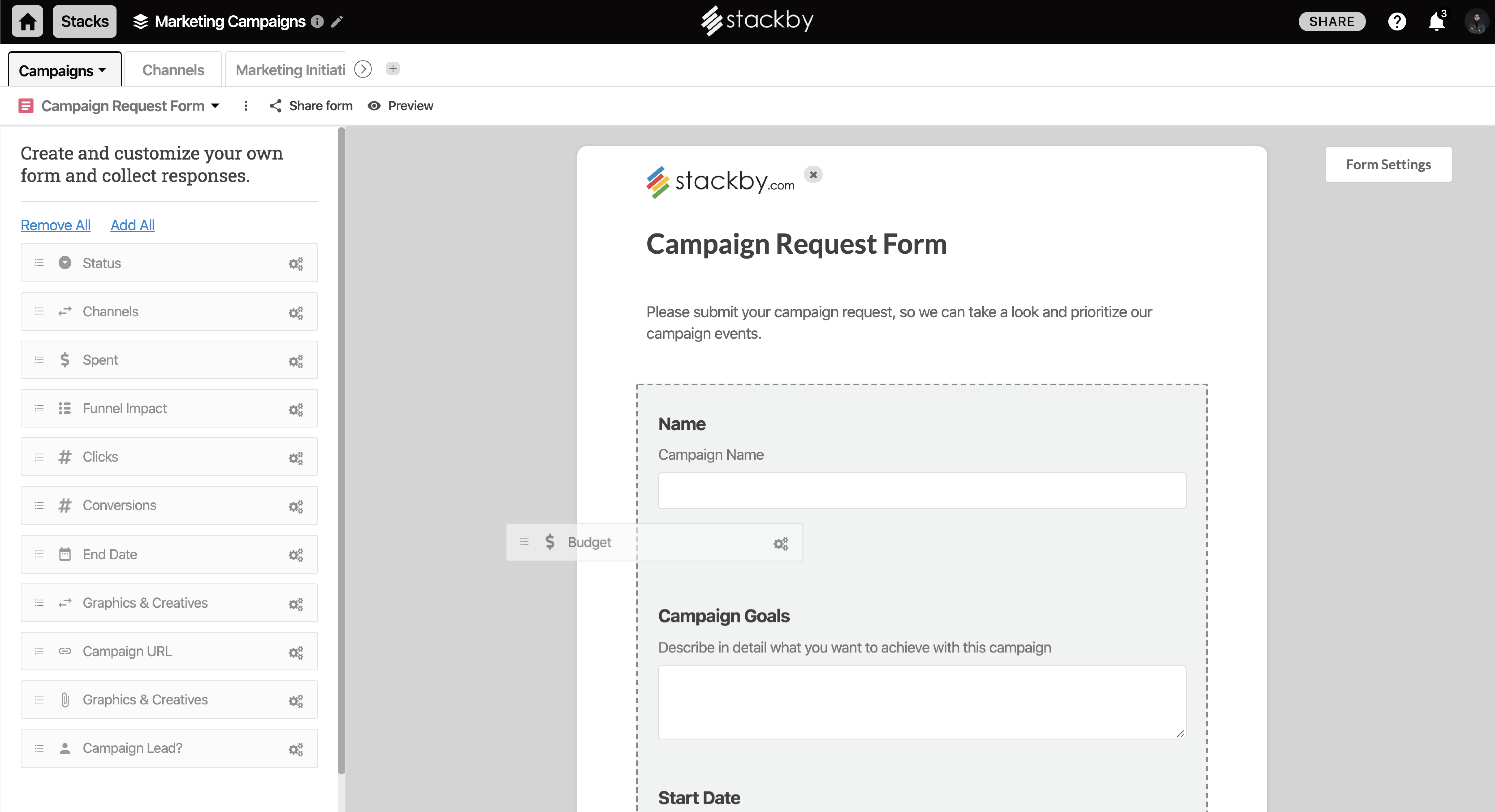
Stackby is designed to bring together the simplicity of spreadsheets, the functionality of databases and integrations with best business APIs to let anyone build their own tools, the way they want. No coding needed. Users can build a database from scratch, import data from pre-existing sources like spreadsheets or Google Sheets, or choose from over 100 pre-built templates across multiple categories. Stackby offers over 25 unique column types like text,…
We started on the process automation journey a few years back and people kept coming back to ask, was there an alternative that would allow us to connect all the disparate systems in my organisation. We looked at RPA, that wasn't the answer, some of the larger players could do …
Airtable is the "gold standard" when it comes to relational databases. SmartSuite is the "gold standard" when it comes to how nice a relational database can look. Stackby takes a cue from Airtable in how it delivers and interacts with data, and it offers a better cost …
As an Airtable user, I was glad to see an available alternative. Stackby has ticked the boxes and exceeded my expectations. They also continue to grow and improve the service, making it even more appealing and valuable. Support has also been responsive and consistent. I would …
The use case and feature set against airtable is equivalent if not better and the offer of LTD access as well as specific add-ons make Stackby the better choice every time.
We have been using Airtable so often but once your team grows it costs a lot of money, to be honest. Stackby could be a great fit for our team but of course, Airtable is a more mature tool. I'm really hoping that Stackby reaches the level of Airtable at some point one day. For …
This is a legitimate competitor to Airtable! They are well on their way to meeting the feature set offered by this much bigger and older company. Stackby has done some amazing things with this platform, and I hope they continue their great work to keep improving and already …
I am a paying user of both Stackby and Airtable. I use both both as there are some shortcomings of both.
Airtable is more developed and useful on both desktop and mobile, whereas Stackby is not. Airtable has useful internal automations, dashboards and a huge online community, …
We chose Stackby over Airtable primarily because Airtable does not currently have the option to pre-fill default data in a cell. This feature alone is a huge time saver and allows us to skip cells that contain necessary, but redundant data.
Catalytic is best suited for process automation. It is great with unstructured data and the machine learning capability is so accessible. The AI aspect is super intuitive and helps make good business decisions. The ability to drop pushbots into process and then do a seamless handshake to a human and back again is not something I have seen anywhere else.
Based on my experience, I can provide specific scenarios where Stackby is well suited and others where it may be less appropriate: Project Management: Stackby is an excellent choice for project management scenarios. Its ability to create custom databases, track tasks, assign responsibilities, and collaborate in real-time makes it highly effective for managing and monitoring project progress. CRM and Sales: Stackby is well suited for managing customer relationships and sales processes. Its customizable database structure allows for organizing customer information, tracking leads, managing deals, and generating reports. The ability to integrate with other tools further enhances its usefulness in CRM and sales workflows. Content Planning: Stackby is a great fit for content planning scenarios. Users can create databases to manage editorial calendars, track content ideas, assign tasks to team members, and monitor content performance. Collaboration features facilitate seamless content collaboration and ensure timely publishing.
Implement the same views available on desktop into the mobile app
Internal automations (like Airtable)
Ability to implement and display info as a dashboard (like Airtable)
Polish up the formatting of formulas, inputting them causes user frustration due to the formula input cursor jumping around
Better intelligence and ease of inputting data in bulk i.e have the fields automatically identify what data is being input and format appropriately (like Airtable does)
Using Catalytic is dead simple, click and drag. Start simple and iterate. Once you start using the tool, you soon want to add more in and then the more you add in the higher the ROI. People will start to line up to want to use it, and realise the benefits
Stackby is overall pretty easy to use, especially if you're used to something like Airtable or SmartSuite. Some of the pages seem like near exact clones (though they put their own creative spin on things). I'd prefer a slighty fresher interface (like SmartSuite), but I'm willing to sacrifice that for the better price and great customer service.
We have been so lucky with Catalytic, the team have been super responsive and more than willing to go that extra mile to make sure we have everything that we need. Even with the time zone challenges, they are the kind of team that will always make sure they are available and will follow up until we have the answer and more.
We started on the process automation journey a few years back and people kept coming back to ask, was there an alternative that would allow us to connect all the disparate systems in my organisation. We looked at RPA, that wasn't the answer, some of the larger players could do what we were looking for, but it came at a price that precluded usage. Then we should Catalytic was right in that sweet spot, - we call it bang for buck, functionality that was accessible from a price point of view but delivered in terms of realising our goals
I have also tried Ora.Pm. Infinity has better graphical interface, but nowhere near as many features and the UI isn't as effective (i.e, moving around with keys). Grist has a much more technical interface and it comes from being more of a database/interactive spreadsheet vs Stackby. Grist has much more functionality in terms of formulas, but is much harder to learn to use and less other functionalities. Ora.PM is more of a test at a task management app, and doesn't compare - Stackby is much better.