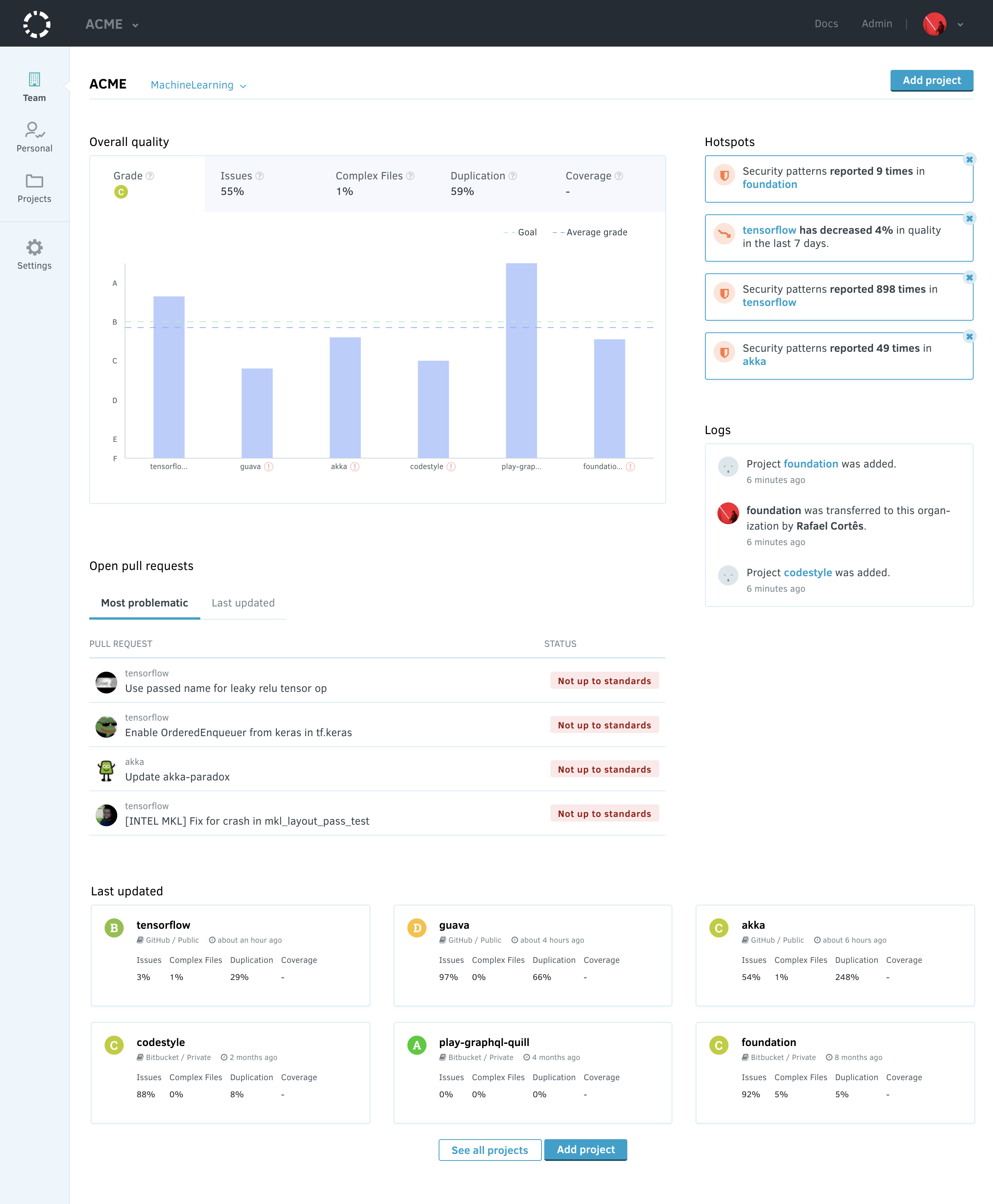
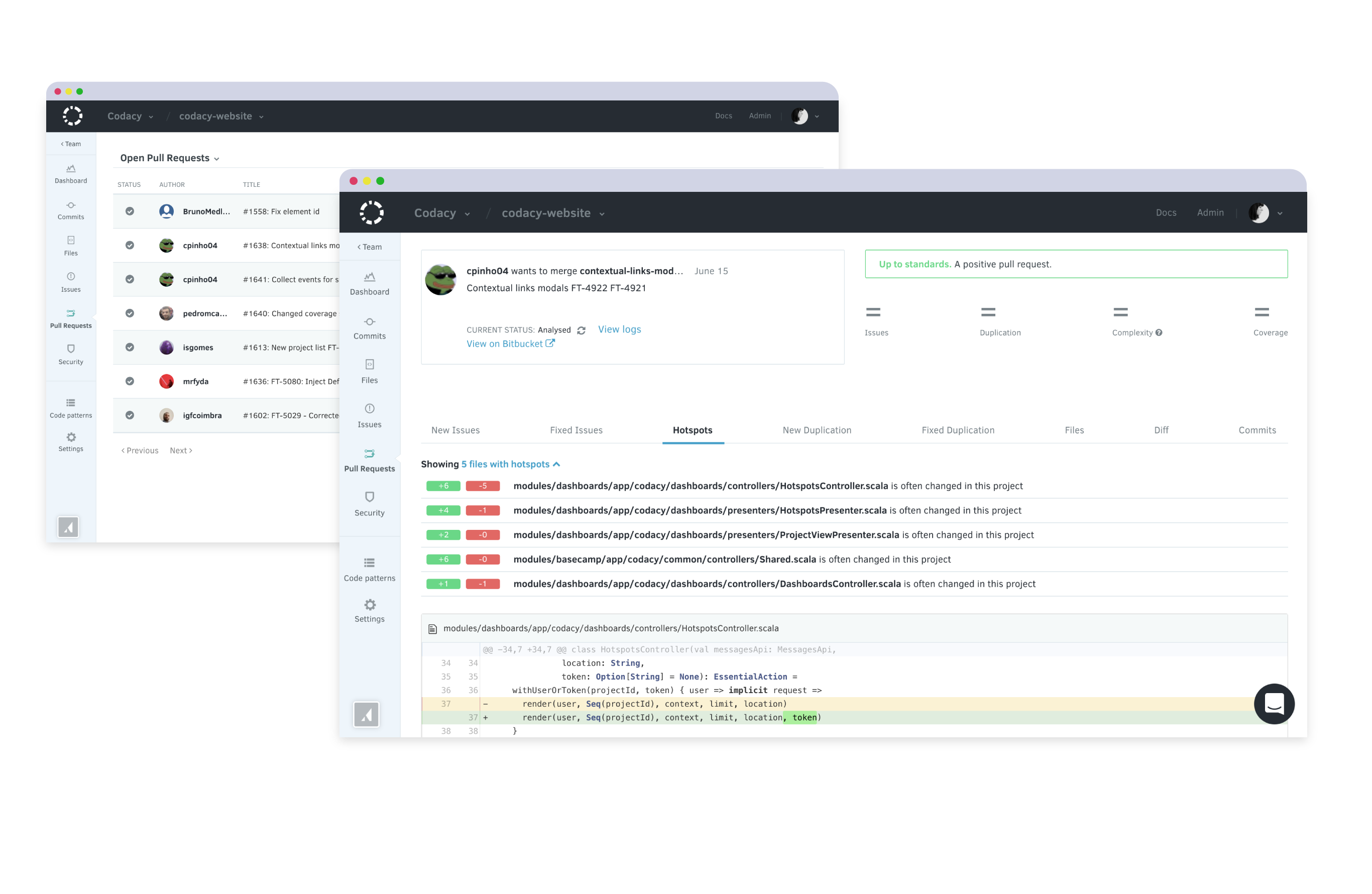
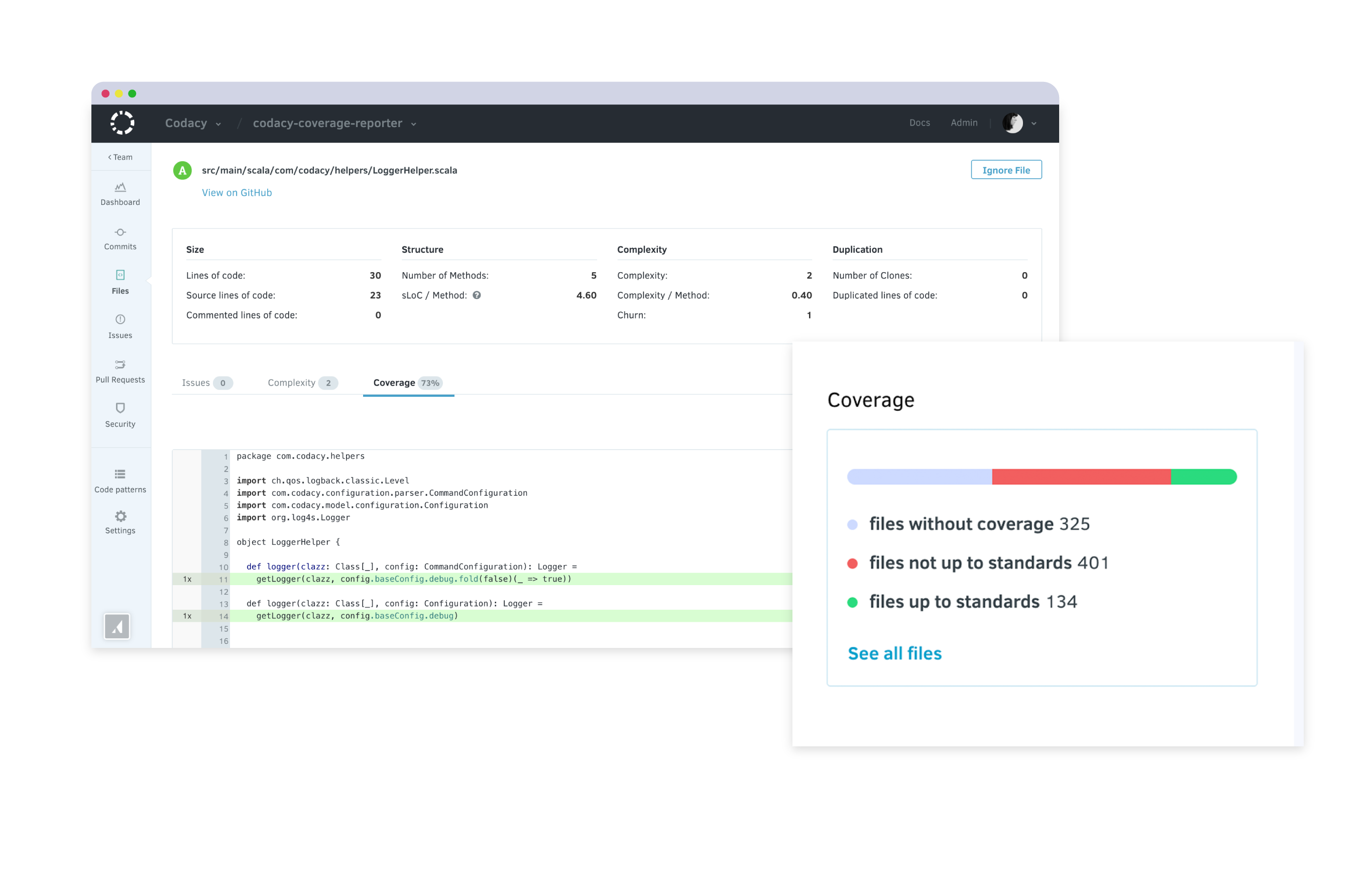
Codacy automates code reviews and monitors code quality on every commit and pull request reporting back the impact of every commit or pull request, issues concerning code style, best practices, security, and many others. It monitors changes in code coverage, code duplication and code complexity. Saving developers time in code reviews thus efficiently tackling technical debt. JavaScript, Java, Ruby, Scala, PHP, Python, CoffeeScript and CSS are currently supported. Codacy is static analysis…
$0
Crucible
Score 10.0 out of 10
N/A
Atlasssian Crucible is a peer review tool for finding bugs and defects in version control tools Subversion, Git, Mercurial, CVS, and Perforce.
N/A
Pricing
Codacy
Crucible
Editions & Modules
Open Source
$0.00
Startup
$0.00
Pro
$15.00
user/mo
Enterprise
$40.00
user/mo
No answers on this topic
Offerings
Pricing Offerings
Codacy
Crucible
Free Trial
Yes
No
Free/Freemium Version
Yes
No
Premium Consulting/Integration Services
No
No
Entry-level Setup Fee
Optional
No setup fee
Additional Details
—
—
More Pricing Information
Community Pulse
Codacy
Crucible
Considered Both Products
Codacy
Verified User
Anonymous
Chose Codacy
Even though it is paid while SonarQube is free, we chose Codacy because it is simpler to configure and maintain the implemented rules. In addition, it offers support for the main programming languages on the market, ensuring that we can continue to use it if we want to use …
Codacy is an amazing and fantastic tool I really like the UI/UX with great amount of customizations around rules for code review. It supports multiple languages like Java, PHP and Python hence making it the best, fast, and easy to get real-time quality codes. The support is …
Codacy provides a good support mechanism and has very intuitive UI. Even a newbie can understand the details of a code base. The best part is you don't have to manually update everything. Once you have connected the git repository, it will automatically rate the code and …
Not exactly an apples to apples comparison. Back when we were using SVN, Crucible was the go-to solution for code review. As we started moving to use Git and using pull requests (via Bitbucket), code review is now performed by using pull requests exclusively.
Crucible has a better look and feel for developers because it is web compatible and works well with IE or Chrome. Being that it is a web browser friendly, using Crucible is seamless and user-friendly. Github is an external tool on a different environment that requires more …
Crucible was first on the market and the price is inexpensive. Crucible integrates with Jira Software and Atlassian Fisheye, providing the ability to track defects efficiently. Sonarqube compares code to 'best standards' but not 'internal standards' and does not integrate to …
I think Crucible isn't quite as clean as Stash/Bitbucket, but it does some things better, like seeing individual commits easier. I also like how stash groups all comments on the overview of the Pull Request.
Gitlab and Github are very comparable to Crucible, and would probably be my first choice if those were the tools used for versioning as they are directly linked to git. Crucible was chosen by a current client and I had no choice in its selection. I would probably have chosen …
It's a great tool that has greatly improved our code and I'd recommend it to anyone. With the ability to check duplicated codes. And automated systems to ensure quality and standards when opening a pull requests. The support team is one of the best team I have worked along with because they are very user-friendly and responsive in case of any challenge.
Depends on the version control and devops process your development teams adopt. Git (via Bitbucket, GitHub, GitLab, etc...) has become the new industry norm, and using pull requests can often provide the same code review features Crucible is used for. However, if you require code review beyond change/diff based (i.e. via pull request), then Crucible allows you to review code with more granular control, such as on per file basis.
It can sometimes be a bit slow to load. A server reboot for us tends to solve that issue. I'm not sure if it is a server issue, or maybe Crucible may have some caching issues.
I wish that you could easily stop the review creation process, rather than abandoning it.
Even though it is paid while SonarQube is free, we chose Codacy because it is simpler to configure and maintain the implemented rules. In addition, it offers support for the main programming languages on the market, ensuring that we can continue to use it if we want to use other languages in new products.
Gitlab and GitHub are very comparable to Crucible, and would probably be my first choice if those were the tools used for versioning as they are directly linked to git. Crucible was chosen by a current client and I had no choice in its selection. I would probably have chosen GitHub if given a say.
I am not involved in the acquisition of Crucible so I cannot comment on the financial investment but I believe it is a necessary tool to have in any software shop, small or big.
As a developer, having Crucible as the code review process is a great asset and will save time and reduce risks which I believe is a positive return of investment.