Concrete CMS (formerly Concrete5) is a free and open source, PHP built content management system for content on the web and also for intranets. It is optimized to support the creation of online magazines and newspapers.
N/A
Jive
Score 8.7 out of 10
N/A
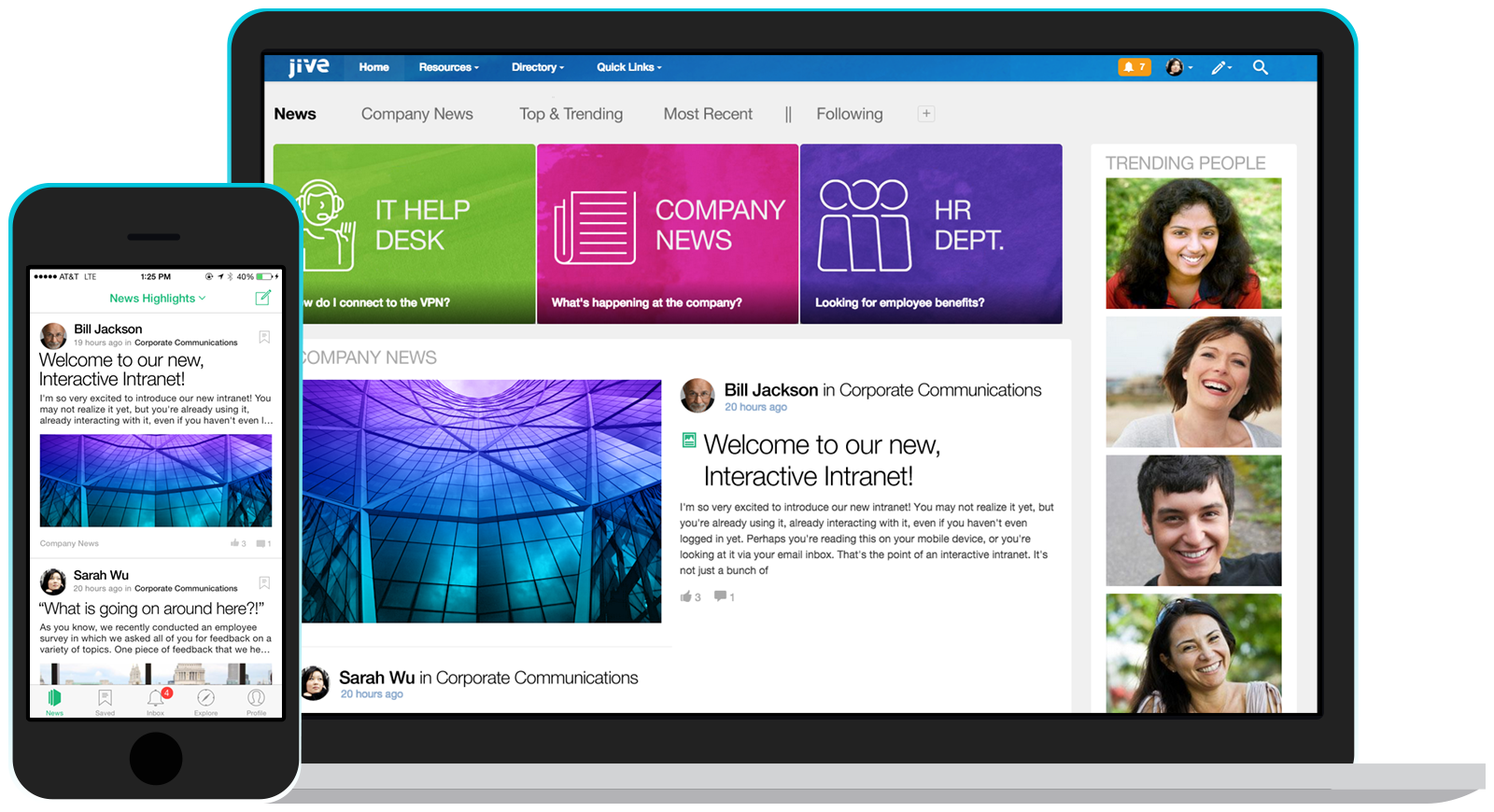
Jive Software, part of the Aurea family of customer experience solutions, provides the gateway to an organization's most important assets – its knowledge and people. Jive's interactive intranet solution promises to connect people, information and ideas to help businesses outpace their competitors. The vendor says the product has more than 30 million users worldwide across every industry, and is consistently recognized as a leader by top analyst firms.
My initial test was to time how long it took to create a very basic site from scratch with no prior knowledge. Concrete CMS won decisively. Over time, I've worked on projects that use other systems, and the challenges I encounter always affirm my choice to stay with Concrete …
WordPress is a basic blogging tool that has been hacked into a CMS, it is not as intuitive or comprehensive as Concrete CMS. It requires more updates and it can be harder to locate settings that the user needs. However, as a business, the WordPress team has been very …
ConcreteCMS is different from all other a used. all others have a specific purpose, like Odoo or Dolibarr for ERP/CRM, Magento Prestashop ... for e-commerce, GLPI and other CMMS for material management, and so on. Concrete CMS is usable for all, flexible, natively for CMS or …
I didn't have to spend too much time learning Concrete CMS, whereas I had to spend a long time learning other CMSs. After struggling to develop a plugin for WordPress, developing an add-on for Concrete CMS was piece of cake thanks to many available APIs. Making custom themes …
WordPress is a real nightmare, needs regular updates. Plugins almost need daily updates, you hardly can do anything in WordPress without a plugin. ConcreteCMS offers a solid, strong basis that already includes almost all functionality you need to develop and launch a site. And …
Easier to set up and manage. Easier to edit content. Not as feature-rich so it might not work for very special projects. Harder to get client buy-in when they only know Word Press. Great for quick projects, and for the right client more complex engagements. Free of complex …
Like I said before, Concrete5 is a system to build a more inclusive internet, with tools easier to manage. WordPress is a tool to make a blog and you need a lot of modifications to reach the basics of Concrete5. It's easier to work with concrete5 in many ways, both developing …
Concrete5 is much easier to use than Drupal and has more functionality set up out of the box with just enough add-ons to get the job done. I have used both WordPress and Drupal, and this sits between them. Concrete5 is not quite as easy as WordPress but much easier than Drupal …
We previously used Joomla! but found clients were struggling to find their way around the eding interface. Switching to Concrete5 changed this and we now have fewer support issues and much more positive feedback from clients.
Concrete5 was far easier to use than alternatives--which is very important when handling support issues for clients. As a developer, the architecture makes it easier to extend the core functions elegantly without overwriting core code. Although a few other CMS platforms have …
Front-end web design & development, graphic design
Chose Concrete CMS
I select Concrete5 when working with an experienced PHP-developer. The code is exceptionally well-written and to my clients, C5 is a secure, easy to edit platform for websites that do not have a too high dependence on third-party plugins.
Wordpress at the time was riddled with security breaches in the news and while Concrete5 was smaller (and therefore a smaller attack vector), after eleven years of use, Concrete5 has only had one published incident with an add-on that resolved within hours and with excellent …
If your web team is tired of dealing with CMS training issues, you need to consider Concrete5. If your technical team and host are tired of dealing with website security issues, you need to consider Concrete5. If you're pulling your hair out over frequent update patches …
Concrete is better than all this for its UX and code base. The feature set is rich and you don't need loads of third-party plugins. It never gets hacked and is updated by a core team or is accessible via email or Slack. Has a great community backing it up and with good support …
Concrete5 is by far the easiest for the end user. The user who edits the website can do so with very little training and not just with regards to the content. New pages and functions are easy to create and install. SEOand contact form functions are built in as standard.
I adopted Concrete5 after an end-user trial. With a variety of well known and lesser known CMS (including the above) in their fresh install state, I asked a group of users to register an account and then add a page with some text and an image on it. Concrete5 came out top by a …
Concrete5 is superior in most usecases to all other commonly used CMS platforms. The only thing where Joomla is outpreforming it is bulk editing. WordPress needs at least 20 plugins to do what Concrete5 does out of the box.
Programming C5 templates and custom views is a dream, …
Wordpress is much easier to use but I feel that it has less to offer. If you are looking for an easy WYSIWYG web site editor, Wordpress is probably a great option. If you are looking for something a little more robust, Concrete5 may be an option to look in to.
Concrete5's UI is a bit more dated compared to Wordpress, and the ecosystem for plugins is smaller. But out of the box, Concrete5 does more with its clean code than Wordpress does. Wordpress's UI and large plugin/community around it is its biggest strength as a product, not the …
Concrete5 is easier to use than Drupal or Joomla, and beats them in terms of features. WordPress gives Concrete5 a run for its money as far as extension and theme availability, as well as user base and support availability. But Concrete5 beats Wordpress hands down with features …
We had a Google phone number set up before and Jive was a lot better option than that. It is more consistent and can be configured much easier and with more advanced settings. Additionally, based on the pricing as well as working with the rep on our account, it was a perfect …
We also use Skype to communicate in our organization. They are both useful for organizational communication. The good thing is in Jive, you will have your own personal timeline. Jive also has a newsfeed or timeline that you can browse where you can see the latest updates from …
Jive provided phone support which can be useful in case of emergency. Jive's initial pricing was free which helped jumpstart the process. It also provided JIRA integration which we needed for certain teams. Jive also had Zendesk integration which was useful for support teams to …
We use Jive to keep in touch and share mass updates/important information to the company. It's a good way to keep up to date on what's going on, read articles others share and get to know each other a little better.
We found that Jive had integrations with the existing IT infrastructure/tools which was nicely aligned with our strategy of playing nice with the existing ecosystem, rather than compete against it. Jive uses a technology stack that is well known by our organisation …
I honestly don't recall what we briefly used before Jive - it wasn't good and didn't last long. I think it was under-utilized because you couldn't really do a whole lot with it. Jive does pretty much everything we need it to do, so for that reason alone, Jive is the superior …
I was not involved in the decision to implement Jive versus competitors. My presumption is that the feature set at the time was attractive compared to options like SharePoint. Useful to note that SharePoint seems to have closed the gap in recent years.
I think Jive is a very unique platform in that it is very user intuitive, and acts just like the social networks we've all grown to love and used to. I think it's a great way for the team in disparate locations to stay in touch, and a great way for management to monitor …
Very powerful collaboration tool, intuitive, easy to use and commonly used by software vendors - so once you are experienced with it you can apply your knowledge using it in many places.
Jive is a little behind the curve in comparison with the latest Microsoft features. Jive's lack of native capabilities to support work that requires process or structure increasingly puts it at a disadvantage.
Jive works more with how people actually work and not how admins think that people should work. For example, relying on a folksonomy of tagging instead of a restricted taxonomy is far more practical with how users actually search for content. By putting the power to the users, …
Without getting into specifics, Jive is relatively strong in terms of more 'ready to deploy' business solutions that require less overhead on the client organization side in terms of IT infrastructure, operational support and ongoing administration and maintenance. While some …
Verified User
Anonymous
Chose Jive
Drupal would be much better suited. They have fast version upgrades and immediate customer support. Jive lacked in all those areas
Verified User
Anonymous
Chose Jive
I have worked on Lithium and Liferay. LifeRay has an advantage that it is opensource and will be cheaper. However it lacks the ton of features provided by Jive. Lithium does not support advanced customizations (except for theming). Jive does have the capability to customize …
Concrete5 is perfect for a website that needs to be regularly updated without accessing the code, whether that be because a developer created your site for you, or because you yourself are a developer who wants to keep the time spent on updates down.
In my experience, it's less useful for modern web apps such as PWAs that would benefit more from technologies such as React and Vue.
The content in the news section isn't totally responsive - meaning if I have a small window taking up half my screen, the images for the headline articles may not load properly and when I maximize that window, it's left with ugly half-loaded images. Also, the collaboration feature for Office documents is great in theory but tends to cause more pain than it's worth to just download the document and open it separately in Word or Excel.
Concrete5 has a modular editing system, so you can edit the pages without having knowledge of coding. You just pick the module you want to insert or edit and click where you want it to go.
You are able to edit modules in an HTML format if you would like to, so if you have the knowledge you can have even more control over your modules.
You can also edit entire page themes by selecting them from the page layout menu. This allows you a greater versatility of the pages on your site.
Concrete5.6 websites have no good path to migrate to 5.7, short of manual content migration. This is a big problem and affected the user community negatively.
Some features that were available as paid add-ons in 5.6, such as discussion forums and e-commerce shopping cart, are missing from newer versions 5.7/5.8.
Starting to develop add-ons and customizations for Concrete5 can be challenging as 5.7/5.8 documentation is not yet complete.
I have had nothing but good experiences with Concrete5. I have used it on several client websites and even several of my own sites. It is the leading CMS I will go to if I have a need to dynamically update content on a website by people who are typically untrained. They have solved every angst I had with the other solutions I have evaluated in the past and continue to be the simplest to implement and customize.
There are always external factors that can impact this decision but currently, the Jive platform is maintaining its lead in the market place in this area. If the innovation in this space by Jive continues, then this number will remain high. Integration with other systems and adaptability to changes in the market or in client needs will also make this decision hard to predict more then 6 months into the future
Although there is a slight learning curve (as with any software), it is very easy to use once you get a hold of it. It is easy to upload and manage files (and other digital assets), and the drag-n-drop interface on the front-end is easy for end-users to understand
Since it's not tied to a central server (other than for authorizing updates and assigning licenses to specific sites), it's available pretty much 100% of the time.
Uptime was OK. But there was one day that the system crashed for a whole day. Our company was unable to operate. And all the plugins to word/excel froze causing those systems to freeze.
Jive posted a statement to the media saying all customers were up, but we were not.
The site works extremely well, the front end flies, searches and form submissions are very fast indeed. The reason its a 9 not a ten? the back end can be a little slow at times, and this is unfair, because for the backend to be so amazing, it has to do a huge amount of work!
Concrete5 is open-source and has an incredibly strong, polite, and supportive community. You can get an answer to nearly anything you want to do with Concrete5 by googling for it, searching the Concrete5 discussion forums or stack overflow, or posting your question to the forum. Members are very courteous and do not look down on those with less knowledge. And answers are always quick, informative, and supportive.
They did an OK job when I needed them. Except for the one day the system went down. Jive pointed the finger at the hosting company, and the hosting company pointed the finger at Jive. No reliable information came to us.
Jive online training is there. It is OK/average. I feel some other companies are doing better. It is not a piece that is required to have a successfully implementation, but it could be useful to improve it
It's important that any CMS is implemented by a skilled developer. Content management is not a commodity. One of the keys I've found with Concrete5 is to create a homogenous content-entry method (e.g. focus on in-context editing OR focus on using the Composer feature). This seems to make it more likely that site editors will be able to easily come back to editing after a layoff without having to "remember" too much.
I didn't have to spend too much time learning Concrete CMS, whereas I had to spend a long time learning other CMSs. After struggling to develop a plugin for WordPress, developing an add-on for Concrete CMS was piece of cake thanks to many available APIs. Making custom themes and blocks was much easier than WordPress.
I honestly don't recall what we briefly used before Jive - it wasn't good and didn't last long. I think it was under-utilized because you couldn't really do a whole lot with it. Jive does pretty much everything we need it to do, so for that reason alone, Jive is the superior tool.