Concrete CMS (formerly Concrete5) is a free and open source, PHP built content management system for content on the web and also for intranets. It is optimized to support the creation of online magazines and newspapers.
N/A
ManageWP
Score 10.0 out of 10
N/A
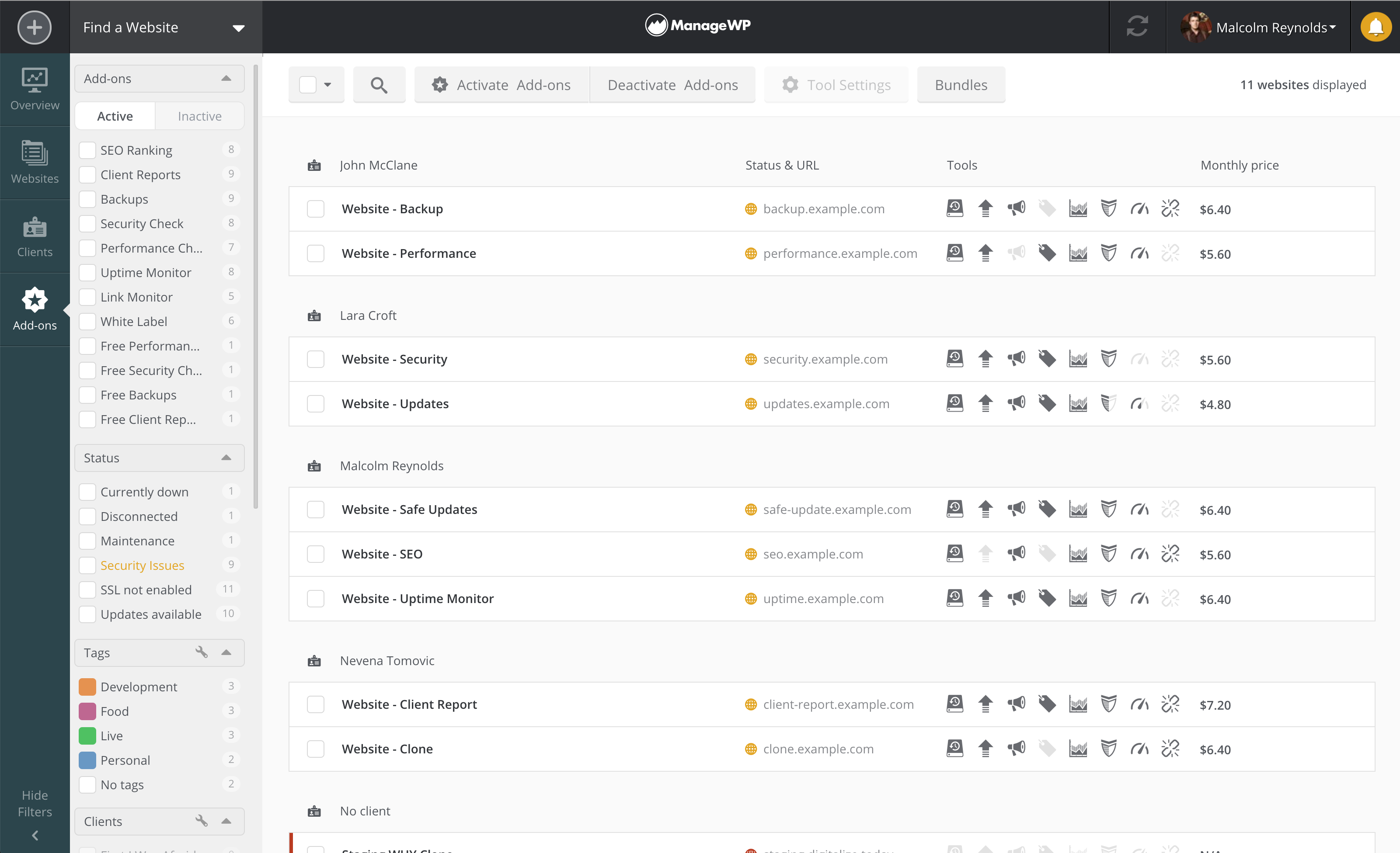
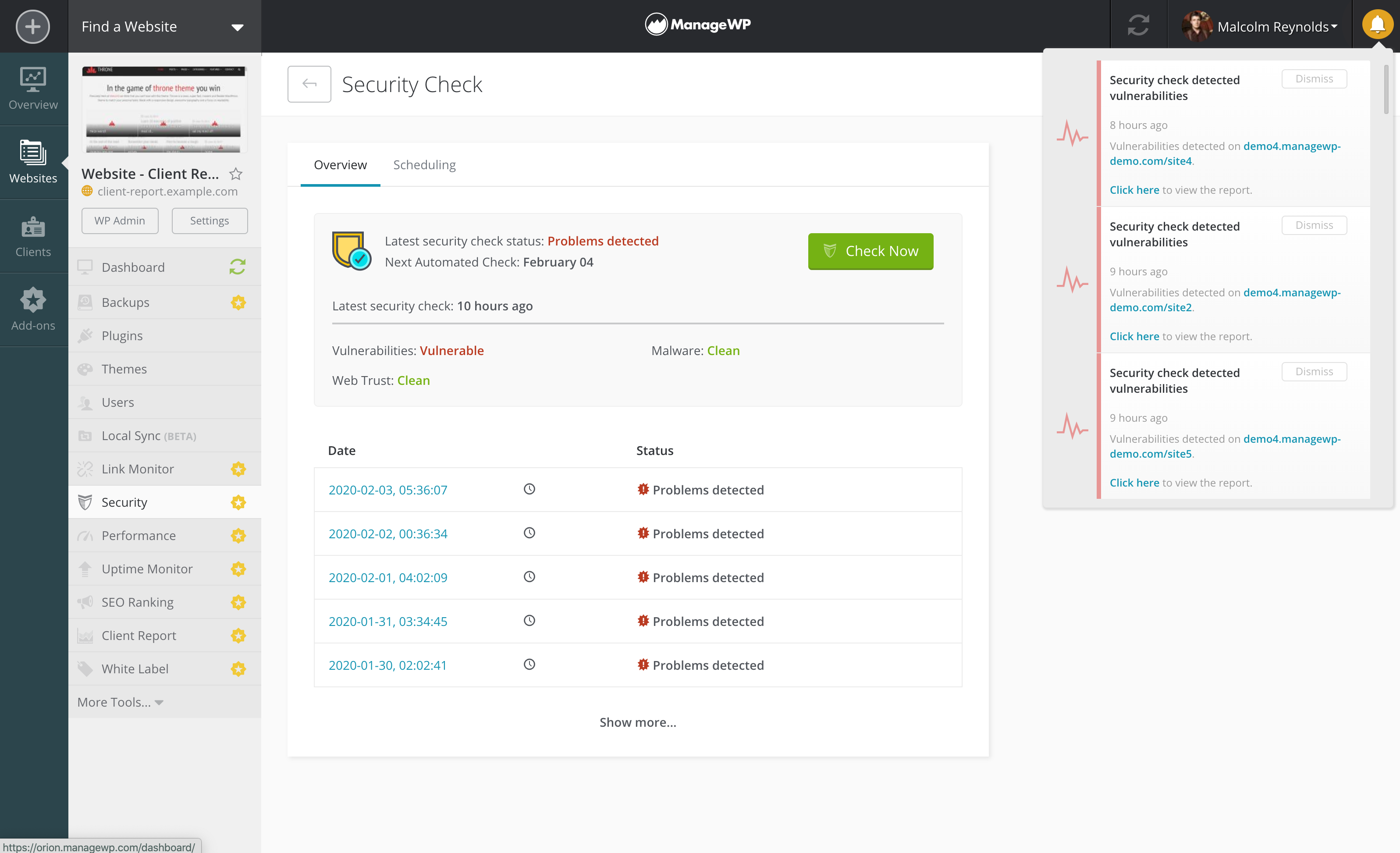
ManageWP is a WordPress management console that allows users to manage multiple WordPress sites with ease.
N/A
Pricing
Concrete CMS
ManageWP
Editions & Modules
No answers on this topic
No answers on this topic
Offerings
Pricing Offerings
Concrete CMS
ManageWP
Free Trial
No
No
Free/Freemium Version
Yes
Yes
Premium Consulting/Integration Services
No
No
Entry-level Setup Fee
No setup fee
No setup fee
Additional Details
—
Starting is easy and free. Premium upgrades are there for those that need more. If you want to free up your time and let ManageWP do the heavy lifting - we are there for you with a number of automations (safe updates, automated backups, scheduled security and performance checks, etc.), site migration tools, website templates and more.
Special bundles were built for agencies and companies creating affordable discounts for customers with large number of websites.
More Pricing Information
Community Pulse
Concrete CMS
ManageWP
Features
Concrete CMS
ManageWP
Security
Comparison of Security features of Product A and Product B
Concrete CMS
9.5
Ratings
16% above category average
ManageWP
9.5
Ratings
16% above category average
Role-based user permissions
9.50 Ratings
9.50 Ratings
Platform & Infrastructure
Comparison of Platform & Infrastructure features of Product A and Product B
Concrete CMS
9.7
Ratings
24% above category average
ManageWP
10.0
Ratings
27% above category average
API
9.70 Ratings
10.00 Ratings
Internationalization / multi-language
9.70 Ratings
10.00 Ratings
Web Content Creation
Comparison of Web Content Creation features of Product A and Product B
Concrete CMS
8.4
Ratings
8% above category average
ManageWP
8.2
Ratings
6% above category average
WYSIWYG editor
9.30 Ratings
8.00 Ratings
Code quality / cleanliness
10.00 Ratings
8.00 Ratings
Admin section
10.00 Ratings
9.80 Ratings
Page templates
10.00 Ratings
8.00 Ratings
Library of website themes
4.20 Ratings
9.00 Ratings
Mobile optimization / responsive design
9.70 Ratings
7.50 Ratings
Publishing workflow
7.70 Ratings
7.00 Ratings
Form generator
6.60 Ratings
00 Ratings
Web Content Management
Comparison of Web Content Management features of Product A and Product B
Concrete5 is perfect for a website that needs to be regularly updated without accessing the code, whether that be because a developer created your site for you, or because you yourself are a developer who wants to keep the time spent on updates down.
In my experience, it's less useful for modern web apps such as PWAs that would benefit more from technologies such as React and Vue.
It is well suited to anyone that has a Wordpress website, whether it be an individual or a company managing multiple clients sites, its an easy way to manage, maintain and keep your website running smoothly and secure.
Concrete5 has a modular editing system, so you can edit the pages without having knowledge of coding. You just pick the module you want to insert or edit and click where you want it to go.
You are able to edit modules in an HTML format if you would like to, so if you have the knowledge you can have even more control over your modules.
You can also edit entire page themes by selecting them from the page layout menu. This allows you a greater versatility of the pages on your site.
Concrete5.6 websites have no good path to migrate to 5.7, short of manual content migration. This is a big problem and affected the user community negatively.
Some features that were available as paid add-ons in 5.6, such as discussion forums and e-commerce shopping cart, are missing from newer versions 5.7/5.8.
Starting to develop add-ons and customizations for Concrete5 can be challenging as 5.7/5.8 documentation is not yet complete.
I have had nothing but good experiences with Concrete5. I have used it on several client websites and even several of my own sites. It is the leading CMS I will go to if I have a need to dynamically update content on a website by people who are typically untrained. They have solved every angst I had with the other solutions I have evaluated in the past and continue to be the simplest to implement and customize.
Although there is a slight learning curve (as with any software), it is very easy to use once you get a hold of it. It is easy to upload and manage files (and other digital assets), and the drag-n-drop interface on the front-end is easy for end-users to understand
Since it's not tied to a central server (other than for authorizing updates and assigning licenses to specific sites), it's available pretty much 100% of the time.
The site works extremely well, the front end flies, searches and form submissions are very fast indeed. The reason its a 9 not a ten? the back end can be a little slow at times, and this is unfair, because for the backend to be so amazing, it has to do a huge amount of work!
Concrete5 is open-source and has an incredibly strong, polite, and supportive community. You can get an answer to nearly anything you want to do with Concrete5 by googling for it, searching the Concrete5 discussion forums or stack overflow, or posting your question to the forum. Members are very courteous and do not look down on those with less knowledge. And answers are always quick, informative, and supportive.
It's important that any CMS is implemented by a skilled developer. Content management is not a commodity. One of the keys I've found with Concrete5 is to create a homogenous content-entry method (e.g. focus on in-context editing OR focus on using the Composer feature). This seems to make it more likely that site editors will be able to easily come back to editing after a layoff without having to "remember" too much.
I didn't have to spend too much time learning Concrete CMS, whereas I had to spend a long time learning other CMSs. After struggling to develop a plugin for WordPress, developing an add-on for Concrete CMS was piece of cake thanks to many available APIs. Making custom themes and blocks was much easier than WordPress.
ManageWP is definitely the best in class product for WordPress website management. There are other tools such as InfiniteWP that do similar things, but don't have as complete an offering. Other options like WPEngine are also for hosting and we are not interested in that element. I think that ManageWP is the best tool out there for what it does.
Reduced update times - allows me to check for updates on all our sites once a week without spending countless time logging in and updating each one manually.
Free backups - allows me to have redundant backups just in case other systems fail, without any effort.
Free platform - many of the provided features are free, making it very useful for companies who want to keep costs low.