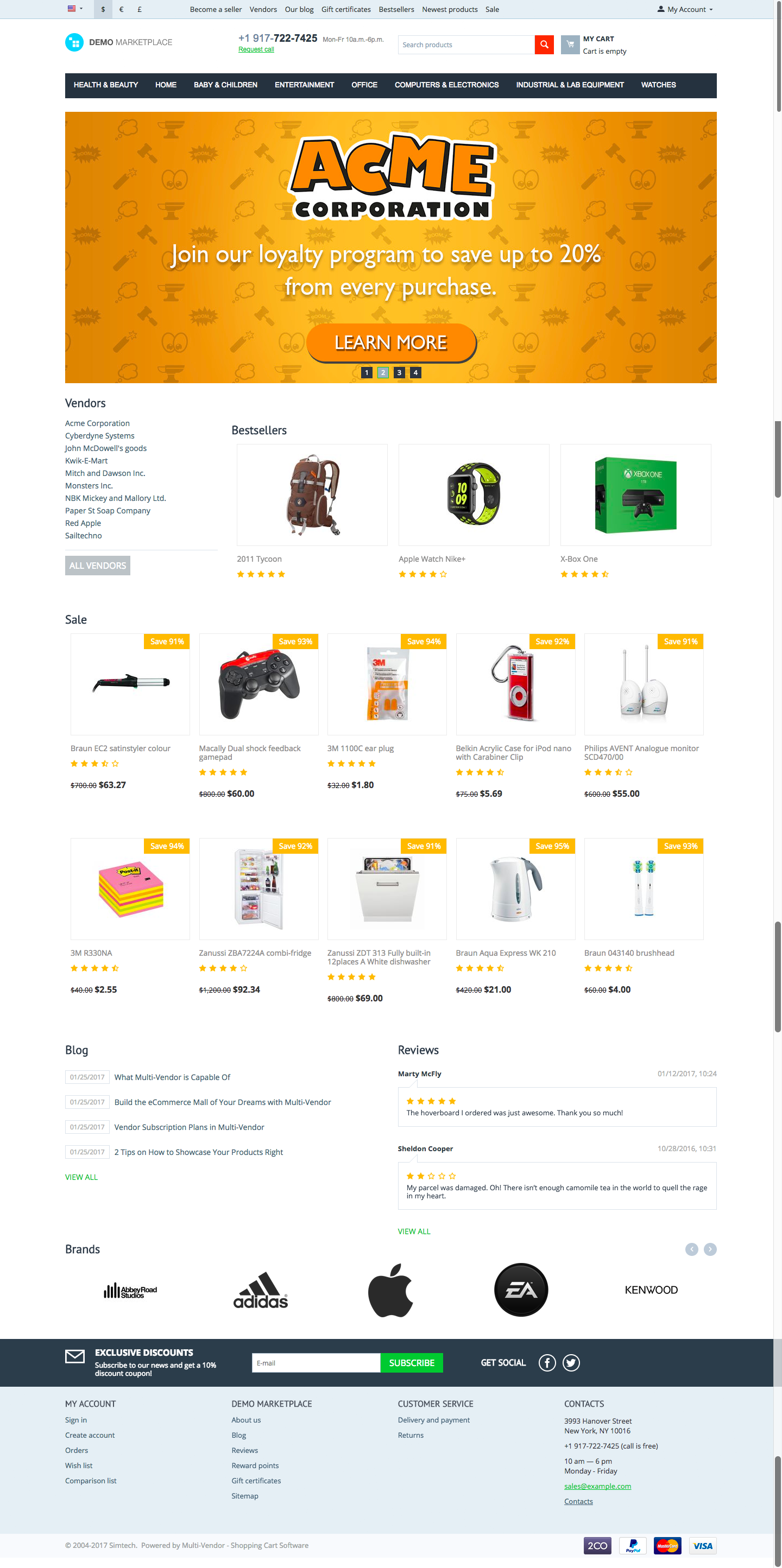
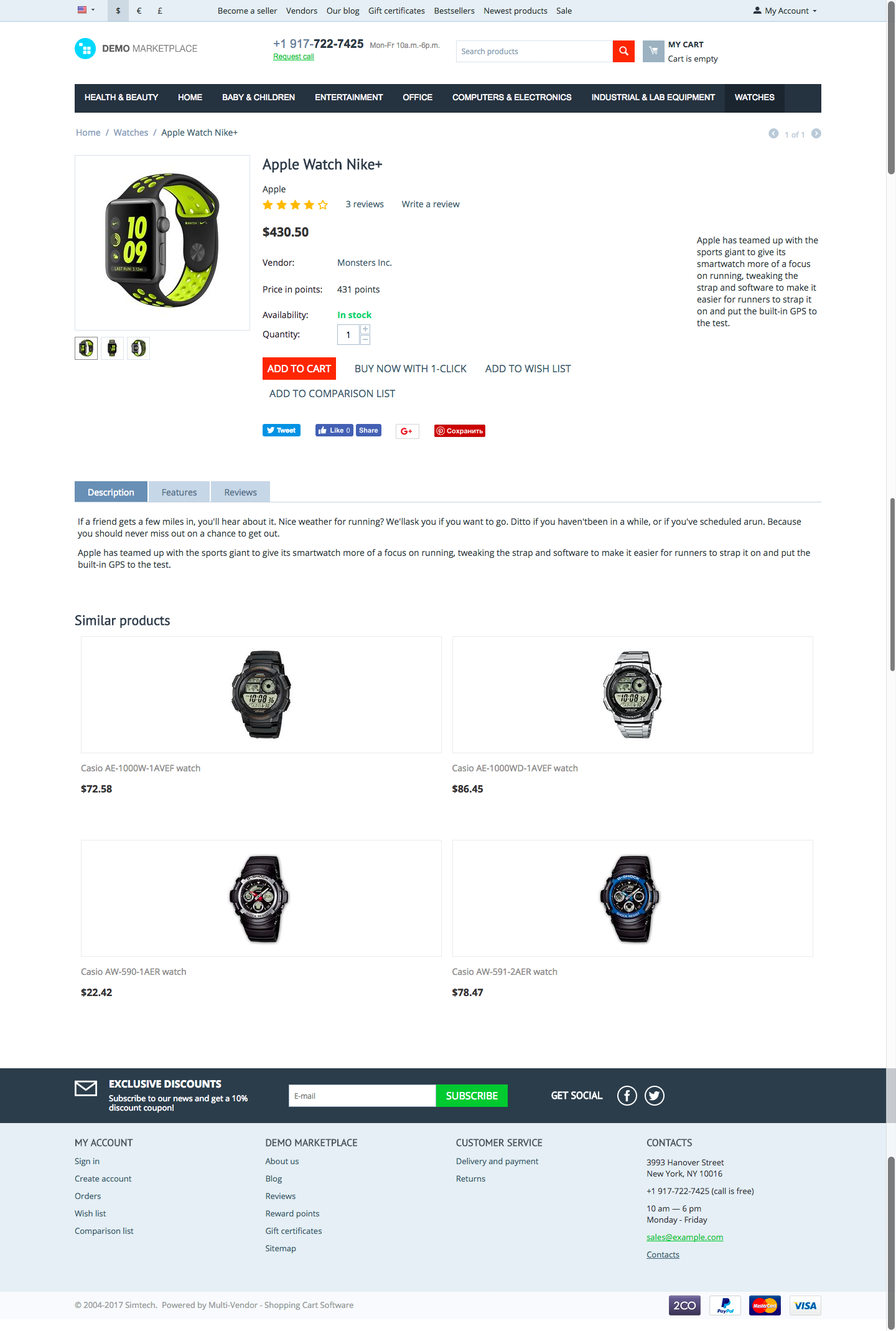
CS-Cart Multi-Vendor is an eCommerce marketplace software for SMBs available in cloud (No-Code) and self-hosted (On-Premises) versions. It allows users to open an online marketplace, where the user is the admin, and all the others—invited sellers. Each seller has his or her own micro-store with a customizable storefront, categories, filters, and search. Just like in Amazon. In the CS-Cart Multi-Vendor marketplace platform, managing vendors is designed to be simple:…
$660
per year
IBM Cloud Foundry
Score 6.0 out of 10
N/A
IBM Cloud Foundry is an IBM version of the open-source platform designed for building, testing, deploying, and scaling applications. Enterprises can run Cloud Foundry in a public isolated environment, while natively integrating with other IBM Cloud services, such as AI, Blockchain, and IoT.
$0.07
Per GBH
Pricing
CS-Cart Multi-Vendor
IBM Cloud Foundry
Editions & Modules
Standard
$660
per year
Plus
$1,320
per year
Ultimate
$3,300
per year
Unlimited
Contact Sales
one-time fee
Community Runtimes
$0.07
Per GBH
Offerings
Pricing Offerings
CS-Cart Multi-Vendor
IBM Cloud Foundry
Free Trial
Yes
Yes
Free/Freemium Version
No
No
Premium Consulting/Integration Services
No
No
Entry-level Setup Fee
Optional
No setup fee
Additional Details
—
—
More Pricing Information
Community Pulse
CS-Cart Multi-Vendor
IBM Cloud Foundry
Features
CS-Cart Multi-Vendor
IBM Cloud Foundry
Online Storefront
Comparison of Online Storefront features of Product A and Product B
CS-Cart Multi-Vendor
8.6
Ratings
9% above category average
IBM Cloud Foundry
-
Ratings
Product catalog & listings
8.80 Ratings
00 Ratings
Product management
8.90 Ratings
00 Ratings
Bulk product upload
8.30 Ratings
00 Ratings
Branding
8.70 Ratings
00 Ratings
Mobile storefront
8.00 Ratings
00 Ratings
Product variations
8.50 Ratings
00 Ratings
Website integration
8.60 Ratings
00 Ratings
Visual customization
8.70 Ratings
00 Ratings
CMS
8.80 Ratings
00 Ratings
Online Shopping Cart
Comparison of Online Shopping Cart features of Product A and Product B
CS-Cart Multi-Vendor
8.4
Ratings
9% above category average
IBM Cloud Foundry
-
Ratings
Abandoned cart recovery
8.20 Ratings
00 Ratings
Checkout user experience
8.50 Ratings
00 Ratings
Online Payment System
Comparison of Online Payment System features of Product A and Product B
CS-Cart Multi-Vendor
8.9
Ratings
7% above category average
IBM Cloud Foundry
-
Ratings
eCommerce security
8.90 Ratings
00 Ratings
eCommerce Marketing
Comparison of eCommerce Marketing features of Product A and Product B
CS-Cart Multi-Vendor
8.4
Ratings
9% above category average
IBM Cloud Foundry
-
Ratings
Promotions & discounts
8.80 Ratings
00 Ratings
Personalized recommendations
8.00 Ratings
00 Ratings
SEO
8.40 Ratings
00 Ratings
eCommerce Business Management
Comparison of eCommerce Business Management features of Product A and Product B
CS-Cart Multi-Vendor
8.0
Ratings
0% below category average
IBM Cloud Foundry
-
Ratings
Multi-site management
8.70 Ratings
00 Ratings
Order processing
8.50 Ratings
00 Ratings
Inventory management
6.50 Ratings
00 Ratings
Shipping
7.30 Ratings
00 Ratings
Custom functionality
8.90 Ratings
00 Ratings
Platform-as-a-Service
Comparison of Platform-as-a-Service features of Product A and Product B
Great for a quick and easy setup of a multi-vendor solution, supporting multiple stores / languages / payment options. Will probably need some tuning if you have 1 million products or so. Great if you have a PHP dev or team, probably not the best option if you don't know the language and need to customise backend logic.
IBM Cloud Foundry is a solid service from the IBM Cloud platform. It is easy to learn, and does not usually require you to make drastic changes to your existing applications. It is especially good for new applications that are cloud native, or micro-services, that can be easily updated and deployed. With its blue/green deployment, you can achieve 0 downtime for your customers.
Intuitive user interface makes it easy for anyone to use, regardless of their professional background.
A lot of the services integrate well with external platforms, APIs, and programs, not just IBM services. A lot of the competitors in this space lack this ability.
Maybe it is just our contract in particular, but support and help is always made available.
Sometimes the API Connect GUIs don't cleanly disengage after attaching models or updating schema and it is hard to know what has been written successfully and which (if any) models or tables were missed. I shouldn't have to manually check through a list of 377 models to find the ones in and out of a list on either models, folder or database tables. Printing a summary even in logs which did a "diff" sort of thing between 'task-set' and 'task-completed' (referring to attaching models or updating schema as tasks here as 'tasks').
Provide access to Postgres Database in Sydney datacentre for Australia.
Clearer documentation around setting up a secure (referring to SSL and certificate setup here) server on eg, chubby1.au-sydney.mybluemix.net.
Allow a ramp in pricing onto the Blockchains. We will not be able to afford it until quite a few years into production, even if we launch successfully.
The software consists of most of all e-commerce related features. Also, there are plenty of third party addons are available in the market which can improve our business. There are a lot of powerful themes available in the cs cart market which improve the look and feel on the front store. If CS-cart adjusted the price on their software license cost, controlling the third party addon cost and provide more freelancers with cheaper hourly rate for the customization on the cs-cart multi vendor software, the cs-cart company can be a master among other e-commerce software companies in the world.
For big vision in doing something in online marketplace, I think CS-Cart can help to scale up and run business smoothly. CS-Cart started their business in 2005 and since [then has been] running successfully worldwide. It means they have a large scale of experience in implementing online marketplace based software and we can rely on them.
IBM Cloud Foundry is our first choice industry-standard platform as a service (PaaS) which has always provided us with quicker, simpler, and more consistent ways for the deployment of the cloud-native applications which in result saved us lots of time and money.
From an investment point of view, it is naturally much more profitable to purchase CS-Cart Multi-Vendor than to assemble a team of developers and try to create such a platform from scratch.
Creating a marketplace is a rather risky business. If you don't know a lot about marketplace building technologies, consider investing in a different business. But if you have already decided on the idea, and all you have to do is find a suitable platform, then CS-Cart Multi-Vendor will probably be a profitable investment. And if your sales go at least half a year after purchasing this platform, then you will quickly enough recoup these several thousand dollars.
This was the founding solution used to allow us to move in to and test out a cloud pipeline. This is what paved the way for a full production cloud solution to be possible.
Having Cloud Foundry at the base of our development and sandpit environment, segregated away from our standard on premise solution has moved away red tape and ensured an agile way forward.