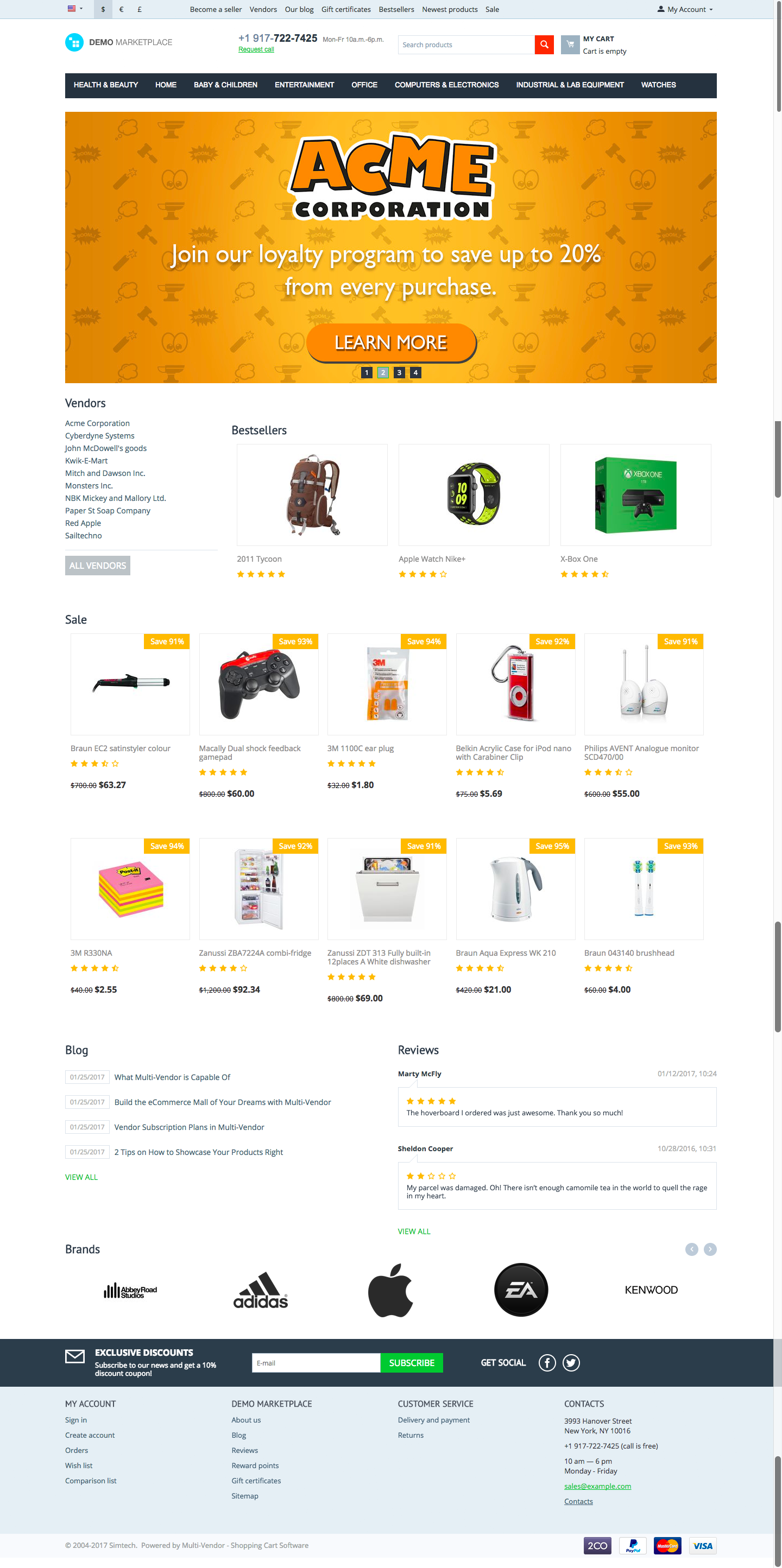
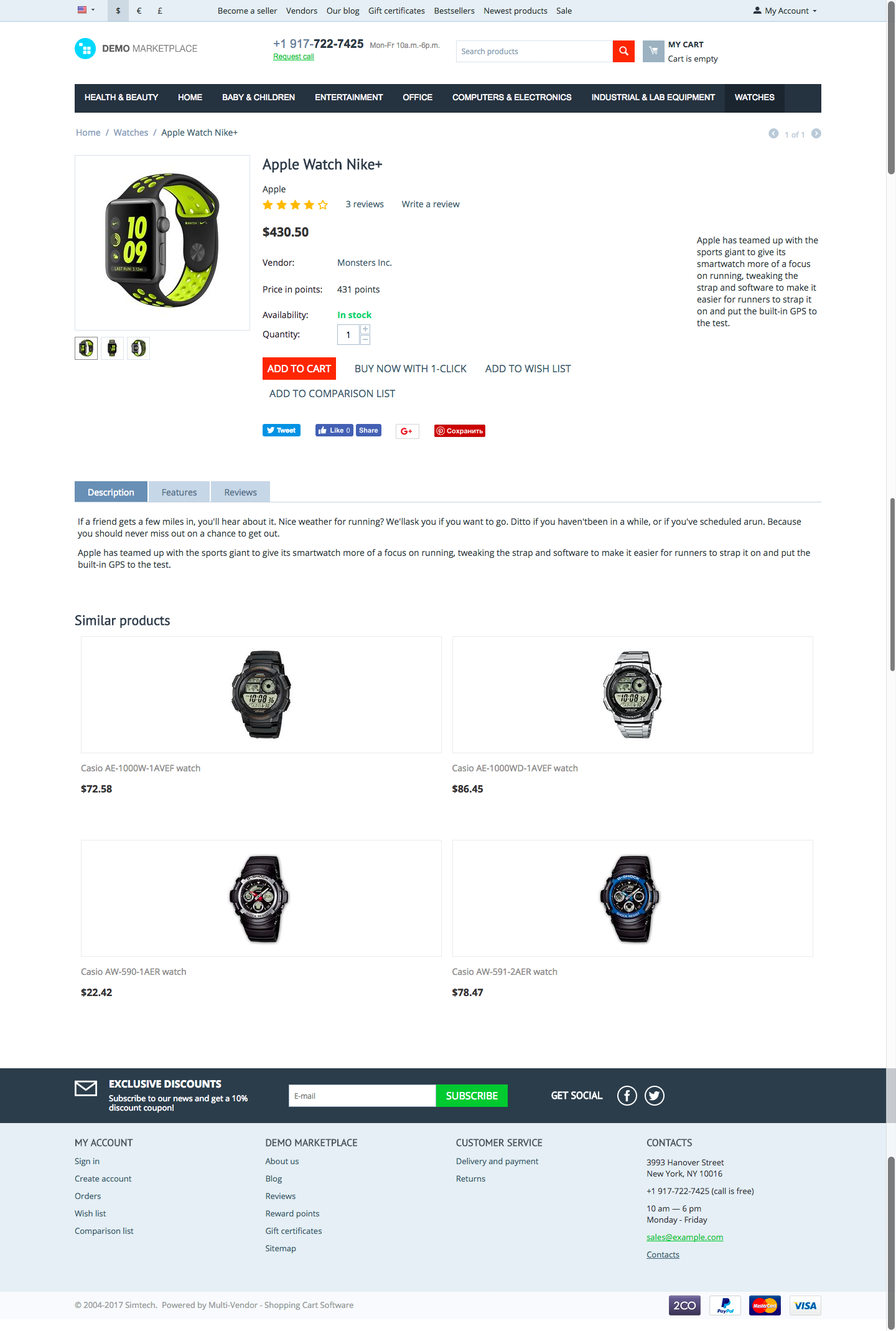
CS-Cart Multi-Vendor is an eCommerce marketplace software for SMBs available in cloud (No-Code) and self-hosted (On-Premises) versions. It allows users to open an online marketplace, where the user is the admin, and all the others—invited sellers. Each seller has his or her own micro-store with a customizable storefront, categories, filters, and search. Just like in Amazon. In the CS-Cart Multi-Vendor marketplace platform, managing vendors is designed to be simple:…
$660
per year
Shopify
Score 9.1 out of 10
N/A
Shopify is a commerce platform designed for both online stores and retail locations. Shopify offers a professional online storefront, a payment solution to accept credit cards, and the Shopify POS application to power retail sales.
$39
per month
Pricing
CS-Cart Multi-Vendor
Shopify
Editions & Modules
Standard
$660
per year
Plus
$1,320
per year
Ultimate
$3,300
per year
Unlimited
Contact Sales
one-time fee
Basic Shopify
$39
per month
Grow
$105
per month
Advanced
$399
per month
Shopify Plus
2,000
per month
Shopify Plus
2,300
per month
Offerings
Pricing Offerings
CS-Cart Multi-Vendor
Shopify
Free Trial
Yes
Yes
Free/Freemium Version
No
No
Premium Consulting/Integration Services
No
No
Entry-level Setup Fee
Optional
No setup fee
Additional Details
—
A 25% discount is offered for annual billing.
More Pricing Information
Community Pulse
CS-Cart Multi-Vendor
Shopify
Considered Both Products
CS-Cart Multi-Vendor
Verified User
Anonymous
Chose CS-Cart Multi-Vendor
Shopify is less expensive than Mirakl and probably more feature-rich. Shopify is probably the cheapest upfront to get started and the best user experience (at least the easiest to get to a point where customers like it). MultiVendor is still an excellent product but it's tricky …
For big vision in doing something in online marketplace, I think CS-Cart can help to scale up and run business smoothly. CS-Cart started their business in 2005 and since [then has been] running successfully worldwide. It means they have a large scale of experience in …
We selected CS-Cart Multi-Vendor Marketplace Platform because we actually control the shopping cart. I would hate to get into a subscription model where a third party can take over your hard work because you didn't pay a monthly fee (or missed it). I also dislike the idea of …
Great for a quick and easy setup of a multi-vendor solution, supporting multiple stores / languages / payment options. Will probably need some tuning if you have 1 million products or so. Great if you have a PHP dev or team, probably not the best option if you don't know the language and need to customise backend logic.
Shopify is perfect for companies who are looking to run a simple-to-medium base e-commerce system and aren't looking to get too fancy with integrations. Those companies, though, that have more complex integrations (especially with checkout) might be better off using another e-com system out there where you have access to the full core code.
Basic requests for store management are not out of the box. Shopify puts a lot of stock in their apps and app partners to bring some of the features that I expected to be out of the box. I've used Shopify for multiple clients and ran into roadblocks for each when we were unable to do basic things. Sometimes the apps are free and it's no big deal. Other times you have to pay for another service to do something as basic as set up stock out reports and notifications.
Their support/team communication is poor. Again, working on multiple stores with license on all their levels and the support was consistently unresponsive or unhelpful.
If you're a partner managing multiple stores, the log-in between the partner dashboard and your individual stores is confusing. I'm often found in a loop searching for the right place to log in because you can't access the stores you are a partner on in the same way as the other Shopify stores. Seems minor, but it's a frustrating thing I encounter often.
Nothing we have used in the past or have seen thus far even comes close to offering what we get with Shopify Plus, especially for the price. You cannot even come close to getting what we are getting at the price we pay. We are beyond thrilled and Shopify Plus meets and exceeds all of our needs and expectations. We love it!
The software consists of most of all e-commerce related features. Also, there are plenty of third party addons are available in the market which can improve our business. There are a lot of powerful themes available in the cs cart market which improve the look and feel on the front store. If CS-cart adjusted the price on their software license cost, controlling the third party addon cost and provide more freelancers with cheaper hourly rate for the customization on the cs-cart multi vendor software, the cs-cart company can be a master among other e-commerce software companies in the world.
It is fairly easy to use Shopify regardless of what task you are attempting to perform. Most things are customizable to a degree without requiring coding ability. I have very limited coding experience and have still been able to navigate my way around changing features of the website that require edits to the code with the use of AI and trial-and-error. This previously wasn't possible with the WooCommerce platform.
In terms of support I give Shopify a 9 out of 10 because they're always very friendly and thorough, and they personally can't solve my problem for me they always point me in the proper direction with the proper information I need to move forward
Shopify offered us several trainings to setup a Shopify store, how to build a brand, SEO, product photography etc. All this content have been super helpful in our journey.
For big vision in doing something in online marketplace, I think CS-Cart can help to scale up and run business smoothly. CS-Cart started their business in 2005 and since [then has been] running successfully worldwide. It means they have a large scale of experience in implementing online marketplace based software and we can rely on them.
Shopify out of the box had more features and did what we were looking to do that BigCommerce could not do without extensive customizations using a third-party vendor. That made it a very easy choice to switch to Shopify. Most of the customizations needed in Shopify we were able to do ourselves.
From an investment point of view, it is naturally much more profitable to purchase CS-Cart Multi-Vendor than to assemble a team of developers and try to create such a platform from scratch.
Creating a marketplace is a rather risky business. If you don't know a lot about marketplace building technologies, consider investing in a different business. But if you have already decided on the idea, and all you have to do is find a suitable platform, then CS-Cart Multi-Vendor will probably be a profitable investment. And if your sales go at least half a year after purchasing this platform, then you will quickly enough recoup these several thousand dollars.
It got the store up quickly so the client could start selling. She was previously selling products on Etsy and Facebook and wanted to consolidate everything onto one website, so the main thing Shopify solved was to reduce the store owner's time in managing all her products on multiple sites. Also, we had previously built a website on Wix with all the custom functionality and branding she needed - a truly great, high-end website - but it performed so slowly that it was unusable. So the speed at which Shopify can be set up and then works on the page is appreciable.
The website was manageable by the client - she could figure the system out herself after a while so she saved money on costs for hiring developers. She did have to hire developers to customize some of the plug-ins but costs are all relative; it wasn't a high investment compared to building a full e-commerce website. With the complexity and size of her product base and the functionality and branding she wanted to have in a website, and the potential of her business, she would have needed to invest well over $10,000 to get to where she really needs to be. In the end she kept the budget under $5000.00.
Costs kept climbing with plug-ins having to be added with everything. My client became more involved in building the website and began to try multiple plugins, and she did not have the skill base to evaluate the plugins functionalities so she chose plugins that did not do everything she needed, and then ended up paying the plugin developers to customize the plugins. So on one hand, it's pretty amazing to be able to bring up an e-commerce website as quickly as a week or so, but on the other hand if you need anything customized or deeper functionality in regards to product searching and filtering on the web page, and management on the backend, it quickly goes beyond the skills of the average person to manage, and above their expected budget as well. In the end my client really did not get anything close to the functionality for the website we had originally envisioned.
Shopify was the easiest way we could find to bring the client's products to a global market. We evaluated several other platforms and the functionality simple did not seem to be adequate, so Shopify seemed like the only solution that could do enough of what we needed and still stay within this client's budget. Really the problem in this project was not platform per se but that the budget wasn't large enough. Shopify managed to provide a solution for an ecommerce store with thousands of products on a tiny budget, so in the sense of pure functionality it provided the best value of all the platforms we evaluated. The solution still isn't big enough for this client's business though so, without having insights into this client's post-build sales results, my guess is that because her new website did not make her products easier to sort through, and she likely didn't have much more budget left to invest in SEO and other marketing of the website, her sales probably didn't increase substantially as a result of having built the website. So I think this project all in all did not likely have a high ROI.