Cube is a financial planning & analysis (FP&A) platform that aims to enable finance teams to be more strategic and positively contribute to company growth activities by spending less time on manual, repetitive task, from Cube Planning headquartered in New York.
N/A
SAP BPC (Business Planning and Consolidation)
Score 8.5 out of 10
N/A
The SAP BPC software is designed to help users plan and achieve a faster, more accurate close. The SAP BPC software aims to help users spend more time growing their business and less time closing books. The vendor’s value proposition is that their software delivers planning, budgeting, forecasting, and financial consolidation capabilities in a single application. This, in turn, enables them to easily adjust plans and forecasts, speed up budget and closing cycles, and ensure compliance with…
Cube lacks a lot of the forecasting and planning capabilities of other FP&A tools in the market, but it excels at providing flexibility in aggregating data from multiple places into a single source of truth and then building reports driven off of that data. Cube is very …
Cube has an easier implementation and functionality is appropriate, quick-to-learn and a perfect match for an organisation of our scale and growth. There is less flexibility in the reporting & formatting in-built in Cube, and it's a far way off the in-built modelling …
Cube was the most flexible while still doing everything we need it to do. Because it is a spreadsheet native platform we could quickly and easily integrate it into the processes we already had. While at the same time learning how Cube worked so that we could fully leverage its …
Cube support team is much more willing to help. Cube product team is adding new features at a faster pace. Cube is more functional within excel. Cube has better version control and general ledger organization. Cube customer service is incredibly helpful and their team is full …
Cube was chosen because of its price, customer support and ease to integrate and learn. my team learned it pretty fast and their customer support team consists of ex-fpa folks so they know the problems that the users deal with on a day to day. they gave us a good plan to …
Cube was just a lot easier to use than Vena. We took some time to look at Vena as well and while their product was impressive, our organization was not yet there. We needed something we could implement quickly, and in today's day and age I think that is a very important quality …
Cube is a much simpler and easier to use platform compared to its competitors. The setup was extremely easy, and required almost no help from IT. The big standout difference was the cube support team though. They were available from start to finish when implementing the …
Causal is a much more sophisticated product, but would require that we completely switch away from all of our current models and using google sheets. Cube allowed us to continue operating as is, but with a quicker data connection.
Workday Adaptive Planning was too cumbersome to implement. It was expected to take 6 months to implement it + teething issues. This would be after you know exactly what you want. With our business that is going through significant growth year on year and things rapidly changing, …
90% of what Hyperion offered Cube offers. Cube is missing the drill down feature which I believe is its biggest flaw. If you have revenue you cant double click on revenue and have it blow out all the revenue accounts at the lowest level. For companies that have hundreds …
I guess Oracle PBCS is more suitable for a larger organization. Thus with a small company lie us that require agile planning and reporting, it's not as good of a fit.
Cube is a much more cost-effective tool that is also much simpler for the business to manage. It does not require an in-house IT team and the admin functionalities are very straightforward.
We switched to Cube because of its ease of use. Adaptive had way too many moving parts and was too restrictive for what we were trying to achieve. With a small Finance team, it was hard to have multiple people be power users of Adaptive vs Cube which was extremely intuitive for …
Other products are more robust than Cube Planning (Anaplan, Vena) but the price tag is also way higher. Cube Planning provides us with flexibility, customer support, and overall great value for money
Planful was just a bit too advanced (and costly) for what we needed at this point of our company (much like Adaptive). With those types of platforms, you really do need a consultant to help create the needs specific to your personal business, which ends up adding costs. Causal …
Cube is more affordable than other finance products that are out there. I have also tried Plan Guru, but ran into issues as Plan Guru desktop version was only for PC's and cloud version did not have the same capabilities as the desktop version, so it was a catch-22.
It was the ease of implementation, the speed to be up and running, the competitive price, and the continued support that sold us on Cube compared to other software.
Chose SAP BPC (Business Planning and Consolidation)
Sage BPC is very much ahead of Dimensions in multiple areas. The speed and ease of reporting with Sage is very good when compared (although the bank reconciliation task is one thing that i feel is much more effort on Sage and takes more time than previous). We selected SAP BPC …
Chose SAP BPC (Business Planning and Consolidation)
SAP BPC was decided to be implemented into our company due to the added value compared to other competitors who offer the same systems. Although SAP BPC has room for improvement, the ease of use was the deciding factor that resulted in the company picking it. Organization, …
Chose SAP BPC (Business Planning and Consolidation)
SAP Analytics Cloud is the future of planning for SAP data sources. The features in SAP Analytics Cloud are modern and user friendly but not all scenarios from SAP BPC are covered yet.
Chose SAP BPC (Business Planning and Consolidation)
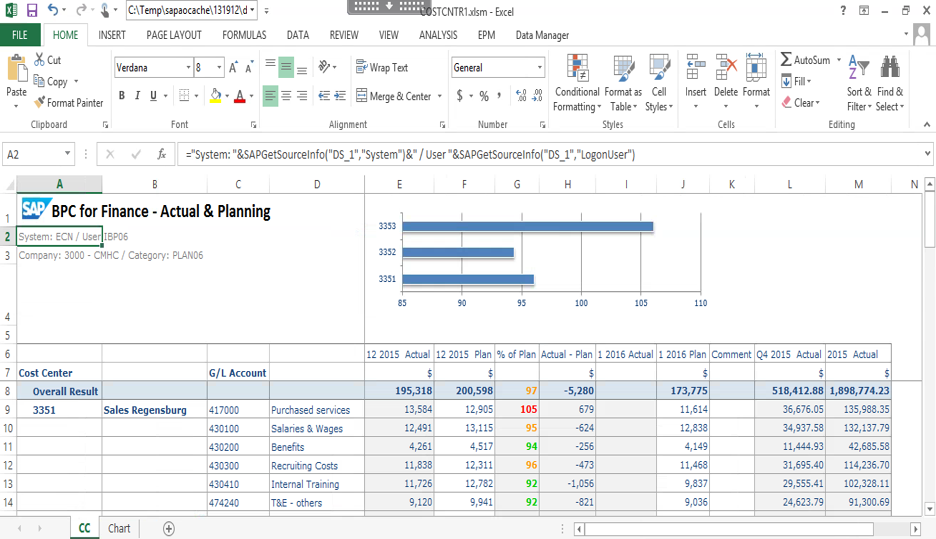
The main advantage SAP BPC (Business Planning and Consolidation) has over Tableau, or Business Warehouse is that the data can be input and reported via Excel spreadsheets instead of navigating the rather clunky world of SAP. The data in SAP BPC (Business Planning and …
Chose SAP BPC (Business Planning and Consolidation)
I am not too familiar with other products in this space. This was picked right before I started working at the organization. I am only in a support role for SAP BPC.
Chose SAP BPC (Business Planning and Consolidation)
We selected BPC because our Company is SAPified from the backbone. Has native and proven integrations so to start we only have to activate the pre-installed SAP Business Content and configure based in our current metadata (entities, chart of accounts, intercompanies, cost …
Chose SAP BPC (Business Planning and Consolidation)
Actually, for this client, no alternative has been evaluated, because SAP BPC was already in place and already installed previously However, in my opinion, once a large company has an SAP-based structure, it is quite understandable that the same company continues to use SAP …
Chose SAP BPC (Business Planning and Consolidation)
BPC was chosen primarily due to the revenue calculations it was capable of. The other factor in BPC's favor was the seamlessness of the multi-currency capabilities.
Chose SAP BPC (Business Planning and Consolidation)
With Hyperion we struggled as it didn’t have integrated planning and consolidation, whereas BPC does have it. BPC is easier for reporting as it is Excel-based. Also BPC has prepackaged business process flows that helped a lot. Hyperion on the other hand has a faster response …
1) The budget process. In QBO the budgeting capability is non-existant, unless you like manually typing in every scenario and not being able to budget by class. Cube houses my budget/forecast scenarios & lets me view and analyze by my company's preferred data points; department, GL account, vendor, & sales campaign. I'm able to run monthly budget variance reports and plan for the future with ease. 2) We've begun using Cube to help analyze profitablity by sales job. We've never had such easy access to this type of info in the past, so this is a benefit I can directly attribute to Cube. 3) We're beginning now to use an integration with our payroll software to work on headcount planning and payroll analysis.
For a large company trying to bring processes and functions together with one tool, SAP BPC is a great solution. It requires hours of effort to implement and configure, which would not be appropriate for smaller companies. SAP BPC also requires dedicated resources to maintain the system on a day to day basis, as well as an administrator type personnel who can troubleshoot slow performance or issues with the system. You also need users who are willing and exciting to use this system and actually trust that this is a solution.
Allows for full integration of data to be analyzed in real time. Although we still load actuals on a delayed basis (2 business days after month end), when developing the budget, we not longer have to do a full loading process from a different application into BPC prior to being able to report and analyze the current budget status to prior budget versions or actuals.
It is easy to learn basic report building. The hardest part is learning the available dimensions and the different possible combinations and their results, but that will also vary from company to company depending on the complexity of the industry.
Limited to 8 top line dimensions. Although you can bring in as many attributes of data as you want, but I would really like Cube to increase top line dimensions to 10.
The ability for cross level interaction within multiples cube would be a major plus once implemented.
SAP BPC training content and trainers are very good. The training is structured and provides a very good understanding of the product features and functionalities. I attended 6 separate training sessions of week-long or more. I had very good experience in all the sessions. The training is organized very well.
Cube was just a lot easier to use than Vena. We took some time to look at Vena as well and while their product was impressive, our organization was not yet there. We needed something we could implement quickly, and in today's day and age I think that is a very important quality to have. Start up and early stage companies do not have the luxury of implementation teams and massive IT resources so Cube was a huge help.
Sage BPC is very much ahead of Dimensions in multiple areas. The speed and ease of reporting with Sage is very good when compared (although the bank reconciliation task is one thing that i feel is much more effort on Sage and takes more time than previous). We selected SAP BPC (Business Planning and Consolidation) as we have multiple foreign entities and a team in India producing reports so needed one package that could reliably provide information in one currency and show it clearly.
When originally implemented (as the predecessor product Outlooksoft) BPC took ASU from trying to budget and forecast for a 2B enterprise out of spreadsheets and into a far more consolidated tool. It has saved us considerable time over the years and paid for itself several times over.
BPC also allows us to present our budget in multiple different views to support management, board and departmental reporting.