Drupal is a free, open-source content management system written in PHP that competes primarily with Joomla and Plone. The standard release of Drupal, known as Drupal core, contains basic features such as account and menu management, RSS feeds, page layout customization, and system administration.
N/A
Magnolia
Score 8.1 out of 10
Mid-Size Companies (51-1,000 employees)
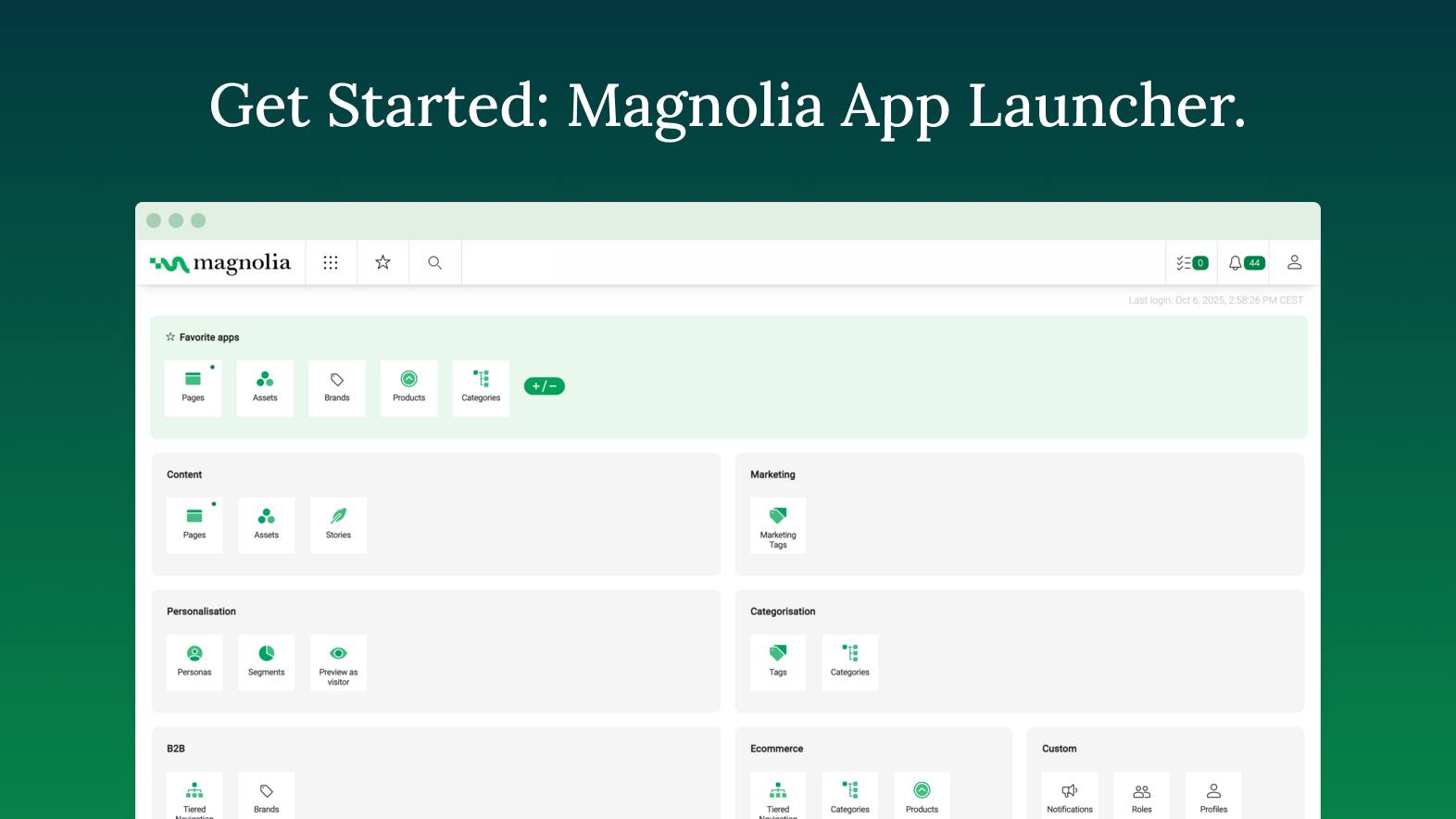
Founded in Switzerland in 1997, Magnolia is a CMS used to build composable digital experiences. Magnolia helps create fully integrated customer experiences and speeds up digital delivery of content. Magnolia boasts 480 enterprise customers, thousands of Community Edition deployments, and more than 200 certified Magnolia Partners around the world. They further state that their enterprise customers include Sanofi, Generali, the Atlassian, The New York Times, Harley Davidson, and Union…
Drupal excels at allowing seasoned programmers to really get creative with marketing initiatives in terms of working with a theme and the core code. That being said, it is definitely much more challenging for average developers and front-end builders to use, especially at …
Drupal has some advantages and disadvantages when stacked up against Wordpress,, including that Wordpress is easier to user for beginners and requires less training to get started. I noticed that while using Drupal, more help and assistance was needed from developers to make …
Director of UX development, social media and SEO/SEM
Chose Drupal
Drupal can be more complex to learn, but it offers a much wider range of applications. Drupal’s front and backend can be customized from design to functionality to allow for a wide range of uses. If someone wants to create something more complex than a simple site or blog, …
I inherited Drupal from a developer who made the website for our nonprofit many years ago. It was increasingly obvious that it wasn't a fit for our organization, which has multiple staff and volunteers who need to edit or update the website but don't have coding experience. Wix …
Drupal requires less to no coding abilities to spin up sites. Even if someone is preparing to develop sites that require technical know how then Drupal provides role based systems to seperate developers from content writers. Drupal 8 and 9 now have a vast array of plugins. Now …
WordPress for sure has a bigger community, a lot of paid extensions which sometimes is easier to purchase and get started, a lot of pre-designed templates to get you going, but nowadays with the scale of the projects we've been working with, and the need for custom-tailored …
We use both, for different projects (Joomla and Drupal). Drupal proved to be more robust, more secure and more integrable with PHP applications. Drupal requires a more senior technical team but allows for more complex activities. It's great if you have a medium to a large …
We first had a WordPress-based website, that evolved to a custom third-party developed content management system. In both cases, that involved additional costs for any change request, any security or any scalability need. WordPress didn't meet enterprise requirements. That also …
Drupal is community-backed making it more accessible and growing at a faster rate than Sitefinity which is a proprietary product built on .NET. Drupal is PHP-based using some but not all Symphony codebase. Updates for Drupal are frequent and so are feature adds.
Drupal is far more usable and stable than Joomla!, and the developer community support is significantly stronger. While Drupal is often compared to WordPress, they are fundamentally different platforms, and in most projects, it's very clear when the requirements are beyond what …
We have used many content management systems — WordPress, Wix, Squarespace, ExpressionEngine, and more. Drupal is more powerful and flexible than most.
We did a comparison of Drupal against Joomla, WordPress, and Ingeniux. We found that its multiple themes available for web pages, user management, comment management, and form generation stands apart from its competitors.
I've used Wordpress sparingly when helping a client with an existing website. I find it much less powerful and robust, and frankly confusing. The way Wordpress websites are set up in the backend doesn't make sense to me after getting used to how Drupal is set up. They're …
Drupal is really the only well-supported open-source CMS that is designed for large, data-rich websites. There just really weren't any good alternatives. There are plenty of CMSs that excel at small to medium-sized websites. But for a large website with lots of structured data, …
Although Drupal is not the most used, it has great performance and is more used in professional projects. It allows us to expand without starting from scratch.
Security-wise and traffic-wise Drupal is built to handle a lot. While the other platforms mentioned ( mainly Wordpress ) are great and have a large community, I would only use Drupal for an Enterprise level platform to build a website on. I first learned about Drupal about 10 …
Drupal supports lots of devices like Mac, Windows, Linux etc. easily, and it is an open source product so there's no cost required. Lots of other products require purchasing, costing a high amount. The support system of Drupal is also good in comparison to other products. The …
Drupal is certainly a more complex animal, comparatively. But its power lies in its flexibility, extensibility, and stability. And the API is fantastic. There's really nothing else like it.
I selected Drupal because of the simplicity upon going live. "Simple" is not the word I would use prior to the site going live though. I have used Jumla (which I believe was part of Drupal as one CMS about 12 or 15 years ago). Jumla is almost identical in capabilities to …
In my mind, Drupal and WordPress are the top open source CMSes, and I rarely recommend not going with an open source CMS. WordPress can be great, especially for single developers, but I find that the code structure and extensibility of Drupal makes it superior for many use …
I've used Squarespace and Wordpress for other businesses, and Drupal was honestly selected due to cost. It does a good job of scaling across our organization - and many units have benefited from having a space to provide content. Squarespace is more modern, and Wordpress may …
Drupal has strong role-based permissions for users, powerful content blocks for editing, and granular customizing options in their views. For a company or organization requiring a lot of customization, Drupal can be a really powerful tool. However, Drupal does require …
Magnolia DXP offers similar or more capability compared to the other platform, while much easier to implement. For example, Adobe Experience Manager tend to be more monolithic in nature, heavier footprint compared to Magnolia. Hence when implementing a DXP, it is much faster to …
The Broadleaf CMS was quite basic and was not a full fledged CMS and hence we had to chose Magnolia to address the business requirement for our B2B platform
Magnolia is in a league of it's own vs the other platforms I have previously used. Rather than being a turnkey solution Magnolia puts the power into the hands of your company and developers allowing you to build anything you can imagine. Being a DXP rather than a CMS Magnolia …
Magnolia is not as costly as other enterprise grade platforms and is easier to deploy, more reliable and less resource hungry. It's often also easier to use and certainly easier to use than it's Open Source counterparts. It also manages content in a much more structured manner …
I've used several CMSs like AEM and EpiServer, and comparatively, they all excel at different things. Magnolia is the best to develop for/against. Episerver has the best/most fluid UI in terms of content editing, and the overall admin experience AEM is just all around sucks.
Similar to how one might choose a specific programming language to solve a specific problem, Magnolia has its place among the rest, depending on the use case. While it does not have the most pleasant user experience compared to others, its customization options are streets …
Cost was prohibitive for SiteCore. We liked the support that Magnolia gives us in terms of being an actual Company. We love open-source, but have had problems with Umbraco in the past in terms of upgrade paths etc.
Of all the ones we looked at that met our requirements Magnolia was clearly the best value for money and had a solid background that you could trust and that could take care of you in case of problems.
For us, Magnolia is the best option for our needs. FirstSpirit by eSpirit is missing on the list. We are moving away from FirstSpirit as it feels outdated. Wix has better usability, but is not suitable for enterprise. WordPress I would only recommend for private projects. …
Putting all together: capabilities, support, community and price... Magnolia is the best combination, maybe not the best on each aspect, but for sure in the combination
I choose Magnolia in front of everyone since it is one of the content managers that best adapts to all the modifications that are required by businesses
One of the most important points that magnolia has over other products is the possibility of extending its functionalities. Being open-source, it is possible to inspect how everything is done and replicate it to change functionalities. In this way, many features that customers …
I use magnolia because my client asked for it in the beginning because he had a long history of using magnolia for years. I think magnolia is middle-hight rated in the stack of similar products. Maybe it's not very well-publicized and it needs better marketing techniques or …
Good documentation and examples Online demos to mess with and test functionalities Easier to install Better knowledge about the product Ability to centralize content of the same type in apps Better performance in some scenarios Better usability: In the newest versions, …
Especialista Digital Experiences Platforms en atSistemas
Chose Magnolia
Magnolia is a good competitor in the DXP scenario: Reduced costs License costs are contained, what brings customers the ability to develop their business with a minor impact Open source platform It helps customers to adapt the platform to some special needs DXP …
Magnolia has all flexible capabilities that offer the user the best cloud marketing experience and great functionalities for effective data analytics generation. Reporting through Magnolia tools is also another important aspect since it allows the production of effective …
Magnolia has an automatic, and speedy social media publication extension, which spread content to all social sites. Also, the insertion of extensions and plugins is more effective when on Magnolia against the opponents. Magnolia admits and adopts diversity, hence, it is a …
We developed a corporate website using Drupal, which features a large number of static pages and several dynamic functions, including a contact us form, location finder, and job posting. We utilized Drupal with some customization to achieve the desired functionalities. We have also worked on e-commerce sites using Drupal, and there is a scope for improvements, specifically in cataloging.
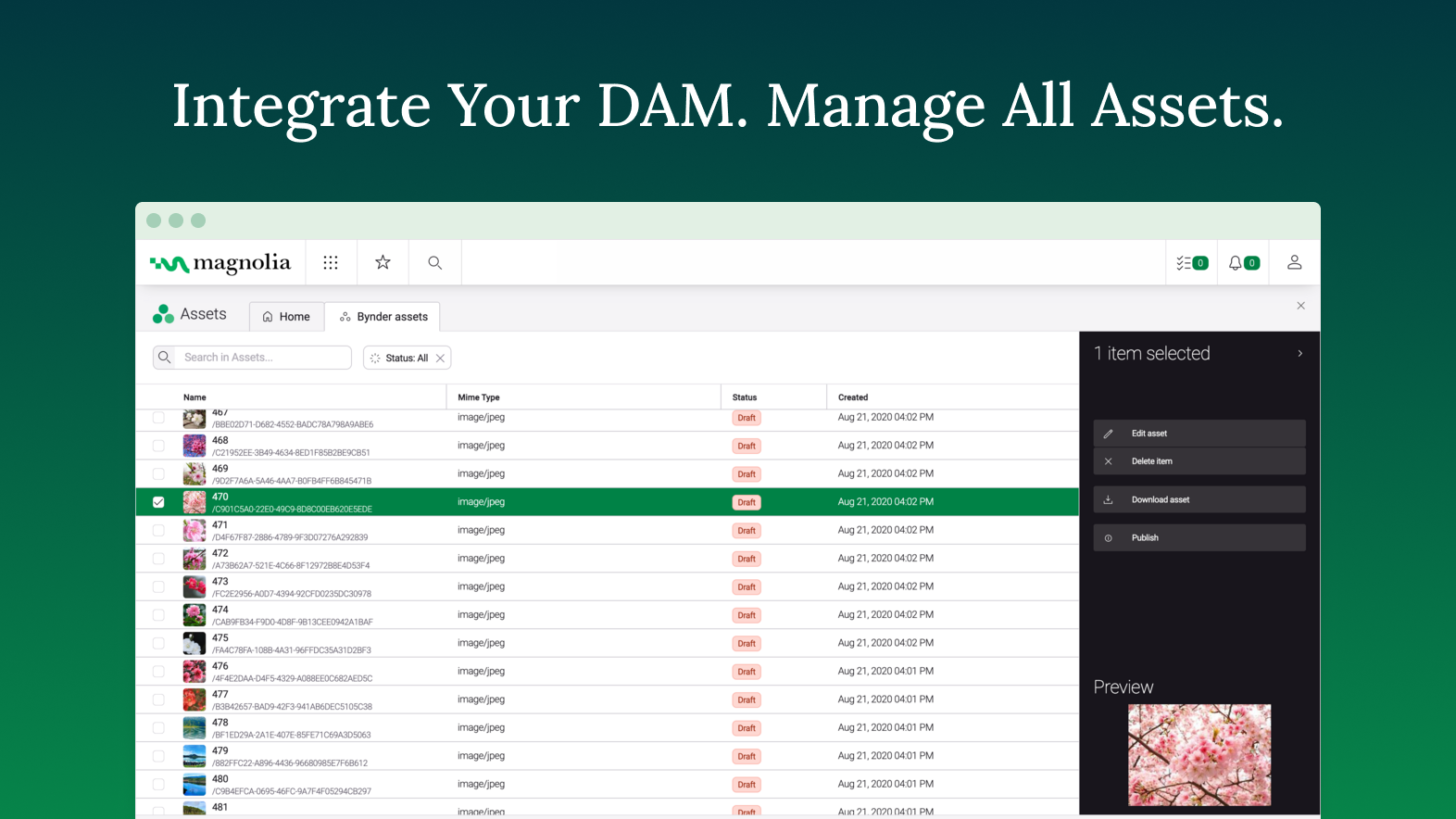
If you need a business CMS that brings along a good amount of features and also give you the chance to develop features on your own, Magnolia would be a good choice. Even if you have not the fitting infrastructure around, Magnolia provides you different ways like SAAS oder PAAS. If you have to review your code our have any problems the team behind will helps in a short time. Without using the connectors it is not so easy to connect special functionalities like Marketing tools or optimization tools. The DAM is very slow if you have an huge amount of documents and pictures to store for your website - you have to add an external DAM.
Content Types... these are amazing. Whereas a more simplistic CMS like Wordpress will basically allow you to make posts and build pages, Drupal 8 gives you the ability to define different types of content that behave differently, and are served up differently in different areas of the website.
Extensibility... it scales, ohhhh does it scale. They've really figured out server-side caching, and it makes all the difference. Once a page has been cached, it's available instantly to all users worldwide; and when coupled with AWS, global redundancy and localization mean that no matter where you're accessing the site, it always loads fast and crisp.
Workflows... you have the ability to define very specific roles and/or user-based editorial workflows, allowing for as many touchpoints and reviews between content creation and publication as you'll require.
Versatility of defining actions for custom handlers.
Reloading classes when code is modified in a local dev environment is nice. While it doesn't seem to work when changes extend beyond the method body (i.e., adding methods), it remediates the pain of long startup times.
Security and new release notifications are a hassle as they happen too often
Allowing them to write PHP modules is a big advantage, but sometimes integrating them is a small challenge due to the version the developer is working on.
I really like Drupal, and besides the one major issue with not being able to update from version 6 to version 7 and I am happy to continuing using it. Hopefully as time goes on they will make it easier to upgrade or provide better tools for mid-level web designers like myself to build out new sites without the help of expensive 3rd party's.
Magnolia is an innovative CMS, for example it is possible to use the ipad to manage the contents. Magnolia’s team works hard to improve the product; the community is small but active and the support for the enterprise version is good. Magnolia’s team asks the users what they think and what they need, and the new functionalities planned for Magnolia 5.3 are very exciting for example the content personalization.
It has a very steep learning curve. When starting with Drupal, the functionality and setup have to be learned, which is complex in comparison to tools like WordPress. Drupal is more powerful and can create a wider range of applications, but it definitely has a learning curve. I would recommend it to anyone who wants to make a dynamic web application bigger than the scale of a WordPress blog.
There are a ton of small things that could make this CMS great Off the top of my head... 1) Better navigation between a component and its corresponding node in the jcr ( devs often have to flip between a page and a spot in the jcr even though there could be a button to take you from a page/component in the pages app to its location in the JCR) 2) Why does a content editor need to open the page to edit the page properties? They could just as easily edit the dialog from the tree view if they have many pages to touch, and it would save them time by not having to render the page.
Drupal itself does not tend to have bugs that cause sporadic outages. When deployed on a well-configured LAMP stack, deployment and maintenance problems are minimal, and in general no exotic tuning or configuration is required. For highest uptime, putting a caching proxy like Varnish in front of Drupal (or a CDN that supports dynamic applications).
Drupal page loads can be slow, as a great many database calls may be required to generate a page. It is highly recommended to use caching systems, both built-in and external to lessen such database loads and improve performance. I haven't had any problems with behind-the-scenes integrations with external systems.
It's a lean and performant platform. You don't need to put reverse proxy servers in front of it to speed it up (although that does make it go even quicker) as there are various layers of caching built in to the application. While it's a little cryptic, the internal caching system is actually quite configurable and can be tuned to the right sort of content.
Often what tends to surprise many an IT manager is that you can run it on relatively modest hardware. We've often been met with "are you sure ?" but the reality is that it doesn't need a whole lot of horsepower.
As noted earlier, the support of the community can be rather variable, with some modules attracting more attraction and action in their issue queues, but overall, the development community for Drupal is second to none. It probably the single greatest aspect of being involved in this open-source project.
You always get an answer based on your SLA. But you always get a solution. That's the successfactor in this case. To often i was frustrated about people in a company without even a clue what there product is about or how to solve a problem. Magnolia's Support Team does a very good job and try to help you in most of the cases
I was part of the team that conducted the training. Our training was fine, but we could have been better informed on Drupal before we started providing it. If we did not have answers to tough questions, we had more technical staff we could consult with. We did provide hands-on practice time for the learners, which I would always recommend. That is where the best learning occurred.
The on-line training was not as ideal as the face-to-face training. It was done remotely and only allowed for the trainers to present information to the learners and demonstrate the platform online. There was not a good way to allow for the learners to practice, ask questions and have them answered all in the same session.
Plan ahead as much you can. You really need to know how to build what you want with the modules available to you, or that you might need to code yourself, in order to make the best use of Drupal. I recommend you analyze the most technically difficult workflows and other aspects of your implementation, and try building some test versions of those first. Get feedback from stakeholders early and often, because you can easily find yourself in a situation where your implementation does 90% of what you want, but, due to something you didn't plan for, foresee, or know about, there's no feasible way to get past the last 10%
Drupal's capabilities outpace WordPress by miles. Drupal is more customizable, scales better for larger companies and has advanced content types. If you own a small business or work at a startup company, I would recommend WordPress but if your firm is trying to scale and you have more than 50 employees I would recommend Drupal.
Magnolia DXP offers similar or more capability compared to the other platform, while much easier to implement. For example, Adobe Experience Manager tend to be more monolithic in nature, heavier footprint compared to Magnolia. Hence when implementing a DXP, it is much faster to build using Magnolia, at a much lower TCO. The other platform like Kontent.ai and Strapi are pure headless platform and offer lesser features. What really make Magnolia different is the APAC team, who are all out to support their client in the implementation, ensuring their client maximize their platform and the project implementation is successful. This is some thing that is not experienced when using other platform(s)
Drupal is well known to be scalable, although it requires solid knowledge of MySQL best practices, caching mechanisms, and other server-level best practices. I have never personally dealt with an especially large site, so I can speak well to the issues associated with Drupal scaling.
Drupal helped us launch a creative, marketing- and product-focused website with custom coding integrations tailored to our goals.
Drupal allows us to rely on secure and consistently updated core code.
Drupal's code taxing on the server does start to get a bit heavy as you go along with customizations, so at some point, we decided to stop. We want to ensure our Google Page Score remains high, including paying close attention to page load speed.
We have placed web content management in the hands of the organisation than retained it within the technology team.
We were able to quickly move to MVP and release and we are now focussed on moving the platform forward at some pace whilst not being burdened with BAU work inside the technology team as so much as self-service to trained organisational users
The use of the SAAS/PASS has inbuilt business resiliency as specialist work and aspects such as underlying security is done by Magnolia and we are able to focus internal effort on building out the platform.