Drupal vs. Optimizely One

Overview
ProductRatingMost Used ByProduct SummaryStarting Price
Drupal
Score 6.8 out of 10
N/A
Drupal is a free, open-source content management system written in PHP that competes primarily with Joomla and Plone. The standard release of Drupal, known as Drupal core, contains basic features such as account and menu management, RSS feeds, page layout customization, and system administration.N/A
Optimizely One
Score 7.3 out of 10
N/A
Optimizely One is a digital experience platform, helping marketing and product teams accelerate digital growth, powering the marketing and digital lifecycle from planning to analysis through a unified workflow. Optimizely One accelerates every step of the process with embedded AI.N/A
Pricing
DrupalOptimizely One
Editions & Modules
No answers on this topic
Offerings
Pricing Offerings
DrupalOptimizely One
Free Trial
NoNo
Free/Freemium Version
NoNo
Premium Consulting/Integration Services
NoNo
Entry-level Setup FeeNo setup feeOptional
Additional Details
More Pricing Information
Community Pulse
DrupalOptimizely One
Considered Both Products
Drupal
Chose Drupal
Drupal excels at allowing seasoned programmers to really get creative with marketing initiatives in terms of working with a theme and the core code. That being said, it is definitely much more challenging for average developers and front-end builders to use, especially at …
Chose Drupal
Drupal has some advantages and disadvantages when stacked up against Wordpress,, including that Wordpress is easier to user for beginners and requires less training to get started. I noticed that while using Drupal, more help and assistance was needed from developers to make …
Chose Drupal
Drupal can be more complex to learn, but it offers a much wider range of applications. Drupal’s front and backend can be customized from design to functionality to allow for a wide range of uses. If someone wants to create something more complex than a simple site or blog, …
Chose Drupal
I inherited Drupal from a developer who made the website for our nonprofit many years ago. It was increasingly obvious that it wasn't a fit for our organization, which has multiple staff and volunteers who need to edit or update the website but don't have coding experience. Wix …
Chose Drupal
Drupal requires less to no coding abilities to spin up sites.
Even if someone is preparing to develop sites that require technical know how then Drupal provides role based systems to seperate developers from content writers.
Drupal 8 and 9 now have a vast array of plugins. Now …
Chose Drupal
WordPress for sure has a bigger community, a lot of paid extensions which sometimes is easier to purchase and get started, a lot of pre-designed templates to get you going, but nowadays with the scale of the projects we've been working with, and the need for custom-tailored …
Chose Drupal
Drupal's commerce module features custom e-commerce functionality, allowing for customization that fits our commercial enterprise model.
Chose Drupal
We use both, for different projects (Joomla and Drupal). Drupal proved to be more robust, more secure and more integrable with PHP applications.
Drupal requires a more senior technical team but allows for more complex activities. It's great if you have a medium to a large …
Chose Drupal
We first had a WordPress-based website, that evolved to a custom third-party developed content management system. In both cases, that involved additional costs for any change request, any security or any scalability need.
WordPress didn't meet enterprise requirements. That also …
Chose Drupal
Drupal is community-backed making it more accessible and growing at a faster rate than Sitefinity which is a proprietary product built on .NET. Drupal is PHP-based using some but not all Symphony codebase. Updates for Drupal are frequent and so are feature adds.
Chose Drupal
Drupal is far more usable and stable than Joomla!, and the developer community support is significantly stronger. While Drupal is often compared to WordPress, they are fundamentally different platforms, and in most projects, it's very clear when the requirements are beyond what …
Chose Drupal
We were looking for an open source CMS. WordPress wasn't powerful enough for our needs. Joomla was too difficult for our team to use.
Chose Drupal
We have used many content management systems — WordPress, Wix, Squarespace, ExpressionEngine, and more. Drupal is more powerful and flexible than most.
Chose Drupal
We did a comparison of Drupal against Joomla, WordPress, and Ingeniux. We found that its multiple themes available for web pages, user management, comment management, and form generation stands apart from its competitors.
Chose Drupal
I've used Wordpress sparingly when helping a client with an existing website. I find it much less powerful and robust, and frankly confusing. The way Wordpress websites are set up in the backend doesn't make sense to me after getting used to how Drupal is set up. They're …
Chose Drupal
Drupal is really the only well-supported open-source CMS that is designed for large, data-rich websites. There just really weren't any good alternatives. There are plenty of CMSs that excel at small to medium-sized websites. But for a large website with lots of structured data, …
Chose Drupal
Although Drupal is not the most used, it has great performance and is more used in professional projects. It allows us to expand without starting from scratch.
Chose Drupal
Security-wise and traffic-wise Drupal is built to handle a lot. While the other platforms mentioned ( mainly Wordpress ) are great and have a large community, I would only use Drupal for an Enterprise level platform to build a website on. I first learned about Drupal about 10 …
Chose Drupal
Drupal supports lots of devices like Mac, Windows, Linux etc. easily, and it is an open source product so there's no cost required. Lots of other products require purchasing, costing a high amount. The support system of Drupal is also good in comparison to other products. The …
Chose Drupal
Drupal is certainly a more complex animal, comparatively. But its power lies in its flexibility, extensibility, and stability. And the API is fantastic. There's really nothing else like it.
Chose Drupal
I selected Drupal because of the simplicity upon going live. "Simple" is not the word I would use prior to the site going live though. I have used Jumla (which I believe was part of Drupal as one CMS about 12 or 15 years ago). Jumla is almost identical in capabilities to …
Chose Drupal
In my mind, Drupal and WordPress are the top open source CMSes, and I rarely recommend not going with an open source CMS. WordPress can be great, especially for single developers, but I find that the code structure and extensibility of Drupal makes it superior for many use …
Chose Drupal
I've used Squarespace and Wordpress for other businesses, and Drupal was honestly selected due to cost. It does a good job of scaling across our organization - and many units have benefited from having a space to provide content. Squarespace is more modern, and Wordpress may …
Chose Drupal
Drupal has strong role-based permissions for users, powerful content blocks for editing, and granular customizing options in their views. For a company or organization requiring a lot of customization, Drupal can be a really powerful tool. However, Drupal does require …
Chose Drupal
We've used ION and WordPress. However, Drupal tends to be more customizable, secure, and overall more professional in the website-building business.
Optimizely One
Chose Optimizely One
There is a big difference between the two: Google Optimize uses Bayesian analysis while Optimizely uses Frequenting. There is a risk of counting multiple visits. Google Optimize data isn't available instantly (if I remember correctly). Optimizely's analyses dashboard is a …
Features
DrupalOptimizely One
Security
Comparison of Security features of Product A and Product B
Drupal
2.0
Ratings
120% below category average
Optimizely One
-
Ratings
Role-based user permissions2.00 Ratings00 Ratings
Platform & Infrastructure
Comparison of Platform & Infrastructure features of Product A and Product B
Drupal
7.7
Ratings
1% above category average
Optimizely One
-
Ratings
API9.30 Ratings00 Ratings
Internationalization / multi-language6.00 Ratings00 Ratings
Web Content Creation
Comparison of Web Content Creation features of Product A and Product B
Drupal
5.3
Ratings
37% below category average
Optimizely One
-
Ratings
WYSIWYG editor1.00 Ratings00 Ratings
Code quality / cleanliness9.30 Ratings00 Ratings
Admin section3.00 Ratings00 Ratings
Page templates4.00 Ratings00 Ratings
Library of website themes3.00 Ratings00 Ratings
Mobile optimization / responsive design10.00 Ratings00 Ratings
Publishing workflow9.30 Ratings00 Ratings
Form generator3.00 Ratings00 Ratings
Web Content Management
Comparison of Web Content Management features of Product A and Product B
Drupal
5.0
Ratings
38% below category average
Optimizely One
-
Ratings
Content taxonomy10.00 Ratings00 Ratings
SEO support1.00 Ratings00 Ratings
Bulk management10.00 Ratings00 Ratings
Availability / breadth of extensions2.00 Ratings00 Ratings
Community / comment management2.00 Ratings00 Ratings
Best Alternatives
DrupalOptimizely One
Small Businesses
ManageWP
ManageWP
Score 10.0 out of 10
Bloomreach - The Agentic Platform for Personalization
Score 8.6 out of 10
Medium-sized Companies
RWS Tridion Sites
RWS Tridion Sites
Score 9.0 out of 10
RWS Tridion Sites
RWS Tridion Sites
Score 9.0 out of 10
Enterprises
RWS Tridion Sites
RWS Tridion Sites
Score 9.0 out of 10
RWS Tridion Sites
RWS Tridion Sites
Score 9.0 out of 10
All AlternativesView all alternativesView all alternatives
User Ratings
DrupalOptimizely One
Likelihood to Recommend
2.0
(0 ratings)
9.0
(0 ratings)
Likelihood to Renew
8.2
(0 ratings)
-
(0 ratings)
Usability
3.0
(0 ratings)
-
(0 ratings)
Availability
9.7
(0 ratings)
-
(0 ratings)
Performance
8.9
(0 ratings)
-
(0 ratings)
Support Rating
5.0
(0 ratings)
-
(0 ratings)
In-Person Training
8.0
(0 ratings)
-
(0 ratings)
Online Training
6.0
(0 ratings)
-
(0 ratings)
Implementation Rating
5.1
(0 ratings)
-
(0 ratings)
Ease of integration
9.0
(0 ratings)
-
(0 ratings)
Product Scalability
8.0
(0 ratings)
-
(0 ratings)
User Testimonials
DrupalOptimizely One
Likelihood to Recommend
We developed a corporate website using Drupal, which features a large number of static pages and several dynamic functions, including a contact us form, location finder, and job posting. We utilized Drupal with some customization to achieve the desired functionalities. We have also worked on e-commerce sites using Drupal, and there is a scope for improvements, specifically in cataloging.
Read full review
It is well suited for heavy-duty A/B testing where management would like to see and quantitatively determine the effect of a change. It is not so efficient to try for a single page simple form, except when the form is part of a larger workflow. The security model is not very well understood, including RBAC and protection against injection attacks.
Read full review
Pros
  • Content Types... these are amazing. Whereas a more simplistic CMS like Wordpress will basically allow you to make posts and build pages, Drupal 8 gives you the ability to define different types of content that behave differently, and are served up differently in different areas of the website.
  • Extensibility... it scales, ohhhh does it scale. They've really figured out server-side caching, and it makes all the difference. Once a page has been cached, it's available instantly to all users worldwide; and when coupled with AWS, global redundancy and localization mean that no matter where you're accessing the site, it always loads fast and crisp.
  • Workflows... you have the ability to define very specific roles and/or user-based editorial workflows, allowing for as many touchpoints and reviews between content creation and publication as you'll require.
Read full review
  • Provides quicker release cycle for the way the product cards should be displayed.
  • Provides feedback for new product introduction and how it'll be perceived.
  • Allows rapid blackout from user experience changes that alters traffic flow.
Read full review
Cons
  • Security and new release notifications are a hassle as they happen too often
  • Allowing them to write PHP modules is a big advantage, but sometimes integrating them is a small challenge due to the version the developer is working on.
  • Steep learning curve, but worth it
Read full review
  • Can use better interface for managing test, including scheduling and notification.
  • Feels too heavy for simple projects, though this isn't a factor once past the PoC stage.
  • Notification on various aspects can be made more powerful and granular if such a need arise.
Read full review
Likelihood to Renew
I really like Drupal, and besides the one major issue with not being able to update from version 6 to version 7 and I am happy to continuing using it. Hopefully as time goes on they will make it easier to upgrade or provide better tools for mid-level web designers like myself to build out new sites without the help of expensive 3rd party's.
Read full review
No answers on this topic
Usability
It has a very steep learning curve. When starting with Drupal, the functionality and setup have to be learned, which is complex in comparison to tools like WordPress. Drupal is more powerful and can create a wider range of applications, but it definitely has a learning curve. I would recommend it to anyone who wants to make a dynamic web application bigger than the scale of a WordPress blog.
Read full review
No answers on this topic
Reliability and Availability
Drupal itself does not tend to have bugs that cause sporadic outages. When deployed on a well-configured LAMP stack, deployment and maintenance problems are minimal, and in general no exotic tuning or configuration is required. For highest uptime, putting a caching proxy like Varnish in front of Drupal (or a CDN that supports dynamic applications).
Read full review
No answers on this topic
Performance
Drupal page loads can be slow, as a great many database calls may be required to generate a page. It is highly recommended to use caching systems, both built-in and external to lessen such database loads and improve performance. I haven't had any problems with behind-the-scenes integrations with external systems.
Read full review
No answers on this topic
Support Rating
As noted earlier, the support of the community can be rather variable, with some modules attracting more attraction and action in their issue queues, but overall, the development community for Drupal is second to none. It probably the single greatest aspect of being involved in this open-source project.
Read full review
No answers on this topic
In-Person Training
I was part of the team that conducted the training. Our training was fine, but we could have been better informed on Drupal before we started providing it. If we did not have answers to tough questions, we had more technical staff we could consult with. We did provide hands-on practice time for the learners, which I would always recommend. That is where the best learning occurred.
Read full review
No answers on this topic
Online Training
The on-line training was not as ideal as the face-to-face training. It was done remotely and only allowed for the trainers to present information to the learners and demonstrate the platform online. There was not a good way to allow for the learners to practice, ask questions and have them answered all in the same session.
Read full review
No answers on this topic
Implementation Rating
Plan ahead as much you can. You really need to know how to build what you want with the modules available to you, or that you might need to code yourself, in order to make the best use of Drupal. I recommend you analyze the most technically difficult workflows and other aspects of your implementation, and try building some test versions of those first. Get feedback from stakeholders early and often, because you can easily find yourself in a situation where your implementation does 90% of what you want, but, due to something you didn't plan for, foresee, or know about, there's no feasible way to get past the last 10%
Read full review
No answers on this topic
Alternatives Considered
Drupal's capabilities outpace WordPress by miles. Drupal is more customizable, scales better for larger companies and has advanced content types. If you own a small business or work at a startup company, I would recommend WordPress but if your firm is trying to scale and you have more than 50 employees I would recommend Drupal.
Read full review
There is a big difference between the two: Google Optimize uses Bayesian analysis while Optimizely uses Frequenting. There is a risk of counting multiple visits. Google Optimize data isn't available instantly (if I remember correctly). Optimizely's analyses dashboard is a lot richer and offers a better experience, though it may get intimidating.
Read full review
Scalability
Drupal is well known to be scalable, although it requires solid knowledge of MySQL best practices, caching mechanisms, and other server-level best practices. I have never personally dealt with an especially large site, so I can speak well to the issues associated with Drupal scaling.
Read full review
No answers on this topic
Return on Investment
  • Drupal helped us launch a creative, marketing- and product-focused website with custom coding integrations tailored to our goals.
  • Drupal allows us to rely on secure and consistently updated core code.
  • Drupal's code taxing on the server does start to get a bit heavy as you go along with customizations, so at some point, we decided to stop. We want to ensure our Google Page Score remains high, including paying close attention to page load speed.

Read full review
  • Almost immediate payoff in terms of the benefit.
  • Easy to justify the TTM benefits to upper management.
  • Still somewhat hard to justify ROI, though this is not my expertise.
Read full review
ScreenShots

Optimizely One Screenshots

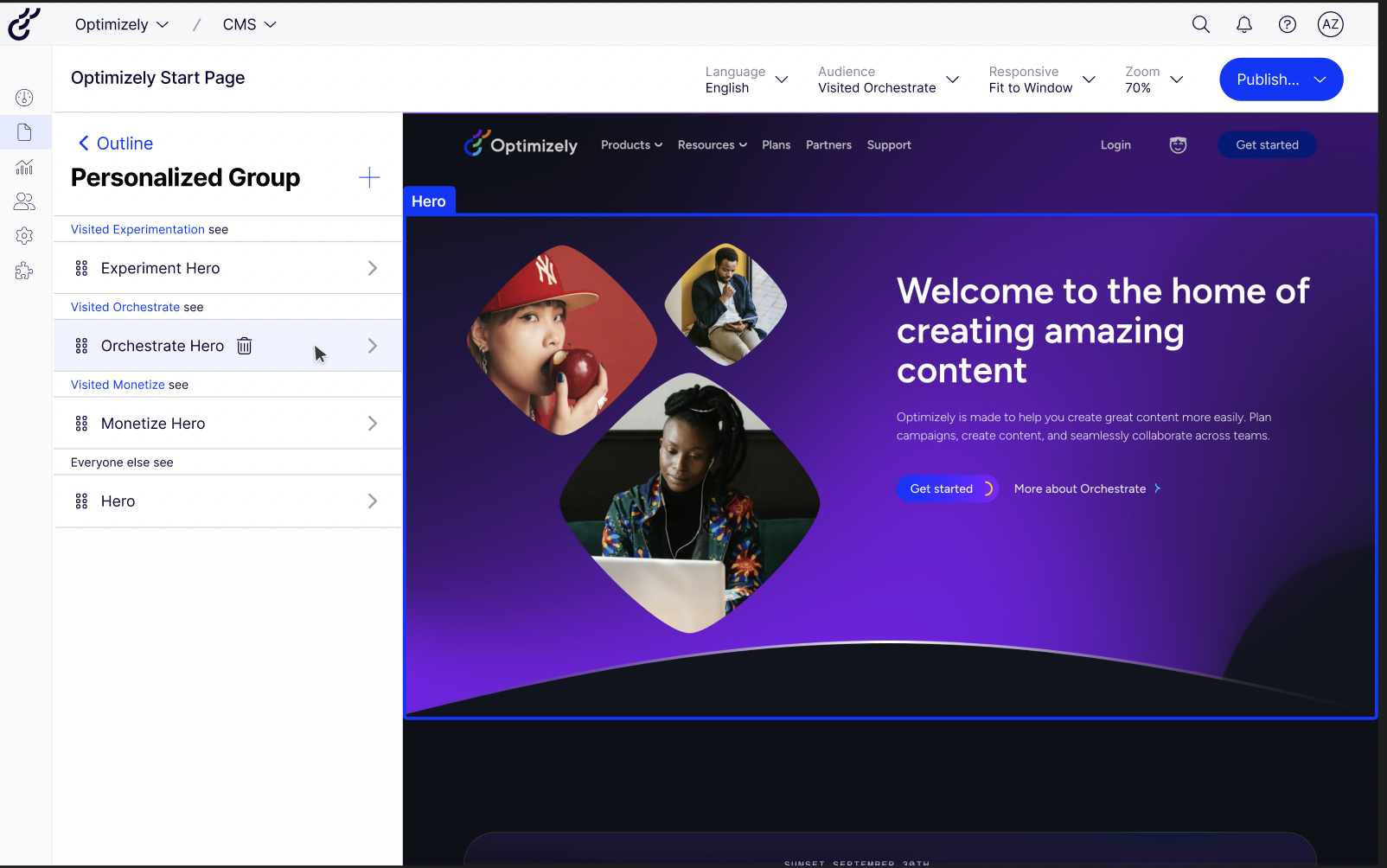
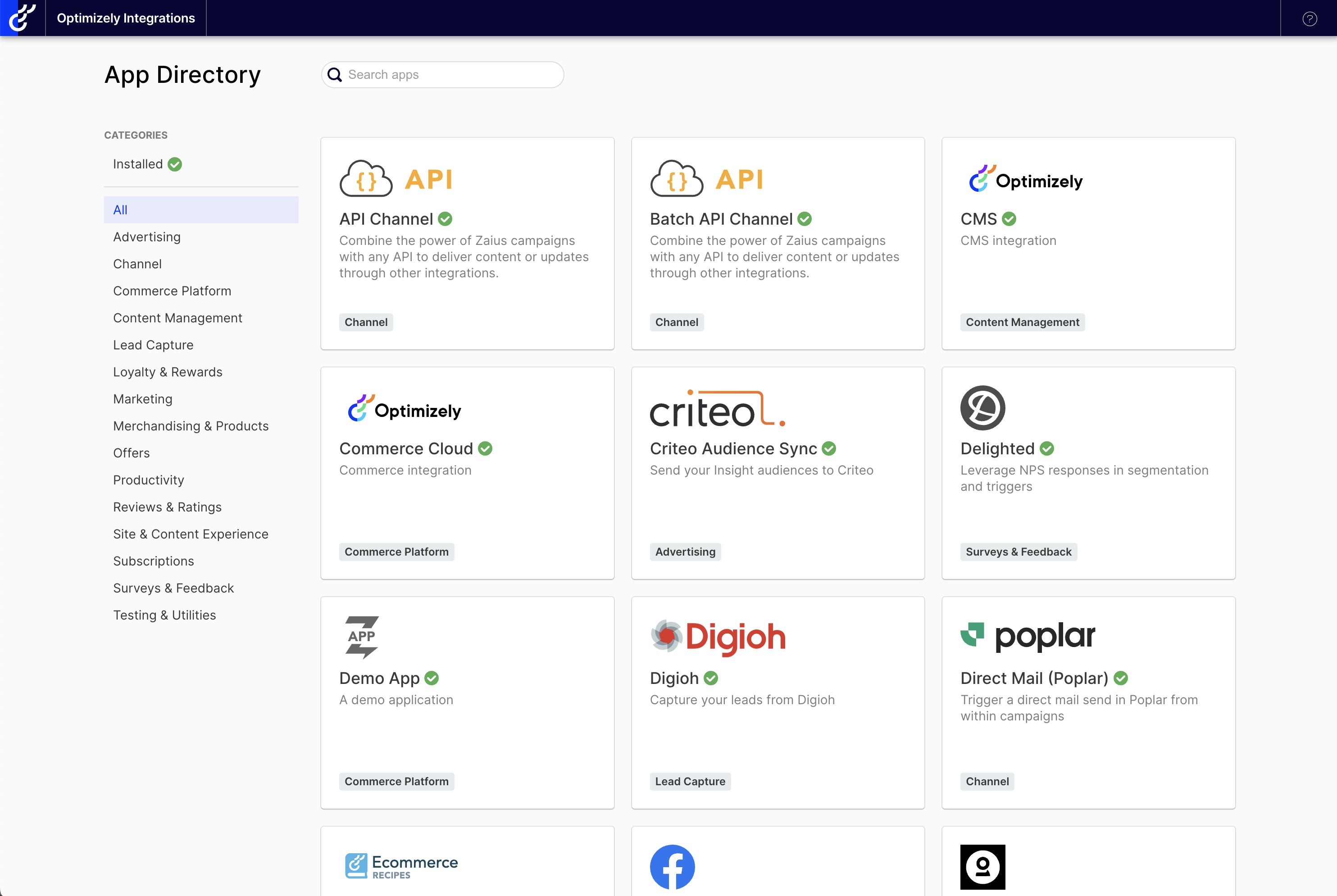
Screenshot of admin centerScreenshot of an Optimizely Content Management System content previewScreenshot of the integrations app directoryScreenshot of the reporting dashboardScreenshot of the Content Management System Visual Builder, used to create and edit dynamic experiences in the Visual Builder, no coding required.Screenshot of Content Marketing Platform Calendar: Gain full visibility into planned and scheduled content and campaigns with the ability to save and share views.