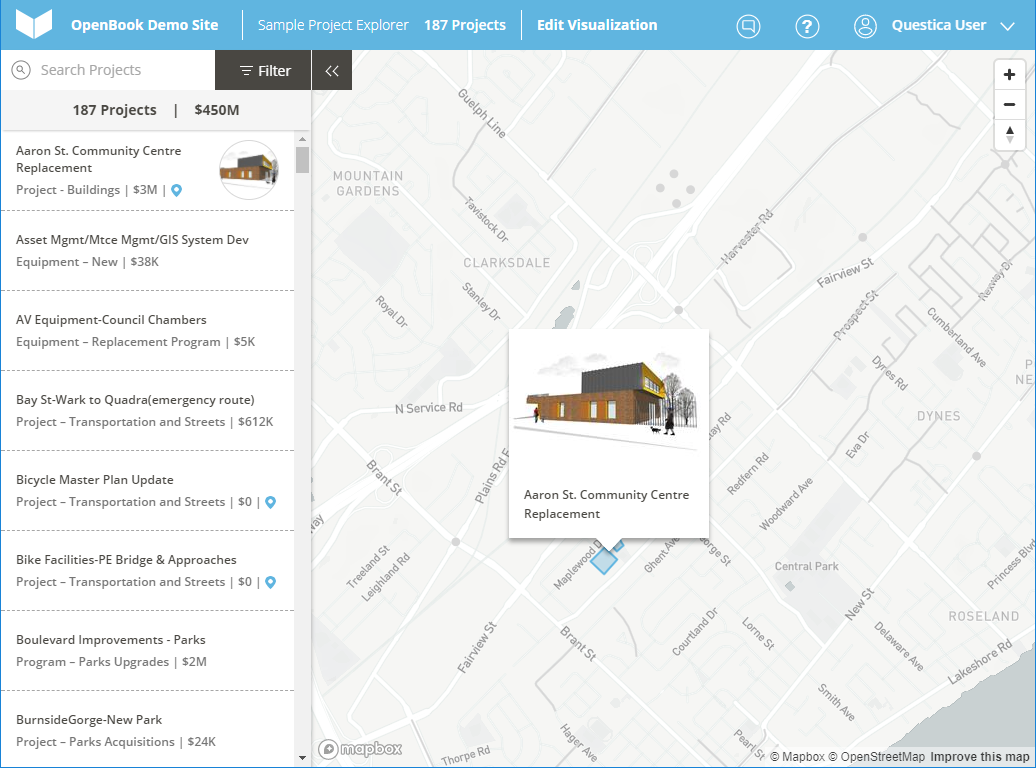
Euna Budget (Questica Budget and OpenBook) is a budgeting tool that enables organizations to share and communicate their financials and other data, when and where they need to. Additionally, its Project Explorer for Capital Budgets allows organizations to display on an interactive map every infrastructure project, including the budget, actual spend, funding sources, and accompanying documentation, images, video, etc.
N/A
IBM Planning Analytics
Score 8.8 out of 10
N/A
IBM Planning Analytics, powered by IBM TM1®, is an integrated planning solution designed to promote collaboration across the organization and help keep pace with the speed of modern business. With its calculation engine, this enterprise performance management solution is designed to help users move beyond the limits of spreadsheets, automating the planning process to drive faster, more accurate results. Use it to unify data sources into one single repository, enabling users to build…
$825
per month 5 users
Pricing
Euna Budget
IBM Planning Analytics
Editions & Modules
No answers on this topic
Essentials
$825
per month 5 users
Standard
$1,650
per month 10 users
Offerings
Pricing Offerings
Euna Budget
IBM Planning Analytics
Free Trial
No
Yes
Free/Freemium Version
No
Yes
Premium Consulting/Integration Services
No
No
Entry-level Setup Fee
No setup fee
Optional
Additional Details
—
—
More Pricing Information
Community Pulse
Euna Budget
IBM Planning Analytics
Considered Both Products
Euna Budget
Verified User
Anonymous
Chose Euna Budget
It stacked up very well. We evaluate at least 3 companies before making software decisions and this one was a clear contender. The map visualization and pop ups are wonderful to be able to visually see what you are discussing in person. These are qualities the rest do not have.
It includes Oracle Cloud EPM Planning, Anaplan, and Adaptive Insight before deciding to choose IBM Planning Analytics. We selected Planning Analytics because of its work with complicated and many area models, the capability to work with big amounts of data, and compatibility …
Other options, namely Anaplan, Oracle EPM Cloud, and SAP Analytics Cloud, were also considered. Anaplan's interface lacked analytical depth. For product design metrics, flexibility was not as good in Oracle EPM Cloud. The final choice was moved by the fact that it was driven …
Prior to making the decision to go with IBM Planning Analytics, we had considered such options as Anaplan, Oracle Hyperion, and SAP Analytics Cloud. Despite the collaborative solutions offered by Anaplan and the good connection with other systems by SAP, the superb set of tool …
In this case, Vena and Planful are considered as other products that can be compared with IBM Planning Analytics, but among them, IBM Planning Analytics is more optimal in terms of user interface and integration. Its preconfigure risk assessment model and its format and …
This was an older verions that was also very good, but the new IBM Planning Analytics is a far better tool that enables better scenario planning or what-if analysis.
Planning Analytics integrates seamlessly with Cognos Analytics to support all aspects of our Financial Reporting against both dimensional (TM1) and relational and ad hoc data sources
Why IBM Planning Analytics when compared to Oracle Hyperion: Better excel integration Less data movement and duplication Better cloud offering More aforeable licensing
IBM Planning Analytics with Watson will be up and running more quickly and be easier to maintain if modeling flexibility, scale, and the ability to plan at greater levels of detail are important requirements.
I am personally trying to explore the features of SAP analytics cloud in order to find if it's possible to integrate other sources of data and api based integrations, but I'm still on it while using the IBM planning analytics for my project currently. But looking at the intial …
I worked with Hyperion a long time ago. It was not a Oracle product yet. One great feature of this solution that was really great at the time, was the modeling process of ir, with a very robust engine for sparse cubes. the performance was excellent at the time. But today I can …
IBM Planning Analytics with Watson is much more flexible and scalable in comparison. IBM PAW is the clear winner for our organization's successful planning and analysis needs.
Anaplan does not handle sparsity; this is very problematic for large volume data sets (many 0's). There also are limitations to the number of dimensions that can be used in a module. If more dimensions are required, then separate modules need to be built and intertwined. IBM PA …
Because of its ability in planning, budgeting and forecasting or work progress.it has made it easy in driving sales hence profitability and lowering costs,also with ability to forecast the decision making has never been made this easier. The reasons for selecting are on its …
Compare to its competition it has good visual and graphical interface that helps to customized according to user needs. It helps to apply the best possible algorithm according to different model scenario that provides the best possible results. Predictive forecasting and AI …
Citizen engagement would be the area where it could be best suited. I don't really see it outside of the public sector but we use it to interact with our clients in the public sector. It helps to be able to show the transparency of engagement of citizens to communicate best with local government agencies.
For a CFO or a COO to do budgeting and planning, IBM Planning Analytics would be essential. It is a tool that can take in multiple data sources and showcase them in a multidimensional way. If you are looking just for a BI or reporting tool, Planning Analytics would be considered "overkill".
Since IBM Cognos Express is suitable only for medium data warehouse environment, we are not sure if this tool solves the long term need as the business keeps growing rapidly. So its a 50/50 ratio to renew Express license. But having said that, the components of IBM Cognos Express are also available in other Cognos BI suites like Cognos 10.x version. So we will probably upgrade our environment to IBM Cognos 10.x which comes with more new features.
It's very easy to use and intuitive enough that you can guide yourself through even if you do not have IT on staff to assist you. It's easy to set up and get going in minutes. All you have in front of you to analyze data and present. It's helpful for the customer too.
IBM Planning Analytics is generally good in terms of functionalities. It can be used reduce time for budget planning, resource planning, demand forecasting, etc. The performance of IBM Planning Analytics is acceptable, but user interface can be improved. It would be good to see new features that allow users to customise the dashboard.
I haven't had to deal with support much because it's such an easy-to-use product but when I have, they have been very easy to talk to, engage, and resolve our needs quickly. The challenges we had were met over the phone as they walked us through the system.
Although I find the IBM Planning analytics documentation quite time consuming, their support with email and call is something i can term as very considerate and patient, I have had few calls about the features and how i would want to implement them within my projects, and the teams have been super helpful to resolve my issues
It stacked up very well. We evaluate at least 3 companies before making software decisions and this one was a clear contender. The map visualization and pop ups are wonderful to be able to visually see what you are discussing in person. These are qualities the rest do not have.
For strong technical teams and flexibility IBM Planning Analytics is the way to go. For quicker adoption and less technical teams Anaplan is the best option. If consolidation, financials, and moving from legacy tools are main focus than OneStream will be a really good choice. If deeply invested into SAP already than the SAP BPC will be the best fit to maintain the investment.