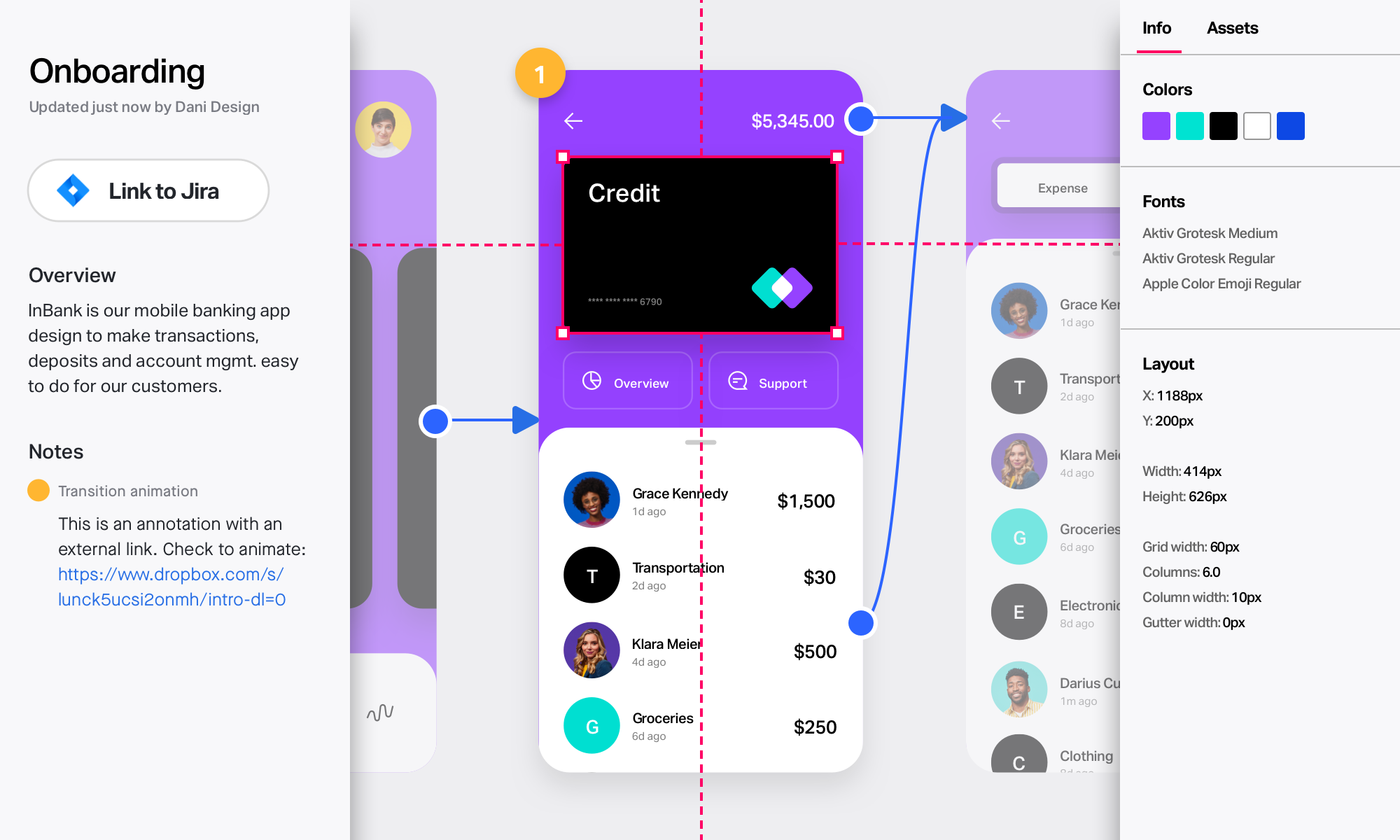
FigJam is an online interactive whiteboard from Figma headquartered in San Francisco, presently in beta (2021) but available to the public in a free trial. The vendor states that in 2022, FigJam will have plans for $0, $8, and $15 per editor, per month.
$36
per year per editor
InVision
Score 5.8 out of 10
N/A
InVision is a collaborative design and prototyping platform with features such as freehand drafting mode and interactive mockups, collaboration, idea management, user testing, and integration with Slack and other collaboration tools. According to the vendor, 1 million designers are using the free version.
$0
Pricing
FigJam
InVision
Editions & Modules
FigJam Professional
$36
per year per editor
FigJam Organization
$60
per year per editor
Free
$0
Pro
$7.75
per user/per month
Enterprise
Contact Sales
Offerings
Pricing Offerings
FigJam
InVision
Free Trial
Yes
No
Free/Freemium Version
Yes
No
Premium Consulting/Integration Services
No
No
Entry-level Setup Fee
No setup fee
No setup fee
Additional Details
—
—
More Pricing Information
Community Pulse
FigJam
InVision
Considered Both Products
FigJam
Verified User
Anonymous
Chose FigJam
It is similar, but it provides more usable solutions for brainstorming sessions and presentation purposes. Now empowered with AI and some new cool stuff, it may be the most dangerous competitor to FigJam. However, it will win the race if FigJam is more responsive and gets more …
FigJam works best in pair with Figma, as it allows you to keep track of your project in one place, supporting all phases of the process. The functionality is more intuitive, quick, and efficient. Visually, I also prefer it more —it’s more enjoyable and playful, making the …
Microsoft Whiteboards are better, in my opinion, but not friendly with Figma files (can't export layered assets, raster only). Better in the sense that the drawing and and marker tools felt more natural and the AI features are just better, like auto-shapes, vs. FigJam's …
Positive: FigJam is cheaper than Miro and allows connecting with FigJam, where we design our user interfaces. FigJam is more complete and visually appealing than draw.io, although draw.io is free. FigJam allows calls, which both competitors do not. Negative: Miro has …
If Sketch was on Windows with an app on par with their Mac app, I would never even look at FigJam. Sketch has local work sorted, accessible and scaleable, good collaborative features, and accessibility features, too. It feels modern and polished, with actual files you can …
I feel like Figjam is great at at what it does. It provides a great overall place to be able to use a virtual whiteboard and help teams collaborate. Especially remote teams. It actually does it better than others. There are some tools such as Invision Freehand that at the …
I have only used InVision as a tool for designing mockups. I wouldn't be able to draw a fair comparison to other tools since I have more experience with InVision.
FigJam has more shapes, more importable reactions, and for me it's less likely to lag. It's also way easier to connect arrows to sticky notes in FigJam and overall rough designs look cleaner than in InVision.
[InVision] provides the ability to iterate really quickly, in fact, it is so intuitive that can be applied on live wireframe designing, while the ideas are being scratched and stormed from the team in a single discovery session, as well as allowing and giving access to the …
We went with InVision because we were already bought into that ecosystem. We have since decided to move to Figma, as we were not receiving the features we needed from InVision and the associated tools (Whimsical, Sketch, Abstract, and Zeplin). The ROI of Figma allows us to free …
InVision can be a powerful tool when paired with Sketch and other platforms like Freehand. However, Figma is currently the industry leader in terms of functionality and usability for collaborative UI design and prototyping. Invision's sharing and prototyping features are its …
Main difference is InVision's easy to use prototyping capability. When it is compared to Marvel and Axure RP, while it has less capabilities on tools it is more robust than both. I believe Figma is just a new and upgraded version of InVision where you could do everything online …
InVision is a bit limited overall compared to other programs like Figma, Photoshop, Illustrator and XD. At the time we selected InVision they were one of the leaders and introduced a lot of new features that were beneficial. However now we've moved back to many of the Adobe …
We only tested out using Adobe XD for similar uses and found it to be more challenging to fit within our processes. It didn't have as robust a set of capabilities as InVision and wasn't as easy to use enterprise wide. I recall also having issues with working with Sketch.
InVision was the best tool for our team. It has the features that best fit our process but is also flexible enough for make it work in various situations where visuals are a core component. We've been using InVision for over 5 years and we're not likely to move to another …
InVision's design is much more polished and seamless due to its apps on mobile and web. They are very easy to learn and gather feedback compared to Sketch or Principle. Although these features are quickly coming to the other apps, InVision has an upper hand at the moment with …
Zeplin also allows to share design spec and collect feedback, but the ability to have prototype changes the game.
Also, other products like Craft plugin is cherry on the cake.
Compared to other tools, InVision is a very solid tool with a great reputation and prototyping functionalities to back it up. InVision was the first prototyping tool we purchased, and it’s served us really well. However, more and more design tools are now also providing …
Balsamiq is a better tool for interactive prototyping and dynamic transition. InVision is definitely better for handling various designs, separated by projects and shared with different access levels across multiple organizations.
Other design tools have been creating their own prototyping functionality, which has made InVision less valuable over time. It is much more convenient to use the same tool for both design and prototyping, because it removes the unnecessary steps of exporting, importing, and …
InVision works seamlessly and easily when sharing and requesting comments from others. Other products I've used like Balsamiq and Dropbox (earlier versions) provided online displays of work, but no easy way to collect feedback or quickly update. InVision provides enterprise …
InVision is a great tool to use and well worth the price. However, if you're looking for some variety, UXPin and Figma are worth looking into too. While UXPin may be a tad simplistic in the design ability, Figma is a great competitor to InVision. Both tools are worth looking …
I actually haven't used anything that's similar to InVision, so can't compare. I'm not even sure there is anything out there that can actually compare to InVision. It's an ideal tool for any designer that wants to improve client/team feedback. I highly recommend it and look …
As the industry leader, XD and Figma have had some catching up to do. I think now InVision will have to innovate to hold these products off. Several are doing what made InVision famous, and in some instances do it even better. There is an insane amount of competition and …
Truthfully, while we have looked at others, InVision has the name recognition in the web design community and a tight integration with Sketch which is what was important to us. We have not seriously considered others, but may in the future as our needs change. This is our first …
FigJam is perfect for the early stages of a project, where every member from cross-functional teams can participate, because it’s intuitive and has a very low entry barrier.
InVision is well suited for design reviews and immersing yourself in the experience of an app-to-be. As a Product Manager, it's difficult to take abstract concepts, user pain points, and business needs, and produce a vision for an app without a visual aid to communicate a vision. InVIsion offers PMs, designers, and developers the opportunity to sketch a vision, communicate about it with inline commenting, and shareable with other stakeholders.
Designs can be very slow to load on mobile devices, particularly when they include many screens.
There isn’t an offline version of the full app, which feels less-than-ideal for many of our teammates who live in areas with more spotty internet.
There are limited functionalities to portray animations and transitions. This hasn’t been a huge issue, but it makes the app feel a little out of date, considering the range of such functionalities in other apps.
I don't use it often, because the organization I work in uses a different environment on a commo basis. This is rather used between the designers, who prototype the solutions in Figma - they just have it as a workbook/notebook for their ideas. However, if those need to be shared with stakeholders or other organization members, the designers are expected to use a different environment.
I didn't need to contact InVision support, as I've never needed it. They have an intuitive UI, and most of the questions are answered in their help portal or in tutorials online. Since many people use it, there a great resources available on for example YouTube. No problems so far with InVision.
It is similar, but it provides more usable solutions for brainstorming sessions and presentation purposes. Now empowered with AI and some new cool stuff, it may be the most dangerous competitor to FigJam. However, it will win the race if FigJam is more responsive and gets more attached to Figma, where the prototyping takes place.
[InVision] provides the ability to iterate really quickly, in fact, it is so intuitive that can be applied on live wireframe designing, while the ideas are being scratched and stormed from the team in a single discovery session, as well as allowing and giving access to the whole organization to the final outcome