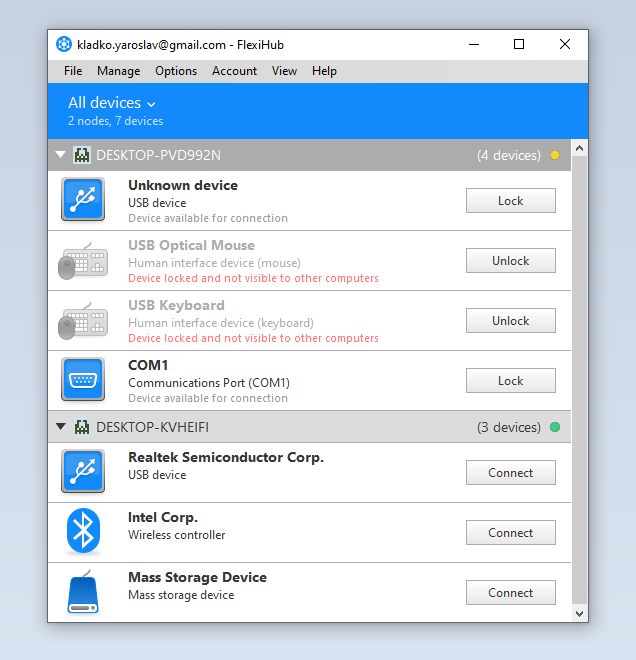
Software as a service for accessing USB devices connected to remote computers over the Internet FlexiHub enables users to set up a USB over network connection so they can link remotely-located computers with USB peripherals attached to a local machine. Users can share USB devices over Ethernet and connect them in real-time no matter if they are down the hall, across the city, or on the other side of the world. FlexiHub is a software as a service for redirecting all types of…
N/A
Azure IoT Hub
Score 7.1 out of 10
N/A
Microsoft's Azure IoT Hub is a managed service for bidirectional communication between IoT devices and Azure. Azure IoT Hub provides a cloud-hosted solution back end to connect virtually any device. Users can extend their solutions from the cloud to the edge with per-device authentication, built-in device management, and scaled provisioning.
I made the switch to FlexiHub because I found it to be more reliable and user-friendly for my specific needs. FlexiHub offers a more seamless experience when it comes to remotely accessing and managing USB devices, with fewer connectivity issues compared to the other products I …
I preferred AWS because it's faster to learn while more complex on Azure, either way, Azure is very complete and professional, although more expensive sometimes.
Azure IoT provides robust bi-directional communication within the cloud and can store millions of messages from the different devices on the cloud. It provides seamless communication and it's easy to integrate different IoT applications like app service and device management. …
Very comparable to the AWS offer, although brings additional security. Far ahead the rest of the industry, with end to end architecture and feature-set. Geo availability is a plus as well. Pricing could be more flexible or easy to understand - too many different components to …
We’ve put FlexiHub through its paces to see if it’s any good for remote vehicle health checks. We tried the app out with a handful of USB devices for car diagnostics and so far, everything is going smoothly. We also worked to develop an iOS app for remote diagnostics. Our testers from another office easily connected over the Internet thanks to FlexiHub. FlexiHub works perfectly in UDP connections, and needs an Internet connection. But there is no opportunity to work over LAN. This can be an issue.
I would recommend Azure IoT Hub for the energy industry and for massive scaling, maintaining security, and easy management of devices. It could be less suited from my point of view to small IoT projects due to the steeper learning curve.
Azure IoT support professionals are strong, and always provide timely responses. Vast documentation and examples are available, plus a network of professionals in the market. It's very comparable to the main competitor offer, and easily integrated into the main Azure product offer. Azure IoT is not a new solution, so it is very mature and support can easily address any day to day or architectural concern you have.
I made the switch to FlexiHub because I found it to be more reliable and user-friendly for my specific needs. FlexiHub offers a more seamless experience when it comes to remotely accessing and managing USB devices, with fewer connectivity issues compared to the other products I was using. also TeamViewer's pricing structure didn't align well with my needs. FlexiHub's subscription plans offered a better fit for my usage.
Azure IoT provides robust bi-directional communication within the cloud and can store millions of messages from the different devices on the cloud. It provides seamless communication and it's easy to integrate different IoT applications like app service and device management. It handles heavy throughput and can collect sensor data which is cool.