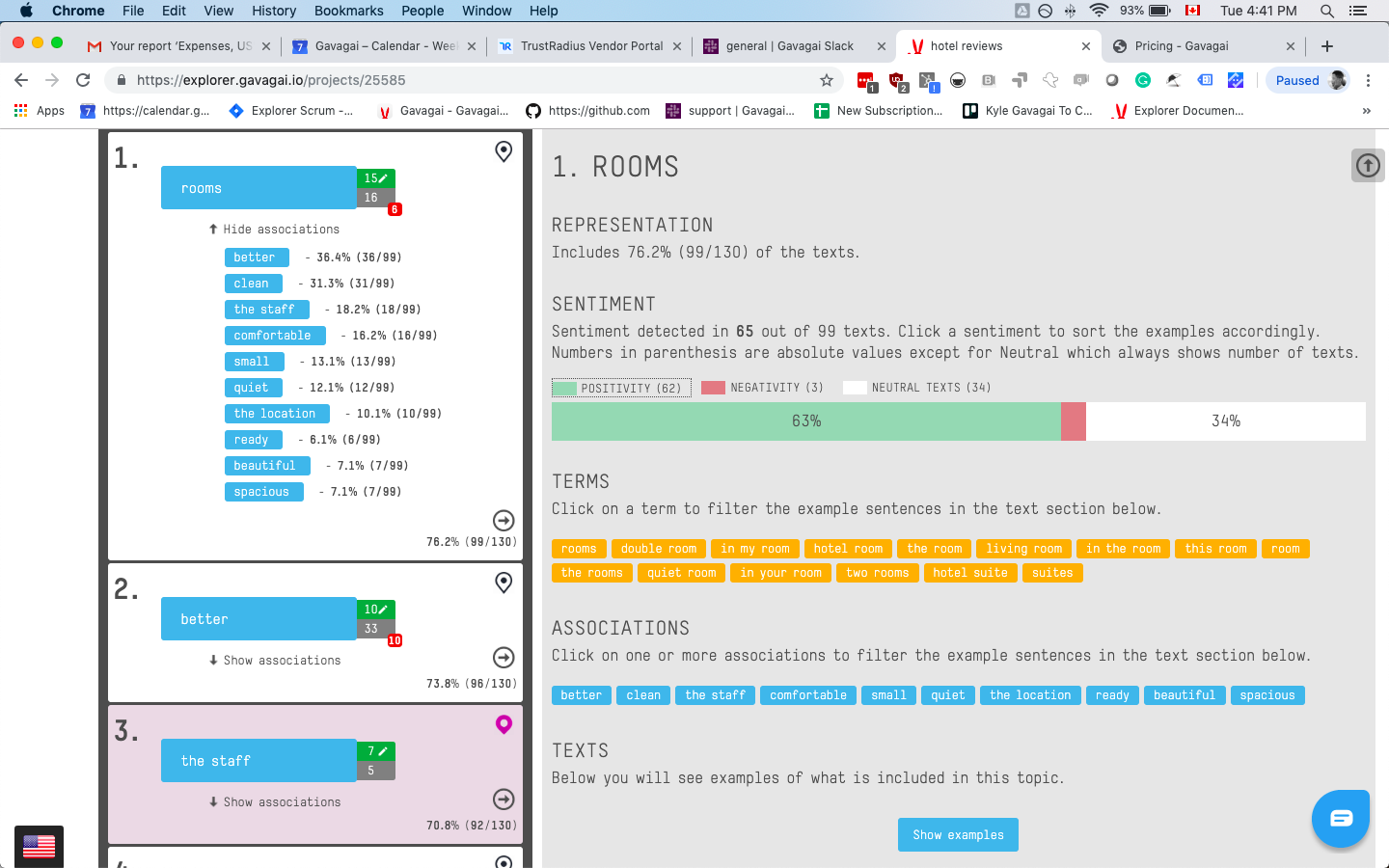
Gavagai Explorer is a text analysis tool for companies that want to keep track of what their customers think – regardless of which language they speak. Explorer analyzes texts in 47 languages. The texts get automatically analyzed and the results are presented in interactive and share-able Dashboards. Gavagai understands meaning The majority of the text data it analyzes comes from sources such as surveys, reviews, emails, chat conversations, and social…
$3,000
Time used to Set Up
Jupyter Notebook
Score 9.4 out of 10
N/A
Jupyter Notebook is an open-source web application that allows users to create and share documents containing live code, equations, visualizations and narrative text. Uses include: data cleaning and transformation, numerical simulation, statistical modeling, data visualization, and machine learning. It supports over 40 programming languages, and notebooks can be shared with others using email, Dropbox, GitHub and the Jupyter Notebook Viewer. It is used with JupyterLab, a web-based IDE for…
N/A
Pricing
Gavagai
Jupyter Notebook
Editions & Modules
Small - 3 project slots -1200 credits
€ 120 per month - More or extra credits can be purchased
Number of Texts Analyzing, number of seats, number of projects
Medium - 10 project slots - 1200 credits
€ 400 per month - More or extra credits can be purchased
Number of Texts Analyzing, number of seats, number of projects
Large - 50 project slots - 1200 credits
€ 2,000 per month - More or extra credits can be purchased
Number of Texts Analyzing, number of seats, number of projects
The Entire Web Application
$3000.00
Time used to Set Up
Enterprise
quote: https://www.gavagai.io/request-quote/
Number of Texts Analyzing, number of seats, number of projects
No answers on this topic
Offerings
Pricing Offerings
Gavagai
Jupyter Notebook
Free Trial
Yes
No
Free/Freemium Version
No
No
Premium Consulting/Integration Services
No
No
Entry-level Setup Fee
Optional
No setup fee
Additional Details
Buy extra credits at any time
Bought credits never expire
Deputy Manager - Consumer Insights and Brand Development
Chose Gavagai
I didn't evaluate many options while choosing Gavagai, I had explored a few local vendors whose capabilities were either incomplete or were not up to the mark. Their customer support was also quite poor. Also, the tool was debugged enough which led to frequent crashing. Alchmer …
As a beginner I tried all of them but finally due to simple and user friendly interface I opted it. I also tried visual basic which is also good platform with versatility, however for basic need it is the best.
Jupyter is very easy to understand and easy to use. And can also be used by a student, freelancer, small industries, big industries. Jupyter also provides you a tool to work with machine learning and artificial intelligence.
Jupyter Notebook is very attractive platform for new developers to code and to learn programming and perform tasks as compared to other IDE. It has very well and easy visualization, interactive programming and sharing the live code and slideshow is very easy as compare to …
Jupyter is still the most well known and widely used platform I've seen. Using it over other competition like Zeppelin simply because of its availability, and my familiarity with its functionality.
Jupyter Notebook is unique in that it offers a flexible, lightweight, easy-to-replicate way of organizing your code in a visually intuitive fashion that can be exported in a number of formats. I've found that the broad functionalities available within the notebooks suit a lot …
Well, so far Jupyter Notebook has been the better tool for me. It gives us more freedom & has more ability to train ML models & do the data visualization more efficiently. It's easier to operate & has a very simple-to-understand UI & with the support for taking data from …
I have used PyCharm as well as Jupyter Notebook and for me, Jupyter wins almost every time. I really like its user-friend interface for someone who is new to python programming. The ability to run a big chunk of code part by part is a big game-changer for me. One thing I would …
It should have cleaner support for multi-environment setup and should also increase the amount of features. Moreover, more support should be present for other programming languages. It should also have the option to set a specific location that opens up whenever I run command …
Jupyter Notebook has a nicer interface than RStudio in our opinion and since most of our group is familiar with Jupyter Notebook it has made it a default choice. Overall the interactive programming as well as the easy visualizations, model deployment, and markdown made Jupyter …
Jupyter Notebook is the core feature extended on by many commercial alternatives. The commercial alternatives have more feature integration with the rest of their portfolio. RStudio is another competitor for interactive and literate programming.
An interesting thing is that Jupyter Notebook is run on browser environments which may or may not be a positive feature according to cases. VS Code on [the] other hand doesn't use any interface and can run Jupyter Notebooks too. Sometimes my browser consumes too much RAM due to …
With Jupyter Notebook besides doing data analysis and performing complex visualizations you can also write machine learning algorithms with a long list of libraries that it supports. You can make better predictions, observations etc. with it which can help you achieve better …
I like Jupyter Notebook over the other two because it keeps my work more organized. It helps me to structure my workflow and the ability to run commands in chunks keeps me from being confused when coming back to the work after some time.
I selected Jupyter Notebook because this is better integrated with the existing production systems than optional tools (for example, R). It is also commonly used tool within the scientist community.
When I tried Zeppelin in 2017, it was still in initial versions, Jupyter was way ahead as of then. Zeppelin had limitations and I wasn't confident of it making progress as much as Jupyter.
Gavagai is well suited for a B2C business that receives a lot of customer feedback in a form of open-ended text. It makes life easier for the customer experience team to efficiently identify the strengths and areas of improvement for the business. It saves a lot of time and also the hassle of analysing text data manually. It is not just a word cloud tool that shows you the words with the most number of mentions. Gavagai directs you towards actionability.
I would rate it 9/10 while recommending Jupyter Notebook as it offers me a wide range of functionality to operate. It is very well suited for someone who is new to python programming as the user interface helps you build code line by line. I personally have written multiple programs in Python using Jupyter Notebook as it helps me organize long code by breaking it in a structure. Also the ability to write comments using '#' helps a lot to a reader understand the code.
Need more Hotkeys for creating a beautiful notebook. Sometimes we need to download other plugins which messes [with] its default settings.
Not as powerful as IDE, which sometimes makes [the] job difficult and allows duplicate code as it get confusing when the number of lines increases. Need a feature where [an] error comes if duplicate code is found or [if a] developer tries the same function name.
Jupyter is highly simplistic. It took me about 5 mins to install and create my first "hello world" without having to look for help. The UI has minimalist options and is quite intuitive for anyone to become a pro in no time. The lightweight nature makes it even more likeable.
I didn't evaluate many options while choosing Gavagai, I had explored a few local vendors whose capabilities were either incomplete or were not up to the mark. Their customer support was also quite poor. Also, the tool was debugged enough which led to frequent crashing. Alchmer although is not a direct competitor to Gavagai, since it's more of a customer feedback tool with additional capabilities of text analytics. I found Alchemer to be extremely expensive. Zonka on the other hand was quite welcoming to feedback from me and promised to develop additional capabilities for my specific requirements although the plan didn't go through due to internal reasons.
Jupyter Notebook is unique in that it offers a flexible, lightweight, easy-to-replicate way of organizing your code in a visually intuitive fashion that can be exported in a number of formats. I've found that the broad functionalities available within the notebooks suit a lot of needs I have for EDA, modeling, and data export that makes other software products fairly redundant.