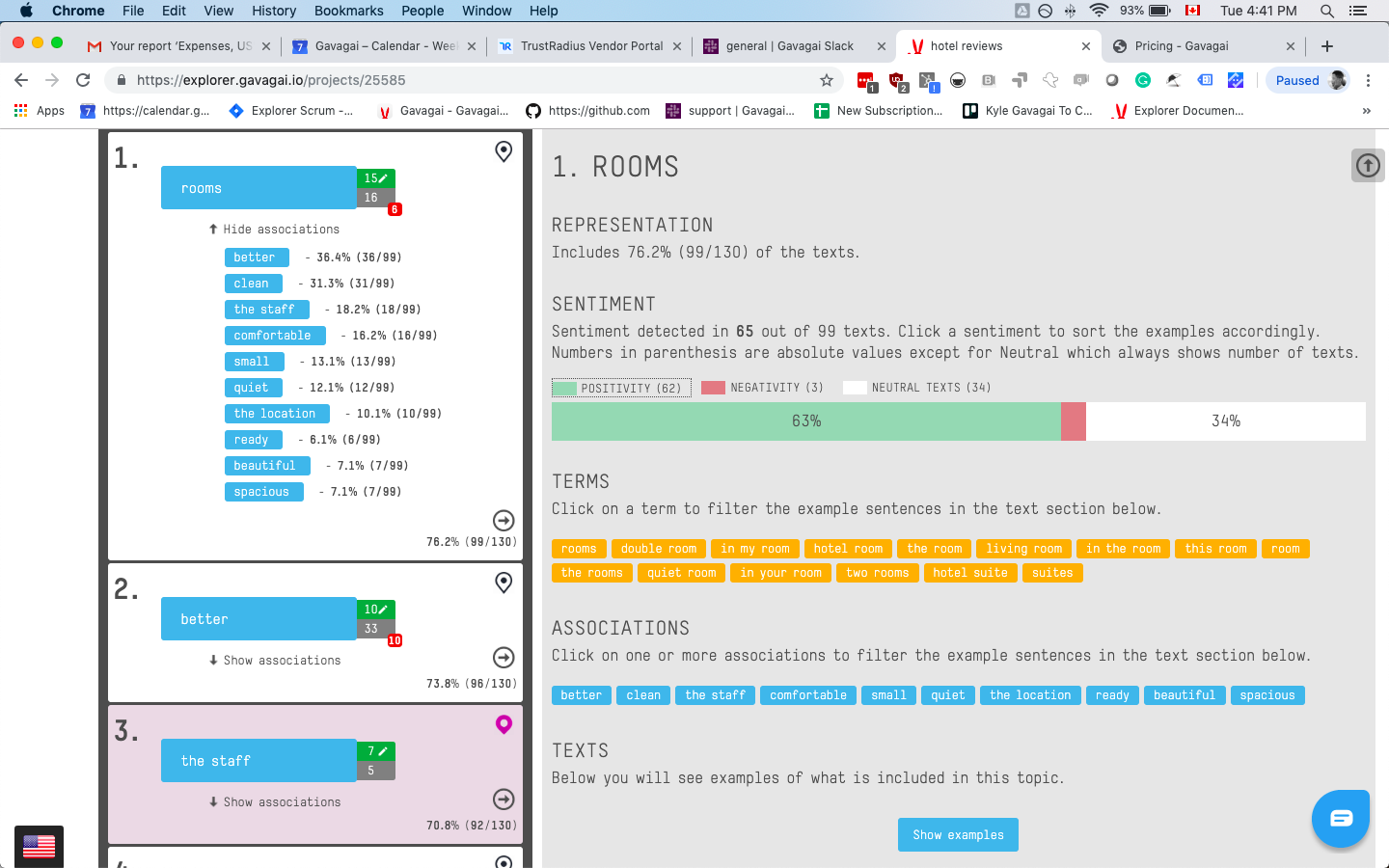
Gavagai Explorer is a text analysis tool for companies that want to keep track of what their customers think – regardless of which language they speak. Explorer analyzes texts in 47 languages. The texts get automatically analyzed and the results are presented in interactive and share-able Dashboards. Gavagai understands meaning The majority of the text data it analyzes comes from sources such as surveys, reviews, emails, chat conversations, and social…
$3,000
Time used to Set Up
Oracle Database
Score 8.0 out of 10
N/A
Oracle Database, currently in edition 23ai, is a converged, multimodel database management system. It is designed to simplify development for AI, microservices, graph, document, spatial, and relational applications.
$0.05
per hour
Pricing
Gavagai
Oracle Database
Editions & Modules
Small - 3 project slots -1200 credits
€ 120 per month - More or extra credits can be purchased
Number of Texts Analyzing, number of seats, number of projects
Medium - 10 project slots - 1200 credits
€ 400 per month - More or extra credits can be purchased
Number of Texts Analyzing, number of seats, number of projects
Large - 50 project slots - 1200 credits
€ 2,000 per month - More or extra credits can be purchased
Number of Texts Analyzing, number of seats, number of projects
The Entire Web Application
$3000.00
Time used to Set Up
Enterprise
quote: https://www.gavagai.io/request-quote/
Number of Texts Analyzing, number of seats, number of projects
Oracle Base Database Service - Standard
$0.0538
per hour
Oracle Base Database Service - Enterprise
$0.1075
per hour
Oracle Base Database Service - High Performance
$0.2218
per hour
Standard Edition
Contact Sales
Enterprise Edition
Contact Sales
Personal Edition
Contact Sales
Offerings
Pricing Offerings
Gavagai
Oracle Database
Free Trial
Yes
Yes
Free/Freemium Version
No
Yes
Premium Consulting/Integration Services
No
No
Entry-level Setup Fee
Optional
No setup fee
Additional Details
Buy extra credits at any time
Bought credits never expire
Gavagai is well suited for a B2C business that receives a lot of customer feedback in a form of open-ended text. It makes life easier for the customer experience team to efficiently identify the strengths and areas of improvement for the business. It saves a lot of time and also the hassle of analysing text data manually. It is not just a word cloud tool that shows you the words with the most number of mentions. Gavagai directs you towards actionability.
I believe Oracle Database is still the best RDBMS database which is the database to consider for OLTP applications and for Adhoc requests. They are good in Datawarehousing in certain aspects but not the best. Oracle is also a great database for scaling up with their Clusterware solution which also makes the database highly available with services moving to the live instance without much trouble.
New (actually it is more than five years old) multi-tenant architecture is not as straightforward as SQL Server, but it has been enhanced in Oracle 12c Release 2 and later 18c and 19c.
Many features require additional licensing (either as options or as packs) that increase the total cost
It is very likely to use this 12c (or next version) of Oracle Database. Nothing close to it in the marketplace in terms of performance, reliability and overall database management efficiency. If Oracle did one thing really good - it is it's OLTP Database I must say.
Many of the powerful options can be auto-configured but there are still many things to take into account at the moment of installing and configuring an Oracle Database, compared with SQL Server or other databases. At the same time, that extra complexity allows for detailed configuration and guarantees performance, scalability, availability and security.
1. I have very good experience with Oracle Database support team. Oracle support team has pool of talented Oracle Analyst resources in different regions. To name a few regions - EMEA, Asia, USA(EST, MST, PST), Australia. Their support staffs are very supportive, well trained, and customer focused. Whenever I open Oracle Sev1 SR(service request), I always get prompt update on my case timely. 2. Oracle has zoom call and chat session option linked to Oracle SR. Whenever you are in Oracle portal - you can chat with the Oracle Analyst who is working on your case. You can request for Oracle zoom call thru which you can share the your problem server screen in no time. This is very nice as it saves lot of time and energy in case you have to follow up with oracle support for your case. 3.Oracle has excellent knowledge base in which all the customer databases critical problems and their solutions are well documented. It is very easy to follow without consulting to support team at first.
Overall the implementation went very well and after that everything came out as expected - in terms of performance and scalability. People should always install and upgrade a stable version for production with the latest patch set updates, test properly as much as possible, and should have a backup plan if anything unexpected happens
I didn't evaluate many options while choosing Gavagai, I had explored a few local vendors whose capabilities were either incomplete or were not up to the mark. Their customer support was also quite poor. Also, the tool was debugged enough which led to frequent crashing. Alchmer although is not a direct competitor to Gavagai, since it's more of a customer feedback tool with additional capabilities of text analytics. I found Alchemer to be extremely expensive. Zonka on the other hand was quite welcoming to feedback from me and promised to develop additional capabilities for my specific requirements although the plan didn't go through due to internal reasons.
Oracle Database is among the easiest to integrate with, program against, have a reliable cluster with DR, and has the most understood and well-documented databases. It suits really well if the software shop is primarily Java-based, and deals with large volumes of data with a high degree of diversity among the applications by purpose and use. Paid support is recommended as well as planned periodic patching and upgrades.
We wasted lots of money (Oracle is crazy expensive), time and effort on the project and were highly relieved when we found a different approach to supporting our aging ERP app that did not include Oracle.
Because of the difficulty of using Oracle, we spent a lot of money on consultants to help us over the conversion hump. Also wasted. And it was interesting to see them struggle with the software. Upgrades never went well always requiring multiple site visits, for example.