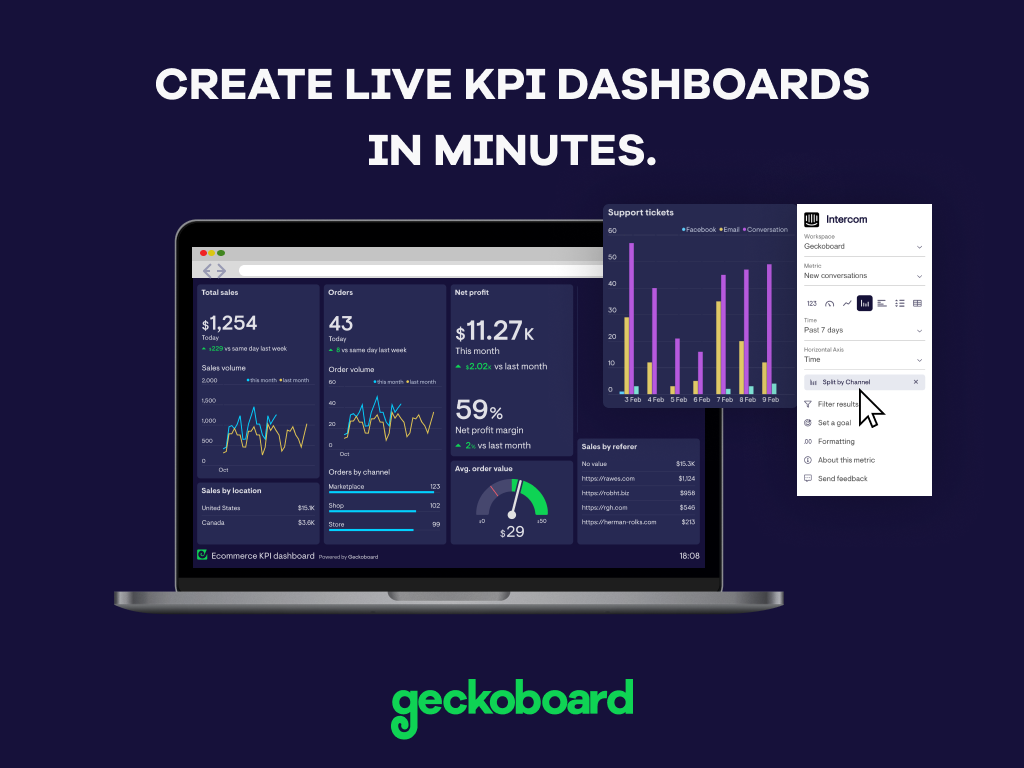
Geckoboard enables users to create real time dashboards using data from over 80 cloud services. It integrates with other products such as: AWeber, Basecamp, Campaign Monitor and HubSpot.
$35
per month
MS SharePoint / SQL
Score 8.5 out of 10
N/A
MS SharePoint / SQL refers to Microsoft Sharepoint, a web-based collaborative platform, being used in tandem with Microsoft SQL Server to provide business intelligence analytics and reporting. They can provide BI content such as data connections, reports, scorecards, dashboards, and more.
N/A
Pricing
Geckoboard
MS SharePoint / SQL
Editions & Modules
Starter
$35
per month
Team
$159
per month
Team Plus
$275
per month
Company
$599
per month
No answers on this topic
Offerings
Pricing Offerings
Geckoboard
MS SharePoint / SQL
Free Trial
Yes
No
Free/Freemium Version
Yes
No
Premium Consulting/Integration Services
No
No
Entry-level Setup Fee
No setup fee
No setup fee
Additional Details
—
—
More Pricing Information
Community Pulse
Geckoboard
MS SharePoint / SQL
Considered Both Products
Geckoboard
Verified User
Anonymous
Chose Geckoboard
We are a Google shop and our Analytics and Reporting team have and use GDS. However, Geckoboard can output some of the same types of data (albeit maybe not as granular) and can be used by a wide swath of our users (including project managers, account execs, developers, etc.). …
I find Geckoboard and Klipfolio to be in parallel in terms of performance and presentation. I will say that Klipfolio pulls slightly ahead as it allows for custom branding (great when sharing data with external stakeholders) and having access/edit control based on roles.
Business Analyst (Business Development/Market Valuation)
Chose Geckoboard
Geckoboard is a great dashboard that offers value and simplicity. It is easy to train and use right away. The other systems are more expensive but offer more details.
SharePoint is more reliable in terms of data storage, security, and accessibility by only required users compared to ClickUp. Also, SharePoint is easier to learn and use for any user, as tutorials are easily available online. Also, SharePoint is a product of Microsoft, which …
Simple: MS Sharepoint/SQL is the best and robust databases motor now are incorporating some features in order to improve users and DB admins experience.
Box is a content storing portal where you can host and share documents/files to others. But it does not have [Sharepoint's] capabilities like... versions, automation, email approvals, etc. And Microsoft Exchange is a mailing database that can be used for exchanging data using …
Has better support than MySQL and more developers are familiar with it. Oracle syntax is more cumbersome and less developers are experienced these days with Oracle.
If you are looking for a document management and collaboration tool to use as a web portal that comes with SQL data base and easy to manage and something you can learn very quick, look no further than SharePoint but if you need a pure database then this is not for you.
We use MS SQL more just because of how widely it's used and how popular it is. It's easier to install, maintain, and support compared to the other ones we've tried.
Vice President, Chief Architect, Development Manager and Software Engineer
Chose MS SharePoint / SQL
At the time of the two large projects, SharePoint was the enterprise solution so we were required to use that. We have since lobbied the enterprise teams to review and consider Atlassian confluence and were successful. Confluence is cheaper than Sharepoint which is why we …
At its core, MS SharePoint (with SQL) is for managing document-based content. It falls just short of being a best in class records manager (it does offer some features for this though), and it isn't the easiest to solution to make great looking modern and engaging web sites. …
We looked at Google Drive but it didn't have the API and integration that SharePoint has with 3rd party software providers. Also, Google Drive has basic functionality compared to MS SharePoint and how you can customize and build-out.
I haven't used any other products that compete with it. I started my career at Microsoft and the two subsequent locations have also been Microsoft shops.
Dropbox is a user-friendly product, but Sharepoint is a native Microsoft product that can be implemented into any Microsoft products, which are used mostly in our environment. Finding solutions on the internet is much easier, as it is used commonly by other organizations as …
I have used both Google Drive and Zoho Docs which seem similar to MS SharePoint. The main differences I noticed as a user is that the user interfaces in both Google Drive and Zoho Docs were much more intuitive and they were much easier to navigate than MS SharePoint. There …
We had staff resources able to create, configure, and mange our sharepoint environment, so it made sense for us and gave us greater flexibility than these turnkey solutions. Certainly each solution has its merits and each are completely different price points. We already had …
We evaluated Atlassian Confluence and compared it to our current SharePoint implementation. We felt that the two products were quite similar in the user experience but we chose to keep our SharePoint farms up and running. This was mainly due to the cost of switching and the …
A beautiful UI, with visuals that interest even those that hate staring at data. It's well suited for small to medium-sized businesses/corporations in which high-level sharing of data between teams is required -- the larger the distance between teams, the better as it's a great tool for level-setting on complex data. It would be less appropriate for small businesses, or those that do not need to summarize complex data to share with those not familiar with the data source
As I mentioned in my previous answers, MS SharePoint is very useful as a shared drive for the organization and is very easy to manage. It also helps us import data from SharePoint directly into PowerBI for creating reports. According to my understanding, only share link features should be improved.
This was a long-term buy-in from a corporate perspective, to remain in the SharePoint space. Migration is certainly possible, which is good for planning and having options further out. At this point, the only planned migration is to eventually move the architecture up to SharePoint/SQL 2013. At that point, we will be able to leverage some greater efficiencies, some enhanced content design and management features, and some more current social features. It is well worth a full consideration in any shop looking at a new implementation of or migration to SharePoint (although you will probably be considering 2013 versions or beyond in those discussions), but the platform should be a strong competitor to any alternatives. Realizing the capability of a fully-branded and customized website was not part of the original choice for the architecture at Lincoln, but seeing it implemented and functioning now with this capacity far beyond original expectations has certainly cemented plans to continue using it.
With a simple interface and available templates, creating basic dashboards is easy. Obviously depending on the data you want to visualize, there may be higher learning curves. That being said, they have a huge amount of integrations and extensible frameworks. If you are using anything made in the past ten years there is an API function or integration that can get it talking to the platform. As such, it's pretty easy to hit the main data points you want and get it on a cheap display in front of your team.
I gave this rating due to MS SharePoint being a big help with our userbase. We have a lot of users that are just old enough to not have much technical skills or they have been in this industry long enough to where they haven't really needed to utilize much technology. MS SharePoint helped us move beyond that barrier without too many bumps and bruises.
The support levels vary based on the level of plan that you have but that's to be expected. Virtually everything except the Enterprise plan has basic chat/email support. While they are responsive they are not going to be much assistance in helping you figure out API calls or implementing 3rd party integrations. That is to be expected and the support community can pretty much get you in the right direction if you look.
I've only had to call in to support on one occasion but they were able to work though our issue and find a solution that did fully resolve the issue in a timely manner. I can't always say the same about support from other companies so it was a refreshing change to have support that did help.
We are a Google shop and our Analytics and Reporting team have and use GDS. However, Geckoboard can output some of the same types of data (albeit maybe not as granular) and can be used by a wide swath of our users (including project managers, account execs, developers, etc.). We can also save and reuse boards for similar products and get our data in front of the eyes that need to see it quickly without a lot of fuss.
At the time of the two large projects, SharePoint was the enterprise solution so we were required to use that. We have since lobbied the enterprise teams to review and consider Atlassian Confluence and were successful. Confluence is cheaper than Sharepoint which is why we wanted to bring that in. The enterprise has now made Confluence an enterprise solution as an alternative to SharePoint. After using both I think SharePoint has many more add-ins than Confluence. It has much more customization ability than Confluence. SharePoint is not good for mobile readiness. Confluence is so there is a difference that might lead you to Confluence over SharePoint. I would also say that SharePoint is very document-centric and that Confluence has better KM than SharePoint does. even with the use of SQL Server. We were told that we could not use Google Drive even though it had features we liked.
While we originally used this as an internal IS tool, we eventually have expanded it to be used by nearly every department.
Because pricing is monthly, we can grow or decrease our usage based on our current client needs.
Because it is low cost and easy to deploy, we can utilize it in place of considerable resources in analytics and reporting by delivering snapshots of data without pulling reports.