GitLab DevSecOps platform enables software innovation by aiming to empower development, security, and operations teams to build better software, faster. With GitLab, teams can create, deliver, and manage code quickly and continuously instead of managing disparate tools and scripts. GitLab helps teams across the complete DevSecOps lifecycle, from developing, securing, and deploying software. Differentiators, as described by Gitlab:
Simplicity: With GitLab, DevSecOps can…
$0
per month per user
Planview AgilePlace
Score 9.9 out of 10
N/A
AgilePlace is a project management solution built around flexibility, data-driven analytics, and workflow automation. The software was acquired by Planview in December 2017 to expand that company's capabilities.
As mentioned earlier, the features like chart visualization sets it apart from the others. Other than that, GitLab is open source while other are not and comparatively more secure that its other counterparts. Also, GitLab supports adding other types of attachments which is not …
When i was using the other platform, Some time i face down time, But GitLabs its not happening for single time. GitLab is having easy user interference as compared to other platforms. Pull Request, Code review, Issue tracking, Merging, Access control and User Roles is having a …
GitLab is miles ahead of the competition. In so many words, having a simple UI with robust security and the ability to conduct Git actions takes the cake. The competitions like to say they can do these things easily but their products are more confusing and hard to use.
GitLab allows a self-hosted version that is easy to setup and configure. It is also open-source as compared to GitHub. The integrated CI/CD tools is a plus, since we do not have to worry about those tools, unlike Github. The All-in-one solution of GitLab made sense for our …
Gitlab offers the best support for CI/CD pipelines and the highest degree of customisation for workflows, permissions, and integrations. The integration of BitBucket with JIRA is better than GitLab but CI/CD features are limited in comparison. GitLab's built-in Container …
Gitlab provides basic functionality like any other git tool. Some features of push and pull requests , clone and merge is handled equally well. It lacks in AI features which are there in GitHub and setup processes are difficult. Cost difference is the only concern while …
GitHub is an inferior product from most points of view. We had to use it and the teams finds no positives about it. Everything is a downgrade from our previous GitLab solution.
GitLab CI\CD is vastly superior to workflows, for example doing a manual node is just "when : manual" …
It's much simpler than the competitors. The one important feature Gitlab stand out is the CI/CD pipeline. GitHub required integration with external CI tools but Gitlab has this feature built-in. Compare to Jenkins and Teamcity, It's easy to use without any additional Plugins. …
Gitlab seems more cutting-edge than GitHub; however, its AI tools are not yet as mature as those of CoPilot. It feels like the next-generation product, so as we selected a tool for our startup, we decided to invest in the disruptor in the space. While there are fewer …
i have more exoerence in GitLab rather than bitbucket . As personally , it is good for me to understand how things is going on. i have used personally and also in organisation . It is great for developer to see there 3 months ago code and also can come up with new solution to …
Because with Visual Studio code, it was very easy for us to install GitLab in it and have easy access through the terminal and due to GitLab, it was easy to implement codes regarding API and AWS services to make our software better. Gitlens and all features help to check the …
GitLab provides a far superior platform due to it's great integration and CI/CD focus. And while in the beginning the UI might look a bit overwhelming with use you will find it way more useful than it's competitors. The variables and settings also make way more sense and it's …
My feedback may not be important here because when I joined the company they already had GitLab and we still use it due to the ability to do CI/CD Integration, deployments, debugging, code owners approval, and Jira integration. So far we have not had any major blocker that has …
Github is more open-source first and enterprise-first second in their approach. The reverse is true for GitLab. Both are exceptional products and it highly depends on the specific needs of an org
GitLab has a open-source community and great documentation that provides support resources and community contributions. AWS CodeCommit is used for integration with other AWS services in the AWS ecosystem and also have a low community and support compared to GitLab hence …
It was a management decision to use GitLab over other tools. It integrates well with RBAC using Terraform. Runners are easy to setup. Almost all the features the organization used before are available in GitLab.
For small projects or companies that do work on a few only code repositories selecting one of the git code hosting services like GitLab, GitHub, Bitbicket etc does not make a big difference.
But, if you are on a code development company that handles too many repositories and …
Software delivery is the key objective and GitLab made it much easier to hit the group quickly. It worked well with automation, and integrations with other SDLC tools used in the Organization and it is really easy to use. It's widely adopted and has the power to deliver what we …
GitLab's online IDE and code modification is much better compared to Stash. While pricier than Bitbucket, Gitlab also provides CI CD configuration better than BB.
AgilePlace is better than JIRA when it comes to ease of use and intuitiveness of the tool. Card based model and ability to customize/tailor the way you want makes AgilePlace is a great tool. Look and feel as well as colored cards, makes the board layout much more easier to …
All these tools are different and have different uses. Depending upon SDLC your organization uses, you would use any of these tools. They all have their plusses and minuses.
Originally, we had evaluated two other tools next to Planview LeanKit: Kanbantool and Kanbanflow. The latter was a close contestant for productive use, as it was also very customizable and a joy to work with and look at. It also had lower user fees and a mobile integration.
Front-End Web Developer, Office of Mediated Education
Chose Planview AgilePlace
I use Trello a bit for personal use. It's much less powerful than LeanKit, but it's also a better design and simpler to use. ServiceNow has some kanban board stuff built-in, but I wasn't super impressed with it. JIRA seemed to be even more complex than LeanKit for the short …
I think that LeanKit is very similar to Asana's Kanban feature and Trello, but is much less sleek looking than Asana. Asana's clean and sleek UI makes me enjoy project management much more than LeanKit. It might sound silly that the UI makes so much of a difference to me, but …
Our company uses LeanKit, Pivotal Tracker, and Trello. It all depends on what team you're on. There's even a team that just does KanBan on a whiteboard. In the end, I would tank LeanKit above Pivotal Tracker, but below Trello. The differences are relatively subtle between …
Both VersionOne and Trello are good products. VersionOne is for the real hardcore Agile shops who want to track and report on everything related to the Agile process. Trello is a tool that works for Agile, but really is just a simple list making/tracking tool. Both tools serve …
I have used Trello, which is not as robust for tracking and customizing workflows as LeanKit is. It does not scale well to big teams. JIRA is the standard project management software but does not support Kanban well.
Nearly all the other tools I evaluated against are free, so that's one area where LeanKit is not as competitive. LeanKit does allow the experience to be much more customizable, though.
Being from QA I prefer Spiratest and QC for the fact my team can do all our work in one program and it is linked. But the tech department as a whole prefers Leankit as it is the tool of choice based on ease of use and overall performance.
While LeanKit was not designed for project and task management, we selected it because of its collaborative nature as a project and task management platform for our marketing team. It was also selected because our engineering and product management teams were using Leankit. We …
It is well-suited for any project that needs VCS. It's an excellent choice for teams that might be remote or have to collaborate across teams. Plenty of features allow for async working. With its dashboards and reporting features, it is also suitable for nontechnical PMs or stakeholders. It allows for very bespoke customization and can most often do much more than you need it to.
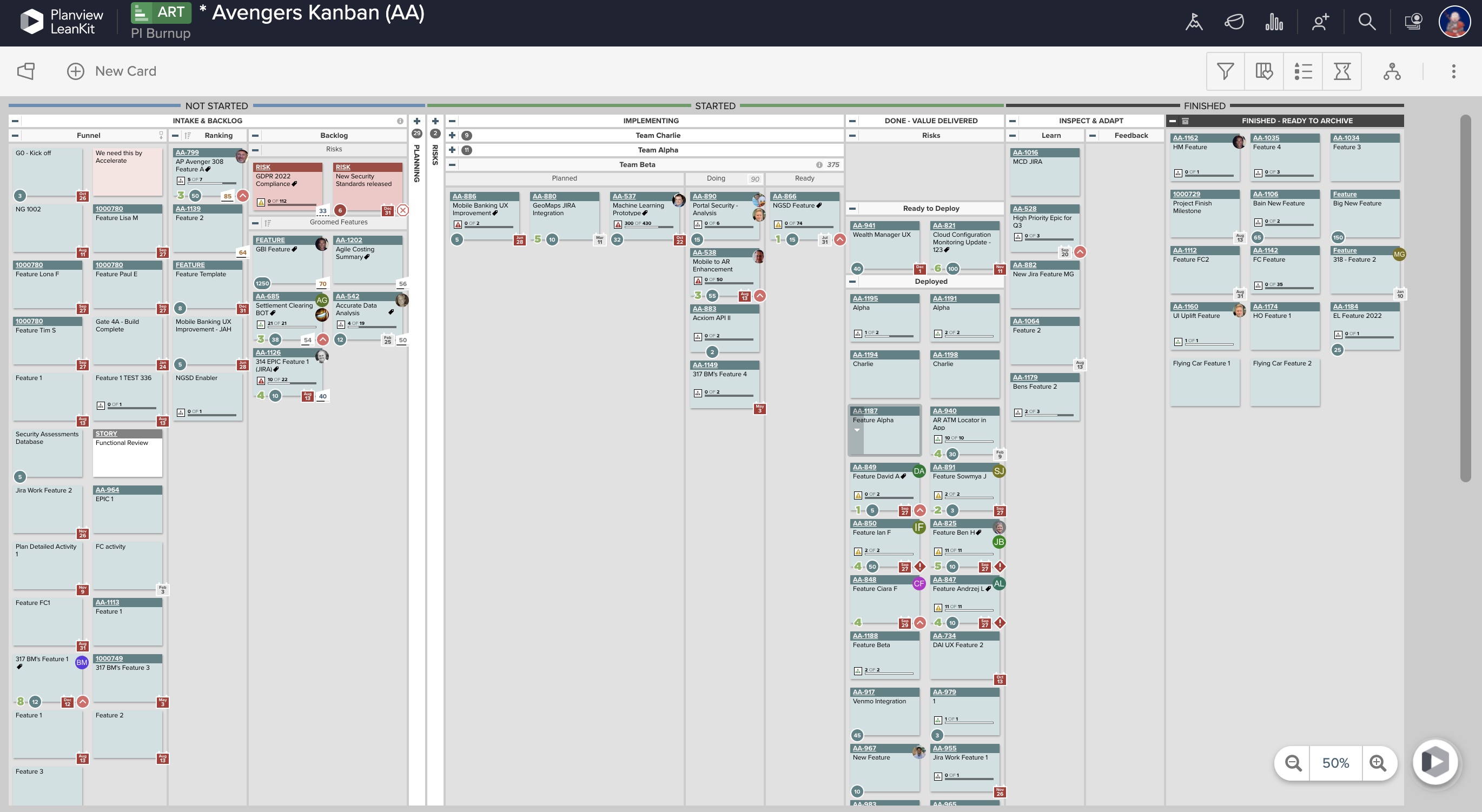
AgilePlace is a great way for teams, or individuals, to bring visibility to the work in process and in their backlog. The color coding and icon use helps to quickly analyze the type of work or status of the work. The product team is doing a good job at listening to their user's feedback and implementing improvements. Where it falls short is when reporting needs to occur.
Okta Integration: We love using SSO for all our SaaS apps, and as new team members join, they can be automatically joined to the appropriate LeanKit boards.
Filtering and viewing: Can filter and refine by several fields as well as custom fields. Assigned Users, Tagged, Card Type, Date, etc
Their analytics and reporting can be helpful for PMs, especially if they have several teams they oversee.
I really feel the platform has matured quite faster than others, and it is always at the top of its game compared to the different vendors like GitHub, Azure pipelines, CircleCI, Travis, Jenkins. Since it provides, agents, CI/CD, repository hosting, Secrets management, user management, and Single Sign on; among other features
I find it easy to use, I haven't had to do the integration work, so that's why it is a 9/10, cause I can't speak to how easy that part was or the initial set up, but day to day use is great!
LeanKit isn't the best designed Kanban system I've seen, but overall it's pretty usable. The boards I've used are pretty complex, so it can be difficult to find things. I found that searching and filtering for specific cards was somewhat of a challenge. Dragging a card from one lane to another is kind of a fun way to get things done though.
I've never had experienced outages from GItlab itself, but regarding the code I have deployed to Gitlab, the history helps a lot to trace the cause of the issue or performing a rollback to go back to a working version
GItlab reponsiveness is amazing, has never left me IDLE. I've never had issues even with complex projects. I have not experienced any issues when integrating it with agents for example or SSO
At this point, I do not have much experience with Gitlab support as I have never had to engage them. They have documentation that is helpful, not quite as extensive as other documentation, but helpful nonetheless. They also seem to be relatively responsive on social media platforms (twitter) and really thrived when GitHub was acquired by Microsoft
Every time I have reached out to the AgilePlace support team I have received a timely response in addition to professional & personal feedback. Their consultants are knowledgeable and the management team is happy to jump in and help when needed.
GitHub is an inferior product from most points of view. We had to use it and the teams finds no positives about it. Everything is a downgrade from our previous GitLab solution. GitLab CI\CD is vastly superior to workflows, for example doing a manual node is just "when : manual" in GitLab while you have to do clickops in GitHub to achieve the same. No overview of code in branches is a minus when we tried to figure out what our colleagues are trying to merge as it looked off.
Originally, we had evaluated two other tools next to Planview LeanKit: Kanbantool and Kanbanflow. The latter was a close contestant for productive use, as it was also very customizable and a joy to work with and look at. It also had lower user fees and a mobile integration. In the end, we picked Planview LeanKit because of several reasons: Aesthetics: The look was much more clean and professional. Reporting: It was obvious from the start that we could use Planview LeanKit as a tool for improvement. API: We needed to integrate the Kanban into our central systems and Planview LeanKit API was (and still is) a way to do it. Card Headers: This sounds like a simple thing, but the headers above the titles fit our work perfectly and looked perfect, which helped the decision.