Gliffy is an online diagramming tool with collaboration features from the San Francisco company of the same name, offering standalone versions of Gliffy and integrated versions for Jira and Confluence.
$6
per month
MindMeister
Score 3.5 out of 10
N/A
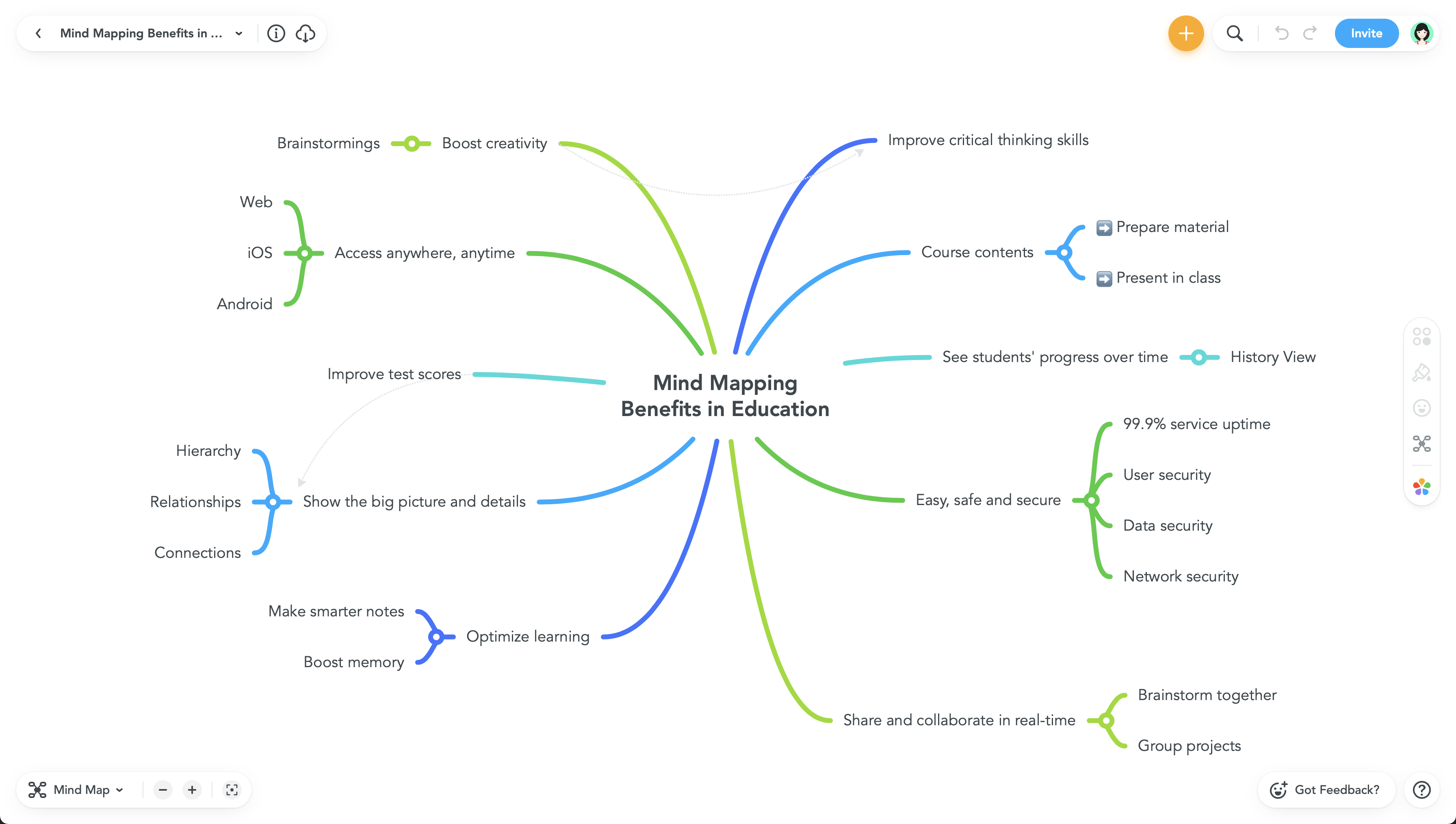
MindMeister is an online mind mapping tool that lets users share maps with an unlimited number of users and collaborate with them in real-time. MindMeister is used to brainstorm ideas, plan projects, take meeting minutes, develop business strategies, and create presentations. MindMeister runs in any standard web-browser as well as on iOS and Android devices, so users can access, edit and present their mind maps anytime, wherever they are. With MindMeister, users…
$45
per 6 months per user
Pricing
Gliffy
MindMeister
Editions & Modules
Professional
$6
per month
Personal
$45
per 6 months per user
Pro
$75
per 6 months per user
Business
$114
per 6 months per user
Offerings
Pricing Offerings
Gliffy
MindMeister
Free Trial
No
No
Free/Freemium Version
No
Yes
Premium Consulting/Integration Services
No
No
Entry-level Setup Fee
No setup fee
No setup fee
Additional Details
For Enterprise pricing, please reach out.
MindMeister offers 6-monthly and yearly subscriptions. Discounts for educational users and non-profit organizations are also available. Up to 22% discount for yearly pricing.
Gliffy is user-friendly, with a drag-and-drop interface that makes it easy to create clear and visually appealing diagrams without steep learning curves. It’s perfect for creating straightforward, quick wireframes. Gliffy lacks features for detailed UI/UX wireframing and prototyping compared to specialized tools like Figma, Sketch, or Adobe XD.
This product is well suited for making mind maps and outlining projects and ideas from the start. It can be tough if you are trying to convert something you began in Docs. It allows for a lot of intuitive creation, making your work flow easily. It can get to be a bit clunky though if you make your map too large.
First it's important to point out that Gliffy has priced itself incredibly well for small to medium sized businesses. Most other similar solutions are so expensive that organizations will avoid getting workflow software overall. Gliffy can take pride in knowing they're helping small business operate better.
Gliffy is incredibly easy to use for a first time user. I rarely have to train someone on how to use it. It's a lot of fun to see people get excited about systems and processes when using Gliffy. If you need to get up and running quickly I can't think of a better solution for workflow visualization.
I also like using Gliffy for mindmapping. I'm sure some mindmapping experts can tell me how I'm doing that incorrectly, but it just works for me. This points to the ease with which Gliffy allows you to get your thoughts down quickly and easily.
The UI is well laid out and easy to use. The workflow makes perfect sense and makes creating tasks a breeze.
The collaboration features make brainstorming not only easy but fun! Everyone enjoys using the tool, which was not the case with other collaboration software we used.
I love being able to get all of my thoughts and ideas on the screen to see them and then be able to connect them in a logical way.
Gliffy does need to improve its pricing model. I believe they were early to market with their product and offerings, however, with the increased competitors they are falling behind in keeping their prices competitive.
Gliffy does need to increase its export conversion migration tools. I can understand why they would not want to port items uses by their products to another product but we are in a world where products need to play nice with others in good faith. It can be done, but you do need to check over what you port either incoming or outgoing.
Would like to see Gliffy allow us to build templates and import them into the repository and have increased the ability to archive those, share and have owners.
I wish collaborators could add comments without having to be given editor privileges. A "Reviewer" role would be helpful.
I would like to be able to toggle note visibility on and off. If there is a way to do it now, I haven't found it. As it is, I have to hover or use the sidebar to see notes.
Two or three times I have seen my nodes spontaneously reverse order in a big map (over their recommended limit). Even so, they are working on tracking the issue down.
Because of its great versatility and ease of use. From diagramming to roadmpas and even user interface wireframes. Once a draft or first version is done we like to use the Confluence integration so we can collaborate and have one single source of truth
I based my assessment on aggregated user feedback and reviews from platforms like G2 and Software Advice. Many users highlight the simplicity and versatility of Gliffy’s interface, which makes it accessible for both beginners and professionals. Features like drag-and-drop functionality, a variety of templates, and integration options (e.g., Atlassian tools) contribute to its high rating.However, it doesn’t score a perfect 10 because some users report performance issues with complex diagrams, limited advanced features compared to competitors, and occasional difficulties with collaboration features. Balancing these strengths and weaknesses lands Gliffy in the 8-9 range for usability
Never had an issue with customer support, though we never really needed anything major as far as technical help. I do not believe they offer 24 hour customer support but we don't need it as MindMeister is not the type of tool we need need 24 hour a day support for. Overall, very happy with the level of support.
Gliffy is easier to use together with Confluence since it provides an integration where you can edit an image directly on the page. Visio and PowerPoint is better drawing tools but we have moved away from them since there isn’t a good way to keep track of the original file of the vector/bitmap included in the Confluence page.
Mindmeister has a good free plan compared with Lucidchart, and better Google Drive integration in my opinion. draw.io has a better free plan than MindMeister, but I prefer MindMeister for mindmap creation still, while I prefer draw.io for other types of diagrams. Xmind is powerful, but bloated, and requires installation on every machine that needs to open the file. The fact that MindMeister is in the cloud is a huge bonus.
Hard to quantify actual $ROI (always is!), though qualitatively I've receive consistent feedback that live modeling with Gliffy is highly valuable for both our customers and internal team:
a) For customers, it's live feedback to demonstrate we are listening and an opportunity to comment / add feedback to ensure we are hitting on key points
b) For internal teams, it's a great reference to track key points on calls and ensure alignment going into the next call
This is particularly important when discussions stall for months. Having Gliffy as a visual has helped us to win business because of the speed with which we could return to "the arena" and keep the ball moving forward.
Our meetings became more productive (time saving /better outcome).
Project management activities became more efficient (time-saving/increased quality/better collaboration).
It became easier to create online repositories to share relevant and well-organized information to our teams (before it was dispersed, incomplete, and difficult to find/manage).