Google Cloud Key Management allows users to manage encryption keys on Google Cloud.
N/A
HashiCorp Vault
Score 8.4 out of 10
N/A
HashiCorp offers Vault, an encryption tool of use in the management of secrets including credentials, passwords and other secrets, providing access control, audit trail, and support for multiple authentication methods. It is available open source, or under an enterprise license.
The UI / UX, first of all, is night and day difference. The main attraction after the services were this: It's user friendly. It welcomes new users and properly guides them on what to do and what you can expect. Honestly, I had a very bad experience with Microsoft Azure in …
HashiCorp Vault integrates with a lot of tools and systems, and the documentation was pretty robust with a lot of community help. Because HashiCorp Vault is also older than other solutions, it is already well developed with a lot of features you need for storing secrets and …
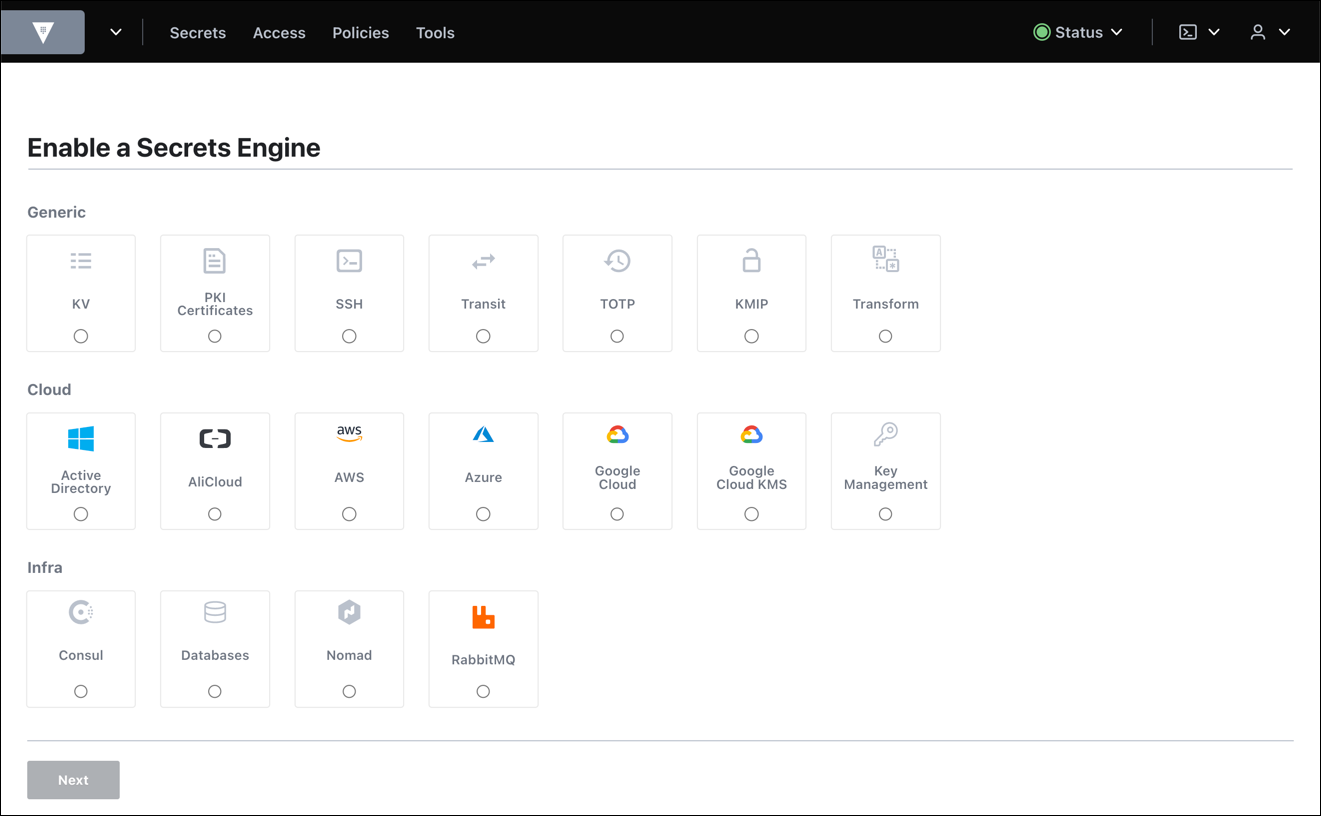
We evaluated Symantec as an existing partner within our enterprise. We found that the API provided by Vault is superior and that was a critical use case in our organization. We also found that Vault has more engine types which allow different types of data to be stored. This …
I already used Encrypted Hiera (which is basically YAML files encrypted with a private key scheme where this key is stored in plain text on the server, which is obviously not the best option). Another solution I also used for this purpose was AWS KMS, but with Vault I don't get …
As mentioned before, HashiCorp Vault really is the best in its class. Having used other secrets management tools, HashiCorp has really made Vault the easiest to use in a cross-compatibility function, in a multi-cloud/hybrid environment, and in multiple fashions. Many other …
Use for most types of cloud SQL services. Excellent modern-day encryption technologies. If a customer wants to manage their keys then Google Cloud Platform is well suited for those people if it matters. Able to divide workloads and pipelines. Customer managed encryption keys support for Data fusion, Data Proc, Cloud SQL, and GKE. We use Cloud EKM: key use operations $0.03 per 10,000 operations for our day to day operations.
Vault is a reliable and resilient as the Key Management System. It is not for the novice user that does not have a background in information security. It requires a significant time investment into the different key engines that the solution offers to get started. It works very well once implemented and is very flexible in general.
HashiCorp Vault is the best there is out there, and it has become critical to our secret management use cases. It would be difficult to find anything that would suit our needs better and that would be beneficial for us to switch over to.
We spent a little more time than we imagined to conceptually understand how HashiCorp Vault operates, as well as how it is configured. This is not trivial, and keep in mind that you will need to take some time to get a thorough understanding of the tool. The documentation could be more helpful in this regard.
Hashicorp has been very responsive to our questions and inquiries up to this point. We are currently working on them to develop a more granular permissions model within Vault. We are very close to achieving our objectives with the help of their support team. We do not seem to be in the same time zone which makes it hard for escalated issues.
The UI / UX, first of all, is night and day difference. The main attraction after the services were this: It's user friendly. It welcomes new users and properly guides them on what to do and what you can expect. Honestly, I had a very bad experience with Microsoft Azure in 2018, so I think the Google Cloud Key Management service is best for me for now and I may give the new Azure a try later.
HashiCorp Vault integrates with a lot of tools and systems, and the documentation was pretty robust with a lot of community help. Because HashiCorp Vault is also older than other solutions, it is already well developed with a lot of features you need for storing secrets and configuration. HashiCorp Vault is also friendlier towards application build and is focused in providing security and a lot of customization for almost any use case scenario. Bitwarden is more limited to password management of enterprise accounts, but for application usage is not that great or easy to integrate. It does not scale well also. AWS Secrets Manager on the other hand is really good but more limited to AWS applications and vendor lock is problematic as well for such a critical piece of infrastructure.