IBM Operational Decision Manager vs. IDERA SQL Inventory Manager

Overview
ProductRatingMost Used ByProduct SummaryStarting Price
IBM Operational Decision Manager
Score 7.1 out of 10
N/A
IBM Operational Decision Manager is presented as a comprehensive decision automation solution that helps users discover, capture, analyze, automate and govern rules-based business decisions, on premises or on cloud. It is formerly known as the IBM Websphere Operational Decision Management, and before that as the ILOG JRules Business Rules Management System (BRMS).N/A
IDERA SQL Inventory Manager
Score 0.0 out of 10
N/A
SQL Inventory Manager helps database administrators to manage Microsoft SQL Server inventory and assets in physical, virtual, and cloud environments. Unlike its competition, it provides automatic discovery of Microsoft SQL Server instances, databases, and analysis services in the network, protection against back level versions and missing security patches, confirmation that instance growth meets license commitments, quick display of server details to determine license cost, monitor instance…
$2,556
for 10 instances with first year maintenance included
Pricing
IBM Operational Decision ManagerIDERA SQL Inventory Manager
Editions & Modules
No answers on this topic
Standard via eCommerce
2,556.00
for 10 instances with first year maintenance included
Offerings
Pricing Offerings
IBM Operational Decision ManagerIDERA SQL Inventory Manager
Free Trial
NoYes
Free/Freemium Version
NoNo
Premium Consulting/Integration Services
NoNo
Entry-level Setup FeeNo setup feeNo setup fee
Additional Details
More Pricing Information
Community Pulse
IBM Operational Decision ManagerIDERA SQL Inventory Manager
Considered Both Products
IBM Operational Decision Manager
Chose IBM Operational Decision Manager
A lot of firms will have their own pseudo-rule engines that are tailored to the application, but adopting open source frameworks like Drools IBM Operational Decision Manager includes an English-like rule language, an IDE for defining vocabulary and rules, an easy interface for …
Chose IBM Operational Decision Manager
When compared to other vendors in the business rule management system, IBM Operational Decision Manager stands out in dimensions of rule engine capabilities, deployment flexibility, and ease of maintenance. It offers a wide spectrum of configuration options to build …
Chose IBM Operational Decision Manager
A lot of organizations will have home grown pseudo rules engines which will be specific to the application, using open source framework like Drools helps to make that better and a tool like RHDM takes it to the next level.

IDERA SQL Inventory Manager

No answer on this topic

Best Alternatives
IBM Operational Decision ManagerIDERA SQL Inventory Manager
Small Businesses

No answers on this topic

No answers on this topic

Medium-sized Companies
IBM Cloud Pak for Business Automation
Score 9.0 out of 10
Redgate Monitor
Redgate Monitor
Score 8.7 out of 10
Enterprises
IBM Cloud Pak for Business Automation
Score 9.0 out of 10
Redgate Monitor
Redgate Monitor
Score 8.7 out of 10
All AlternativesView all alternativesView all alternatives
User Ratings
IBM Operational Decision ManagerIDERA SQL Inventory Manager
Likelihood to Recommend
5.4
(0 ratings)
-
(0 ratings)
User Testimonials
IBM Operational Decision ManagerIDERA SQL Inventory Manager
Likelihood to Recommend
IBM Operational Decision Manager can be used to manage complex business processes with less use of IT infrastructure and more use of centralized decision making. Decision-making depends on a logical framework and the creation of commands for better futuristic decisions with less time consumption and more precision and accuracy. IBM's Operational decision manager application is well suited for such scenarios where complex processes have to be streamlined.
Read full review
No answers on this topic
Pros
  • Converting business policy to business rule.
  • Intelligent and responsive automation decision.
  • Reduction of duplicated functionality.
Read full review
No answers on this topic
Cons
  • There is some confusion for users as they have many different tools and consoles to use and write/edit rules. There is the rule designer, an enterprise console, a business console, etc and there is overlapping functionality between the consoles.
  • There needs to be support added for creating models using the decision modeling notation (DMN). Businesses need to be able to represent the knowledge using a model and DMN is a standard way of representing the information.
  • Also to be able to import and export models that have been created using DMN. There are tools that companies use to create DMN models and represent the business domain and logic. This tool needs to be able to import those models and provide execution runtime for the same.
Read full review
No answers on this topic
Alternatives Considered
A lot of firms will have their own pseudo-rule engines that are tailored to the application, but adopting open source frameworks like Drools IBM Operational Decision Manager includes an English-like rule language, an IDE for defining vocabulary and rules, an easy interface for creating rule applications from scratch and deploying them, as well as tools for testing them locally, through API, and via simulations.
Read full review
No answers on this topic
Return on Investment
  • Improved Time to Market for new products.
  • Operational efficiency.
  • Cost savings in application maintenance.
Read full review
No answers on this topic
ScreenShots

IDERA SQL Inventory Manager Screenshots
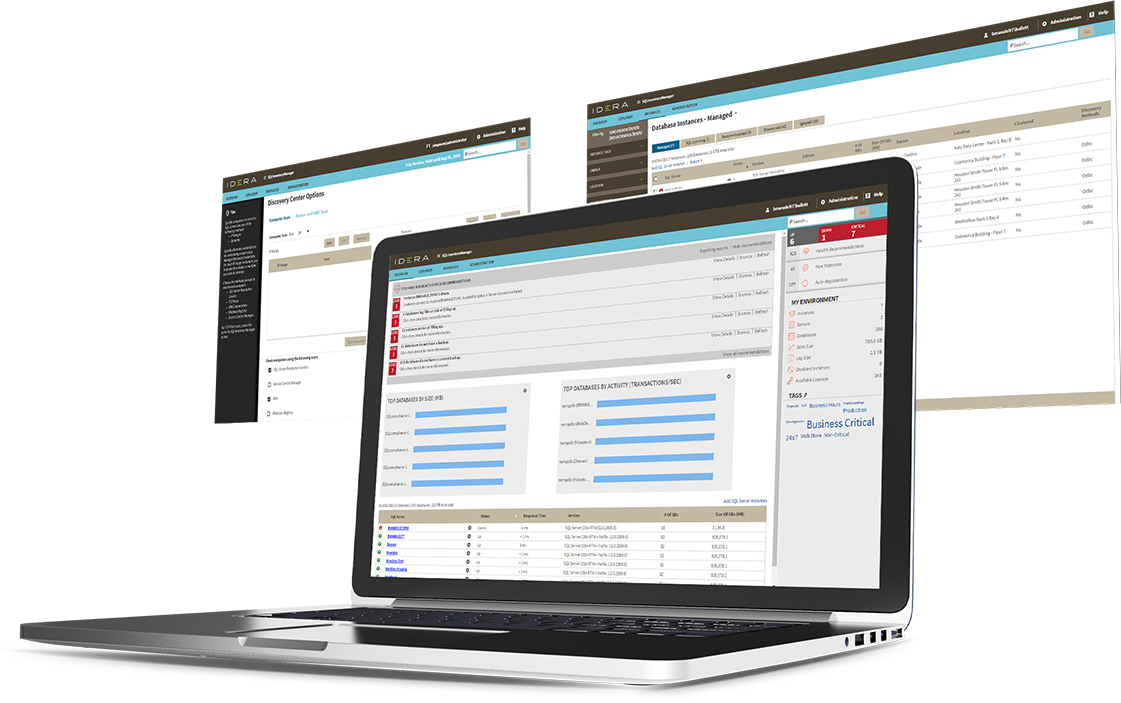
Screenshot of SQL Inventory Manager