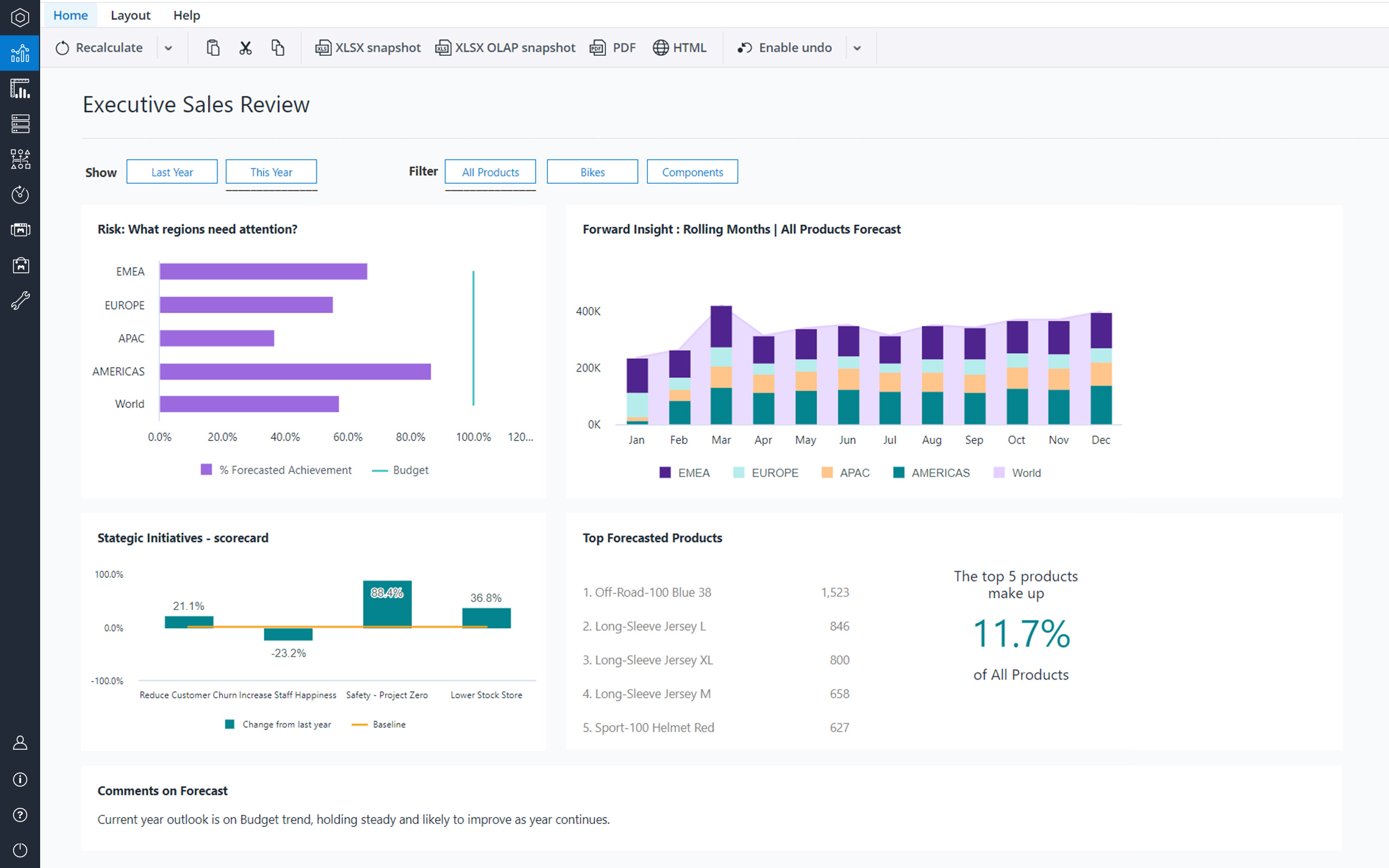
IBM Planning Analytics, powered by IBM TM1®, is an integrated planning solution designed to promote collaboration across the organization and help keep pace with the speed of modern business. With its calculation engine, this enterprise performance management solution is designed to help users move beyond the limits of spreadsheets, automating the planning process to drive faster, more accurate results. Use it to unify data sources into one single repository, enabling users to build…
$825
per month 5 users
Jedox
Score 6.9 out of 10
N/A
Jedox is a Business Intelligence and Corporate Performance Management solution. According to the vendor, their solution’s unified planning, analysis and reporting empowers decision makers from finance, sales, purchasing and marketing. Additionally, the vendor says this solution helps business users work smarter, streamline business collaboration, and make insight-based decisions with confidence. The vendor also says 1,900 organizations in 127 countries are using Jedox for real-time planning…
It includes Oracle Cloud EPM Planning, Anaplan, and Adaptive Insight before deciding to choose IBM Planning Analytics. We selected Planning Analytics because of its work with complicated and many area models, the capability to work with big amounts of data, and compatibility …
Other options, namely Anaplan, Oracle EPM Cloud, and SAP Analytics Cloud, were also considered. Anaplan's interface lacked analytical depth. For product design metrics, flexibility was not as good in Oracle EPM Cloud. The final choice was moved by the fact that it was driven …
Prior to making the decision to go with IBM Planning Analytics, we had considered such options as Anaplan, Oracle Hyperion, and SAP Analytics Cloud. Despite the collaborative solutions offered by Anaplan and the good connection with other systems by SAP, the superb set of tool …
In this case, Vena and Planful are considered as other products that can be compared with IBM Planning Analytics, but among them, IBM Planning Analytics is more optimal in terms of user interface and integration. Its preconfigure risk assessment model and its format and …
This was an older verions that was also very good, but the new IBM Planning Analytics is a far better tool that enables better scenario planning or what-if analysis.
Planning Analytics integrates seamlessly with Cognos Analytics to support all aspects of our Financial Reporting against both dimensional (TM1) and relational and ad hoc data sources
Why IBM Planning Analytics when compared to Oracle Hyperion: Better excel integration Less data movement and duplication Better cloud offering More aforeable licensing
IBM Planning Analytics with Watson will be up and running more quickly and be easier to maintain if modeling flexibility, scale, and the ability to plan at greater levels of detail are important requirements.
I am personally trying to explore the features of SAP analytics cloud in order to find if it's possible to integrate other sources of data and api based integrations, but I'm still on it while using the IBM planning analytics for my project currently. But looking at the intial …
I worked with Hyperion a long time ago. It was not a Oracle product yet. One great feature of this solution that was really great at the time, was the modeling process of ir, with a very robust engine for sparse cubes. the performance was excellent at the time. But today I can …
IBM Planning Analytics with Watson is much more flexible and scalable in comparison. IBM PAW is the clear winner for our organization's successful planning and analysis needs.
Anaplan does not handle sparsity; this is very problematic for large volume data sets (many 0's). There also are limitations to the number of dimensions that can be used in a module. If more dimensions are required, then separate modules need to be built and intertwined. IBM PA …
Because of its ability in planning, budgeting and forecasting or work progress.it has made it easy in driving sales hence profitability and lowering costs,also with ability to forecast the decision making has never been made this easier. The reasons for selecting are on its …
Compare to its competition it has good visual and graphical interface that helps to customized according to user needs. It helps to apply the best possible algorithm according to different model scenario that provides the best possible results. Predictive forecasting and AI …
Calumo is similar product to Jedox. I have used it extensively in my previous role. It was a major contender when we evaluated a BI platform for NIDA. Calumo is a great product as well and it was a very close call. Where we found Jedox to be a better fit for NIDA was the …
Pros:
- Rapid Time-To-Market
- Maximum flexibility due to cell-based approach inherited from Excel (vs. WYSIWYG and drag & drop UI (like BOARD) which is not as flexible)
Power BI in some respects is easier to set up using tabular analysis, which makes creating new models relatively easy in comparison to Jedox, however, the DAX language is more complex to learn than the Groovy script used by Jedox. Jedox's power comes in its ability to write …
Jedox has the edge over these products on total cost of ownership, borne through its quick deployment roll out, ease of use for end users and ease of maintenance.
We normally compete with Cognos TM1, Hyperion and SAP BPC. Functionalities, price and implementation time have no comparison. Jedox is a large the leader in these areas.
Setup and maintenance is much easier. Jedox is one product for all purposes: ETL, Excel-Integration, Web-Integration, Mobile. For TM1 you need the full IBM Cognos Suite to achieve the same. You have to install and configure more than 5 GB of software compared to 400 MB of the …
We have compared Jedox to many other products. Due to the lack of performance management capabilities all 'pure' business intelligence tools (with no write back) were dropped. In comparison with other modern performance management tools Jedox offers more flexibility. Other …
Verified User
Anonymous
Chose Jedox
Jedox Base which has been removed from the market used to be a free option in the in-memory database space capable of write back/modelling. Now the company wants to move in the "Enterprise" space but the product doesn't have the required scalability and is still running on …
Features
IBM Planning Analytics
Jedox
BI Standard Reporting
Comparison of BI Standard Reporting features of Product A and Product B
IBM Planning Analytics
9.7
Ratings
24% above category average
Jedox
9.1
Ratings
17% above category average
Pixel Perfect reports
9.80 Ratings
9.10 Ratings
Customizable dashboards
9.70 Ratings
9.10 Ratings
Report Formatting Templates
9.70 Ratings
9.10 Ratings
Ad-hoc Reporting
Comparison of Ad-hoc Reporting features of Product A and Product B
IBM Planning Analytics
9.7
Ratings
17% above category average
Jedox
8.3
Ratings
2% above category average
Drill-down analysis
9.80 Ratings
8.20 Ratings
Formatting capabilities
9.70 Ratings
8.20 Ratings
Integration with R or other statistical packages
9.80 Ratings
8.50 Ratings
Report sharing and collaboration
9.70 Ratings
8.50 Ratings
Report Output and Scheduling
Comparison of Report Output and Scheduling features of Product A and Product B
IBM Planning Analytics
9.5
Ratings
14% above category average
Jedox
7.9
Ratings
4% below category average
Publish to Web
9.90 Ratings
8.50 Ratings
Publish to PDF
9.90 Ratings
7.90 Ratings
Report Versioning
9.90 Ratings
7.00 Ratings
Report Delivery Scheduling
8.40 Ratings
8.20 Ratings
Data Discovery and Visualization
Comparison of Data Discovery and Visualization features of Product A and Product B
For a CFO or a COO to do budgeting and planning, IBM Planning Analytics would be essential. It is a tool that can take in multiple data sources and showcase them in a multidimensional way. If you are looking just for a BI or reporting tool, Planning Analytics would be considered "overkill".
Jedox is really good when being applied to a specific use case or scenario (such as a budget or planning process). Once embedded, users then start to really understand how it can be used in other, less well defined, areas of their business. It is therefore not as easy to apply it on an enterprise-wide deployment from a "Big Bang" perspective. But very few tools / projects ever meet this goal.
Since IBM Cognos Express is suitable only for medium data warehouse environment, we are not sure if this tool solves the long term need as the business keeps growing rapidly. So its a 50/50 ratio to renew Express license. But having said that, the components of IBM Cognos Express are also available in other Cognos BI suites like Cognos 10.x version. So we will probably upgrade our environment to IBM Cognos 10.x which comes with more new features.
IBM Planning Analytics is generally good in terms of functionalities. It can be used reduce time for budget planning, resource planning, demand forecasting, etc. The performance of IBM Planning Analytics is acceptable, but user interface can be improved. It would be good to see new features that allow users to customise the dashboard.
To me Jedox deserves 10/10 because it is a consistent one-in-all platform with a modern look and feel. It is intuitive to use and allows you to make intuitive applications integrating traditional business intelligence with performance management functionality. It certainly has a short learning curve, especially for those that are familiar with MS Excel. An example: I've lost count but Jedox it is available in more than 25 languages. Another: Jedox does not require programming skills... it is developed to be used by the business.
Jedox has very few bugs. Reports are available through an Excel add-in, the web and/or mobile device (IOS/Android). In my opinion, availability also means high performance, not having to wait for the system to give you the required reports, analysis, dashboards instantly.
Although I find the IBM Planning analytics documentation quite time consuming, their support with email and call is something i can term as very considerate and patient, I have had few calls about the features and how i would want to implement them within my projects, and the teams have been super helpful to resolve my issues
The Jedox support team are highly knowledgeable about both the product and how it is used in real life. They also are typically proactive in resolving issues.
The implementation of SSO, SAML Authentication, HTTPS, Server splitting (Frontend / Backend servers) could be more standardized and made more user friendly to set up (e.g. via setup guide). Otherwise the implementation of Jedox is quick and simple when compared to other similar technologies.
For strong technical teams and flexibility IBM Planning Analytics is the way to go. For quicker adoption and less technical teams Anaplan is the best option. If consolidation, financials, and moving from legacy tools are main focus than OneStream will be a really good choice. If deeply invested into SAP already than the SAP BPC will be the best fit to maintain the investment.
Power BI in some respects is easier to set up using tabular analysis, which makes creating new models relatively easy in comparison to Jedox, however, the DAX language is more complex to learn than the Groovy script used by Jedox. Jedox's power comes in its ability to write back to models and flexibility in setting up reports. We use both for different applications, but if I was wanting to create a model that needed user input I would pick Jedox.
Scalability is often another word for speed. Given enough data, enough users or enough calculations, the tool becomes slower and slower. You will find that Jedox has a very high performance that can even be increased by the use of grafical cards. Other thaen that it does not only offer BI (looking back based on historical ERP data) but also allows you to look forward through integrated budgetting, planning, forecasting, workflow and collaboration. Not easy to find a tool that can support so much business functionality. So, also pretty scalable in that respect.
Financial budgeting and Forecasting are done in a centralized fashion in Jedox now instead of a decentralized excel based approach. A lot of cost savings and improved reliability
Easy to use self-help Dashboards and detailed reports