IBM SPSS Modeler vs. Posit

Overview
ProductRatingMost Used ByProduct SummaryStarting Price
IBM SPSS Modeler
Score 7.1 out of 10
N/A
IBM SPSS Modeler is a visual data science and machine learning (ML) solution designed to help enterprises accelerate time to value by speeding up operational tasks for data scientists. Organizations can use it for data preparation and discovery, predictive analytics, model management and deployment, and ML to monetize data assets.
$4,670
per year
Posit
Score 10.0 out of 10
N/A
Posit, formerly RStudio, is a modular data science platform, combining open source and commercial products.N/A
Pricing
IBM SPSS ModelerPosit
Editions & Modules
IBM SPSS Modeler Personal
4,670
per year
IBM SPSS Modeler Professional
7,000
per year
IBM SPSS Modeler Premium
11,600
per year
IBM SPSS Modeler Gold
contact IBM
per year
No answers on this topic
Offerings
Pricing Offerings
IBM SPSS ModelerPosit
Free Trial
YesYes
Free/Freemium Version
NoYes
Premium Consulting/Integration Services
NoNo
Entry-level Setup FeeOptionalOptional
Additional DetailsIBM SPSS Modeler Personal enables users to design and build predictive models right from the desktop. IBM SPSS Modeler Professional extends SPSS Modeler Personal with enterprise-scale in-database mining, SQL pushback, collaboration and deployment, champion/challenger, A/B testing, and more. IBM SPSS Modeler Premium extends SPSS Modeler Professional by including unstructured data analysis with integrated, natural language text and entity and social network analytics. IBM SPSS Modeler Gold extends SPSS Modeler Premium with the ability to build and deploy predictive models directly into the business process to aid in decision making. This is achieved with Decision Management which combines predictive analytics with rules, scoring, and optimization to deliver recommended actions at the point of impact.
More Pricing Information
Community Pulse
IBM SPSS ModelerPosit
Considered Both Products
IBM SPSS Modeler
Chose IBM SPSS Modeler
Python requires knowledge of programming, higher learning curve vs IBM SPSS Modeler

Chose IBM SPSS Modeler
IBM SPSS Modeler is considerably easier to use. It allows for very rapid development and the ability to get to a goal quickly. There is no need to learn a new programming language so the analyst has the ability to focus on the problem rather than the pedantics of managing …
Chose IBM SPSS Modeler
We additionally use SAS Data Miner as a toolkit. Compared to SAS Data Miner, the SPSS Modeler is a good competitor. SAS probably is more integrated in the market for a visual-based code for data science activities. However, I don't think it offers anything better than SPSS, and …
Chose IBM SPSS Modeler
SPSS has a great set of analytical models, but SPSS is especially strong (compared to other tools) in complex statistical modeling and predictive analytics/statistics. However, the data connectivity features of SPSS are not the best, as the data sources SPSS can work with are …
Chose IBM SPSS Modeler
The field of data analytics has important value for each organization. IBM SPSS Modeler is one of the leaders in this highly competitive vertical. IBM SPSS is very intuitive compared with others, and has reduced the complexity. This software has various good functionalities …
Chose IBM SPSS Modeler
When it comes to investigation and descriptive we have found SPSS Statistics to be the tool of choice, but when it comes to projects with large and several datasets SPSS Modeler has been picked from our customers.
Posit
Chose Posit
SPSS is good for folks who are not as familiar with statistics, and for those who are older or more technologically-experienced and may be overwhelmed by Posit's products. It's also really great for teaching students and getting them exposed. However, because Posit is free, …
Chose Posit
Posit is far better than Jupyter Notebook and Minitab in this regard that Posit is actually capable of doing all kind of analytical stuffs like data pre-processing, wrangling, validation and visualization. On the other hand, Jupyter Notebook can be used for python programming …
Chose Posit
Posit is way way way more reliable than Excel for anything more involved than a quick spreadsheet. Faster speeds, greater charting abilities, flexible functionality and more efficient memory usage. Python is still my go-to for anything that needs integration, but Posit beats …
Chose Posit
I've used ArcGIS and ESRI for similar analysis and while both have their advantages, RStudio is much better suited for running advanced statistics and processing large volumes of data. It can also produce quality maps, however, for visually attractive maps and graphs, ArcGIS is …
Chose Posit
RStudio is better than python for visualizations but it is less common to use it in many organizations. Excel and PowerBI are better for visualization but, they can only be used for simple models. I would choose R Studio for statistical analysis, ML, or DL because the language …
Chose Posit
RStudio works really well compared to competitors such as Jupyter Notebook where there is no environment to visualize variables. RStudio on the other hand is much easier to use and provides the right set of environments for users.
Chose Posit
inter-departmental collaboration - my first choice would be TIBCO Spotfire natural language processing and knowledge graphs - my first choice would be Python information security & visualizations (including d3.js libraries) - my first choice is RStudio
Chose Posit
RStudio is more than a home for a dashboard. It is a content management system for data science. It hosts models, APIs, runs scripts, AND hosts dashboards.
Chose Posit
RStudio stacks up pretty well against its competition. For me, it is really up to personal preference and what you are used to when deciding between the competitions. I like that Python packages have the most external resources, so it's easier to troubleshoot. But RStudio does …
Chose Posit
The most similar products to RStudio that I have used include IBM SPSS and Tableau Prep. In my experience, SPSS is more intuitive and has less of a learning curve; I used it extensively in my undergraduate career in Statistics and Cognitive Science research. While RStudio has …
Chose Posit
RStudio stacks up pretty well against Anaconda. However, Anaconda might be the first choice for someone who likes Python for their analytics and machine learning needs. In the past, I have found it seamless to connect Jupyter Notebook (in Anaconda suite) to integrate with other …
Chose Posit
RStudio was provided as the most customizable. It was also strictly the most feature-rich as far as enabling our organization to script, run, and make use of R open-source packages in our data analysis workstreams. It also provided some support for python, which was useful …
Chose Posit
Personally, I would prefer SPSS over RStudio and SAS, but the cost for licenses for SPSS deters me from continuing to go with IBM's statistics software. RStudio has the advantage in that it is low cost and there are a lot of available resources on YouTube available for users …
Chose Posit
Using [RStudio] requires greater knowledge of statistics and code than SPSS, which has a more simple "point and click" interface. [RStudio] is similar to SAS in its user interface and [requires] the user to write their own queries. [RStudio]'s main advantage is an open-source …
Chose Posit
I tried Stata because it's a standard tool for economists but it doesn't have the flexibility and breadth of R and RStudio. I didn't try other IDEs for R.
Chose Posit
RStudio is free and so that is the main reason that I use it. I like that it is open source and so there are lots of support on the internet. I tried SAS JMP and Python in a text editor but RStudio was better than either of those options for cost and code flexibility …
Chose Posit
RStudio is as good as any software available in the market and is better off than some as it is free. Since it is open source it is improving day by day. I would prefer RStudio over any other tool any day. I would recommend every data analyst to give RStudio a try.
Chose Posit
Much better GUI and customizability than BlueSky. I am able to do a variety of tasks at a much quicker pace.
Chose Posit
I understand the Jupyter notebook is supposed to be good like RStudio, and I've been exposed to it a little bit. But my experience using it has been very little.
Chose Posit
Amazon Quicksight, Power bi, SAS EG, Tableau, Salesforce (TREVI) - Victoria, SharePoint.
Chose Posit
I prefer SPSS to RStudio, but RStudio is very cheap in comparison to the cost of SPSS. IBM's SPSS does a better job holding the hands of users, but it does come at a very expensive license cost. RStudio is a little bit more difficult to use but is cheap.
Chose Posit
These all work synergistically and fulfill slightly different roles. In general this is determined by complexity of task and the degree of training and expertise of the end user. RStudio works well for organisations looking to move into doing more complex analytics. In general …
Chose Posit
There are loads of people in the BI (Business Intelligence) space, of course... but I wouldn't touch any of them because none of them offer anything like the R and Python support that RStudio does. RStudio publishes open-source, they're a public benefit corporation, and they …
Features
IBM SPSS ModelerPosit
Platform Connectivity
Comparison of Platform Connectivity features of Product A and Product B
IBM SPSS Modeler
7.0
Ratings
18% below category average
Posit
9.3
Ratings
11% above category average
Connect to Multiple Data Sources7.00 Ratings8.00 Ratings
Extend Existing Data Sources7.00 Ratings10.00 Ratings
Automatic Data Format Detection00 Ratings10.00 Ratings
Data Exploration
Comparison of Data Exploration features of Product A and Product B
IBM SPSS Modeler
-
Ratings
Posit
9.0
Ratings
7% above category average
Visualization00 Ratings8.00 Ratings
Interactive Data Analysis00 Ratings10.00 Ratings
Data Preparation
Comparison of Data Preparation features of Product A and Product B
IBM SPSS Modeler
-
Ratings
Posit
10.0
Ratings
20% above category average
Interactive Data Cleaning and Enrichment00 Ratings10.00 Ratings
Data Transformations00 Ratings10.00 Ratings
Platform Data Modeling
Comparison of Platform Data Modeling features of Product A and Product B
IBM SPSS Modeler
-
Ratings
Posit
10.0
Ratings
18% above category average
Multiple Model Development Languages and Tools00 Ratings10.00 Ratings
Single platform for multiple model development00 Ratings10.00 Ratings
Self-Service Model Delivery00 Ratings10.00 Ratings
Model Deployment
Comparison of Model Deployment features of Product A and Product B
IBM SPSS Modeler
-
Ratings
Posit
9.9
Ratings
15% above category average
Flexible Model Publishing Options00 Ratings10.00 Ratings
Security, Governance, and Cost Controls00 Ratings9.90 Ratings
Best Alternatives
IBM SPSS ModelerPosit
Small Businesses
Jupyter Notebook
Jupyter Notebook
Score 9.4 out of 10
Jupyter Notebook
Jupyter Notebook
Score 9.4 out of 10
Medium-sized Companies
Posit
Posit
Score 10.0 out of 10
Mathematica
Mathematica
Score 8.2 out of 10
Enterprises
Posit
Posit
Score 10.0 out of 10
Dataiku
Dataiku
Score 7.6 out of 10
All AlternativesView all alternativesView all alternatives
User Ratings
IBM SPSS ModelerPosit
Likelihood to Recommend
7.0
(0 ratings)
10.0
(0 ratings)
Likelihood to Renew
-
(0 ratings)
9.7
(0 ratings)
Usability
8.0
(0 ratings)
8.0
(0 ratings)
Availability
-
(0 ratings)
9.4
(0 ratings)
Support Rating
10.0
(0 ratings)
8.9
(0 ratings)
Implementation Rating
-
(0 ratings)
9.3
(0 ratings)
Configurability
-
(0 ratings)
10.0
(0 ratings)
Product Scalability
-
(0 ratings)
8.2
(0 ratings)
User Testimonials
IBM SPSS ModelerPosit
Likelihood to Recommend
Modeler is well suited for understanding consumer data. The ability to create a prediction and then to understand what is driving that prediction is strong in Modeler. Modeler is closely aligned with the CRISP-DM data mining approach meaning it is not just the 'doing' but also the theoretical background behind the development of data mining models.
Read full review
In my humble opinion, if you are working on something related to Statistics, RStudio is your go-to tool. But if you are looking for something in Machine Learning, look out for Python. The beauty is that there are packages now by which you can write Python/SQL in R. Cross-platform functionality like such makes RStudio way ahead of its competition. A couple of chinks in RStudio armor are very small and can be considered as nagging just for the sake of argument. Other than completely based on programming language, I couldn't find significant drawbacks to using RStudio. It is one of the best free software available in the market at present.
Read full review
Pros
  • A very nice and easy to use interface.
  • A great variety of analytics, from statistical calculation to data validation and predictive statistics.
  • Has a steep learning curve.
Read full review
  • RStudio does an excellent job providing a clean user interface for R or Shiny applications
  • RStudio integrates natively with version control software
  • Users can program with either R or Python
  • RStudio has a command line built in, eliminating the need for a separate program for a REPL
Read full review
Cons
  • Some Analyses aren't there out of the box but can be added through open languages like R and Python.
  • Graphs could be better.
  • Unable to read data stored in OLAP databases
Read full review
  • Ability to scale across the company is limited based on the users license, cannot share a dashboard to the general view of the company.
  • Ability to retain session - not simple method to customize view per user (e.g., once session is ended, the users will return next time to the baseline view).
  • Ability to enable communication between multiple users - leave notes, tag other users, or share specific view.
Read full review
Likelihood to Renew
No answers on this topic
There is no other platform that meets our needs. Even if it was terrible we would still use it but fortunately for us it is a very solid project with a great support team. I hope in the future to expand our use and get more licences as well as upgrade to RStudio workbench but for now we are very happy.
Read full review
Usability
The ability to do predictive modeling, text analytics for both structured & unstructured data, decision management, optimization, and support for various data sources
Read full review
For someone who learns how to use the software and picks up on the "language" of R, it's very easy to use. For beginners, it can be hard and might require a course, as well as the appropriate statistical training to understand what packages to use and when
Read full review
Reliability and Availability
No answers on this topic
RStudio is very available and cheap to use. It needs to be updated every once in a while, but the updates tend to be quick and they do not hinder my ability to make progress. I have not experienced any RStudio outages, and I have used the application quite a bit for a variety of statistical analyses
Read full review
Support Rating
The online support board is helpful and the free add ons are incredibly appreciated.
Read full review
Since R is trendy among statisticians, you can find lots of help from the data science/ stats communities. If you need help with anything related to RStudio or R, google it or search on StackOverflow, you might easily find the solution that you are looking for.
Read full review
Implementation Rating
No answers on this topic
We did it at the individual level: anyone willing to code in R can use it. No real deployment involved.
Read full review
Alternatives Considered
We additionally use SAS Data Miner as a toolkit. Compared to SAS Data Miner, the SPSS Modeler is a good competitor. SAS probably is more integrated in the market for a visual-based code for data science activities. However, I don't think it offers anything better than SPSS, and I really like several of the helpful components for usability for SPSS like peaks into nodes.
Read full review
RStudio was provided as the most customizable. It was also strictly the most feature-rich as far as enabling our organization to script, run, and make use of R open-source packages in our data analysis workstreams. It also provided some support for python, which was useful when we had R heavy code with some python threaded in. Overall we picked Rstudio for the features it provided for our data analysis needs and the ability to interface with our existing resources.
Read full review
Scalability
No answers on this topic
I think that RStudio scales pretty well based on the size of the datasets I'm using. It has multithreading capabilities unlike some other statistical analysis programs which is very useful in cutting down on time. The format of RStudio's syntax also makes it very easy to replicate regardless off the scale of the analysis and data set
Read full review
Return on Investment
  • I am able to study and work from home sustainably
  • I can help others have a high quality university education experience to graduate confident and competent to meet gaps in the wider community
  • Market research for my business
  • Help other small businesses to create viable and high quality products and services
  • Contribute to research projects: ethical, high quality data analyses and interpretation
Read full review
  • Using it for data science in a very big and old company, the most positive impact, from my point of view, has been the ability of spreading data culture across the group. Shortening the path from data to value.
  • Still it's hard to quantify economic benefits, we are struggling and it's a great point of attention, since splitting out the contribution of the single aspects of a project (and getting the RStudio pie) is complicated.
  • What is sure is that, in the long run, RStudio is boosting productivity and making the process in which is embedded more efficient (cost reduction).
Read full review
ScreenShots

IBM SPSS Modeler Screenshots

Screenshot of Use a single run to test multiple modeling methods, compare results and select which model to deploy. Quickly choose the best performing algorithm based on model performance.Screenshot of Explore geographic data, such as latitude and longitude, postal codes and addresses. Combine it with current and historical data for better insights and predictive accuracy.Screenshot of Capture key concepts, themes, sentiments and trends by analyzing unstructured text data. Uncover insights in web activity, blog content, customer feedback, emails and social media comments.Screenshot of Use R, Python, Spark, Hadoop and other open source technologies to amplify the power of your analytics. Extend and complement these technologies for more advanced analytics while you keep control.

Posit Screenshots

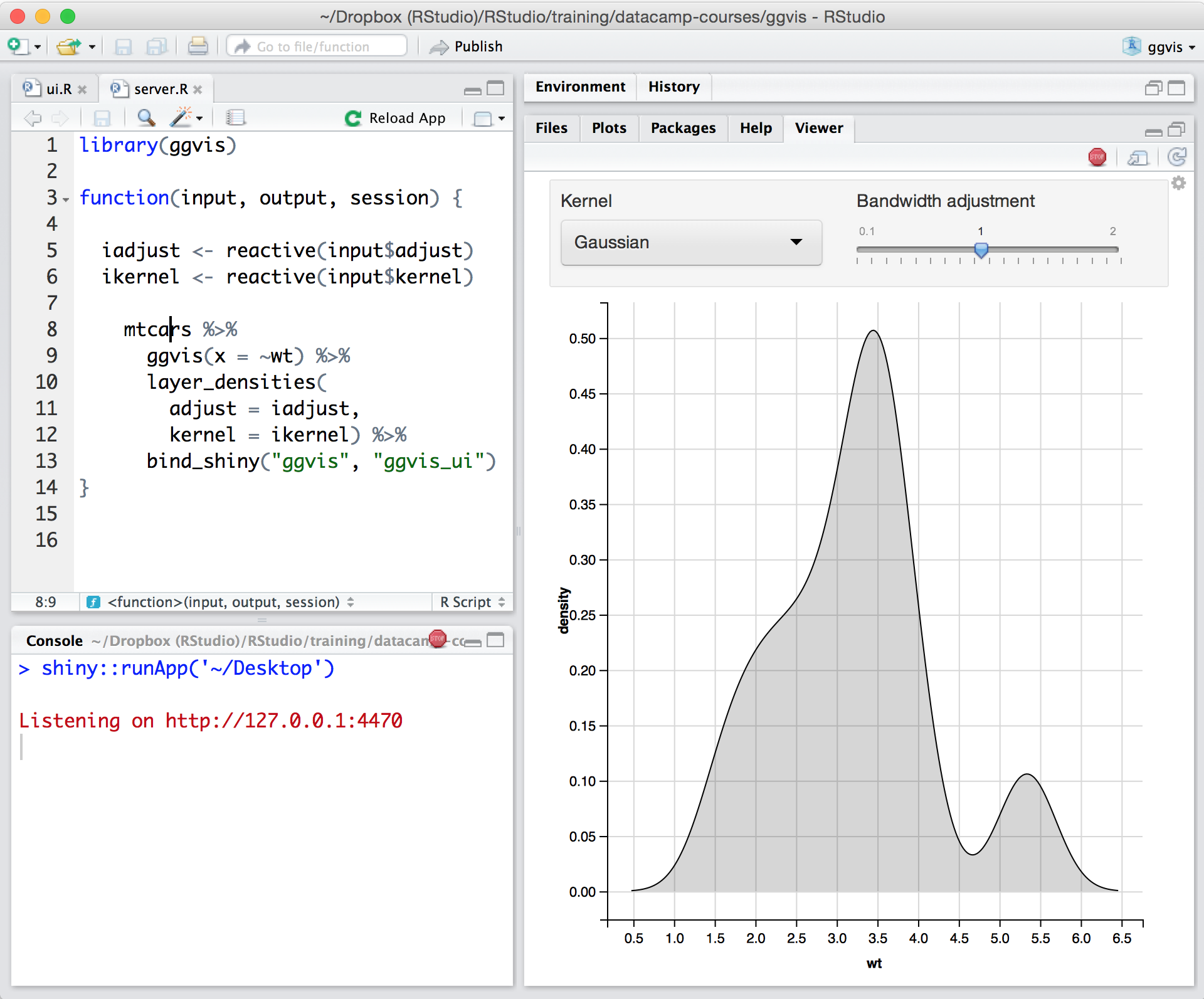
Screenshot of Posit runs on most desktops or on a server and accessed over the webScreenshot of Posit supports authoring HTML, PDF, Word Documents, and slide showsScreenshot of Posit supports interactive graphics with Shiny and ggvisScreenshot of Shiny combines the computational power of R with the interactivity of the modern webScreenshot of Remote Interactive Sessions: Start R and Python processes from Posit Workbench within various systems such as Kubernetes and SLURM with Launcher.Screenshot of Jupyter: Author and edit Python code with Jupyter using the same Posit Workbench infrastructure.